<?xml version="1.0" encoding="utf-8"?><feed xmlns="http://www.w3.org/2005/Atom" ><generator uri="https://jekyllrb.com/" version="3.10.0">Jekyll</generator><link href="https://essentialine.art/feed.xml" rel="self" type="application/atom+xml" /><link href="https://essentialine.art/" rel="alternate" type="text/html" /><updated>2026-08-06T05:18:22+00:00</updated><id>https://essentialine.art/feed.xml</id><title type="html">EssentiaLine</title><subtitle>Drawing, tracing, seeing</subtitle><author><name>Neal C</name></author><entry><title type="html">Botticelli’s Idealization Simonetta Vespucci</title><link href="https://essentialine.art/drawing/botticelli-simonetta-line-and-oil/" rel="alternate" type="text/html" title="Botticelli’s Idealization Simonetta Vespucci" /><published>2026-07-11T00:00:00+00:00</published><updated>2026-07-11T00:00:00+00:00</updated><id>https://essentialine.art/drawing/botticelli-simonetta-line-and-oil</id><content type="html" xml:base="https://essentialine.art/drawing/botticelli-simonetta-line-and-oil/"><![CDATA[<p><img src="/assets/images/botticelli-simonetta-line-and-oil/diptych-simonetta.png" alt="My tracing beside Botticelli's Simonetta Vespucci" />
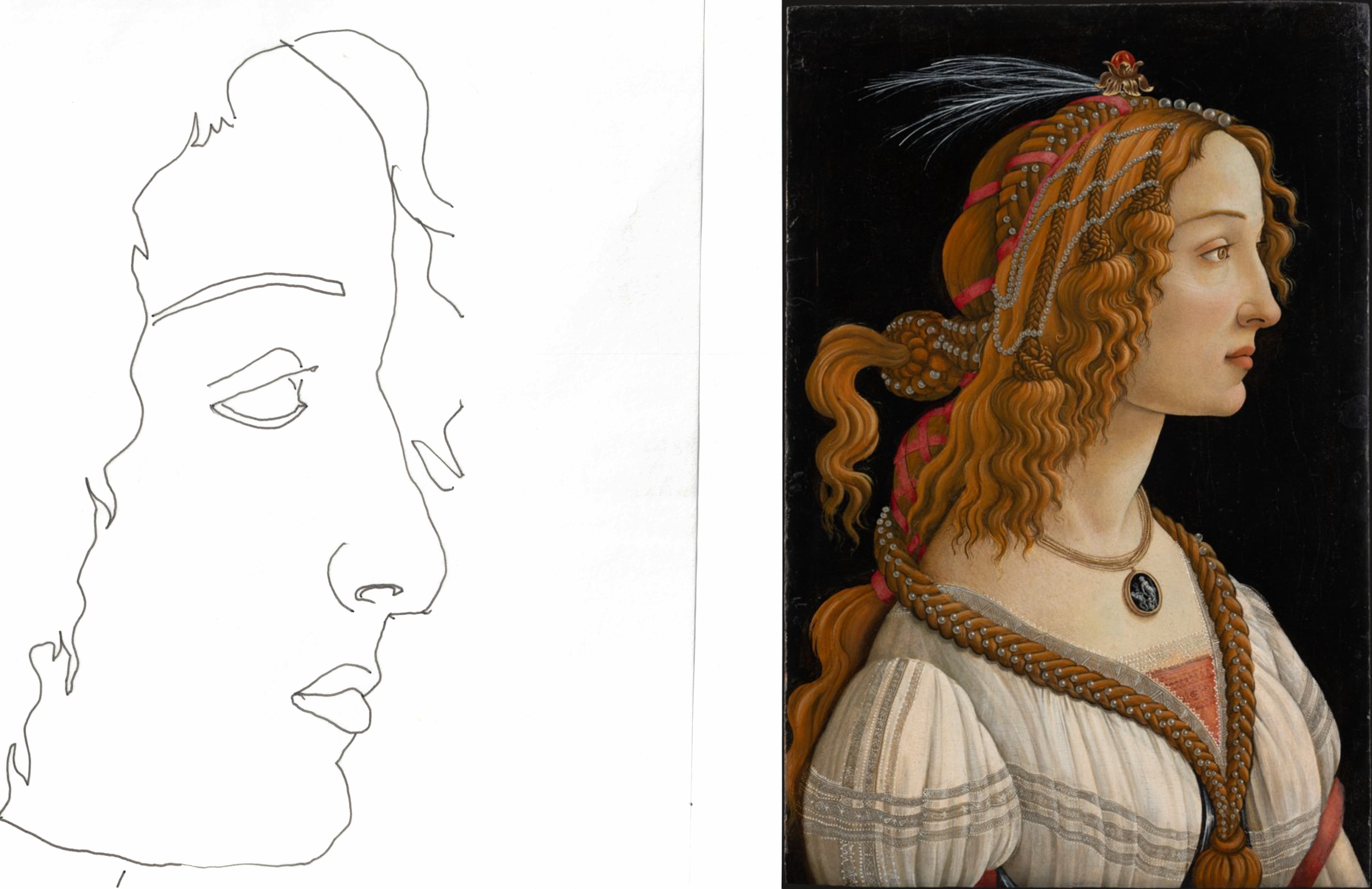
<em>Left: my tracing. Right: Sandro Botticelli, <a href="https://sammlung.staedelmuseum.de/en/work/idealised-portrait-of-a-lady">Ritratto di giovane donna</a>, c. 1480–1485, mixed technique on poplar wood, Städel Museum, Frankfurt am Main — public domain.</em></p>

<p><a id="simonetta"></a></p>

<p>What drew me in was the proportions of where the
eyes, nose, and lips sit on the head. Loomis said beauty is beauty of proportion,
and he built diagrams around exactly this kind of measurement.
I’d also picked up from
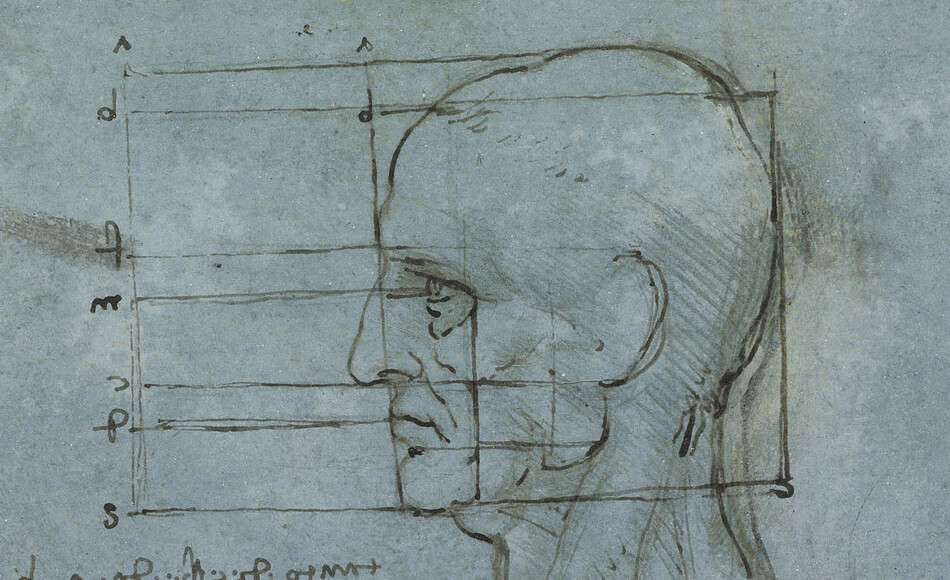
Alon Bement’s <em>The Energetic Line in Figure Drawing</em> that a head in
profile carries its own proportional logic, separate from a three-quarter
or frontal view. The way Leonardo grids the profile out with measuring
lines is ultimately what Bement references, and what I was thinking about.</p>

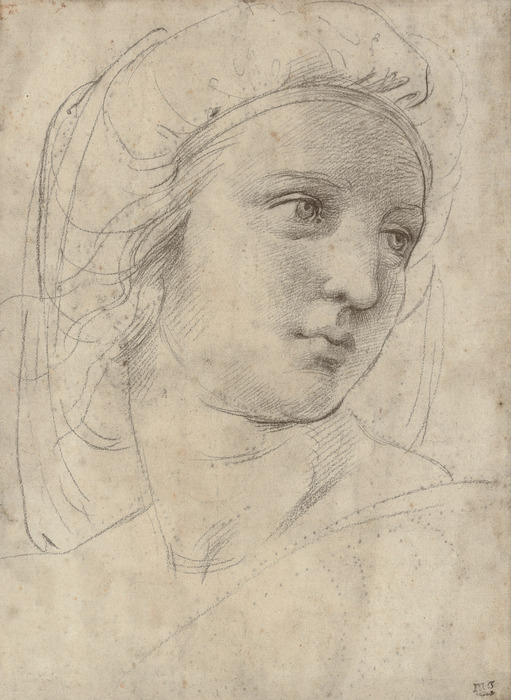
<p><img src="/assets/images/botticelli-simonetta-line-and-oil/leonardo-head-proportions-1490.jpg" alt="Leonardo's proportion study of a head in profile" />
<em>Leonardo da Vinci, <a href="https://www.rct.uk/collection/912601/the-proportions-of-the-head-and-a-standing-nude">The proportions of the head, and a standing nude</a> (detail — the sheet also carries a faint nude figure study, cropped out here), c. 1490, pen and ink over metalpoint on blue prepared paper, Royal Collection Trust — public domain.</em></p>

<p>I think the hair came out well, another thing I’m trying to figure out.</p>

<p>I didn’t know when I drew it that the sitter was already dead by the time
Botticelli painted her — an idealisation, not taken from
life. I’ve always thought Botticelli’s faces look quite similar to one
another, and very feminine as a rule; this one, though, has an
almost masculine edge to it that surprised me, more visible in my tracing.
Whatever that detachment is, I think it’s there in the original, and maybe even more so in my
tracing, closer to ethereality than portraiture, as Botticelli intended.</p>

<p><strong>The painting.</strong> <em>Ritratto di giovane donna</em> (known in English as
<em>Idealised Portrait of a Lady</em>, or <em>Portrait of Simonetta Vespucci as
Nymph</em>), Sandro Botticelli, c. 1480–1485. Mixed technique on
poplar wood, 81.3 × 54 cm. Städel Museum, Frankfurt am Main (inv. 936).
Strict profile, in the tradition of ancient coins and cameos — the
necklace she wears references an actual Medici-collection cameo, tying
the sitter to that circle without painting a literal likeness.</p>

<p><strong>The sitter.</strong> Simonetta Vespucci, celebrated Florentine beauty and the
mistress of Giuliano de’ Medici, died young (1476) years before this was
painted — which is why the museum calls it an “idealised” portrait rather
than a portrait from life: Botticelli is painting her as a mythological
nymph, a posthumous ideal, not a sitting. Her married name comes from
Marco Vespucci, a distant cousin of the explorer Amerigo Vespucci — the
same family the Americas are named after.</p>

<p><strong>The artist.</strong> Sandro Botticelli (1445–1510), Florentine painter,
Renaissance workshop of the Medici court. Public domain: died over 500
years ago.</p>

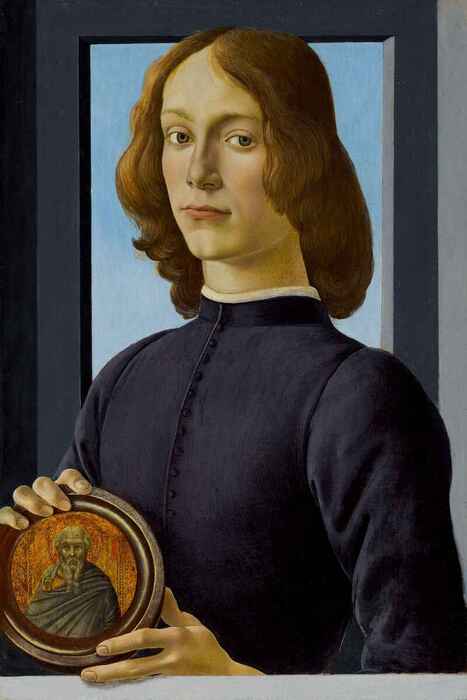
<p><img src="/assets/images/botticelli-simonetta-line-and-oil/botticelli-young-man-roundel-1480.jpg" alt="Botticelli's Ritratto di giovane con medaglione" style="max-width: 45%;" /></p>

<p><em>Sandro Botticelli, <a href="https://commons.wikimedia.org/wiki/File:Botticelli_-_Portrait_of_a_Young_Man_Holding_a_Roundel.jpg">Ritratto di giovane con medaglione</a> (</em>Young Man Holding a Roundel<em>), c. 1480 — public domain. Sold for <strong>$92.2 million</strong> at Sotheby’s in 2021, the auction record for a Botticelli.</em></p>

<hr />

<p><strong>Image credits.</strong> Sandro Botticelli died in 1510, Leonardo da Vinci in
1519 — both public domain by any measure. All photographs are faithful
flat reproductions of public-domain 2-D artworks and carry no separate
copyright of their own (US: <em>Bridgeman Art Library v. Corel</em>, 1999; EU:
Copyright Directive 2019, Art. 14). The Simonetta Vespucci image is
downloaded directly from the Städel Museum’s own collection site, per
their stated public-domain terms — mention: “Städel Museum, Frankfurt am
Main.” The Leonardo profile study is a crop (head and proportion grid
only) of <em>The proportions of the head, and a standing nude</em> (RCIN 912601,
Royal Collection Trust), sourced via Wikimedia Commons under a PD-old tag
— the full sheet also contains a faint figure study. The <em>Ritratto di
giovane con medaglione</em> image is sourced via Wikimedia Commons, tagged
public domain.</p>

<p><strong>Links</strong></p>
<ul>
  <li><a href="https://sammlung.staedelmuseum.de/en/work/idealised-portrait-of-a-lady">Ritratto di giovane donna — Städel Museum</a> — museum catalogue entry, image, PD terms</li>
  <li><a href="https://en.wikipedia.org/wiki/Sandro_Botticelli">Sandro Botticelli — Wikipedia</a></li>
  <li><a href="https://www.rct.uk/collection/912601/the-proportions-of-the-head-and-a-standing-nude">The proportions of the head, and a standing nude — Royal Collection Trust</a> — museum catalogue entry, full sheet</li>
  <li><a href="https://commons.wikimedia.org/wiki/File:Leonardo_da_Vinci_-_RCIN_912601,_The_proportions_of_the_head,_and_a_standing_nude_c.1490.jpg">File on Wikimedia Commons</a> — license, source image</li>
  <li><a href="https://en.wikipedia.org/wiki/Alon_Bement">Alon Bement — Wikipedia</a> — teacher of Georgia O’Keeffe, author of <em>The Energetic Line in Figure Drawing</em></li>
  <li><a href="https://commons.wikimedia.org/wiki/File:Botticelli_-_Portrait_of_a_Young_Man_Holding_a_Roundel.jpg">Ritratto di giovane con medaglione — Wikimedia Commons</a> — file page, license, source</li>
  <li><a href="https://www.sothebys.com/en/press/newsflash-sandro-botticelli">Sotheby’s: record $92.2 million sale</a> — auction press release</li>
</ul>]]></content><author><name>Neal C</name></author><category term="drawing" /><category term="botticelli" /><category term="portrait" /><category term="line" /><summary type="html"><![CDATA[Left: my tracing. Right: Sandro Botticelli, Ritratto di giovane donna, c. 1480–1485, mixed technique on poplar wood, Städel Museum, Frankfurt am Main — public domain.]]></summary></entry><entry><title type="html">Muybridge’s Waltz, reduced to gesture</title><link href="https://essentialine.art/drawing/muybridge-waltz-line-and-photograph/" rel="alternate" type="text/html" title="Muybridge’s Waltz, reduced to gesture" /><published>2026-07-11T00:00:00+00:00</published><updated>2026-07-11T00:00:00+00:00</updated><id>https://essentialine.art/drawing/muybridge-waltz-line-and-photograph</id><content type="html" xml:base="https://essentialine.art/drawing/muybridge-waltz-line-and-photograph/"><![CDATA[<p><img src="/assets/images/muybridge-waltz-line-and-photograph/muybridge-tracing.png" alt="My tracing of the waltz sequence, gesture only" />
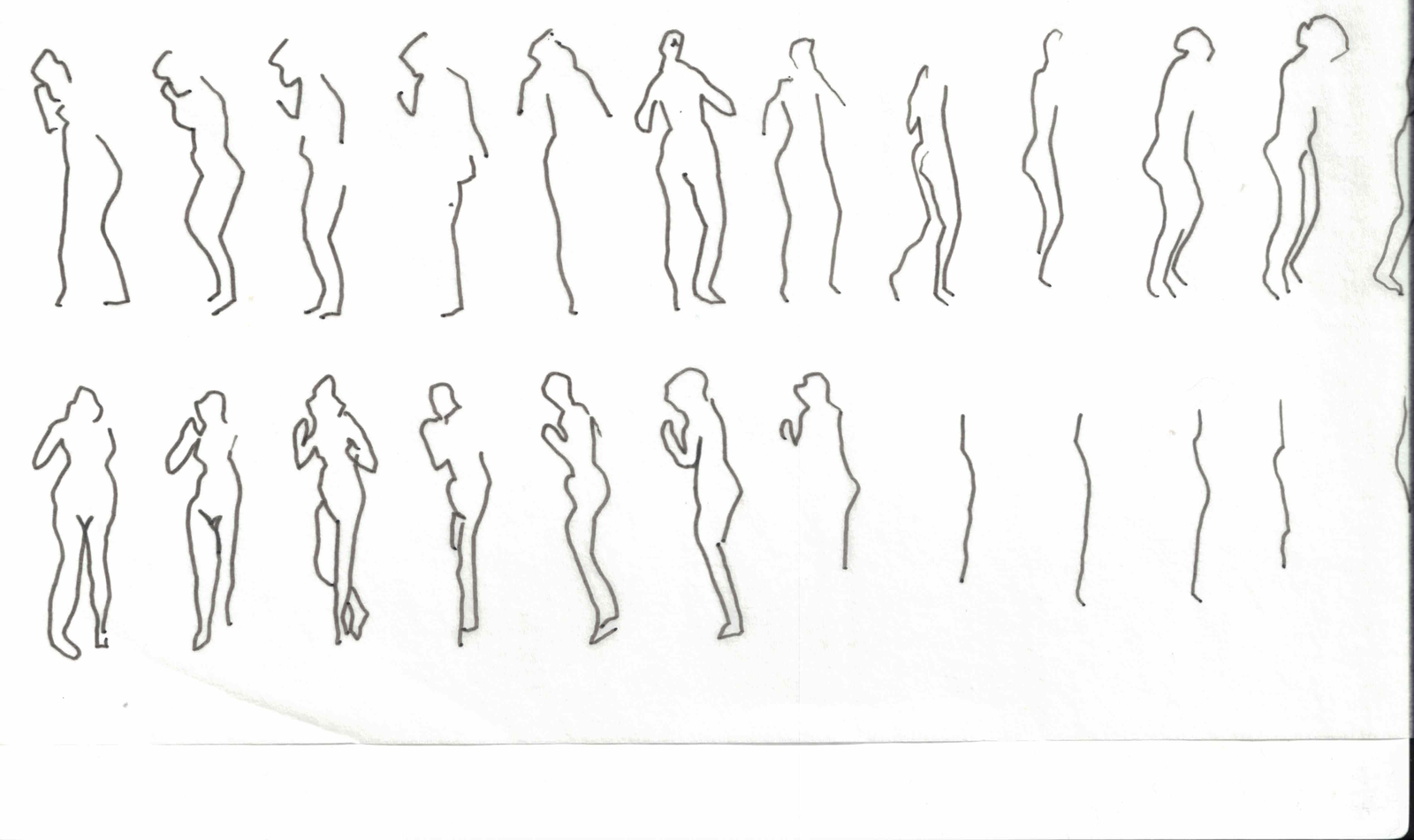
<em>My tracing of Eadweard Muybridge’s <a href="https://commons.wikimedia.org/wiki/File:Animal_locomotion._Plate_195_(Boston_Public_Library).jpg">Animal Locomotion, Plate 195</a>, “Nude woman dancing a waltz,” 1887 — reduced to weighted gesture lines. Source plate linked, not reproduced (see note below).</em></p>

<p>This is Muybridge, a woman doing a waltz. I was hesitant, I don’t
want to draw so many, but then I thought — this is the whole thing, I can
do a minimum line. So I wondered: what is the minimum line needed to
convey this motion? There’s motion here.</p>

<p>Plate 195 is twenty-four exposures of a woman dancing a waltz,
shot from two synchronized camera angles running in parallel down the sheet.
Published by the University of Pennsylvania; this particular scan comes
from the Boston Public Library’s Rare Books Department, one of several
institutions holding original prints of the plates.</p>

<p>I thought it’s probably good to draw the weighted side. So I traced out a
little bit of what it used to be, with the weighted side. Another
interesting thing is that what we really need is the weighted side and
the minimum line. She seems to have shifted her weight to the other side.
The weight comes from Alon Bement’s guidance. He emphasized that the
first and most important line is the one carrying the weight, which
gives a drawing balance and realism, lost if we don’t prioritize it.</p>

<p>Just the weighted line — I don’t think we’re seeing enough to make out
that this is a figure in some of the individual lines, but these are a group.</p>

<p>I don’t quite understand what Muybridge was searching for, really —
there’s the horse, of course, which I think is amazing, and I’ll probably
also do a cat one. Even the horse is flying, as we have motion, the
weight of the being must move, the animal causes its weight to shift and
move, and so tracing teaches the origin and basis.</p>

<hr />

<p><strong>Image note.</strong>
The source plate (Eadweard Muybridge, <em>Animal Locomotion</em>, 1887)
is public domain in the US, and the Boston Public Library’s digitized copy
on Wikimedia Commons is marked public domain.
It is not reproduced on this page, see the link below to view the original.</p>

<p><strong>Links</strong></p>
<ul>
  <li><a href="https://commons.wikimedia.org/wiki/File:Animal_locomotion._Plate_195_(Boston_Public_Library).jpg">Animal Locomotion, Plate 195 — Wikimedia Commons</a>
— the full 24-frame plate</li>
  <li><a href="https://en.wikipedia.org/wiki/Eadweard_Muybridge">Eadweard Muybridge — Wikipedia</a></li>
</ul>]]></content><author><name>Neal C</name></author><category term="drawing" /><category term="muybridge" /><category term="figure" /><category term="line" /><category term="motion" /><summary type="html"><![CDATA[My tracing of Eadweard Muybridge’s Animal Locomotion, Plate 195, “Nude woman dancing a waltz,” 1887 — reduced to weighted gesture lines. Source plate linked, not reproduced (see note below).]]></summary></entry><entry><title type="html">Sargent’s Violet, in pencil</title><link href="https://essentialine.art/drawing/sargent-violet-line-and-graphite/" rel="alternate" type="text/html" title="Sargent’s Violet, in pencil" /><published>2026-07-11T00:00:00+00:00</published><updated>2026-07-11T00:00:00+00:00</updated><id>https://essentialine.art/drawing/sargent-violet-line-and-graphite</id><content type="html" xml:base="https://essentialine.art/drawing/sargent-violet-line-and-graphite/"><![CDATA[<p><img src="/assets/images/sargent-violet-line-and-graphite/diptych-violet-sargent.png" alt="My tracing beside Sargent's Violet" />
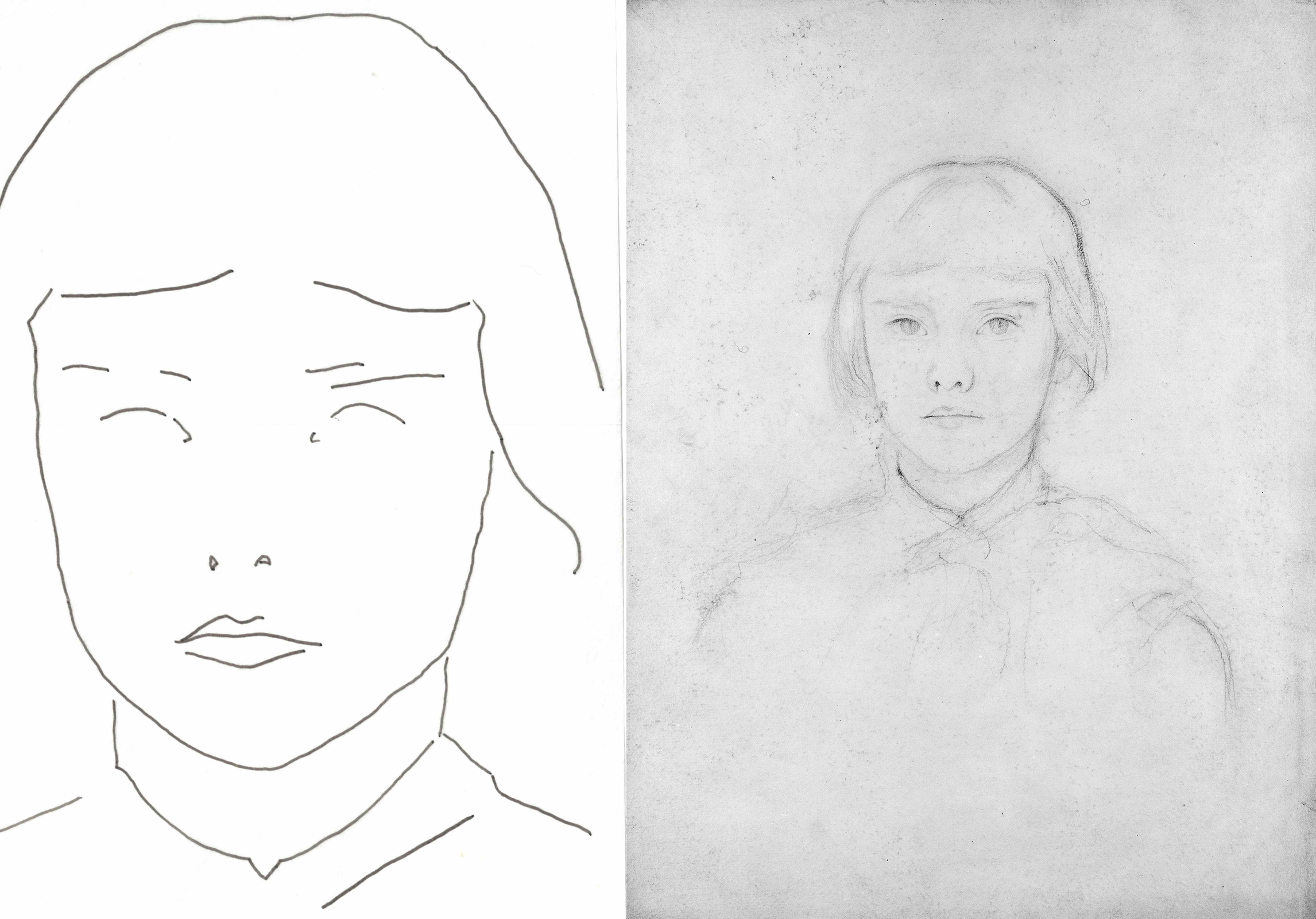
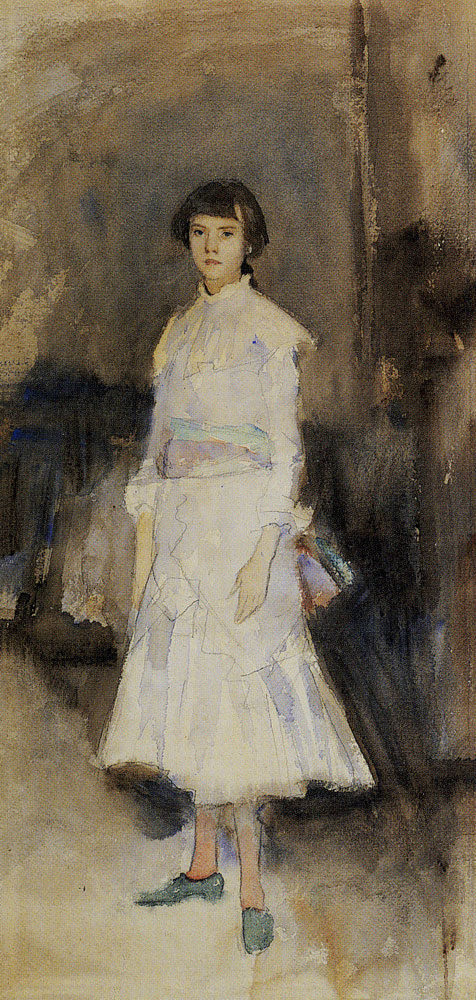
<em>Left: my tracing. Right: John Singer Sargent, <a href="https://www.metmuseum.org/art/collection/search/12462">Violet Sargent</a>, c. 1883, graphite on off-white wove paper, 18 13/16 × 13 15/16 in. (47.8 × 35.4 cm), The Metropolitan Museum of Art — public domain.</em></p>

<p>Sargent drew it around 1883,
alongside a watercolor of the same subject from about the same date —
same haircut, same steady, serious expression, full length instead of just
the head.
This drawing is graphite, committed lines,
his younger sister looking straight back at him —
he was twenty-seven, she was thirteen.
The Met has held the drawing since 1950,
when Violet herself, by then Mrs. Francis Ormond,
gave the museum hundreds of her brother’s works.
This one never had a client.</p>

<p><img src="/assets/images/sargent-violet-line-and-graphite/violet-sargent-watercolor-1883.jpg" alt="John Singer Sargent, Violet Sargent, watercolor, c. 1883" /></p>

<p><em>John Singer Sargent, <a href="https://commons.wikimedia.org/wiki/File:Sargent_-_Violet_Sargent,_c._1883,_nr._73.jpg">Violet Sargent</a>, c. 1883, watercolour and pencil on paper, 45.1 × 21.6 cm — private collection. Public domain.</em>
<br />
I traced this on the same sheet as the two
<a href="/drawing/tonnis-female-warrior-extinction/">Tonnis “Female Warrior”</a> pieces
and wasn’t sure at first which post it belonged in.
I felt there was power in their gazes that linked them together,
but as Sargent for me this drawing stands on its own.</p>

<p>With this drawing and my tracing,
I meant especially to focus on just the basics of the eyes and jawline —
I got something useful out of it.
He understood the lines of her face and eyes at such an early age,
but also her power as an entity, which is more important to me.
I suspect Violet liked this drawing, and kept it for that reason.
It’s not market pricing but a drawing from brother to sister.</p>

<hr />

<p><strong>Image credits.</strong>
John Singer Sargent died in 1925 — public domain by any measure
(life + 70 and beyond).
<em>Violet Sargent</em> is held in The Met’s American Wing, New York
(accession 50.130.87), which has designated this image public domain
under its Open Access policy.</p>

<p><strong>Links</strong></p>
<ul>
  <li><a href="https://www.metmuseum.org/art/collection/search/12462">Violet Sargent (drawing) — The Metropolitan Museum of Art</a>
— full-resolution Open Access image and the 1950 Ormond gift provenance</li>
  <li><a href="https://commons.wikimedia.org/wiki/File:Sargent_-_Violet_Sargent,_c._1883,_nr._73.jpg">Violet Sargent (watercolor) — Wikimedia Commons</a>
— the companion piece discussed above, still in a private collection</li>
  <li><a href="https://en.wikipedia.org/wiki/John_Singer_Sargent">John Singer Sargent — Wikipedia</a></li>
</ul>]]></content><author><name>Neal C</name></author><category term="drawing" /><category term="sargent" /><category term="portrait" /><category term="line" /><summary type="html"><![CDATA[Left: my tracing. Right: John Singer Sargent, Violet Sargent, c. 1883, graphite on off-white wove paper, 18 13/16 × 13 15/16 in. (47.8 × 35.4 cm), The Metropolitan Museum of Art — public domain.]]></summary></entry><entry><title type="html">La Scapigliata and Raphael’s Prato</title><link href="https://essentialine.art/drawing/scapigliata-prato-line-and-oil/" rel="alternate" type="text/html" title="La Scapigliata and Raphael’s Prato" /><published>2026-07-11T00:00:00+00:00</published><updated>2026-07-11T00:00:00+00:00</updated><id>https://essentialine.art/drawing/scapigliata-prato-line-and-oil</id><content type="html" xml:base="https://essentialine.art/drawing/scapigliata-prato-line-and-oil/"><![CDATA[<p><img src="/assets/images/scapigliata-prato-line-and-oil/diptych-scapigliata.png" alt="My tracing beside Leonardo's La Scapigliata" />
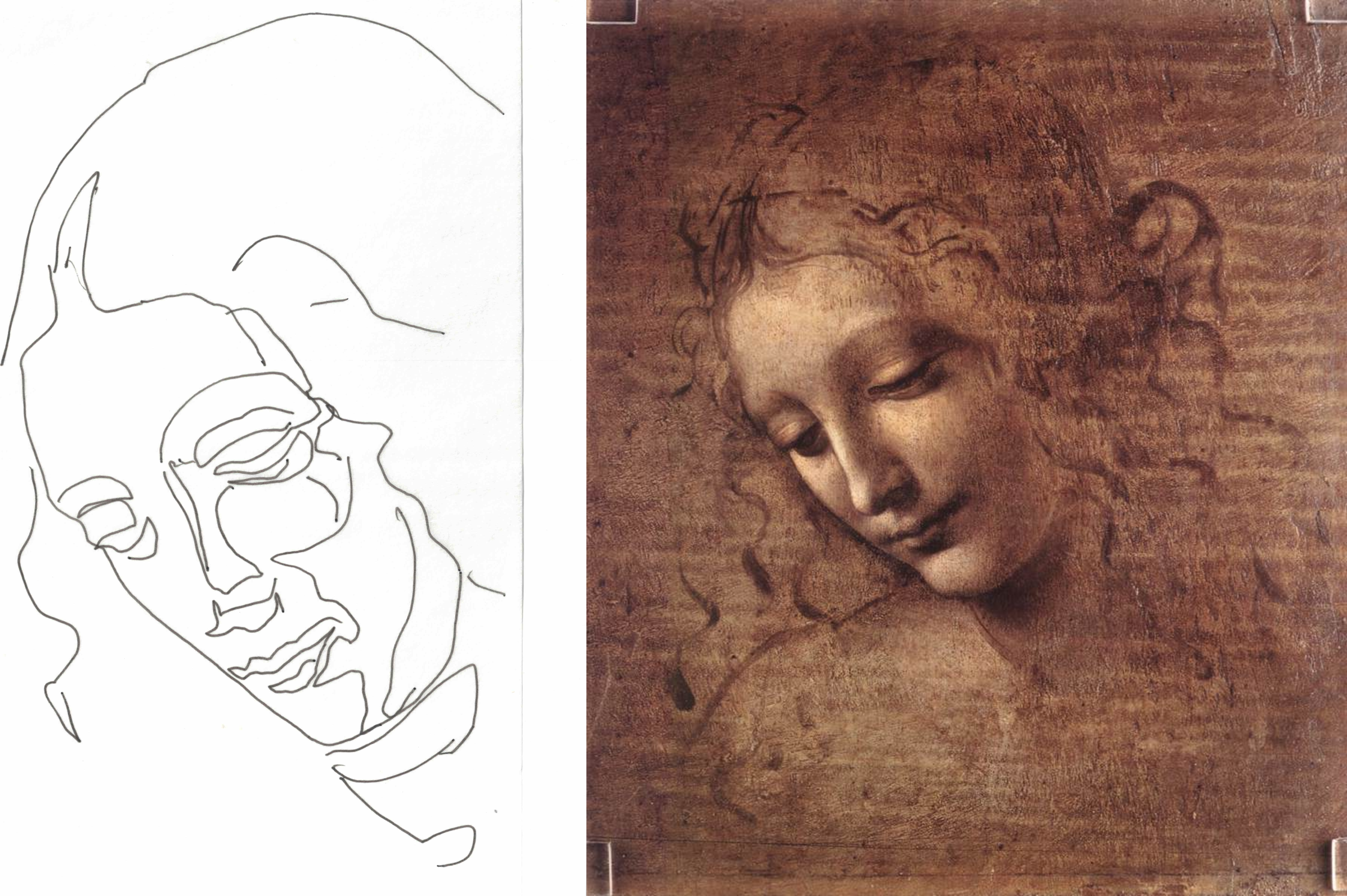
<em>Left: my tracing. Right: Leonardo da Vinci, <a href="https://commons.wikimedia.org/wiki/File:Leonardo_da_Vinci_-_Female_head_(La_Scapigliata)_-_WGA12716.jpg">La Scapigliata</a> (“Lady with Dishevelled Hair”), c. 1506–1508, oil, umber and white lead on poplar panel, Galleria Nazionale di Parma — public domain.</em></p>

<p><small><a href="#scapigliata">La Scapigliata</a> · <a href="#raphael">Raphael’s Madonna del Prato</a></small></p>

<p><a id="scapigliata"></a></p>

<p>There’s something almost metallic though maybe I overworked La Scapigliata.
Leonardo always pulls me toward the anatomical side; in a
way, my tracing reads with a slightly different expression than his,
less joyous and more neutral. I don’t think there was any difference in
ease compared to the Mona Lisa, but this one was clearer to work with.</p>

<p><strong>The painting.</strong> <em>La Scapigliata</em> — Italian for “the dishevelled woman” —
is a small, unfinished panel: an unidentified woman’s head, gazing down,
hair spreading loose behind her, worked up only far enough to show
Leonardo’s process rather than a finished portrait. Attribution to
Leonardo himself (rather than a pupil) is generally accepted but not
unanimous among scholars. Held at the Galleria Nazionale in Parma since
1826.</p>

<p><strong>The artist.</strong> Leonardo da Vinci (1452–1519), Florentine polymath — painter,
draftsman, anatomist, engineer. Public domain by any measure: died over 500
years ago.</p>

<hr />

<p><a id="raphael"></a>
<img src="/assets/images/scapigliata-prato-line-and-oil/diptych-raphael.png" alt="My tracing beside Raphael's Madonna del Prato" />
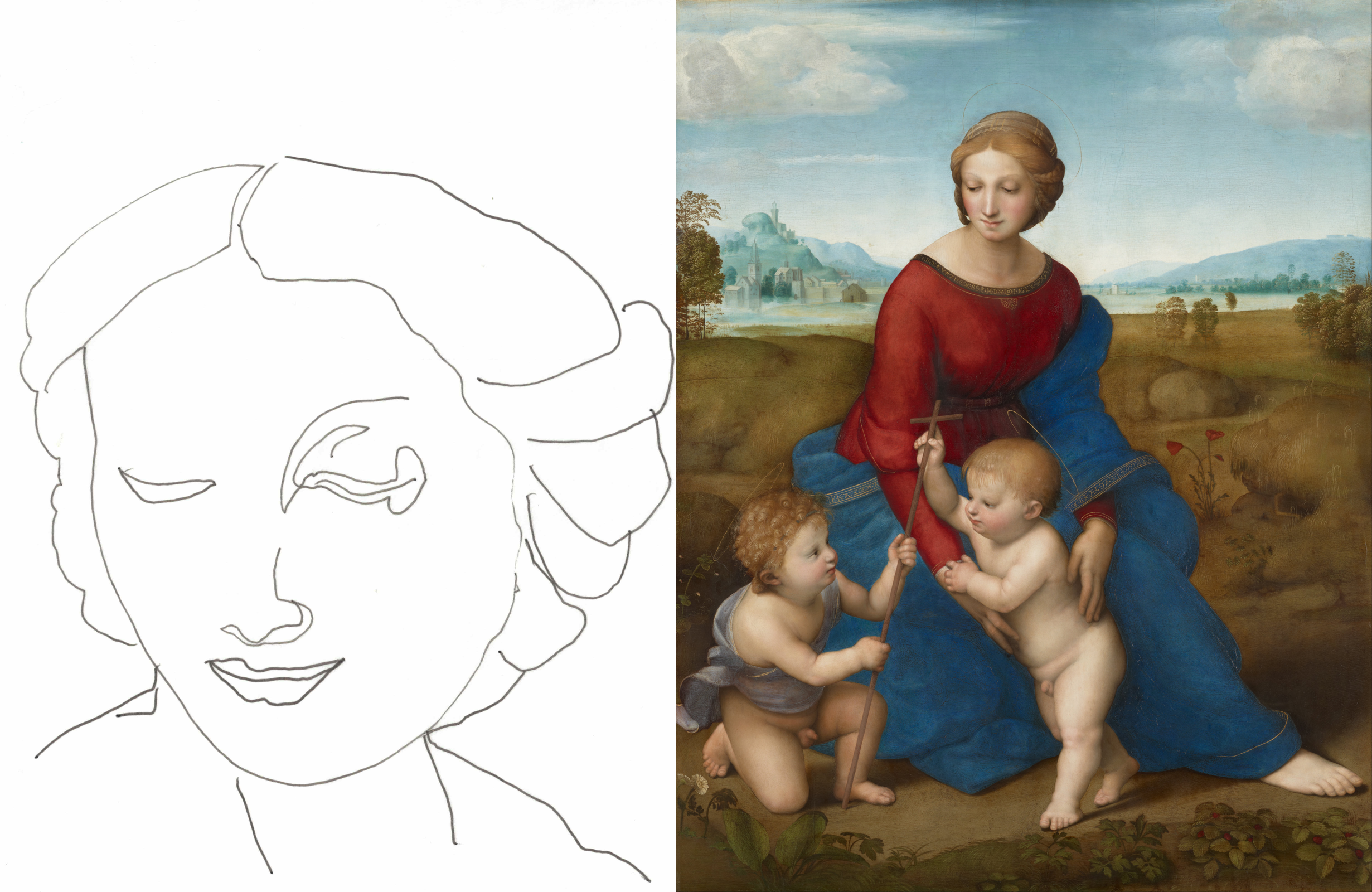
<em>Left: my tracing. Right: Raphael, <a href="https://commons.wikimedia.org/wiki/File:Raphael_-_Madonna_in_the_Meadow_-_Google_Art_Project.jpg">Madonna del Prato</a>, 1506, oil on panel, Kunsthistorisches Museum, Vienna — public domain.</em></p>

<p>By contrast, I like the spareness of del Prato. I did more work on her
left eye than her right — imbalance I’m not sure entirely fails. I
think my tracing has the dimensionality Raphael’s painting has, though
his is smoother and more convincingly real; mine may be going more
directly at what Tsao’s face-patch research points to — the specific
orientation the eyes are read from — than his does. I don’t normally look
at Raphael much; his forms are rounder and smoother than what I usually
gravitate toward.</p>

<p><strong>The painting.</strong> <em>Madonna del Prato</em>, painted in Florence within months of
Raphael’s arrival there in 1504–05, aged 23. The Madonna, the infant
Christ, and the infant John the Baptist are arranged in a pyramid linked
by their gazes — a composition indebted to Leonardo, whom Raphael was
absorbing closely at the time. In the Kunsthistorisches Museum, Vienna,
since 1891.</p>

<p><img src="/assets/images/scapigliata-prato-line-and-oil/leonardo-salvator-mundi-1500.jpg" alt="Leonardo's Salvator Mundi" style="max-width: 45%;" /></p>

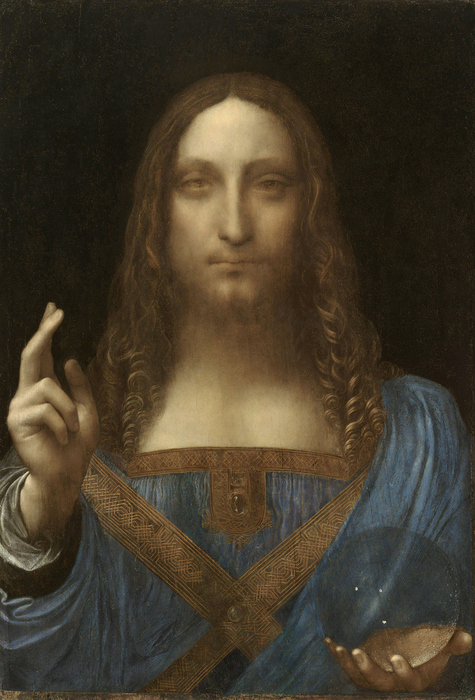
<p><em>Leonardo da Vinci (attribution disputed), <a href="https://commons.wikimedia.org/wiki/File:Leonardo_da_Vinci,_Salvator_Mundi,_c.1500,_oil_on_walnut,_45.4_%C3%97_65.6_cm.jpg">Salvator Mundi</a>, c. 1500 — public domain. Sold for <strong>$450.3 million</strong> at Christie’s in 2017, still the auction record for any painting.</em></p>

<p><img src="/assets/images/scapigliata-prato-line-and-oil/raphael-testa-di-musa-1511.jpg" alt="Raphael's Testa di una Musa" style="max-width: 45%;" /></p>

<p><em>Raphael, <a href="https://commons.wikimedia.org/wiki/File:%22Head_of_a_muse%22_by_Raffaello_Sanzio.png">Testa di una Musa</a> (</em>Head of a Muse<em>), c. 1510–11, black chalk — public domain. Sold for <strong>£29.2 million (~$47.8M)</strong> at Christie’s in 2009, the record for any Old Master drawing — Raphael’s paintings are all in museums, so his drawings are where his market moves.</em></p>

<hr />

<p><strong>Image credits.</strong> Leonardo da Vinci died in 1519, Raphael in 1520 — both
public domain by any measure. All four source photographs are faithful
flat reproductions of public-domain 2-D artworks and carry no separate
copyright of their own (US: <em>Bridgeman Art Library v. Corel</em>, 1999; EU:
Copyright Directive 2019, Art. 14). The <em>Testa di una Musa</em> and <em>Salvator
Mundi</em> images are sourced via Wikimedia Commons, tagged public domain —
the <em>Salvator Mundi</em> attribution to Leonardo (rather than his workshop)
is debated among scholars, noted in the caption above.</p>

<p><strong>Links</strong></p>
<ul>
  <li><a href="https://commons.wikimedia.org/wiki/File:Leonardo_da_Vinci_-_Female_head_(La_Scapigliata)_-_WGA12716.jpg">La Scapigliata — Wikimedia Commons</a> — file page, license, source</li>
  <li><a href="https://commons.wikimedia.org/wiki/File:Raphael_-_Madonna_in_the_Meadow_-_Google_Art_Project.jpg">Madonna del Prato — Wikimedia Commons</a> — file page, license, source</li>
  <li><a href="https://www.khm.at/en/artworks/the-madonna-of-the-meadow-1502">Madonna del Prato — Kunsthistorisches Museum</a> — museum catalogue entry</li>
  <li><a href="https://commons.wikimedia.org/wiki/File:%22Head_of_a_muse%22_by_Raffaello_Sanzio.png">Testa di una Musa — Wikimedia Commons</a> — file page, license, source</li>
  <li><a href="https://www.guinnessworldrecords.com/world-records/most-expensive-drawing-by-an-old-master-sold-at-auction">Guinness World Records: most expensive Old Master drawing</a> — £29.2 million, Christie’s, December 2009</li>
  <li><a href="https://commons.wikimedia.org/wiki/File:Leonardo_da_Vinci,_Salvator_Mundi,_c.1500,_oil_on_walnut,_45.4_%C3%97_65.6_cm.jpg">Salvator Mundi — Wikimedia Commons</a> — file page, license, source</li>
  <li><a href="https://en.wikipedia.org/wiki/Salvator_Mundi_(Leonardo)">Salvator Mundi — Wikipedia</a> — sale history, attribution debate</li>
</ul>]]></content><author><name>Neal C</name></author><category term="drawing" /><category term="da-vinci" /><category term="raphael" /><category term="portrait" /><category term="line" /><summary type="html"><![CDATA[Left: my tracing. Right: Leonardo da Vinci, La Scapigliata (“Lady with Dishevelled Hair”), c. 1506–1508, oil, umber and white lead on poplar panel, Galleria Nazionale di Parma — public domain.]]></summary></entry><entry><title type="html">Schjerfbeck, green then black</title><link href="https://essentialine.art/drawing/schjerfbeck-self-portrait-line-and-oil/" rel="alternate" type="text/html" title="Schjerfbeck, green then black" /><published>2026-07-11T00:00:00+00:00</published><updated>2026-07-11T00:00:00+00:00</updated><id>https://essentialine.art/drawing/schjerfbeck-self-portrait-line-and-oil</id><content type="html" xml:base="https://essentialine.art/drawing/schjerfbeck-self-portrait-line-and-oil/"><![CDATA[<p><img src="/assets/images/schjerfbeck-self-portrait-line-and-oil/diptych-schjerfbeck.png" alt="My tracing beside Schjerfbeck's 1895 self-portrait" />
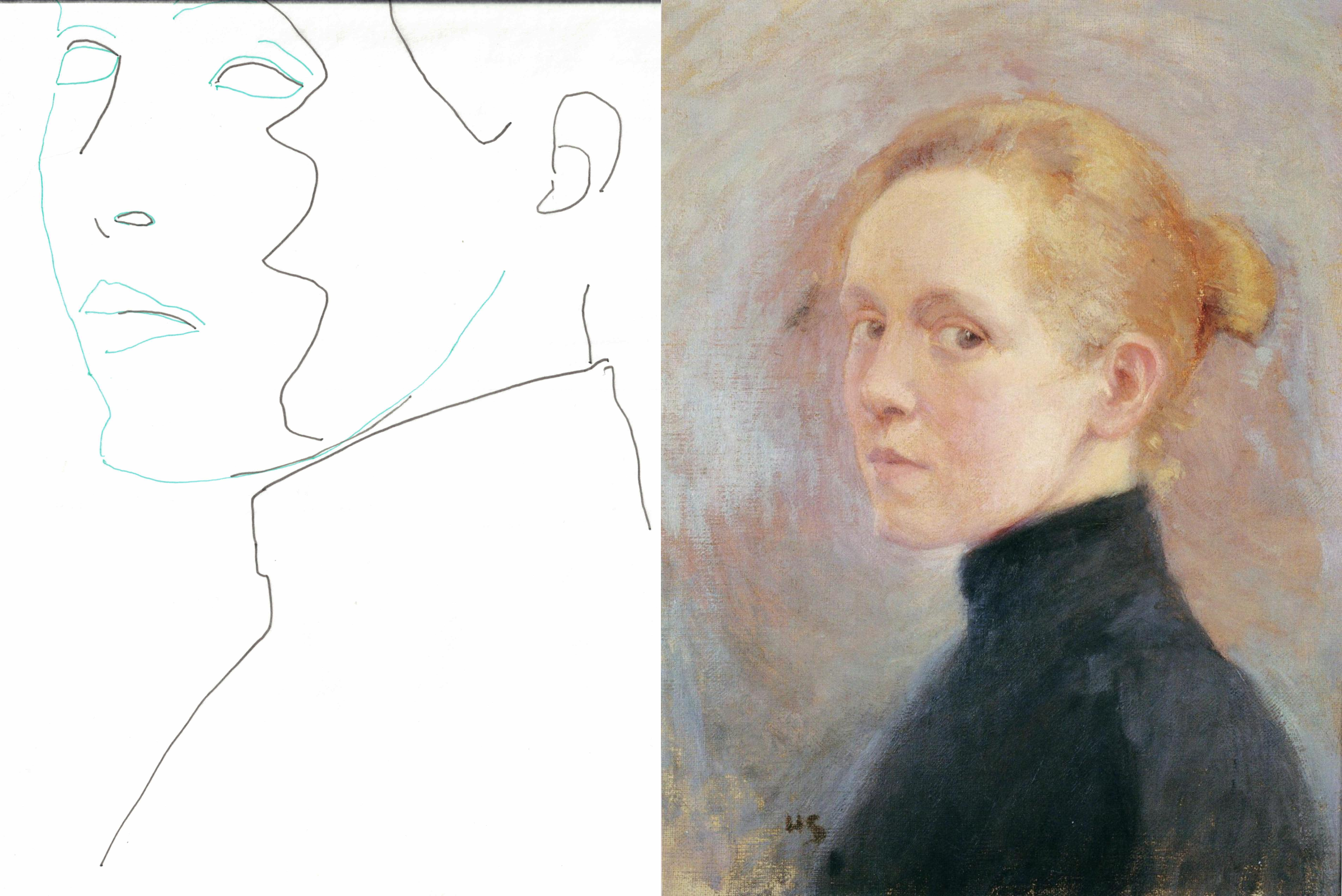
<em>Left: my tracing, green then black. Right: Helene Schjerfbeck, <a href="https://commons.wikimedia.org/wiki/File:Schjerfbeck_self-portrait_1895.jpg">Self-Portrait</a>, 1895, oil on canvas — Ekenäs Museum Center EKTA, Ekenäs (Tammisaari), Finland. Public domain.</em></p>

<p>This is the one I tried in color first.
I started with green, because that’s close to how she handles the light
where her face meets the background in the actual painting —
but on its own it was too faint to read, so I went over it with black.
On the two eyes specifically I reversed the order,
black under green instead of over,
because the eyes needed to hold more weight on the page than anywhere else —
though I’m not entirely sure why that felt right.</p>

<p>I left off the eye-socket shadow initially,
but added a line along the top of the nose,
one at the base of the nostril,
and a black line marking the boundary between the two lips.
Then one ridge line, low across the cheek —
not invented, but lifted straight from one of her own value transitions,
there to help the shadow orient the face.</p>

<p>I’m trying to add as little as possible, incrementally —
doing a little, then stopping, stepping back,
judging if there’s too much missing,
and if so, what’s the least I can add. Then iterating.</p>

<p>There’s a psychological spareness, I think, that comes with age —
we don’t care for the ebullience of youth, just the basics.
We’ve lost too many brain cells to the stresses of life, haha!</p>

<p>Helene Schjerfbeck painted herself for over sixty years —
from a young woman in the 1880s to her skeletal studies in her last months,
working days before she died in 1946.
This 1895 painting is still fully representational, but spare,
with nothing but the face expressing.
Her market took a long time to catch up with her work:
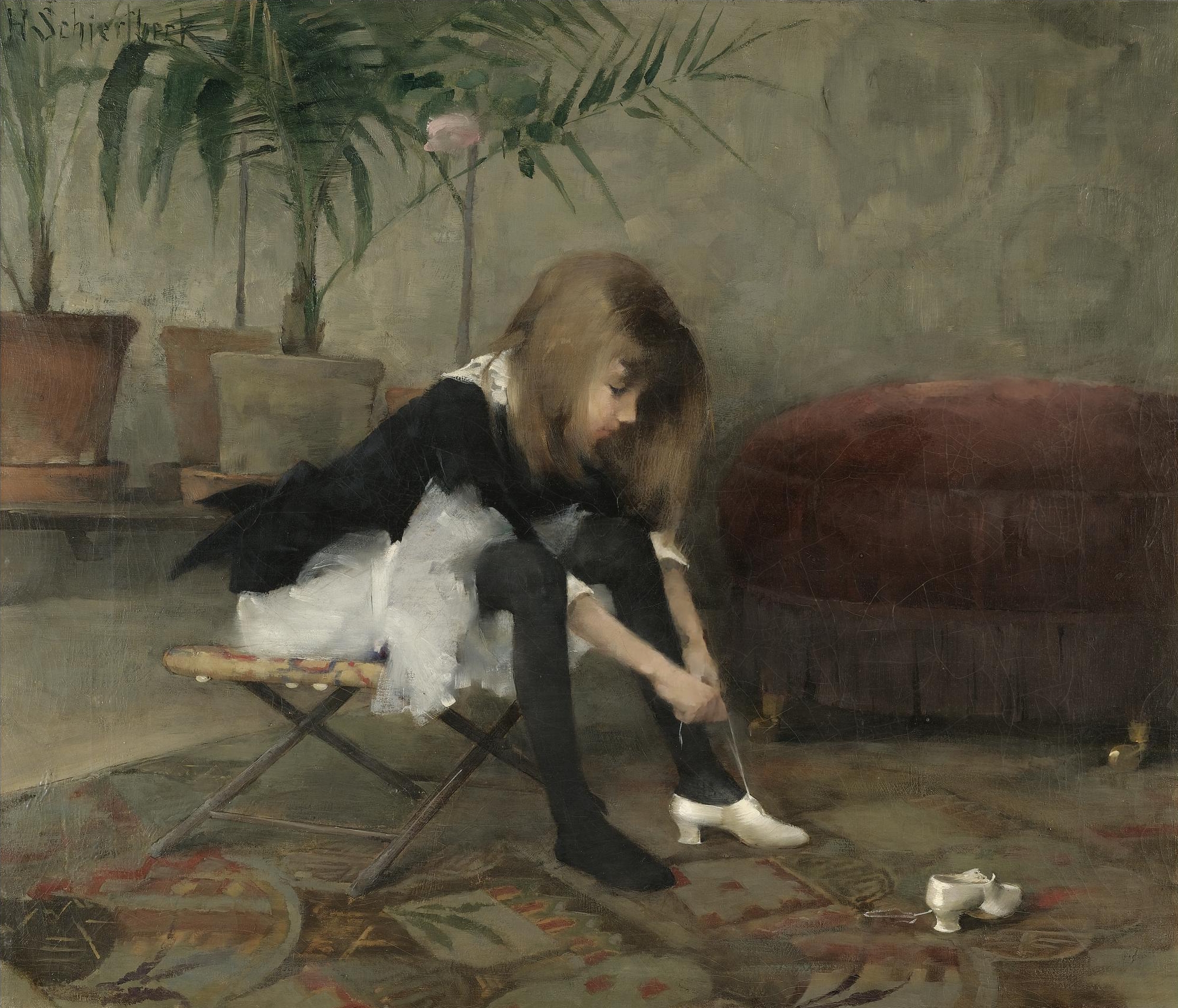
a 2008 Sotheby’s London sale of <em>Tanssiaiskengät (Dancing Shoes)</em>,
estimated at £500,000–700,000,
sold for roughly £3 million (about $6 million) —
and her Royal Academy retrospective in 2019
introduced her properly outside Scandinavia for the first time.</p>

<p><img src="/assets/images/schjerfbeck-self-portrait-line-and-oil/schjerfbeck-dancing-shoes-1882.jpg" alt="Helene Schjerfbeck, Dancing Shoes, 1882" />
<em>Helene Schjerfbeck, <a href="https://commons.wikimedia.org/wiki/File:Tanssiaiskengat_iso_by_Helena_Schjerfbeck_1882.jpg">Dancing Shoes</a> (</em>Tanssiaiskengät<em>), 1882, oil on canvas — the painting behind that 2008 record sale, private collection since. Public domain.</em></p>

<hr />

<p><strong>Image credits.</strong>
Helene Schjerfbeck died in 1946 — public domain in countries
with a life-plus-70-years term (Finland included, since 2017),
and in the US as a pre-1931 work.
<em>Self-Portrait</em> (1895) is held at Ekenäs Museum Center EKTA
(Länsi-Uudenmaan maakuntamuseo) in Ekenäs (Tammisaari), Finland.</p>

<p><strong>Links</strong></p>
<ul>
  <li><a href="https://commons.wikimedia.org/wiki/File:Schjerfbeck_self-portrait_1895.jpg">Self-Portrait, 1895 — Wikimedia Commons</a>
— full-resolution image; held at Ekenäs Museum Center EKTA, Finland</li>
  <li><a href="https://commons.wikimedia.org/wiki/File:Tanssiaiskengat_iso_by_Helena_Schjerfbeck_1882.jpg">Dancing Shoes, 1882 — Wikimedia Commons</a>
— the 2008 record-sale painting discussed above</li>
  <li><a href="https://en.wikipedia.org/wiki/Helene_Schjerfbeck">Helene Schjerfbeck — Wikipedia</a></li>
</ul>]]></content><author><name>Neal C</name></author><category term="drawing" /><category term="schjerfbeck" /><category term="portrait" /><category term="line" /><category term="color" /><summary type="html"><![CDATA[Left: my tracing, green then black. Right: Helene Schjerfbeck, Self-Portrait, 1895, oil on canvas — Ekenäs Museum Center EKTA, Ekenäs (Tammisaari), Finland. Public domain.]]></summary></entry><entry><title type="html">Christiaan Tonnis’s Female Warriors</title><link href="https://essentialine.art/drawing/tonnis-female-warrior-extinction/" rel="alternate" type="text/html" title="Christiaan Tonnis’s Female Warriors" /><published>2026-07-07T00:00:00+00:00</published><updated>2026-07-07T00:00:00+00:00</updated><id>https://essentialine.art/drawing/tonnis-female-warrior-extinction</id><content type="html" xml:base="https://essentialine.art/drawing/tonnis-female-warrior-extinction/"><![CDATA[<p><img src="/assets/images/tonnis-female-warrior-extinction/diptych-extinction14.png" alt="Tracing beside Tonnis's Female Warrior #14 &quot;Extinction,&quot; 1981" />
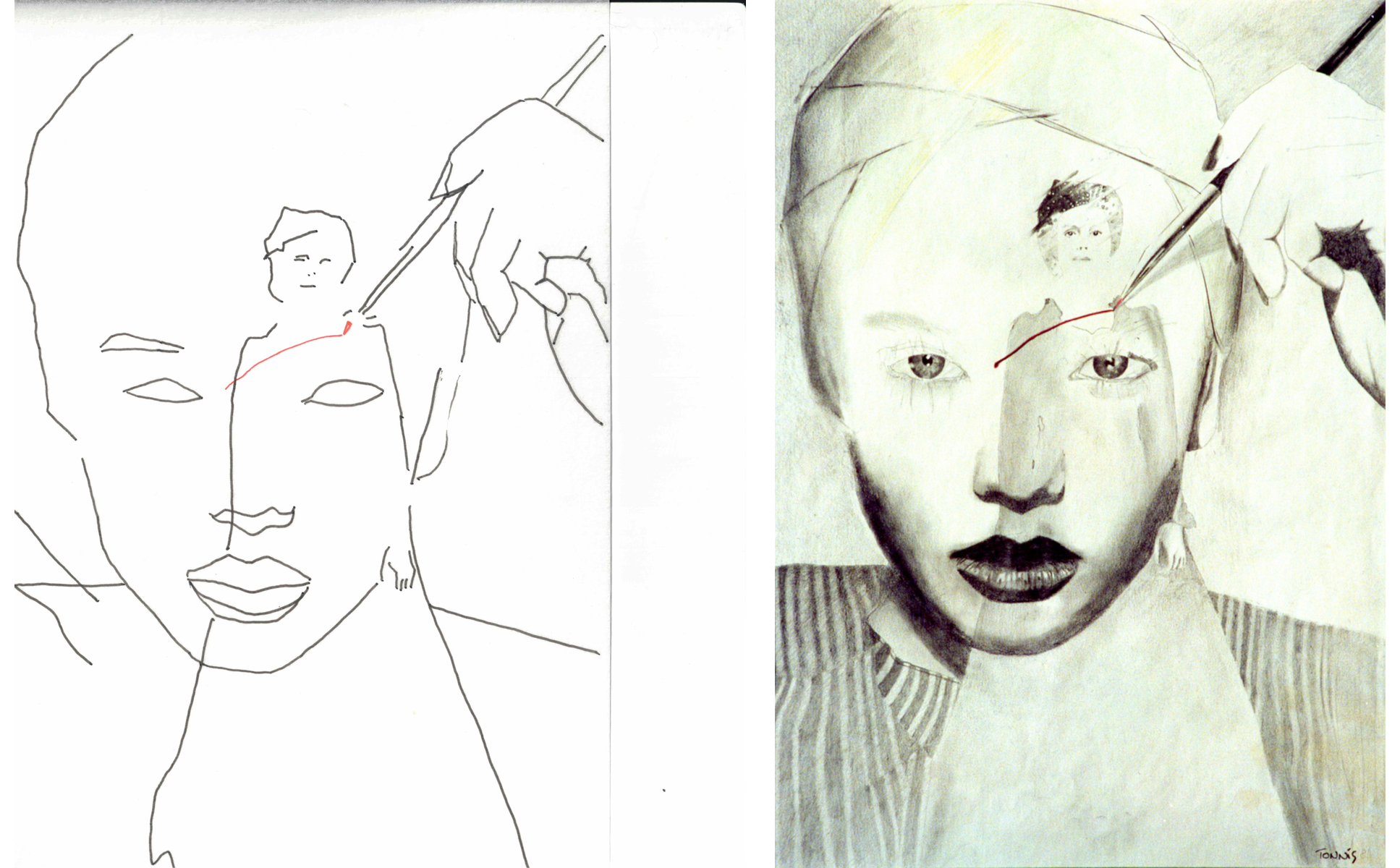
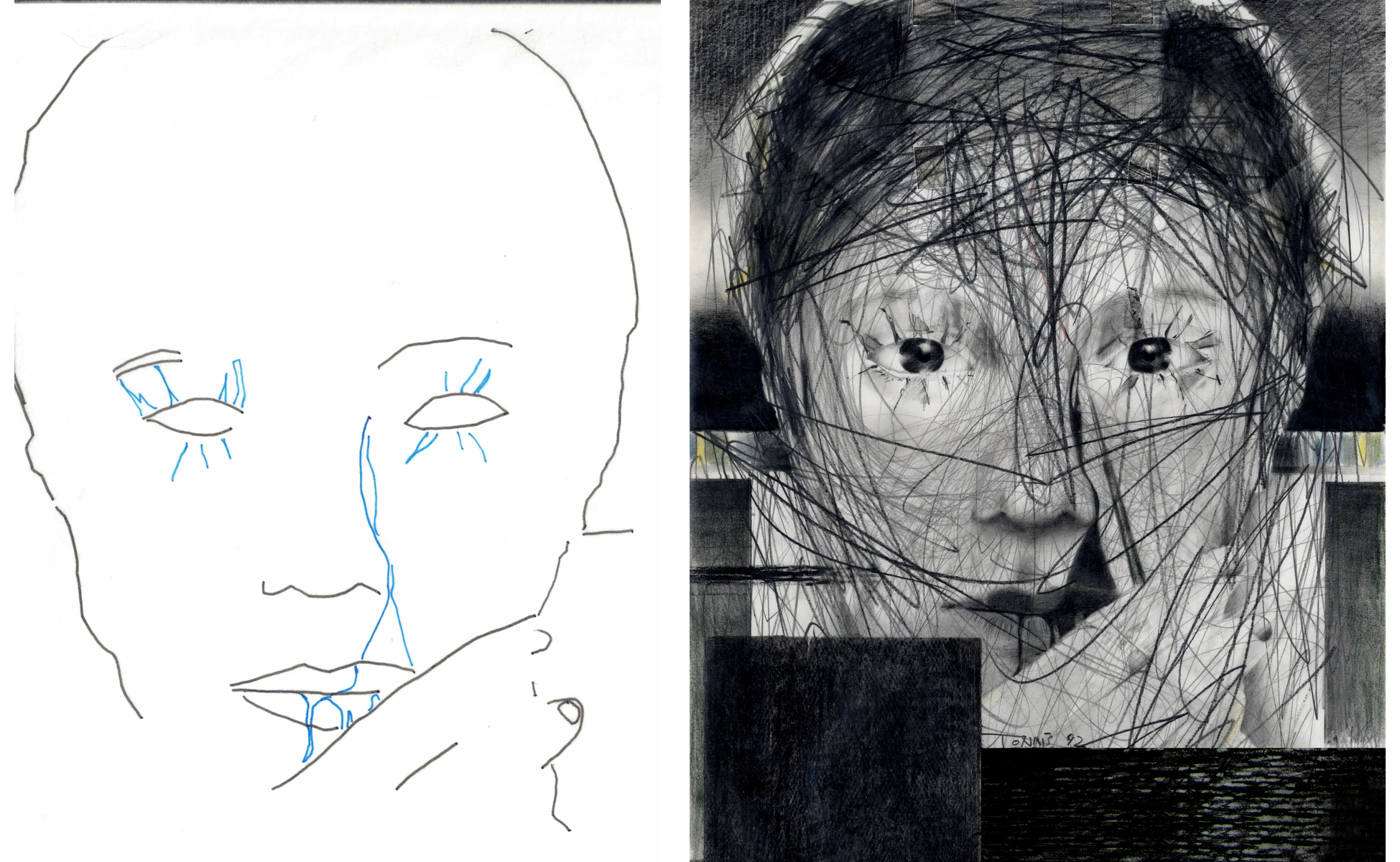
<em>Left: my tracing. Right: Christiaan Tonnis, <a href="https://commons.wikimedia.org/wiki/File:Female_Warrior_-14_%22Extinction%22.jpg">Female Warrior #14 “Extinction”</a>, pencil and colored pencil on paper, 1981 — CC BY-SA 2.0, via Wikimedia Commons.</em></p>
<p>Two tracings so far from Christiaan Tonnis’s <em>Female Warrior</em> series — different
pieces, different years, both pulling at something different in the line.</p>

<p><small><a href="#extinction">Extinction</a> · <a href="#cutting-edge-of-will">Cutting Edge of Will</a></small></p>

<p><a id="extinction"></a>
This is Female Warrior #14, “Extinction,” by Tonnis. I think he actually may
have put it into Creative Commons — Wikimedia says as much about the image.
It’s an incredible piece, genuinely one of my favorites.</p>

<p>This one’s face is so beautiful and perfect. The red line — the stroke
running from the brush down to her forehead — is precise and so painful.
Perfect. I’m reminded of her even walking around different places today.</p>

<p>I didn’t know how I was going to be able to draw this. So much of it has to
do with this almost shadeless quality, the air around the figure, the
eyelashes.</p>

<p>It’s amazing how the arm of the inside girl connects to — has something to
do with — the neck of the other girl, the main girl. There are these little
features, and the expression too. I didn’t know how I was going to do all of
it, plus the lines of the turban, so I decided to just suggest it rather than
fully render it.</p>

<p>For this one I dug out my colored Micron pens. This whole thing is intense —
so much going on. He fully draws the hand itself, which is interesting on its
own — the fingers are just gorgeous, so perfectly done. He works on so many
levels — he even put in the fingernails. Fingernails have a special status, I
think, because they orient the hand.</p>

<p>Since I had my colors out, I thought about using blue for the inside girl —
I’ll do that next. She’s at an angle, she faintly emerges, and then the
dress.</p>

<p>I added a little contour to hold the turban together. He’s using shading
inside the other woman too — I put her hands at the bottom of the cheek,
which is kind of interesting.</p>

<p>Her expression is symbolic, funny, kind of off — the whole piece is
piercing.</p>

<p>It seems like I want to take this, scan it, and add to it again. Maybe next
time I’ll try a version with more color. I just love this piece.</p>

<hr />

<p><a id="cutting-edge-of-will"></a>
<img src="/assets/images/tonnis-female-warrior-extinction/diptych-warrior17.png" alt="Tracing beside Tonnis's Female Warrior #17 &quot;Cutting Edge of Will,&quot; 1992" />
<em>Left: my tracing. Right: Christiaan Tonnis, <a href="https://commons.wikimedia.org/wiki/File:Mental_health_female_warrior_art.jpg">Female Warrior #17 “Cutting Edge of Will”</a>, graphite pencil on paper, 1992 — CC BY-SA 2.0, via Wikimedia Commons.</em></p>
<p>Another female warrior — Cutting Edge of Will. I find
the shape next to the lips so intriguing. I’ve been looking for an inner
image here, like in Extinction, and I haven’t found one — though I suspect
there is one. The longer I look at it, the more I notice: the black fluid
running alongside the nose, which I only realized was fluid once I saw the
shape it takes crossing past her lips. The possible body of water at the
bottom. The noisiness of the lines above her head. There are subtle blocks,
like pieces of tape, in pairs at the center. The walls behind her could be a
prison, or a mental hospital — though his title talks about will.</p>

<p>This one has a lot of scribbles on it — holding lines, covering the face,
and it’s hard to tell which lines are which. It’s an implied line, even down
to the jaw.</p>

<p>I just absolutely love her mysterious eyelashes — could they even be people?
He’s got these remarkable shapes along the nose. There’s a hand again,
perfect, with fingernails, little blocks; I drew the hand next, it was so
hard to see.</p>

<p>Perhaps it’s a kind of hatching, but I noticed that around the eyes, it’s
less scribbled — that’s where I started, afterwards hesitantly adding the
eyelashes in blue this time.</p>

<hr />

<p>There’s similarity between the two faces, in the eyelashes especially,
and some link in the environment around them — I don’t want to
force connection. On their own, these faces are simple, maybe
even transcendent, like a Jungian archetype. They don’t look like warriors
to me, not in the face — but the red, the blue, and the haze around them say
otherwise. Maybe they’re warriors on a different plane.</p>

<p>Strangely, before I scanned these I thought neither one had turned out well.
Then I saw them in the diptych, next to his, and I like them now. For
Extinction, though, I think it’d be interesting to try the inner woman again
in a different color sometime.</p>

<hr />

<p><strong>Image credits &amp; sources.</strong> Christiaan Tonnis is the copyright holder for both
pieces and self-published them to his own Flickr feed under Creative Commons
Attribution-ShareAlike 2.0; Wikimedia’s FlickreviewR bot verified each license
before mirroring to Commons — <em>Extinction</em> on 18 March 2010, <em>Cutting Edge of
Will</em> on 21 June 2020. This isn’t a public-domain claim, it’s the artist’s own
choice to release the work this way. Because both sources are CC BY-SA 2.0, the
tracings/diptychs in this post are offered under the same license: <a href="https://creativecommons.org/licenses/by-sa/2.0/">CC BY-SA
2.0</a>, adapted from Christiaan
Tonnis, <em>Female Warrior #14 “Extinction”</em> (1981) and <em>Female Warrior #17
“Cutting Edge of Will”</em> (1992).
(I saw that Christiaan had
commented on Flickr: a woman named Alisha had used #17 on her mental
health blog, and credited him for it. He thanked her,
calling her article touching and true.)</p>

<p><strong>Links</strong></p>
<ul>
  <li><a href="https://commons.wikimedia.org/wiki/File:Female_Warrior_-14_%22Extinction%22.jpg">Female Warrior #14 “Extinction” — Wikimedia Commons</a> — file page, license, source</li>
  <li><a href="https://www.flickr.com/photos/27056788@N06/2983981504">Female Warrior #14 on Flickr</a> — original upload</li>
  <li><a href="https://commons.wikimedia.org/wiki/File:Mental_health_female_warrior_art.jpg">Female Warrior #17 “Cutting Edge of Will” — Wikimedia Commons</a> — file page, license, source</li>
  <li><a href="https://www.flickr.com/photos/27056788@N06/8881851404">Female Warrior #17 on Flickr</a> — original upload</li>
  <li><a href="https://commons.wikimedia.org/wiki/Christiaan_Tonnis">Christiaan Tonnis — Wikimedia Commons artist page</a></li>
</ul>]]></content><author><name>Neal C</name></author><category term="drawing" /><category term="tonnis" /><category term="line" /><category term="portrait" /><summary type="html"><![CDATA[Left: my tracing. Right: Christiaan Tonnis, Female Warrior #14 “Extinction”, pencil and colored pencil on paper, 1981 — CC BY-SA 2.0, via Wikimedia Commons.]]></summary></entry><entry><title type="html">Vallein Tercinier VSOP</title><link href="https://essentialine.art/drawing/vallein-tercinier-vsop/" rel="alternate" type="text/html" title="Vallein Tercinier VSOP" /><published>2026-07-01T00:00:00+00:00</published><updated>2026-07-01T00:00:00+00:00</updated><id>https://essentialine.art/drawing/vallein-tercinier-vsop</id><content type="html" xml:base="https://essentialine.art/drawing/vallein-tercinier-vsop/"><![CDATA[<div style="display:flex; gap:1rem; margin-bottom:1rem;">
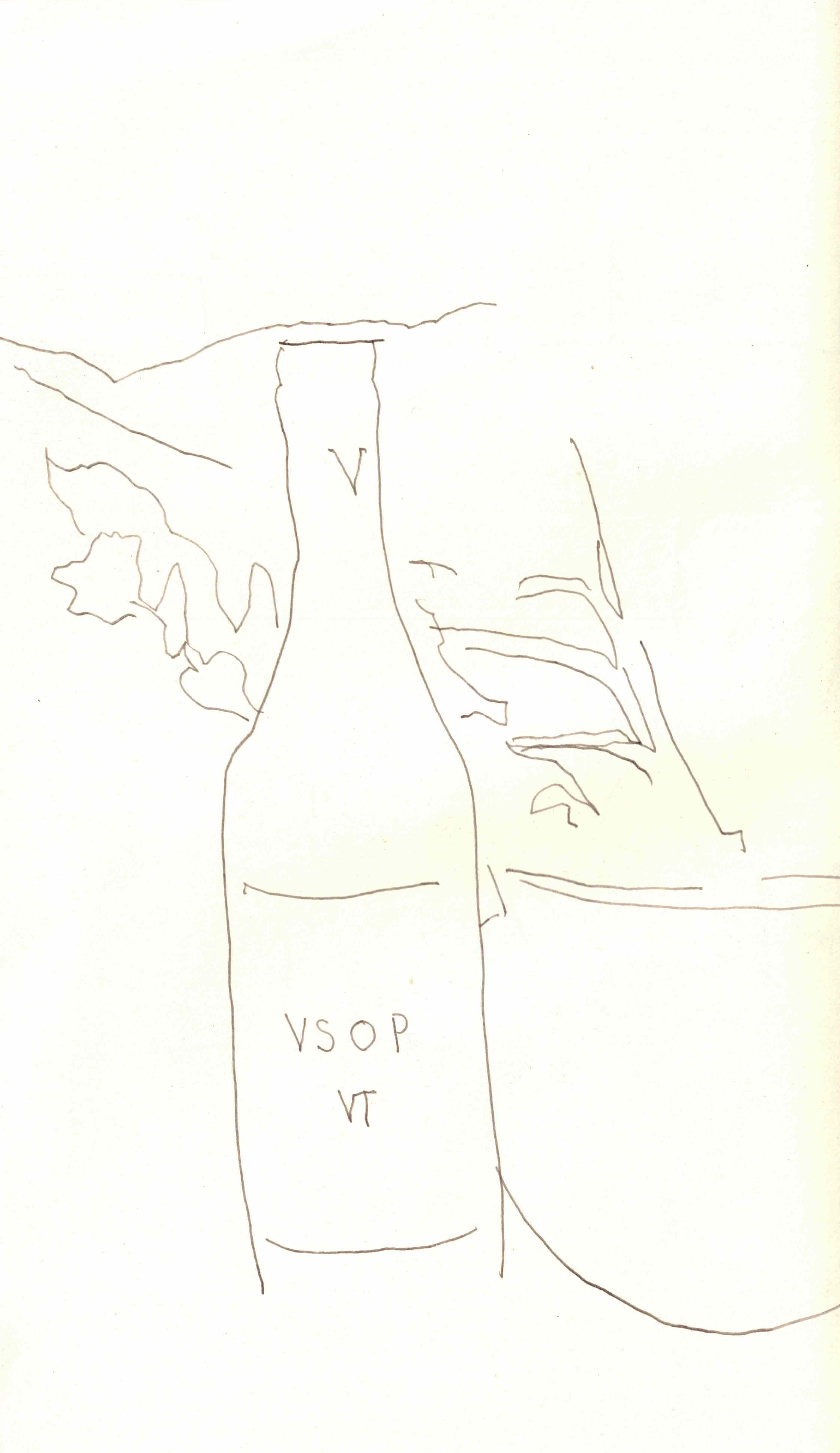
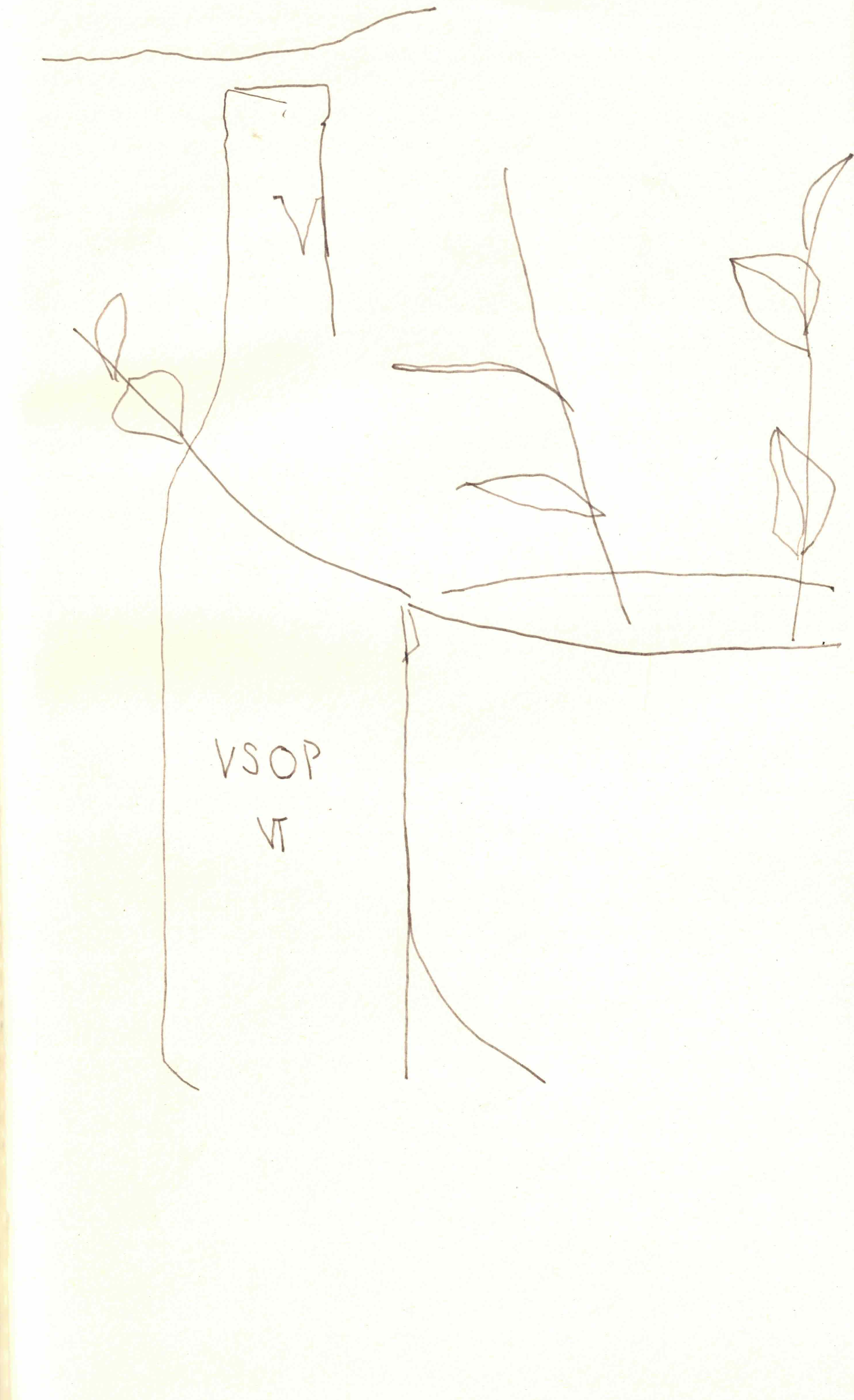
  <img src="/assets/images/vallein-tercinier-vsop/260703fr.vtvsop2.png" alt="Still life, Vallein Tercinier VSOP on the patio, 7.3" style="width:50%; object-fit:contain;" />
  <img src="/assets/images/vallein-tercinier-vsop/260703fr.vtvsop.png" alt="Study, Vallein Tercinier VSOP, 7.3" style="width:50%; object-fit:contain;" />
</div>

<p><small><a href="#drawing">Drawing</a> · <a href="#tasting">Tasting notes</a></small></p>

<p><a id="drawing"></a>
The <a href="https://neolucida.com/">Neolucida XL</a> is interesting — but finicky.</p>

<p>It has a shade slide,
which helps when the sky and notebook are bright but the bottle and yard aren’t quite as bright.
The image is very sensitive to the angle you’re looking through.
You have to be standing over it on a table. Ergonomically challenging.
Scale is controlled by how far the apparatus is from the paper — no zoom knob.</p>

<p>It helps with proportion; Loomis said beauty is beauty of proportion.
I did one without the Lucida first, then remembered I had it.
The one without felt better in some ways — more <a href="https://en.wikipedia.org/wiki/Giorgio_Morandi">Morandi</a>.
But I consider the Lucida important; Hockney mentioned Ingres used it and so its
important to me.
I drew a quick draft without it, but when I tried to stitch the San Gabriels behind the bottle
I failed — the perspective didn’t work. With the Lucida, this kind of
logic and proportions are exactly right.</p>

<p>What drawing or tracing with a camera lucida doesn’t have is as much of you and your mind
inside the process.
The image passes more quickly through you tracing from the bottle
to the paper through a half-mirror, in a narrow, clear way.
A fun tool. A good tool. But one of many.</p>

<p>I want to study more Morandi — there’s something about that minimalism.
Why is he drawing only bottles and pots?
He’s looking for something simple, and so am I.</p>

<p><a href="https://fredericforest.com/">Forest</a> has a nice example in his book — a photo he took of water reflecting on a mountain.
From my table in the yard here I can see a fence and the San Gabriel mountains.
But the composition from this angle isn’t very good.
This is where my table is, and where it’s shady enough at this point in the day.</p>

<hr />

<p><a id="tasting"></a>
Found <a href="https://www.cognac-tercinier.com/en/">Vallein Tercinier</a> through <a href="https://www.reddit.com/r/cognac/comments/1ld4kaz/i_work_in_cognac_ask_me_anything_the_labels_dont/">an AMA on r/cognac</a> — Dan, marketing at Croizet, writing about what the labels don’t tell you.
Asked which names come up when glasses get poured after hours, he named Tercinier.
“Fascinating, slightly offbeat parcels, especially in older releases.”
Wine-Searcher showed one result in LA — <a href="https://www.winehouse.com/">Wine House</a>.</p>

<p>Beautiful, smooth, clean, flammable — gorgeous gasoline vapor, if there was such a thing.
And there is; that’s what it is.
I love this one.
Like Ardbeg’s medicinal bandaids: bad and good at once, but smoother — doesn’t reach as hard.</p>

<p>It’s so dry — the chalk, the Petite Champagne.
Very dry, but still has the fruit.
Incredibly complex.
Almond, toasted oak — hazelnut.
Ugni Blanc — and the VSOP is speaking to an age.</p>

<p>Drinking from a Glencairn.
Just the nose: alcohol — what Dan called vapour. Noticeable, appealing, not overdone.</p>

<p>On the next sips, maybe plum, dark ink.
More depth, more bitter.
And then the perfume — a tininess, a sharpness, pleasant.
You feel it more than you taste it — per Dan.</p>

<p>The VS is open too.
Absolutely lovely, but fewer layers — more wine distillate, less age.</p>

<p>Haven’t opened the Hors d’Age yet.
That’s where I’d expect rancio. Dan’s description from the same thread:
“Walnut, dried fig, antique wood, leather, mushroom, old books, a touch of soy sauce — but in vapour form. More about mood than flavour. You feel it more than you taste it.”
Will report back.</p>

<hr />

<p><strong>Links</strong></p>
<ul>
  <li><a href="https://neolucida.com/">Neolucida XL</a> — camera lucida drawing tool</li>
  <li><a href="https://en.wikipedia.org/wiki/Giorgio_Morandi">Giorgio Morandi</a> — Wikipedia</li>
  <li><a href="https://artsandculture.google.com/asset/museo-morandi-the-collection/hgFzYP2JNGtMyQ?hl=en">Museo Morandi — Google Arts &amp; Culture</a> — free online collection</li>
  <li><a href="https://www.cognac-tercinier.com/en/">Vallein Tercinier</a> — Domaine des Forges, Chermignac</li>
  <li><a href="https://www.winehouse.com/">Wine House, LA</a></li>
  <li><a href="https://fredericforest.com/">Frédéric Forest</a> — artist, <em>Art of the Line in Drawing</em></li>
  <li><a href="https://www.reddit.com/r/cognac/comments/1ld4kaz/i_work_in_cognac_ask_me_anything_the_labels_dont/">r/cognac AMA — Dan at Croizet</a> — what the labels don’t tell you</li>
</ul>]]></content><author><name>Neal C</name></author><category term="drawing" /><category term="cognac" /><category term="still-life" /><category term="neolucida" /><category term="morandi" /><summary type="html"><![CDATA[]]></summary></entry><entry><title type="html">De László’s Doña Graziella, 1928</title><link href="https://essentialine.art/drawing/de-laszlo-portrait-graziella-patino/" rel="alternate" type="text/html" title="De László’s Doña Graziella, 1928" /><published>2026-06-14T00:00:00+00:00</published><updated>2026-06-14T00:00:00+00:00</updated><id>https://essentialine.art/drawing/de-laszlo-portrait-graziella-patino</id><content type="html" xml:base="https://essentialine.art/drawing/de-laszlo-portrait-graziella-patino/"><![CDATA[<p><img src="/assets/images/de-laszlo-portrait-graziella-patino/gracclip.png" alt="My line tracing over de László's 1928 Graziella" />
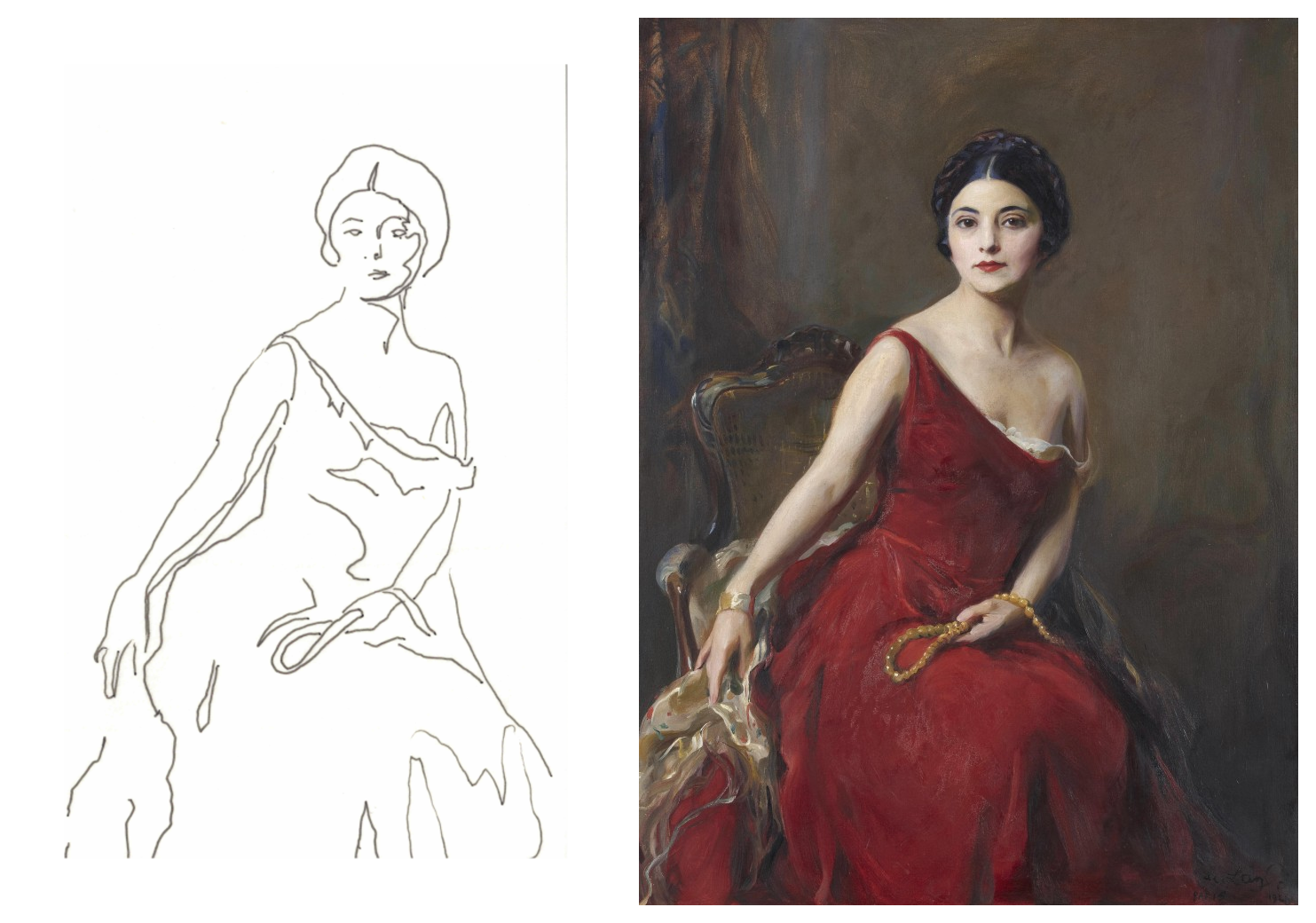
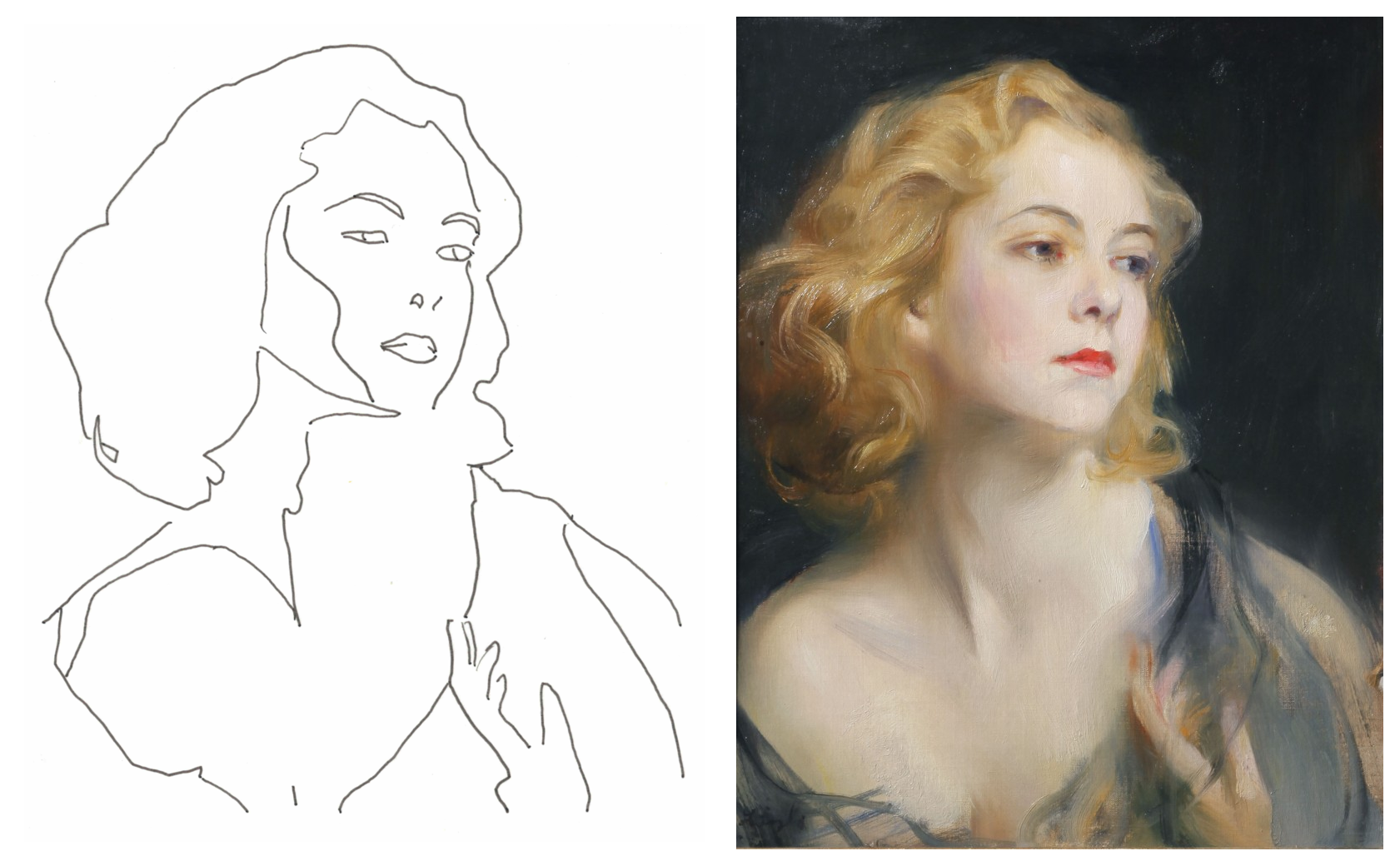
<em>Over a <a href="https://www.christies.com/en/auction/graziella-pati-o-de-ortiz-linares-collection-evening-sale-24810-par/">crop of a Christie’s auction</a>.</em></p>

<p>What made me stop was the face, the eyes, the beauty.
It’s a <a href="https://www.christies.com/en/auction/graziella-pati-o-de-ortiz-linares-collection-evening-sale-24810-par/">crop</a>, and the crop is more intense, more focused,
extraordinary, but it leaves off some kind of grandeur, the fullness of the mystery.
It really does bring in the interest on the face;
the full is better for larger format, but the crop just grabs.</p>

<p>The painting is Philip de László’s <a href="https://www.delaszlocatalogueraisonne.com/catalogue/the-catalogue/ortiz-linares-graziella-patio-de-nee-graziella-patio-rodriguez-6875/search/composition:portrait"><em>Portrait of Doña Graziella Patiño de Ortiz Linares</em></a>, 1928 —
oil on canvas, up at <a href="https://www.christies.com/en/auction/graziella-pati-o-de-ortiz-linares-collection-evening-sale-24810-par/">Christie’s Paris on 23 September 2026</a>,
the hero image of the sale dispersing Graziella Patiño’s own four-decade collection.
Its estimate isn’t public yet — the sale’s headline lots are listed “estimate on request.”
De László (1869–1937) was the society portraitist of his day,
and described his method as “drawing with the brush”: 
skull structure first, alla prima, wet in wet, no overworking.
I drew with a pen, over his brush.</p>

<h2 id="graziella-1928">Graziella, 1928</h2>

<p><img src="/assets/images/de-laszlo-portrait-graziella-patino/diptych-graziella-1928.png" alt="My line beside de László's 1928 oil" /></p>

<p>Reduce his loaded, tonal oil down to a single contour, and somehow the beauty remains —
a testament to his balance and his understanding of the anatomy and the geometry.
But his luminousness is gone, of course, replaced with a spareness.
It’s a decision of where that line goes;
it’s not hard to discern, but in some way it has my judgement.</p>

<p>The line highlights the structure.
Indeed, as he drew the head with the brush, he may have had an underdrawing to guide him;
I suppose these are my guesses of those guides.</p>

<p>Tracing this face, somehow the lines I drew captured not nothing — and there weren’t many.
He made many subtle judgements, but they surface in ways that are detectable with a pen.
Where did the line fight me? Nowhere; it was easy, clean.
He has a consistency, an understanding of geometry.</p>

<p>How much of the form did my lines actually extract? 
I think the tracing captures the face very well — the structure.
De László did preparatory drawings, which perhaps this is uncovering, though I am also adding the shading.
The neck in the painting is much smoother than my line,
but we see he accomplished a lot of 3-D form with his render,
and I think the dress adds a surprising boost to the 3-D-ness.</p>

<p>Is it a study, an homage, or its own drawing? It is all three, in that order.
I find de László very educational because of his approach.</p>

<h2 id="graziella-1931">Graziella, 1931</h2>

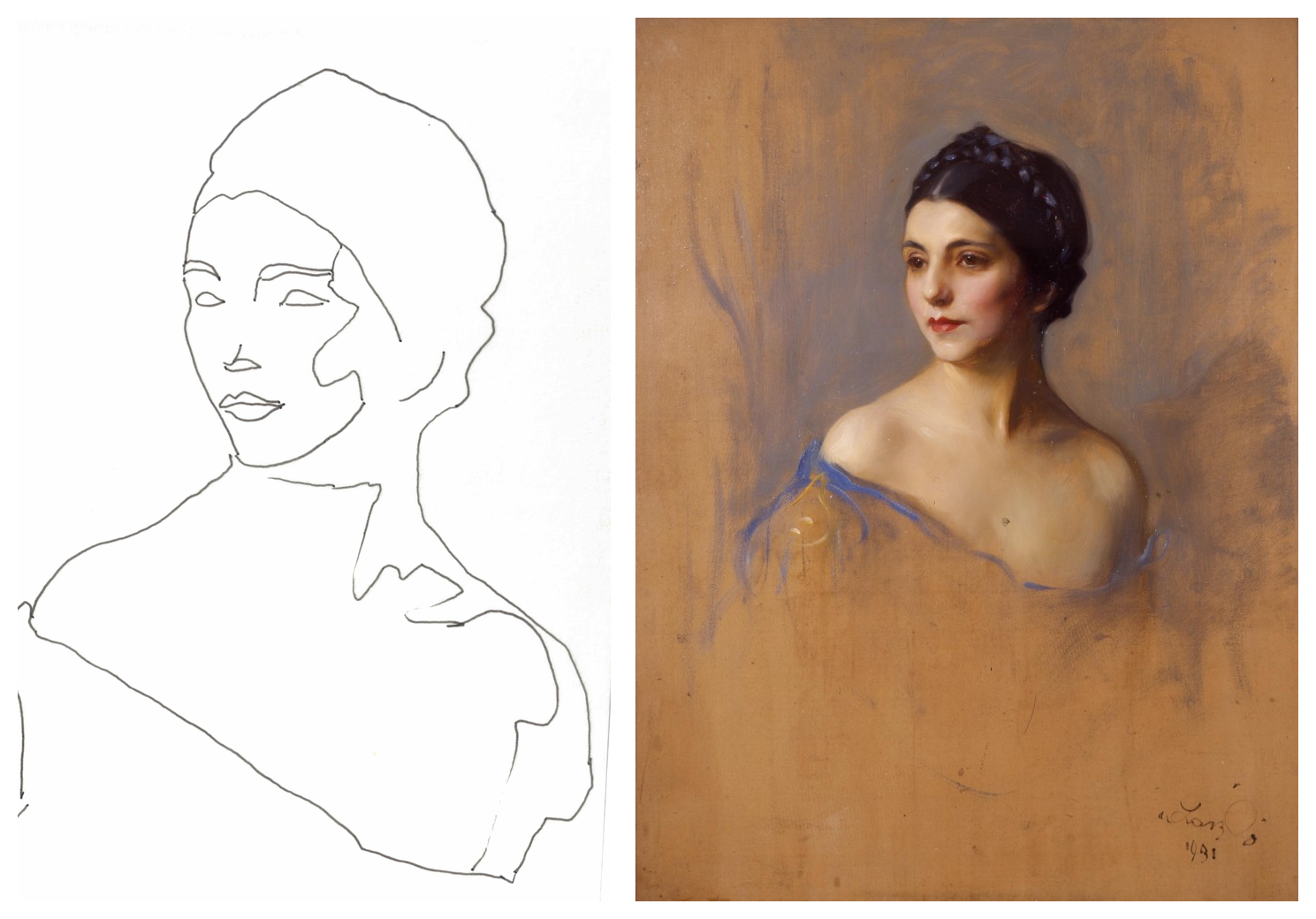
<p><img src="/assets/images/de-laszlo-portrait-graziella-patino/diptych-graziella-1931.png" alt="My line beside de László's 1931 study" />
<em>The 1931 study — <a href="https://www.delaszlocatalogueraisonne.com/catalogue/the-catalogue/ortiz-linares-graziella-patio-de-nee-graziella-patio-rodriguez-6879">de László Catalogue Raisonné, no. 6879</a>.</em></p>

<p>László painted another portait of her a few years later, they were obviously fans of each other.
Less dramatic, flair, red, instead more peaceful, mature, subtle.<br />
We see the face form so clearly here, and shares much with the 1928.</p>

<h2 id="edwina-mountbatten">Edwina Mountbatten</h2>

<p><img src="/assets/images/de-laszlo-portrait-graziella-patino/diptych-edwina.png" alt="My line beside de László's portrait of Edwina Mountbatten" />
<em><a href="https://www.delaszlocatalogueraisonne.com/catalogue/the-catalogue/mountbatten-lady-louis-nee-the-honourable-edwina-ashley-wife-of-1st-earl-mountbatten-of-burma-3520">Lady Louis Mountbatten (Edwina Ashley), 1924 study</a> — public domain (<a href="https://creazilla.com/media/traditional-art/7088822/philip-de-laszlo---study-portrait-of-lady-louis-mountbatten">Creazilla</a>).</em></p>

<p>In Edwina, again, that balanced and revealed face — structure and form: clean, strong.
In the line I couldn’t also capture the remarkable tranquility of her expression, 
which he does with smoothness and with the clarity and breadth of his brush and paint mixtures.</p>

<h2 id="helen-beatrice-myfanwy-hughes">Helen Beatrice Myfanwy Hughes</h2>

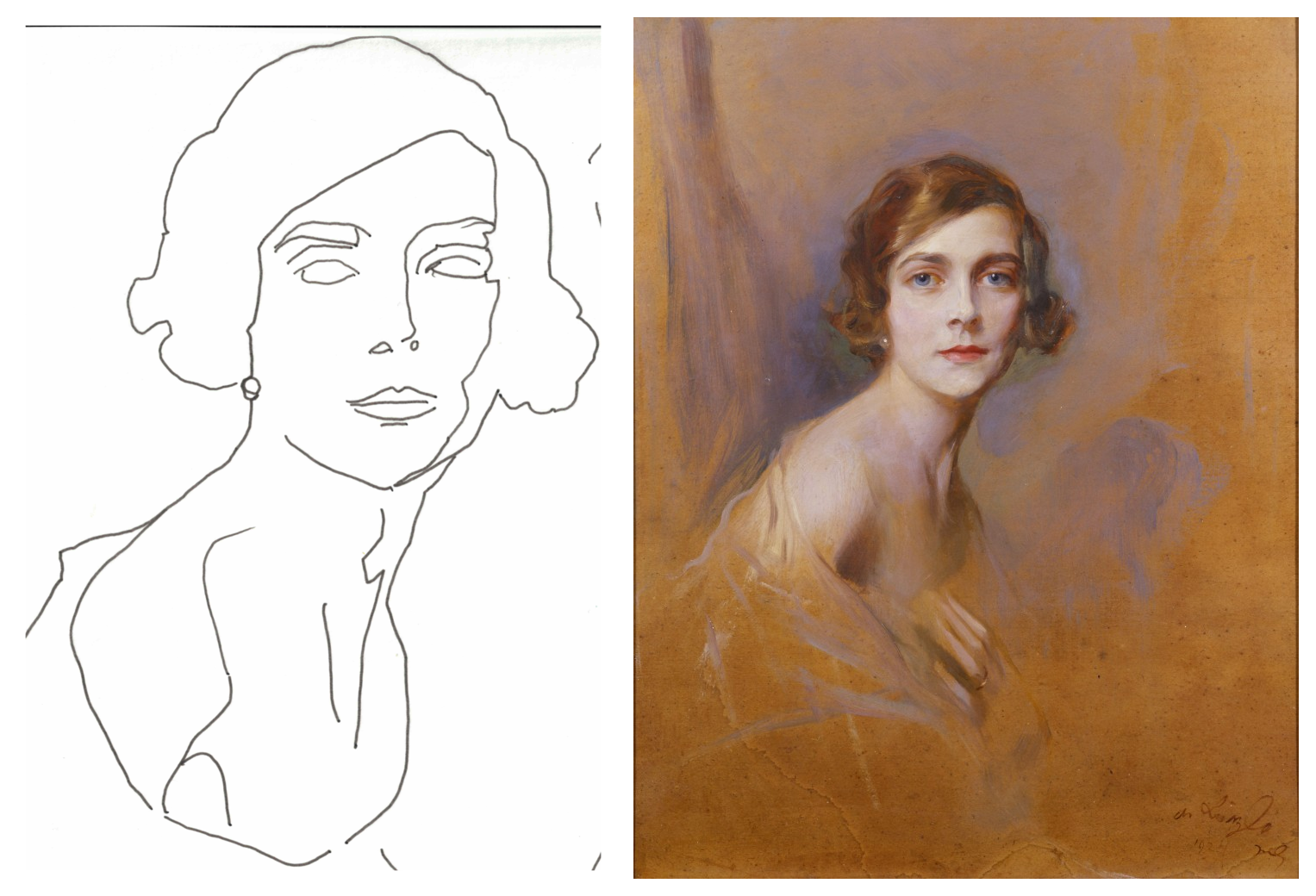
<p><img src="/assets/images/de-laszlo-portrait-graziella-patino/diptych-myfanwy.png" alt="My line beside de László's portrait of Myfanwy Hughes" />
<em>Helen Beatrice Myfanwy Hughes (“Myfanwy”), 1931 — <a href="https://www.delaszlocatalogueraisonne.com/catalogue/the-catalogue/hughes-helen-beatrice-myfanwy-5701">Catalogue Raisonné, no. 5701</a>. It sold at <a href="https://www.christies.com/en/lot/lot-6062540">Christie’s</a> in 2017 for £137,000, against an estimate of £15,000–25,000.</em></p>
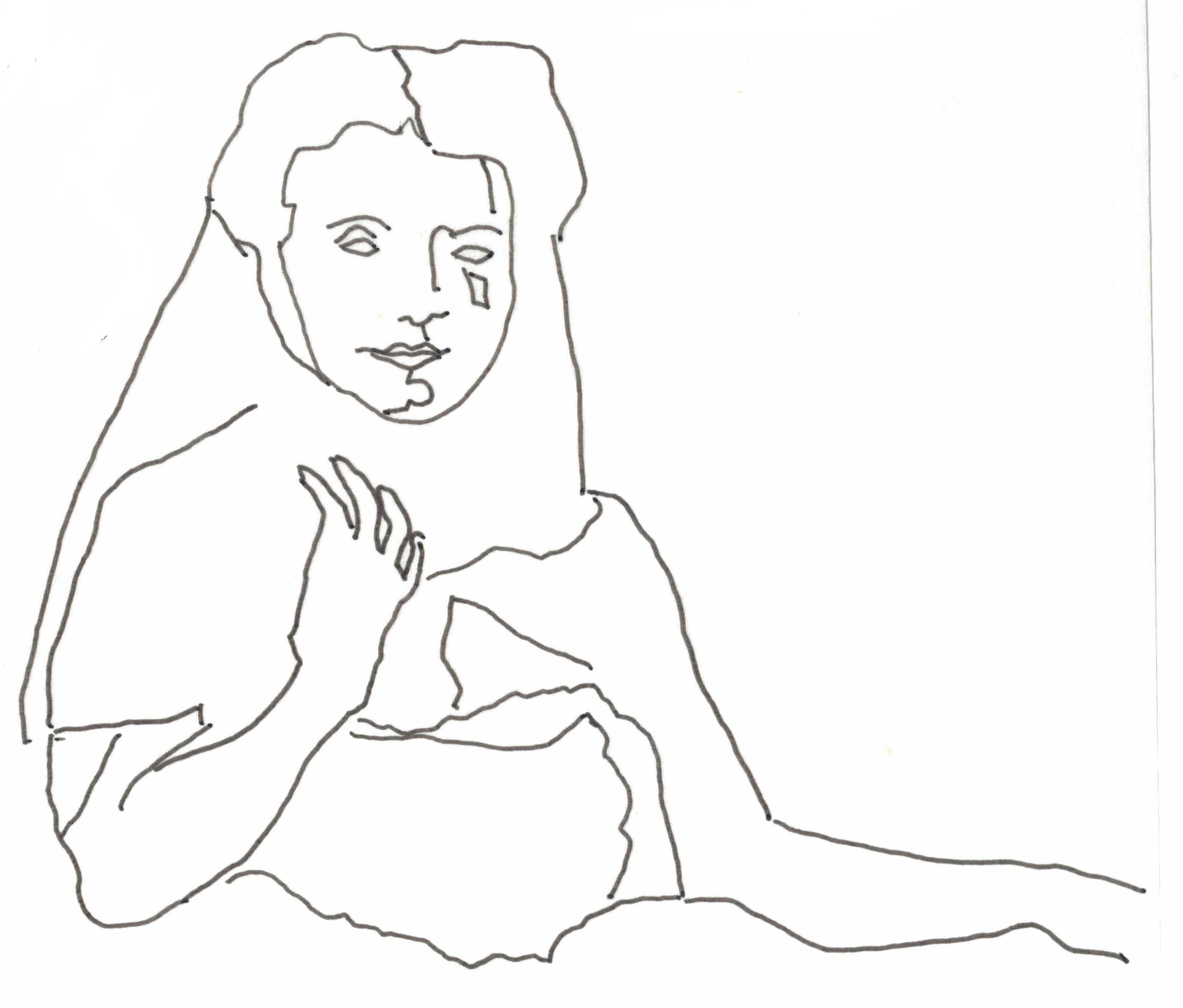
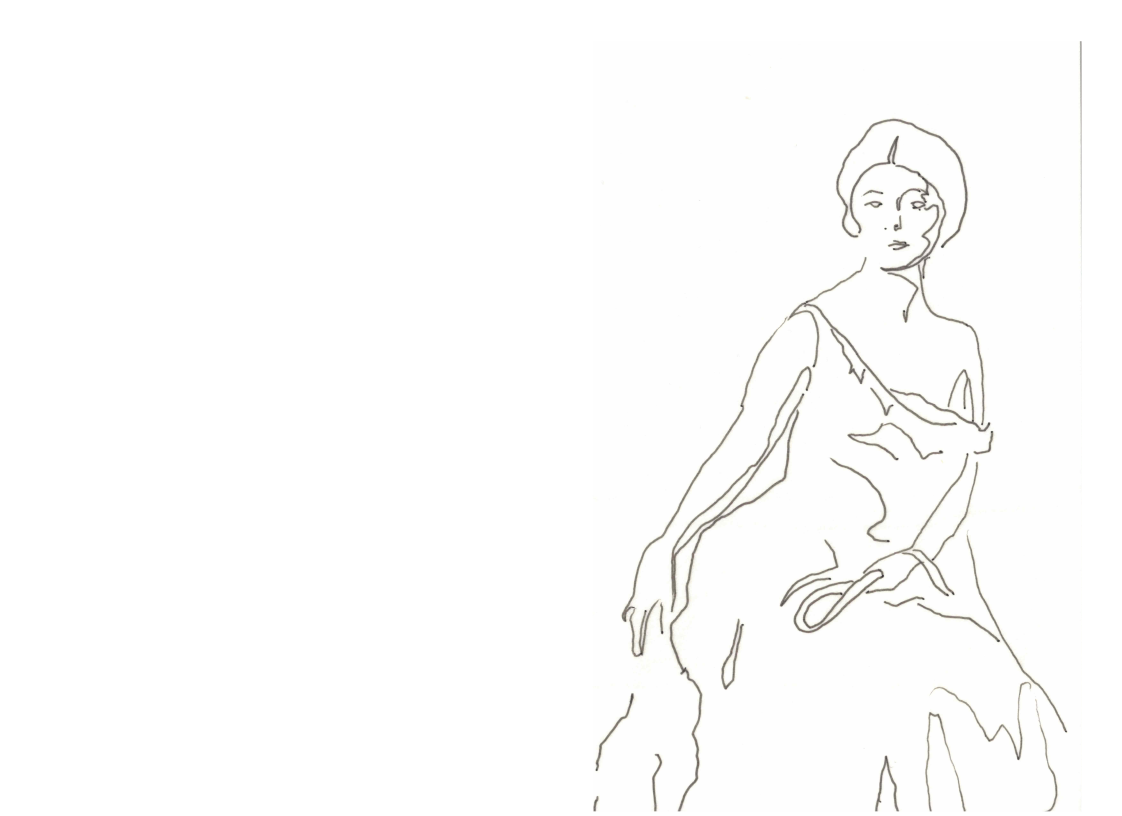
<p>With Myfanwy, when I try to draw it just in lines,
I have to pick certain lines, even cutting across values that he may have used.
This very dramatic blonde hair, so I’m drawing it just as a silhouette.
The hair is extraordinary, 
its silhouette makes clear the glamor and the structure are already inherent,
and that he is decorating and enlivening her overall person with the beautiful brushing of the hair.</p>

<p>When I look at just the tracing — yes, he did a tremendous amount,
but the silhouette, and just what we do have, is interesting.
He’s done something with the gesture, and the person, that’s remarkable.
The dress, how it falls, is one of the signals of 3-D form — kind of masked, but there.</p>

<p>This is not something you see — and I think it is worth even more.
It’s about glamor, yes, but so much more than that:
we can feel László’s sensing of Myfanwy’s personality, her emotion, and his 
technicality is exceptional.</p>

<h2 id="graziella--after-dalí-1942">Graziella — after Dalí, 1942</h2>

<p><img src="/assets/images/de-laszlo-portrait-graziella-patino/260626_dali.grazy.tracing.png" alt="My line tracing after Dalí's portrait of Graziella, 6.26" />
<em>Traced from Dalí’s <a href="https://catalogues.salvador-dali.org/catalogues/en/heritageobject/968/">*Mrs. Ortiz de Linares*</a>, 1942 — Fundació Gala-Salvador Dalí catalogue P 569.</em></p>

<p>While painting this, Dalí <a href="https://www.sothebys.com/en/auctions/ecatalogue/2013/impressionist-modern-art-evening-sale-l13006/lot.68.html">wrote to Graziella</a> describing it as the third stage of a personal trilogy:
“Sadism, Masochism, and now Idealism.”</p>

<p>A different setting — the sky is open, she’s wearing a black veil.
The arm curled against her chest is anatomically precise; the other extends away, not a typical posture.
The cloud at her figure gives depth.</p>

<p>The smile has a Mona Lisa quality — it’s in the lips.
My tracing is not comparable to Dalí’s execution.
Also note Dali carefully painted her eyes.</p>

<p>Further I traced the veil as its own shape but also needed to find the body through it.
Knowing now that Dalí was carrying the Madonna alongside the sadomasochistic,
taking Dali at his word (of course), 
I see his depiction of her veil protectively — perhaps protective of her.
His choice of this contrast invokes the neurological basis of violence and sexuality 
in brain anatomy immediately.</p>

<p>She’s clearly older here, nearly two decades after de László’s 1928.
Perhaps that contributes to Dalí’s trilogy —
though Michelangelo’s Pieta Madonna is much younger.</p>

<h3 id="calligraphy-practice">Calligraphy practice</h3>

<p><img src="/assets/images/de-laszlo-portrait-graziella-patino/260621.callicrop1.png" alt="" /></p>

<p><img src="/assets/images/de-laszlo-portrait-graziella-patino/260621.callicrop2.png" alt="" /></p>

<p><img src="/assets/images/de-laszlo-portrait-graziella-patino/260621.callicrop3.png" alt="" /></p>

<p><strong>Image credits &amp; sources.</strong> De László paintings are <a href="https://en.wikipedia.org/wiki/Philip_de_L%C3%A1szl%C3%B3">public domain</a> —
he died in 1937, so copyright has expired (author’s life + 70; also pre-1930 US publication);
faithful flat reproductions of public-domain art carry no new copyright (US: <em>Bridgeman v. Corel</em>, 1999; EU: Copyright Directive 2019, Art. 14).
The Dalí is copyright Fundació Gala-Salvador Dalí (Dalí died 1989; not public domain until 2060); only my tracing appears here.</p>

<ul>
  <li><em>Doña Graziella Patiño de Ortiz Linares</em>, 1928 — <a href="https://www.delaszlocatalogueraisonne.com/catalogue/the-catalogue/ortiz-linares-graziella-patio-de-nee-graziella-patio-rodriguez-6875/search/composition:portrait">Catalogue Raisonné 6875</a> · <a href="https://www.christies.com/en/auction/graziella-pati-o-de-ortiz-linares-collection-evening-sale-24810-par/">Christie’s sale, 23 Sept 2026</a></li>
  <li><em>Graziella Patiño</em>, 1931 study — <a href="https://www.delaszlocatalogueraisonne.com/catalogue/the-catalogue/ortiz-linares-graziella-patio-de-nee-graziella-patio-rodriguez-6879">Catalogue Raisonné 6879</a></li>
  <li><em>Lady Louis Mountbatten (Edwina Ashley)</em>, 1924 study — <a href="https://www.delaszlocatalogueraisonne.com/catalogue/the-catalogue/mountbatten-lady-louis-nee-the-honourable-edwina-ashley-wife-of-1st-earl-mountbatten-of-burma-3520">Catalogue Raisonné 3520</a> · public domain at <a href="https://creazilla.com/media/traditional-art/7088822/philip-de-laszlo---study-portrait-of-lady-louis-mountbatten">Creazilla</a></li>
  <li><em>Helen Beatrice Myfanwy Hughes</em>, 1931 — <a href="https://www.delaszlocatalogueraisonne.com/catalogue/the-catalogue/hughes-helen-beatrice-myfanwy-5701">Catalogue Raisonné 5701</a> · sold <a href="https://www.christies.com/en/lot/lot-6062540">Christie’s lot 6062540</a>, estimate £15,000–25,000, realised £137,000</li>
  <li>Public-domain basis: <a href="https://en.wikipedia.org/wiki/Philip_de_L%C3%A1szl%C3%B3">Philip de László (1869–1937), Wikipedia</a></li>
  <li><em>Mrs. Ortiz de Linares</em> (Dalí), 1942 — <a href="https://catalogues.salvador-dali.org/catalogues/en/heritageobject/968/">Fundació Gala-Salvador Dalí, catalogue P 569</a> · <a href="https://www.sothebys.com/en/auctions/ecatalogue/2013/impressionist-modern-art-evening-sale-l13006/lot.68.html">Sotheby’s London 2013, lot 68</a> (letter source)</li>
</ul>]]></content><author><name>Neal C</name></author><category term="drawing" /><category term="de-laszlo" /><category term="portrait" /><category term="auction" /><category term="paris" /><category term="oil" /><summary type="html"><![CDATA[Over a crop of a Christie’s auction.]]></summary></entry><entry><title type="html">Matisse’s Lydia: hard line and smoky tone</title><link href="https://essentialine.art/drawing/matisse-lydia-line-and-tone/" rel="alternate" type="text/html" title="Matisse’s Lydia: hard line and smoky tone" /><published>2026-06-13T00:00:00+00:00</published><updated>2026-06-13T00:00:00+00:00</updated><id>https://essentialine.art/drawing/matisse-lydia-line-and-tone</id><content type="html" xml:base="https://essentialine.art/drawing/matisse-lydia-line-and-tone/"><![CDATA[<p><img src="/assets/images/matisse-lydia-line-and-tone/diptych-lydia.png" alt="Tracing beside Matisse's finished oil, Portrait au manteau bleu, 1935" />
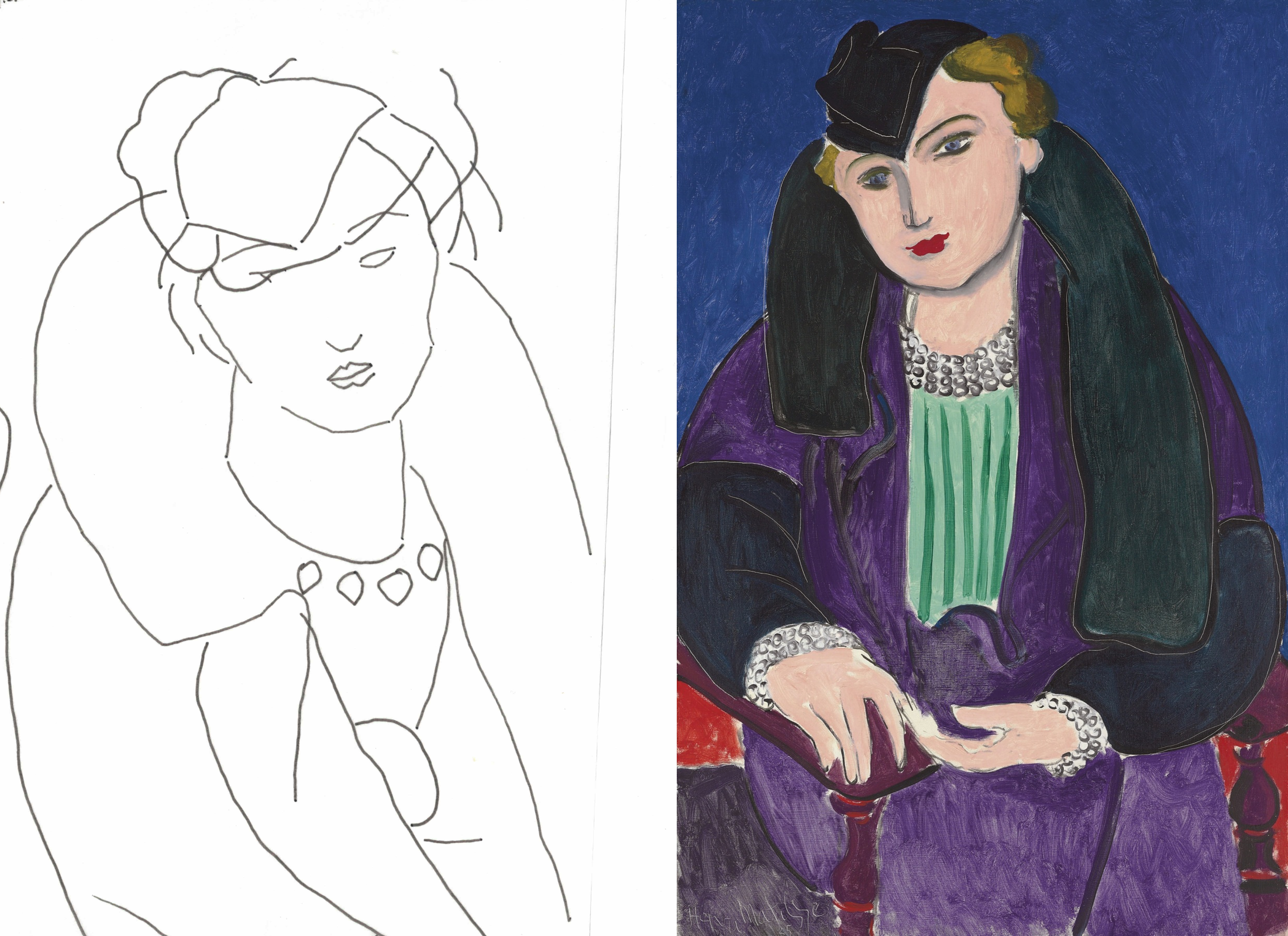
<em>Left: my tracing of Matisse’s charcoal study of 19 November 1935 (not shown — no open reproduction of that exact sheet exists; see below, and <a href="https://www.bridgemanimages.com/en-US/matisse/lydia-1935-charcoal-on-paper/charcoal-on-paper/asset/130101">a related but different Matisse charcoal of Lydia from the same year</a> for reference). Right: <a href="https://fr.wikipedia.org/wiki/Portrait_au_manteau_bleu">Portrait au manteau bleu</a>, December 1935, oil on canvas — Wikimedia Commons, public domain.</em></p>

<p>Matisse drew his study on 19 November 1935 in Nice and it was auctioned recently.
What caught me looking at the charcoal was her face.
I hadn’t seen the oil painting until after working on the post — I’d only been working from the charcoal. Now, seeing the finished one, I especially think there’s something valid about looking at the lines: his colors are blocks, textured of course, but still blocks delineated by the contours. The face is angled differently, which is very interesting, and the eyes are a little different too. The hat was never the point, so I’m glad I got rid of it. It’s strange to me that he didn’t do the veil — I think he could have — but I kind of like that he didn’t.</p>

<p>There are actual hard lines in his study. The contour of her shoulder, the edge of the coat. Then around them — and sometimes right next to them — this soft, rubbed tone. That technique is estompe: you lay down charcoal and then rub it with a paper stump to spread and soften it. Then you erase to get the lights back. The highlights aren’t where you left the paper bare, but where you took charcoal away after the fact. So the luminosity in her face, that sense of light coming through comes from subtraction not absence.</p>

<p>I did one before where I was looking more at what his lines actually were. This time, a little after Nagel, I’ve tried reducing.</p>

<p>I started with the eyes, and even there I backed off a little. I spent a lot more time on the hat on my previous attempt — this time I’m trying to keep it to a minimum.</p>

<p>The face was harder to see before; this time it’s clearer, and the neck, and the upper part of the jacket. Then the hair, because I think the hair matters. One problem: how do I get the hat down to a minimum? He gives it a little hair himself.</p>

<p>One thing you can really see: some of his lines, especially on the jacket, are really long — literally one line from the top of the sheet down to the bottom. You know he knows exactly what he’s doing; people don’t just do that unless they do.</p>

<p>I don’t have any shading, I made the hat too busy on my last attempt, and I don’t know how to make it transparent-ish, but the hat is solid anyway. So I draw a single line for the outer silhouette. That diamond pattern — her necklace — is maybe the most interesting part, but if I draw all of it, it’s already too much. I considered the cross-contours, but decided against them — just the necklace, and stop there.</p>

<p>I might do another one with even fewer lines, without the veil, just the face.</p>

<p>What’s most interesting about the face: there really are eyelids here, pupils, everything. There’s an angularity to how he builds the form — he’s making a point, then just a couple of shading lines.</p>

<p>The other place he’s got a lot of line is the nose. I’m purposely avoiding that — like Nagel — because it’s the center of the face, and you don’t need the shading there to know it’s in place. If the nose sat on the silhouette edge you’d have to draw it. Right now, you don’t.</p>

<hr />

<p>The subject is Lydia Delectorskaya, who was Matisse’s studio assistant. She’d been working for him for a couple of years before he one day looked up from what he was doing and said <em>don’t move</em> — and that was that. She ended up in at least eighty paintings.</p>

<hr />

<p>As a line drawer, it has tension. My instinct is to trust the contour, the lines of light and shade and anatomy. Matisse is adding smoke, the line is there, but the tone that makes you feel the coat is heavy, that her face is three-dimensional, that there’s a window somewhere to the left.</p>

<p>I do think the line gave me the positions and orientations I wanted. The charcoal was unclear intentionally, which is nice — and that’s something I’d say I lost somewhat, though I have obscured an eye, and there’s the veil too.</p>

<hr />

<p>Sotheby’s had the Matisse charcoal in their Masterpieces from the Lewis Collection sale — <em>Lydia (Étude pour Portrait au manteau bleu)</em>, executed 19 November 1935 in Nice. Estimate £1.5–2m. One of five studies for a finished oil, <em>Portrait au manteau bleu</em>.</p>

<p>It sold 24 June 2026 for <strong>£3.75m</strong> (~$4.9m) — nearly double the high estimate.</p>

<p>The lot page is <a href="https://www.sothebys.com/en/buy/auction/2026/masterpieces-from-the-lewis-collection-l26900/lydia-etude-pour-portrait-au-manteau-bleu">here</a> (auction links go dead — don’t count on it). <a href="https://www.bridgemanimages.com/en-US/matisse/lydia-1935-charcoal-on-paper/charcoal-on-paper/asset/130101">Bridgeman Images</a> catalogues a related but different Matisse charcoal of Lydia from the same year — not this exact sheet. More on Matisse at <a href="https://www.henrimatisse.org/portrait-of-lydia-delectorskaya.jsp">henrimatisse.org</a>.</p>

<hr />

<p><strong>Image credits &amp; sources.</strong> Matisse died in 1954 — public domain (author’s life plus 70, expired 2025), and faithful flat reproductions of public-domain art carry no new copyright (US: <em>Bridgeman v. Corel</em>, 1999; EU: Copyright Directive 2019, Art. 14). The charcoal study itself has no open/freely reusable reproduction available (Sotheby’s is JS-rendered and login-gated for results; Bridgeman is paywalled stock), so the diptych above pairs the tracing with the finished oil instead. <em>Portrait au manteau bleu</em> image via Wikimedia Commons.</p>

<p><strong>Links</strong></p>
<ul>
  <li><a href="https://www.sothebys.com/en/buy/auction/2026/masterpieces-from-the-lewis-collection-l26900/lydia-etude-pour-portrait-au-manteau-bleu">Masterpieces from the Lewis Collection — lot page</a> — Sotheby’s (results require login; may go dead over time)</li>
  <li><a href="https://www.artnews.com/art-news/market/sothebys-london-june-2026-evening-sale-report-joe-lewis-1234790208/">$63.5 M. Modigliani Nude from Joe Lewis Collection Leads Sotheby’s London Double-Header Auction</a> — ARTnews, price realized for the Matisse</li>
  <li><a href="https://www.bridgemanimages.com/en-US/matisse/lydia-1935-charcoal-on-paper/charcoal-on-paper/asset/130101">Lydia, 1935, charcoal on paper</a> — Bridgeman Images; a related but different Matisse charcoal of Lydia from 1935, not the exact sheet sold</li>
  <li><a href="https://fr.wikipedia.org/wiki/Portrait_au_manteau_bleu">Portrait au manteau bleu — Wikipédia</a> — the finished oil</li>
  <li><a href="https://www.henrimatisse.org/portrait-of-lydia-delectorskaya.jsp">Portrait of Lydia Delectorskaya</a> — henrimatisse.org</li>
</ul>]]></content><author><name>Neal C</name></author><category term="drawing" /><category term="matisse" /><category term="charcoal" /><category term="line" /><category term="auction" /><summary type="html"><![CDATA[Left: my tracing of Matisse’s charcoal study of 19 November 1935 (not shown — no open reproduction of that exact sheet exists; see below, and a related but different Matisse charcoal of Lydia from the same year for reference). Right: Portrait au manteau bleu, December 1935, oil on canvas — Wikimedia Commons, public domain.]]></summary></entry></feed>