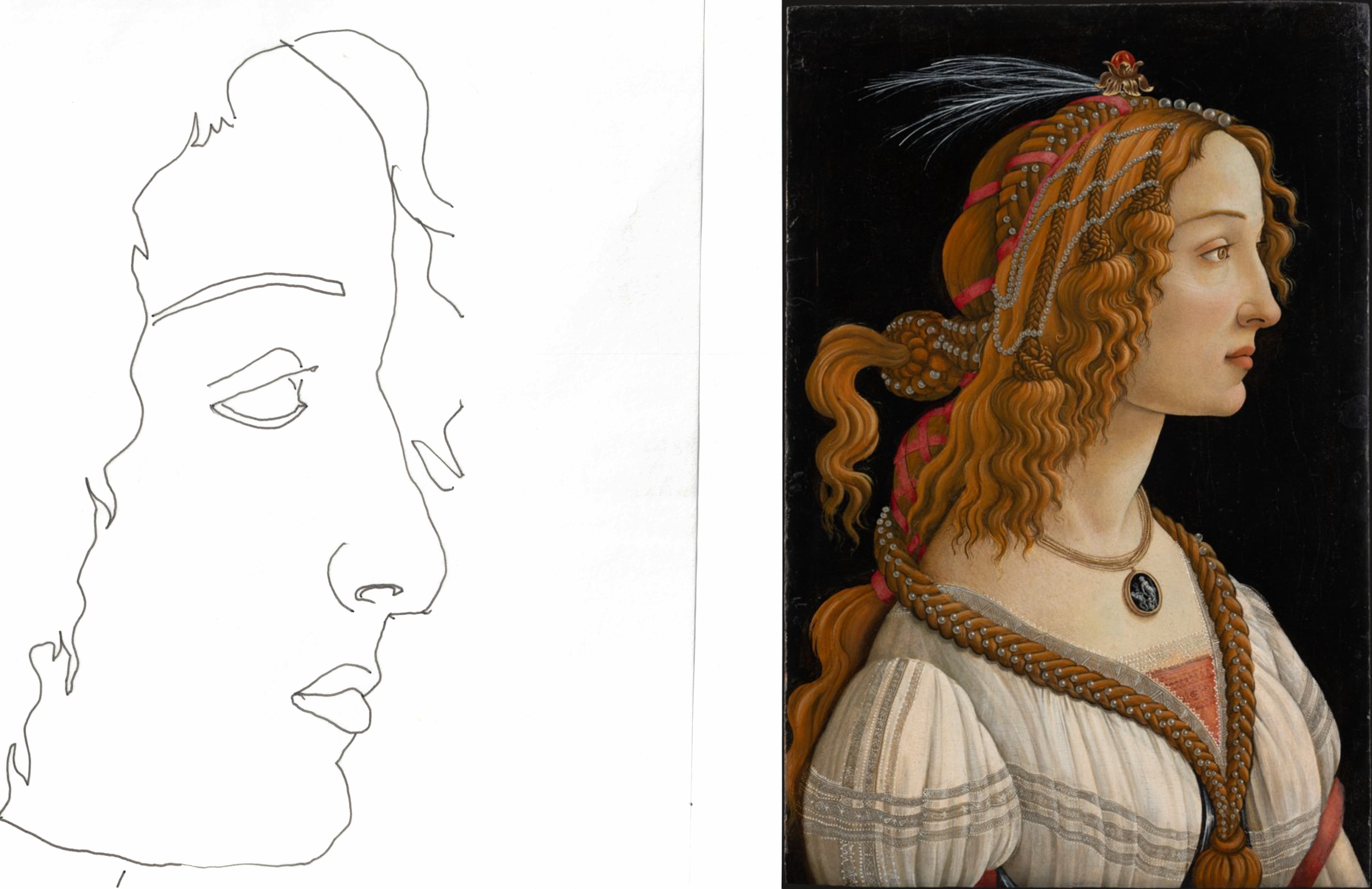
 Left: my tracing. Right: Sandro Botticelli, Ritratto di giovane donna, c. 1480–1485, mixed technique on poplar wood, Städel Museum, Frankfurt am Main — public domain.
What drew me in was the proportions of where the eyes, nose, and lips sit on the head. Loomis said beauty is beauty of proportion, and he built diagrams around exactly this kind of measurement. I’d also picked up from Alon Bement’s The Energetic Line in Figure Drawing that a head in profile carries its own proportional logic, separate from a three-quarter or frontal view. The way Leonardo grids the profile out with measuring lines is ultimately what Bement references, and what I was thinking about.
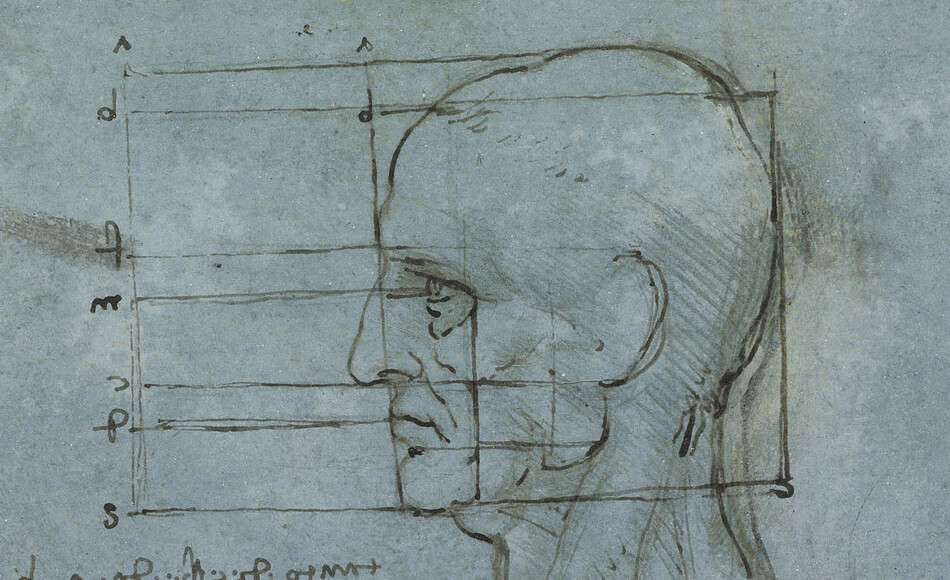 Leonardo da Vinci, The proportions of the head, and a standing nude (detail — the sheet also carries a faint nude figure study, cropped out here), c. 1490, pen and ink over metalpoint on blue prepared paper, Royal Collection Trust — public domain.
I think the hair came out well, another thing I’m trying to figure out.
I didn’t know when I drew it that the sitter was already dead by the time Botticelli painted her — an idealisation, not taken from life. I’ve always thought Botticelli’s faces look quite similar to one another, and very feminine as a rule; this one, though, has an almost masculine edge to it that surprised me, more visible in my tracing. Whatever that detachment is, I think it’s there in the original, and maybe even more so in my tracing, closer to ethereality than portraiture, as Botticelli intended.
The painting. Ritratto di giovane donna (known in English as Idealised Portrait of a Lady, or Portrait of Simonetta Vespucci as Nymph), Sandro Botticelli, c. 1480–1485. Mixed technique on poplar wood, 81.3 × 54 cm. Städel Museum, Frankfurt am Main (inv. 936). Strict profile, in the tradition of ancient coins and cameos — the necklace she wears references an actual Medici-collection cameo, tying the sitter to that circle without painting a literal likeness.
The sitter. Simonetta Vespucci, celebrated Florentine beauty and the mistress of Giuliano de’ Medici, died young (1476) years before this was painted — which is why the museum calls it an “idealised” portrait rather than a portrait from life: Botticelli is painting her as a mythological nymph, a posthumous ideal, not a sitting. Her married name comes from Marco Vespucci, a distant cousin of the explorer Amerigo Vespucci — the same family the Americas are named after.
The artist. Sandro Botticelli (1445–1510), Florentine painter, Renaissance workshop of the Medici court. Public domain: died over 500 years ago.
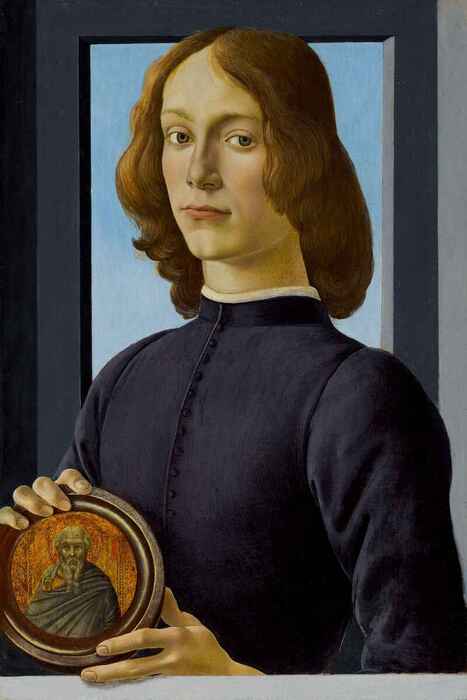
Sandro Botticelli, Ritratto di giovane con medaglione (Young Man Holding a Roundel), c. 1480 — public domain. Sold for $92.2 million at Sotheby’s in 2021, the auction record for a Botticelli.

Image credits. Sandro Botticelli died in 1510, Leonardo da Vinci in 1519 — both public domain by any measure. All photographs are faithful flat reproductions of public-domain 2-D artworks and carry no separate copyright of their own (US: Bridgeman Art Library v. Corel, 1999; EU: Copyright Directive 2019, Art. 14). The Simonetta Vespucci image is downloaded directly from the Städel Museum’s own collection site, per their stated public-domain terms — mention: “Städel Museum, Frankfurt am Main.” The Leonardo profile study is a crop (head and proportion grid only) of The proportions of the head, and a standing nude (RCIN 912601, Royal Collection Trust), sourced via Wikimedia Commons under a PD-old tag — the full sheet also contains a faint figure study. The Ritratto di giovane con medaglione image is sourced via Wikimedia Commons, tagged public domain.
Links
- Ritratto di giovane donna — Städel Museum — museum catalogue entry, image, PD terms
- Sandro Botticelli — Wikipedia
- The proportions of the head, and a standing nude — Royal Collection Trust — museum catalogue entry, full sheet
- File on Wikimedia Commons — license, source image
- Alon Bement — Wikipedia — teacher of Georgia O’Keeffe, author of The Energetic Line in Figure Drawing
- Ritratto di giovane con medaglione — Wikimedia Commons — file page, license, source
- Sotheby’s: record $92.2 million sale — auction press release
