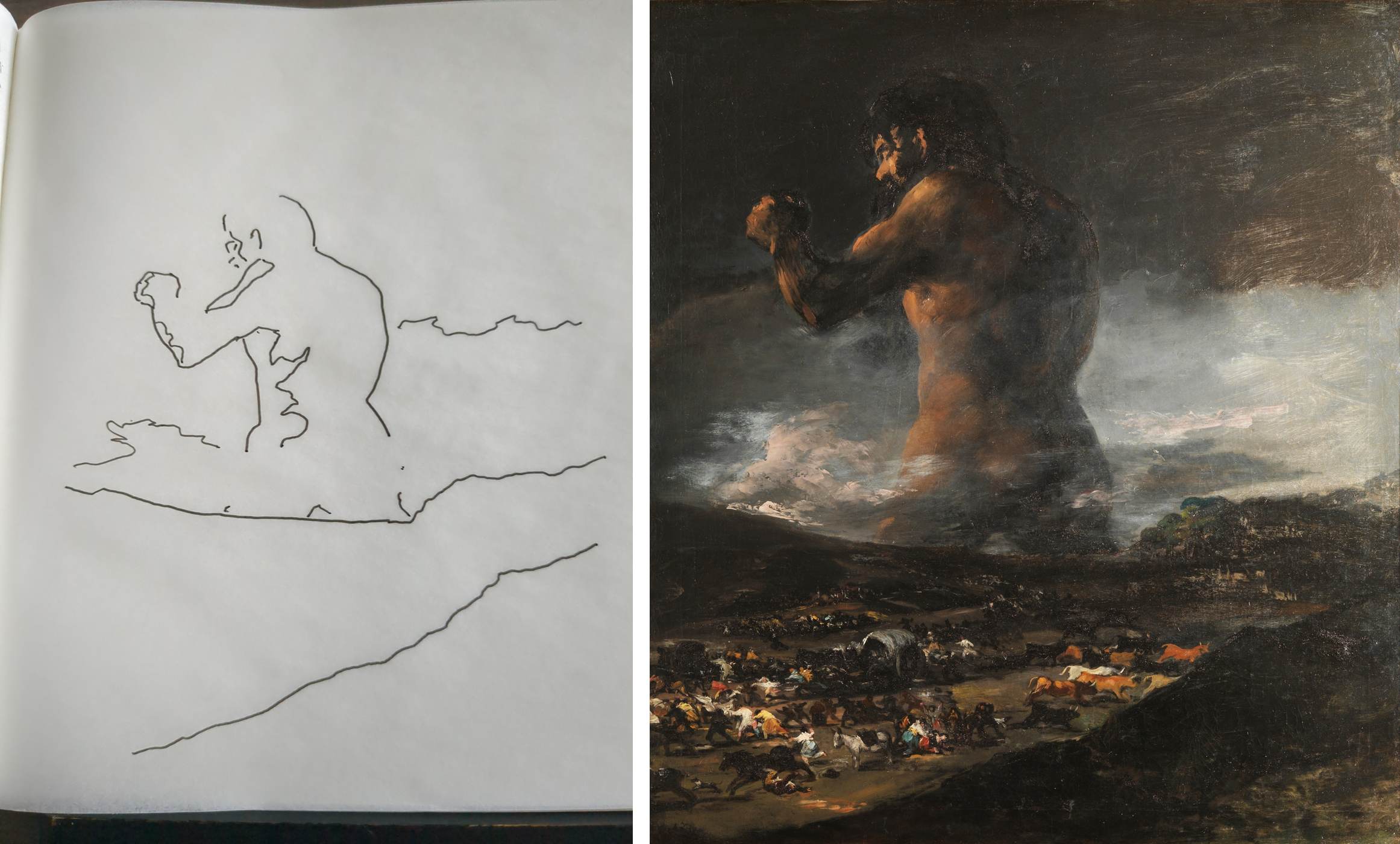
 Left: my tracing, Saturday 26 September. Right: attributed to Francisco de Goya, El coloso (The Colossus), c. 1808–1812, oil on canvas — Museo Nacional del Prado, Madrid, P002785 (image: Wikimedia Commons). Public domain.

The tracing · Auction · Background
Okay, Goya’s El coloso. I’m only starting to look hard at Goya, and I want more of him. This, of course, is spectacular, but even across his other works there’s some kind of simplicity to the portraits. I’ll be revisiting Goya a bit.
Giant as defender or threat: I don’t know the political history of this, but to me the giant seems like a dream figure; indeed I did have a dream with a giant like this. I feel this is some aspect of personality. Jung talked about the collective unconscious, where he felt wars were in many people’s minds.
With this one, it was fairly early: painted around 1808–1812, early in the Peninsular War (1808–1814), and well before the Black Paintings (1819–1823). There was this sort of hill, and area of light.
He’s doing a lot with the light on the face of the colossus, and there’s a dimensionality. But there’s also a blending at the thigh: it’s being obscured by the clouds. Same thing at the back of the neck and the far shoulders. It’s clean, we can see it, but it’s definitely not meant to be too different from that dark sky. Munch might have just blended them. He doesn’t do that.
Where the outline stops: there is a line distinction, and where it was ambiguous because of the cloud I just didn’t draw. I was trying to be parsimonious with the line; I think it sort of worked.
And then all of this activity down here is beyond what a single line should try to hold, so I’m leaving it.
Without the crowd, the scale: yes, the crowd is important, but I couldn’t think of a way to render them while being economical with line, and so I lose some of that scaling power of the painting. I do love Friedrich’s small figures also; perhaps there’s a way to incorporate a small number of figures. Munch also is beautiful.
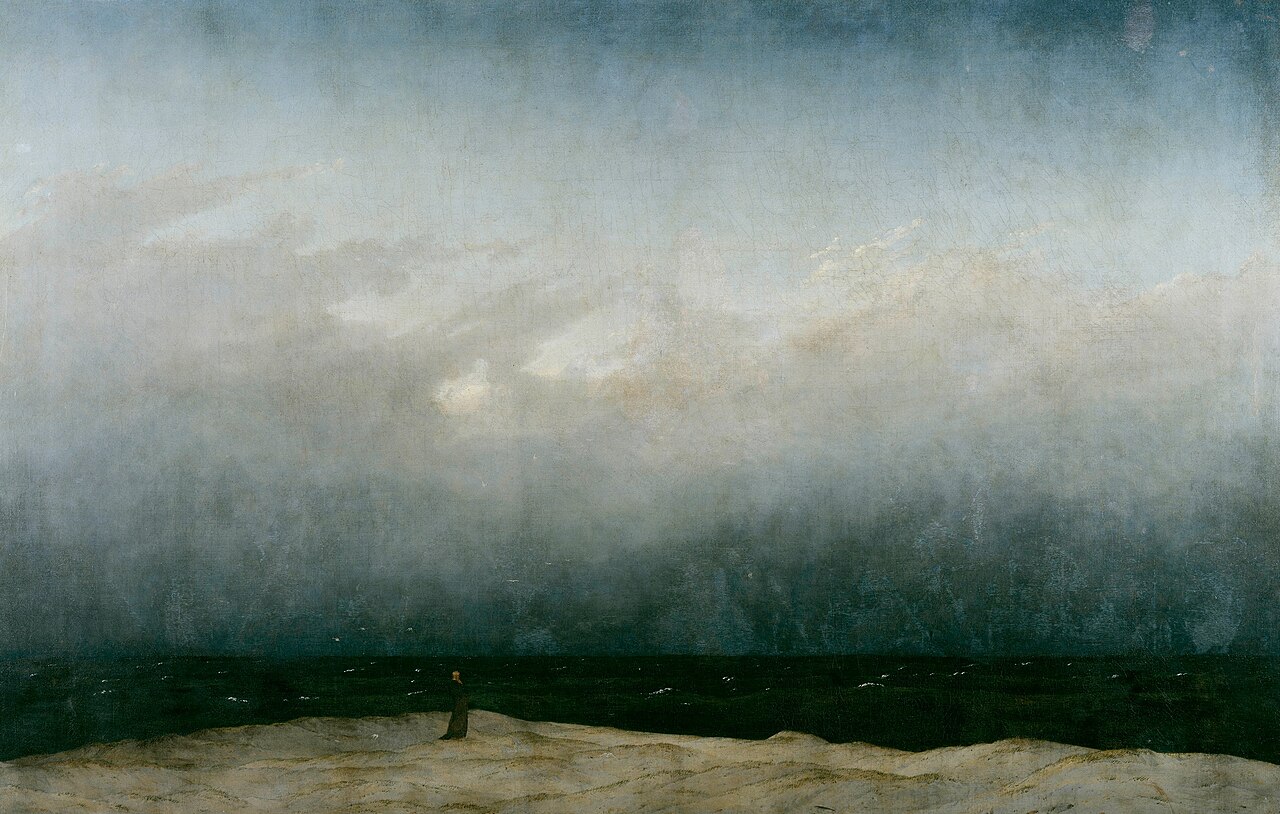
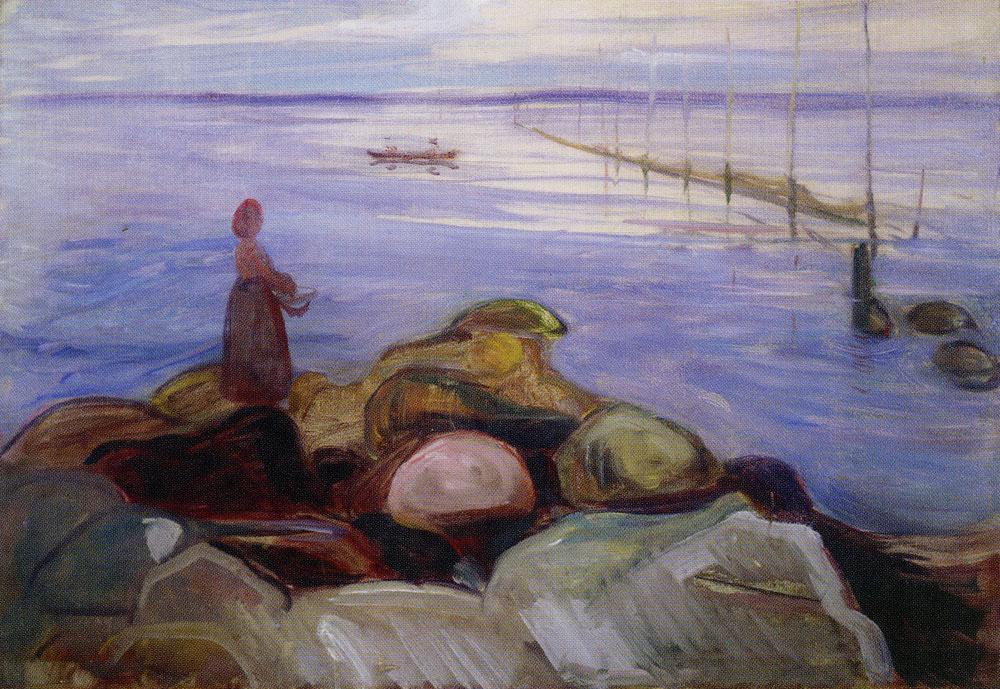
Left: Caspar David Friedrich, Der Mönch am Meer (The Monk by the Sea), 1808–1810, oil on canvas — Alte Nationalgalerie, Berlin (Wikimedia Commons); painted in the same years as El coloso. Right: Edvard Munch, Kvinne ved fjorden i Åsgårdstrand (Woman by the Fjord in Åsgårdstrand), 1898, oil on canvas — private collection (Wikimedia Commons). Both public domain.


And the other question is, if I want to use just some thick lines, what would those lines have to be? A thicker line: I do think this may be interesting to try, variation with a Japanese brush pen.
The anatomy of this giant is perfect. I often focus more on figures. What anatomy needs in line: I am thinking the silhouette is the fundamental and carries a lot of the anatomy, then I draw a line of the light vs dark to trace along muscles that the light was delineating. But I do think the silhouette, and joints, are fundamental, and the light line is perhaps second, but here I added it because I needed more than that and he was using the chiaroscuro.
And then the clouds. In line the clouds become just edges, and I’m keeping them that way. I kind of don’t want to go too much more than that. One could do the front of the arm. One could try to catch this light line here.
Auction. El coloso has never been sold. It went from Goya’s household to his son Javier in 1812, passed through the Fernández Durán family, and reached the Prado in 1931 with the bequest of Pedro Fernández Durán. It was a family inheritance and then a museum gift, without ever going through a saleroom.
Background. El coloso (The Colossus) is an oil on canvas, 116 × 105 cm, painted around 1808–1812 (Wikimedia Commons), during the Guerra de la Independencia (Peninsular War) against Napoleon (Wikipedia). In the 1812 inventory of the estate of Goya’s wife, Josefa Bayeu, it appears as “Un gigante”, marked X for their son Javier (Wikipedia).
Nigel Glendinning traced the image to a patriotic poem, Juan Bautista Arriaza’s Profecía del Pirineo (1810), in which Spain rises as a giant from the Pyrenees against the invasion (Wikipedia): “Cercaban su cintura / celajes de occidente enrojecidos” (Around his waist, the reddened clouds of the west).
In 2008 the Prado’s Goya curator, Manuela Mena, attributed it to Goya’s collaborator Asensio Juliá, reading two marks at lower left as his initials. Glendinning and Jesusa Vega called the case “scandalous”. In 2021 the Prado returned the painting to Goya (Wikipedia). I think it looks like the Black Paintings (1819–1823), and likely to be Goya.
Goya came back to the subject in a print, the Seated Giant (by 1818), a burnished aquatint at The Metropolitan Museum of Art.
Links
- El coloso — Museo Nacional del Prado — the collection record, P002785
- The Colossus (painting) — Wikipedia — provenance, the Arriaza poem, the attribution dispute
- El coloso — Wikipedia (es) — the 1812 inventory entry and the 2021 re-attribution
- Seated Giant — The Met — Goya’s aquatint of the same subject
- Der Mönch am Meer — Wikimedia Commons — Friedrich’s small figure against the sky
- Kvinne ved fjorden i Åsgårdstrand — Wikimedia Commons — Munch, 1898, private collection
- Master image — Wikimedia Commons — Prado-sourced scan
- Process video — Saturday 26 September — YouTube