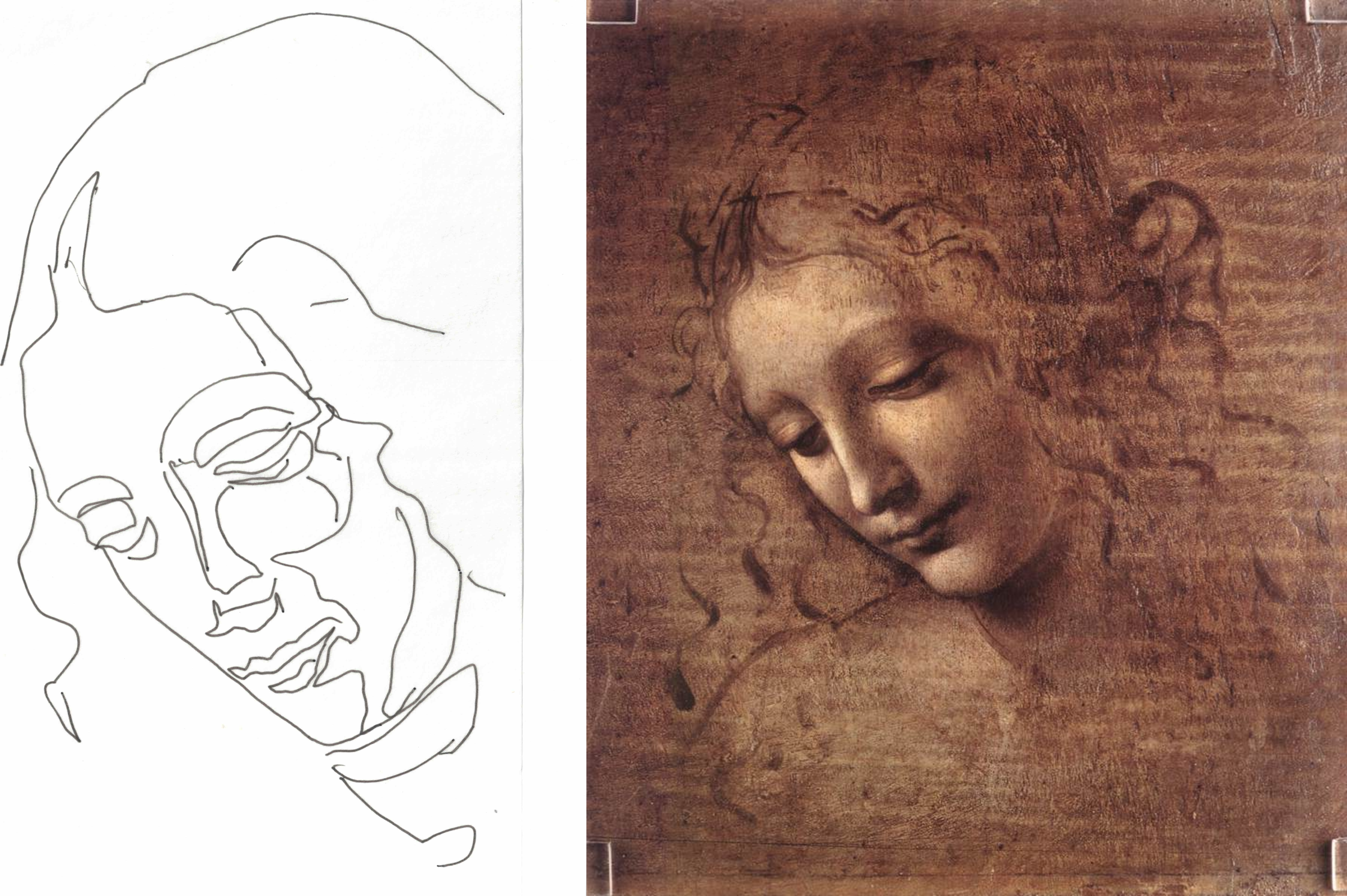
 Left: my tracing. Right: Leonardo da Vinci, La Scapigliata (“Lady with Dishevelled Hair”), c. 1506–1508, oil, umber and white lead on poplar panel, Galleria Nazionale di Parma — public domain.
_-_WGA12716.jpg)
La Scapigliata · Raphael’s Madonna del Prato
There’s something almost metallic though maybe I overworked La Scapigliata. Leonardo always pulls me toward the anatomical side; in a way, my tracing reads with a slightly different expression than his, less joyous and more neutral. I don’t think there was any difference in ease compared to the Mona Lisa, but this one was clearer to work with.
The painting. La Scapigliata — Italian for “the dishevelled woman” — is a small, unfinished panel: an unidentified woman’s head, gazing down, hair spreading loose behind her, worked up only far enough to show Leonardo’s process rather than a finished portrait. Attribution to Leonardo himself (rather than a pupil) is generally accepted but not unanimous among scholars. Held at the Galleria Nazionale in Parma since 1826.
The artist. Leonardo da Vinci (1452–1519), Florentine polymath — painter, draftsman, anatomist, engineer. Public domain by any measure: died over 500 years ago.
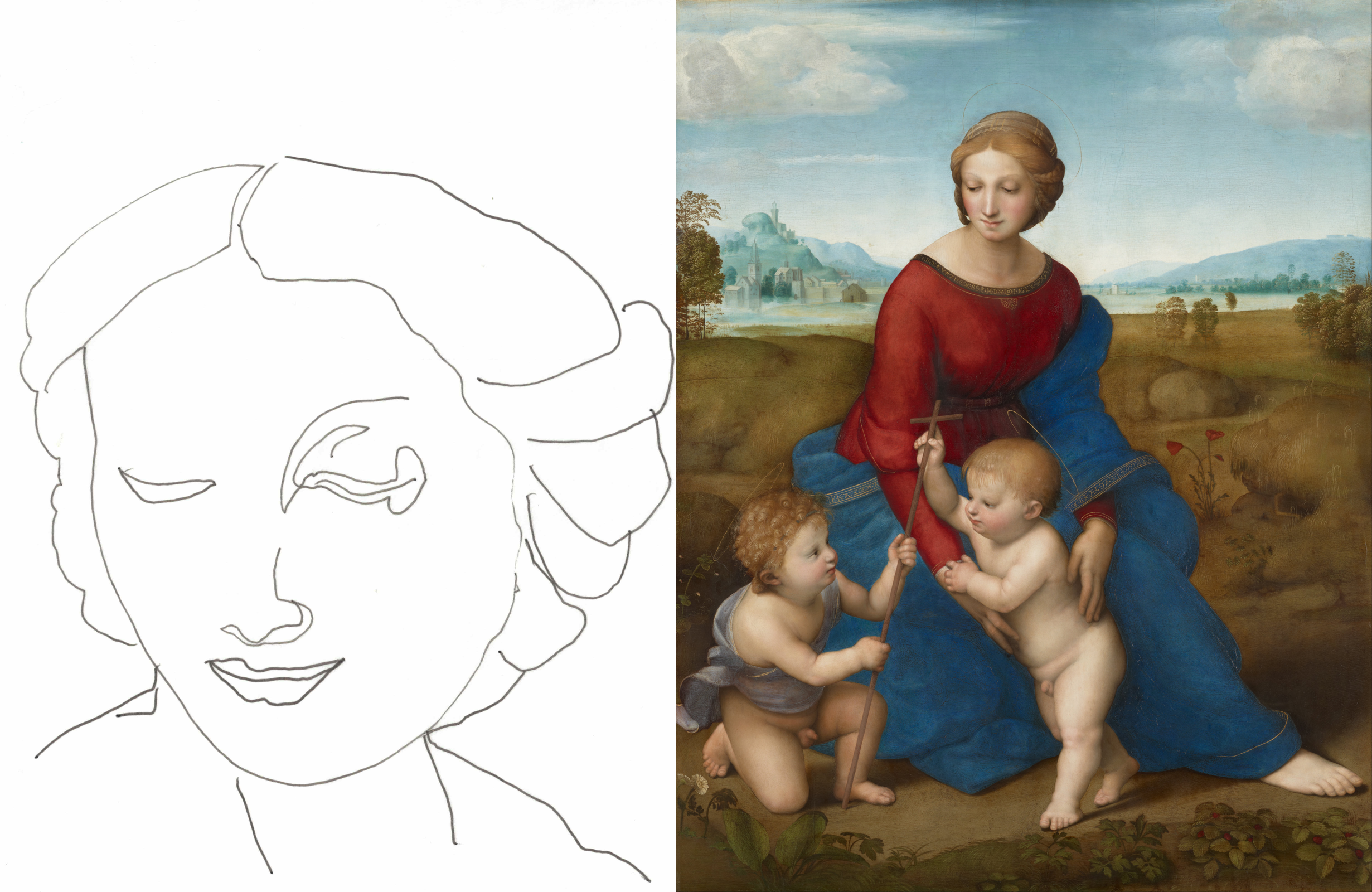 Left: my tracing. Right: Raphael, Madonna del Prato, 1506, oil on panel, Kunsthistorisches Museum, Vienna — public domain.

By contrast, I like the spareness of del Prato. I did more work on her left eye than her right — imbalance I’m not sure entirely fails. I think my tracing has the dimensionality Raphael’s painting has, though his is smoother and more convincingly real; mine may be going more directly at what Tsao’s face-patch research points to — the specific orientation the eyes are read from — than his does. I don’t normally look at Raphael much; his forms are rounder and smoother than what I usually gravitate toward.
The painting. Madonna del Prato, painted in Florence within months of Raphael’s arrival there in 1504–05, aged 23. The Madonna, the infant Christ, and the infant John the Baptist are arranged in a pyramid linked by their gazes — a composition indebted to Leonardo, whom Raphael was absorbing closely at the time. In the Kunsthistorisches Museum, Vienna, since 1891.
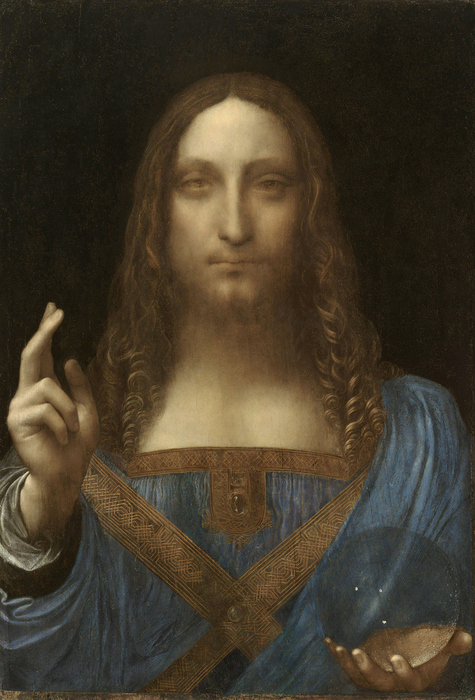
Leonardo da Vinci (attribution disputed), Salvator Mundi, c. 1500 — public domain. Sold for $450.3 million at Christie’s in 2017, still the auction record for any painting.

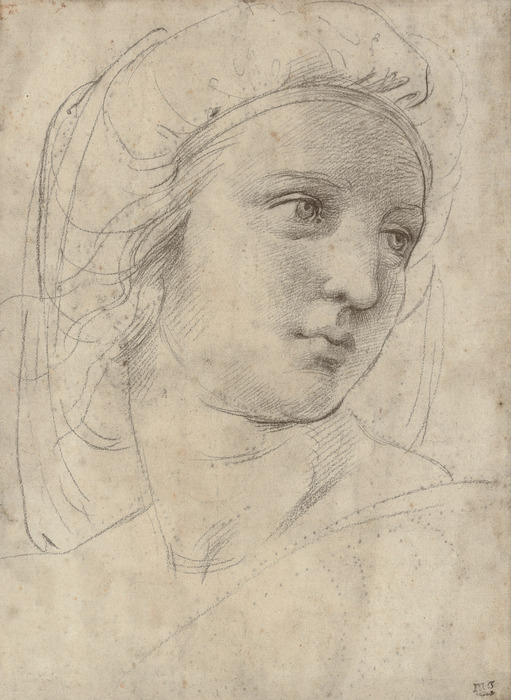
Raphael, Testa di una Musa (Head of a Muse), c. 1510–11, black chalk — public domain. Sold for £29.2 million (~$47.8M) at Christie’s in 2009, the record for any Old Master drawing — Raphael’s paintings are all in museums, so his drawings are where his market moves.

Image credits. Leonardo da Vinci died in 1519, Raphael in 1520 — both public domain by any measure. All four source photographs are faithful flat reproductions of public-domain 2-D artworks and carry no separate copyright of their own (US: Bridgeman Art Library v. Corel, 1999; EU: Copyright Directive 2019, Art. 14). The Testa di una Musa and Salvator Mundi images are sourced via Wikimedia Commons, tagged public domain — the Salvator Mundi attribution to Leonardo (rather than his workshop) is debated among scholars, noted in the caption above.
Links
- La Scapigliata — Wikimedia Commons — file page, license, source
- Madonna del Prato — Wikimedia Commons — file page, license, source
- Madonna del Prato — Kunsthistorisches Museum — museum catalogue entry
- Testa di una Musa — Wikimedia Commons — file page, license, source
- Guinness World Records: most expensive Old Master drawing — £29.2 million, Christie’s, December 2009
- Salvator Mundi — Wikimedia Commons — file page, license, source
- Salvator Mundi — Wikipedia — sale history, attribution debate