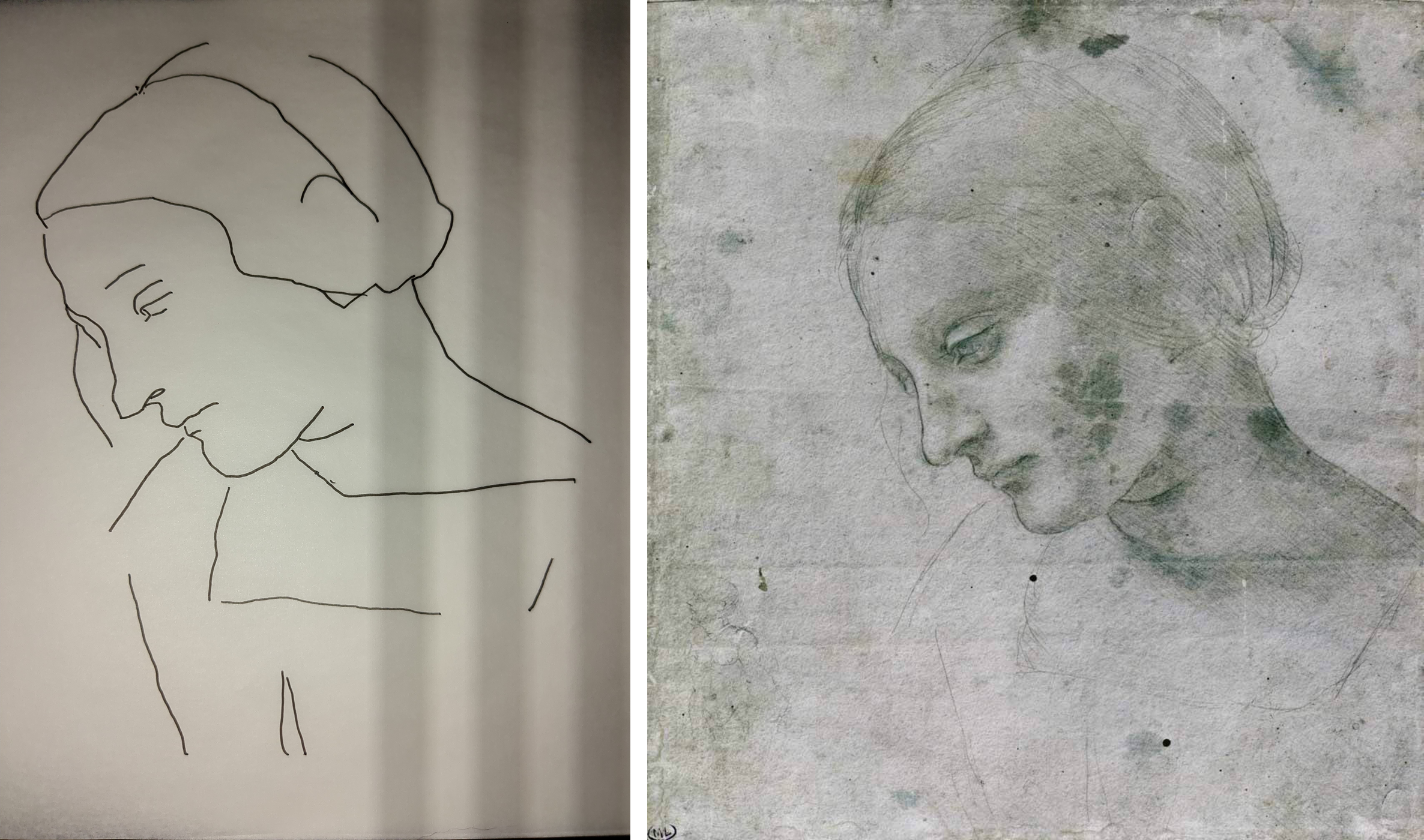
 Left: my tracing, Thursday 17 September. Right: Leonardo da Vinci, Tête de femme presque de profil et croquis d’homme (Head of a Woman Almost in Profile, and Sketch of a Man), c. 1488/1490 — metalpoint (silverpoint) on light gray prepared paper with white heightening, 17.9 × 16.8 cm, Musée du Louvre (INV 2376, Recto). Public domain (Leonardo d. 1519).
The tracing · Auction · Background
He has these hatchings on the back of her neck for shading. It’s the precision, strength of silhouette. He used a fine pencil, also the shoulders and the back and all of this. It has precision of final line as summary.
Around the chin, if we look closely, he drew fine lines near her nose that are past his final silhouette — he is working towards his summary line, but not a lot. He has a lot of description of the eye — not description, but accurate description. I think mine was better before I elaborated, but it’s an interesting picture.
He’s hatching a lot on the back of her neck. There’s more to her dress, actually — seems just incidental at the bottom, I can barely see his lines through the paper. That particular one is really something — it’s a bit of drapery that is widening.
And then her hair. He doesn’t draw eyebrows, usually — we barely can see it. And I think that’s important, I think eyebrows are on the face with maximal biological visual contrast, so I think are designed for visual communication, evolutionarily. I think the eyebrows are expressive and part of how we orient and think about the face and emotion. So the fact that he usually shies away is fascinating. It’s such a problem, really. I do think the brows carry a lot, but perhaps he was reducing even past them, insisting only on the eyelids, which he does past any other in history. Perhaps he suggests, or proves, that the eyes, anatomically, are more important than the colored contrast of the hair of the brows. His eyes, and the features he chooses to pursue in 3D form, are always precise, and even precisely the finest in history.
My medium is unerasable pen — I think that’s why I find these interesting. The ways to remedy a mistake are techniques like reallocating, re-suggesting a mistake as some other feature, like hair, or forcefully overdrawing it with something very heavy, like a wide marker. I feel irreversibility is important in gaining understanding of the form, of the face, of learning to draw with a 3D model in one’s mind.
I love the drawing. The painting, I can clearly see, is not entirely his, and his students had primary influence. His drawing only is what I’m interested in. I agree the painting is not his, even primarily, but I would discount any challenge of this drawing.
Leonardo is a kind of mysterious ancient, like an Egyptian. He has so few finalized paintings, and these extraordinary drawings, scattered amongst all kinds of other things. I wouldn’t question for a second that the Litta is not his, but I sense this drawing is his, and from him I feel there is so much to learn.
There’s less for me to say about this one, because it’s more about just tracing his curves, of his level of precision and expression.
Auction
No sale history for this specific sheet — it’s been in the Louvre since 1856. For scale: a Leonardo drawing essentially never reaches the market at all. The current record for one is Head of a Bear, which sold for £8.8 million (about $12.2 million with premium) at Christie’s London on 8 July 2021 — itself one of only eight Leonardo drawings known to survive in private hands outside the British Royal Collection and the Devonshire Collection at Chatsworth.
Background
The Louvre catalogues this sheet as Tête de femme presque de profil et croquis d’homme (Head of a Woman Almost in Profile, and Sketch of a Man), metalpoint on light gray prepared paper with white heightening, 17.9 × 16.8 cm, c. 1488/1490. It’s part of the Codex Vallardi — around 1,600 additional Leonardo sheets that entered the Louvre together in 1856, from the collection of Giuseppe Vallardi, who had published the group the year before. The previously-published Tête d’enfant de trois quarts à droite is from the same codex.
Since that 1855 publication, the drawing has been connected to the Madonna Litta (Hermitage, Saint Petersburg) as a preparatory study for the Virgin’s head — and this sheet itself is universally attributed to Leonardo, no dispute there. The painting is the disputed one: the Hermitage maintains it as an autograph Leonardo, while art historian Martin Kemp stated in 2017 that he regarded it as “a Boltraffio,” and David Alan Brown has argued for Leonardo’s other pupil Marco d’Oggiono instead, on the grounds that the composition recurs in d’Oggiono’s later work but not in Boltraffio’s. So an undisputed drawing by the master’s own hand may sit behind a painting the owning museum calls his and prominent outside scholars don’t.
A second, smaller sketch — a man’s head and bust in black chalk — sits in the lower left of the same sheet, in a different, right-handed hand. It isn’t Leonardo’s own work.
Links
- Louvre collections — INV 2376, Recto — the museum’s own catalogue entry
- Wikimedia Commons — file page
- Madonna Litta — Wikipedia — the attribution dispute (Hermitage vs. Kemp/Brown)
- Head of a Bear — Wikipedia — auction-record context
- Royal Collection Trust — Leonardo’s drawing materials — how a silverpoint drawing like this one is actually made
- Process video — Thursday 17 September — YouTube
