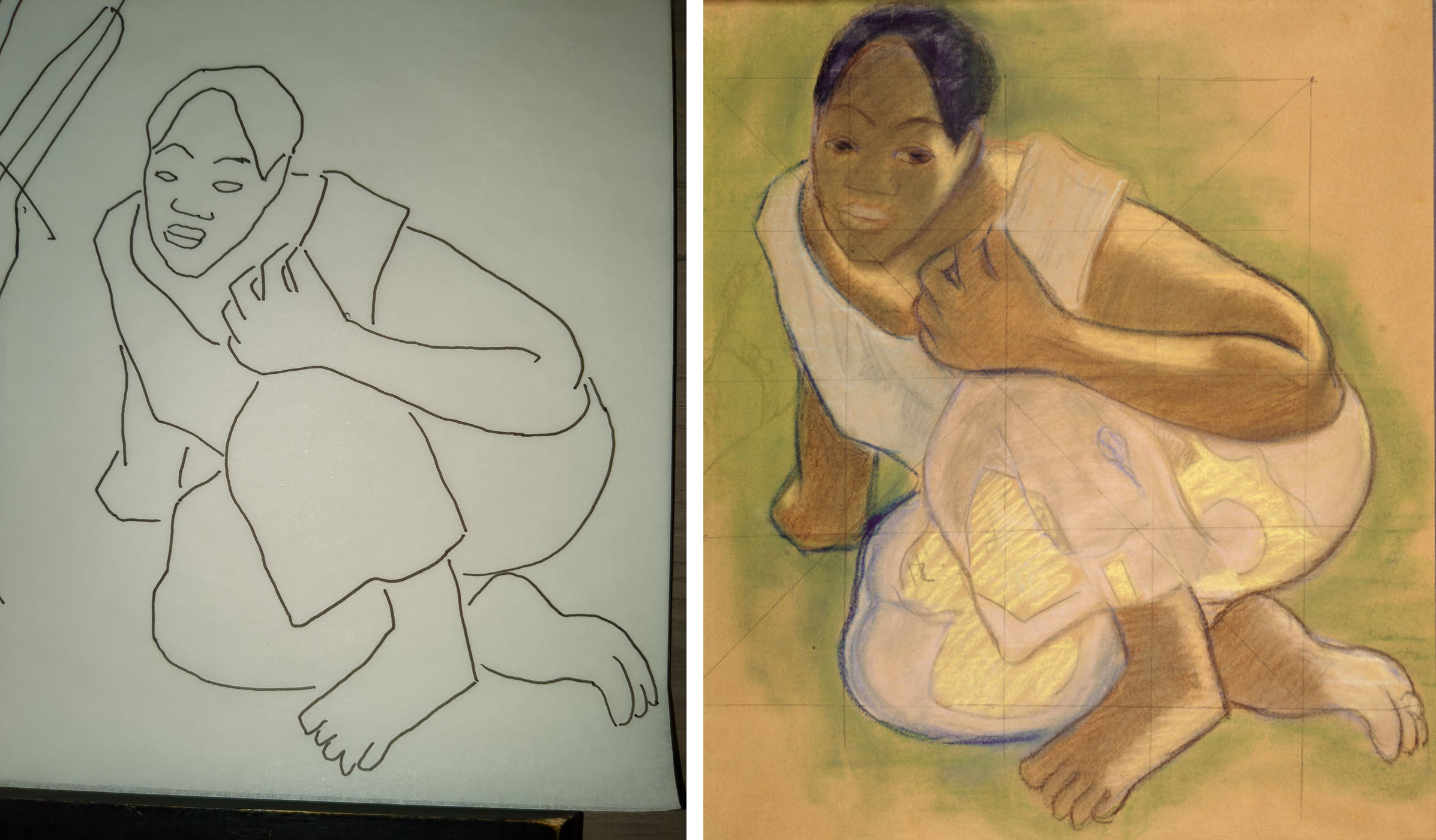
 Left: my tracing, Wednesday 16 September. Right: Paul Gauguin, Crouching Tahitian Woman (related to the painting Nafea faa ipoipo [When Will You Marry?]), 1891/93 — pastel over charcoal, squared in black chalk, on wove paper, 55.5 × 48 cm, Art Institute of Chicago (acc. 1944.578r). Public domain (Gauguin d. 1903).
So this is a study by Gauguin for his famous painting Nafea faa ipoipo? (When Will You Marry?). Being a study, we can see the lines — he has the important lines here, and then these basic types of coloring. The fold of the dress on the left shoulder has a form. The face is actually simple — there’s an edge there, but he’s really not saying more than that. The color is slightly changing, and he’s giving that suggestion through slight changes around her right eye. Her eyebrows seem quite flat.
So he shows her form through line, but he wants coherent simplicity. He shows she has a lot of life, but he’s drawing also very much about simplicity and reduction, flatness — maybe something like Munch’s ideas of merging with the background. Clearly he shows her strong outline, so she’s not merging with the background, but merging with a sort of plane in which he draws her.
And then these light splotches — they may be decorations on the dress. But the solidity of her form is there, and simplicity. And then this grid — the grid probably has to do with a scaling-up or retracing. There may have been a smaller sketch, and he’s lifting lines up through this grid. Very technical, opposite say of the intuition of Frédéric Forest or Erin Meads or Ryan Woodward or Siobhan Twomey. For this kind of work I’ve also looked into the camera lucida. He paints after the copying, I guess thats more important to him, or he feels he’s captured the important lines in the earlier sketch.
Now it becomes a question of this line of the shadow versus light near her left eye, the edge of her face, the rounding and shape of her face — I’ll leave it off. He draws a lot of straight line segments, I think, because of the grid. He was lifting a sketch I think, because when you’re lifting these straight line segments are fine, analytical.
The bottom shape of the left upper arm and elbow is a smooth curve. He chooses, or atleast I do, over-under lines for what’s in front versus behind, to convey a more of the dimensionality — since I only have lines, I take advantage of that as much as I can.
Her right foot is very curved — sort of unrealistically, symbolically curved. I think that’s enough there.
Pose itself — I think we understand it now. And I guess the next question becomes: do we want these lines around the highlights, or is this basic line what we want? I think we want just this — and I think what this amount of line means is that we could have had less, this line of the left shoulder and hip, the face. It’s cleaner to do this, if one is going to do this, with less. It might be interesting to revisit this and see about the real painting — can we somehow simplify it, given the lesson here.
I think what’s important here is that he’s lifting all these lines because he’s going into the painting — versus we’re just trying to intercept the form.
Okay — I think that’s it.
Auction. This drawing is a museum piece — the Art Institute of Chicago’s, since 1944 — not a market data point. For scale, and directly on point: the finished painting it prepared, Nafea faa ipoipo? (When Will You Marry?, 1892), sold privately in February 2015 for close to US$210 million, from the family of Rudolf Staechelin to Sheikha Al-Mayassa bint Hamad Al-Thani — one of the highest prices ever reported for a work of art at the time. That’s a different market, though: a private sale of the finished oil, not an auction result, and not this drawing. Closer in kind: another Gauguin Tahitian-period preparatory drawing, Jeune fille et renard (étude pour La Perte du pucelage), c. 1891, carried a pre-sale estimate of $1–1.5 million at Sotheby’s Modern Evening Auction in New York, 15 November 2022 — the final price isn’t shown on Sotheby’s own public lot page, so it isn’t stated here.
Background. Crouching Tahitian Woman is squared in black chalk — a standard technique for transferring or enlarging a composition. The sheet is dated 1891/93 by the Art Institute of Chicago, which has held it since 1944 (acc. 1944.578r, Margaret Day Blake Collection), after passing through the collections of Alphonse Kann in Paris and Joseph Stransky in New York. It was shown at the 1912 Sonderbund exhibition in Cologne — a landmark early survey of modern art (Cézanne, Van Gogh, Gauguin, Picasso, Munch, and others) that directly influenced the organizers of the 1913 Armory Show in New York — and later at the Art Institute’s own Gauguin retrospectives (1946, 1959) and the Metropolitan Museum of Art (1959).
Links
- Process video — Wednesday 16 September — YouTube
- Art Institute of Chicago — API record for Crouching Tahitian Woman — the museum’s own accession, medium/dimensions, provenance, and exhibition history
- File: Gauguin - Kauerndes Mädchen von Tahiti - 1892 — Wikimedia Commons — the source link tasked into the inbox on 16 September; master image source
- Nafea Faa Ipoipo — Wikipedia — the finished painting and its 2015 private sale
- Sotheby’s — Jeune fille et renard (étude pour La Perte du pucelage), Modern Evening Auction, 15 Nov 2022 — the $1–1.5m estimate comparable
- Sonderbund westdeutscher Kunstfreunde und Künstler — Wikipedia — the 1912 Cologne exhibition this drawing was shown in
