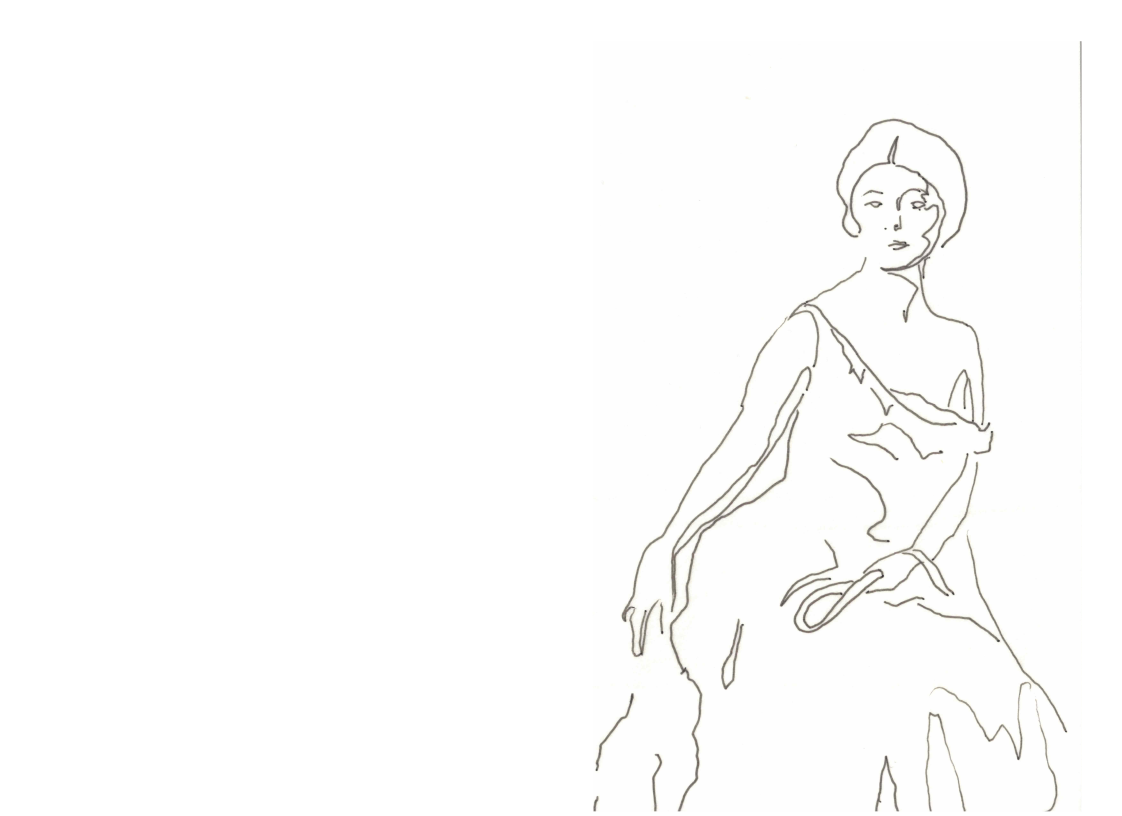
 Over a crop of a Christie’s auction.
What made me stop was the face, the eyes, the beauty. It’s a crop, and the crop is more intense, more focused, extraordinary, but it leaves off some kind of grandeur, the fullness of the mystery. It really does bring in the interest on the face; the full is better for larger format, but the crop just grabs.
The painting is Philip de László’s Portrait of Doña Graziella Patiño de Ortiz Linares, 1928 — oil on canvas, up at Christie’s Paris on 23 September 2026, the hero image of the sale dispersing Graziella Patiño’s own four-decade collection. Its estimate isn’t public yet — the sale’s headline lots are listed “estimate on request.” De László (1869–1937) was the society portraitist of his day, and described his method as “drawing with the brush”: skull structure first, alla prima, wet in wet, no overworking. I drew with a pen, over his brush.
Graziella, 1928
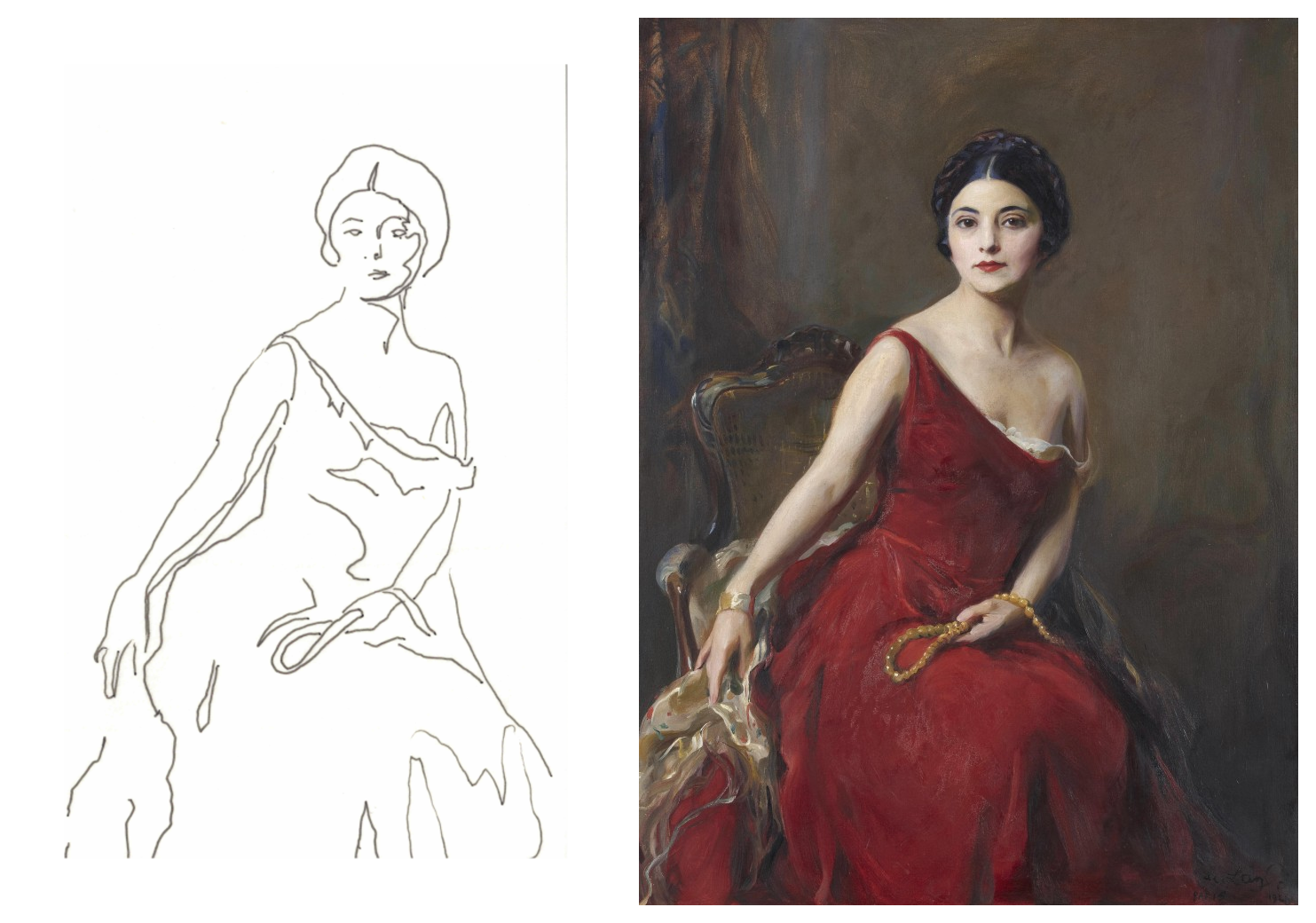
Reduce his loaded, tonal oil down to a single contour, and somehow the beauty remains — a testament to his balance and his understanding of the anatomy and the geometry. But his luminousness is gone, of course, replaced with a spareness. It’s a decision of where that line goes; it’s not hard to discern, but in some way it has my judgement.
The line highlights the structure. Indeed, as he drew the head with the brush, he may have had an underdrawing to guide him; I suppose these are my guesses of those guides.
Tracing this face, somehow the lines I drew captured not nothing — and there weren’t many. He made many subtle judgements, but they surface in ways that are detectable with a pen. Where did the line fight me? Nowhere; it was easy, clean. He has a consistency, an understanding of geometry.
How much of the form did my lines actually extract? I think the tracing captures the face very well — the structure. De László did preparatory drawings, which perhaps this is uncovering, though I am also adding the shading. The neck in the painting is much smoother than my line, but we see he accomplished a lot of 3-D form with his render, and I think the dress adds a surprising boost to the 3-D-ness.
Is it a study, an homage, or its own drawing? It is all three, in that order. I find de László very educational because of his approach.
Graziella, 1931
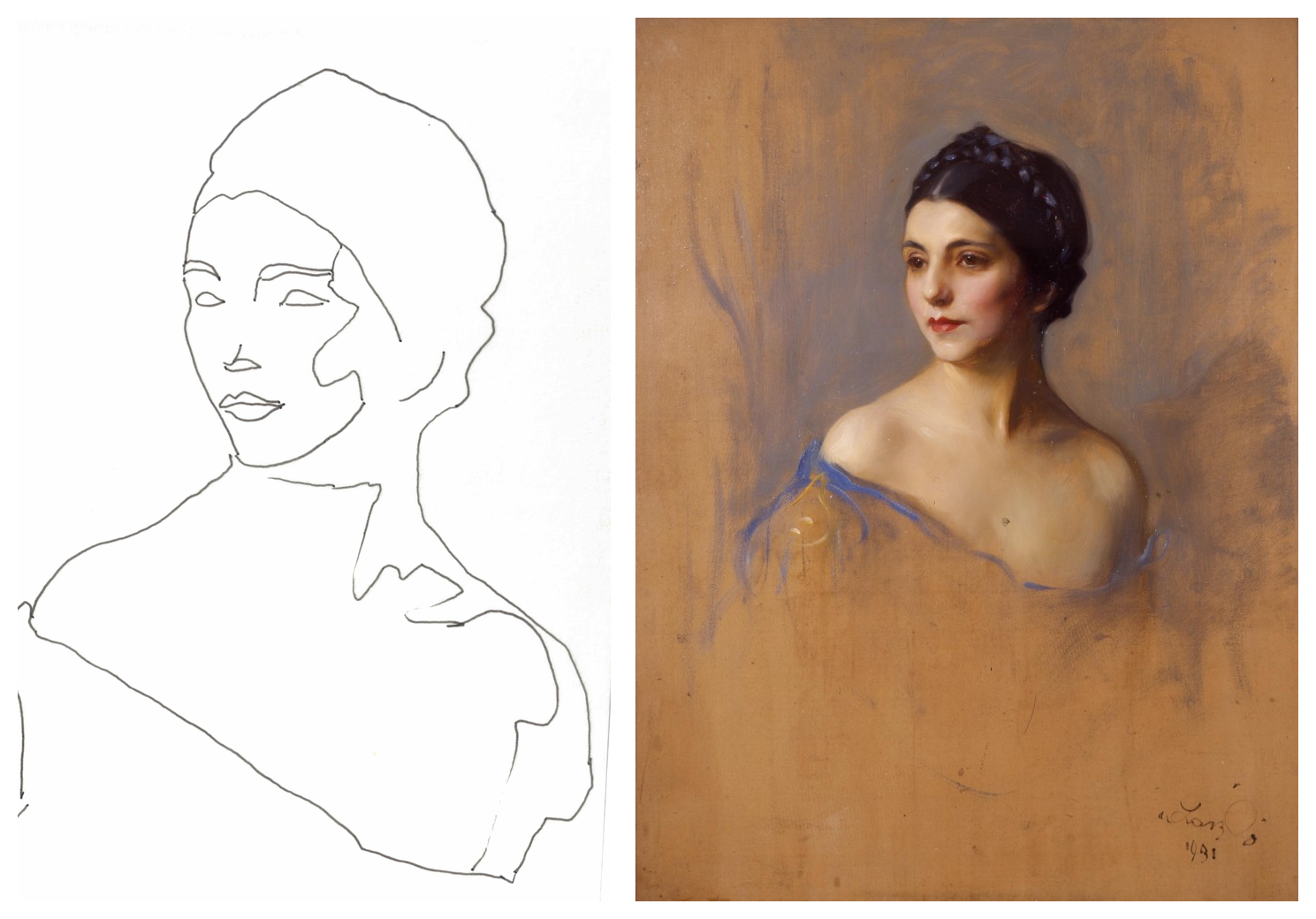 The 1931 study — de László Catalogue Raisonné, no. 6879.
László painted another portait of her a few years later, they were obviously fans of each other.
Less dramatic, flair, red, instead more peaceful, mature, subtle.
We see the face form so clearly here, and shares much with the 1928.
Edwina Mountbatten
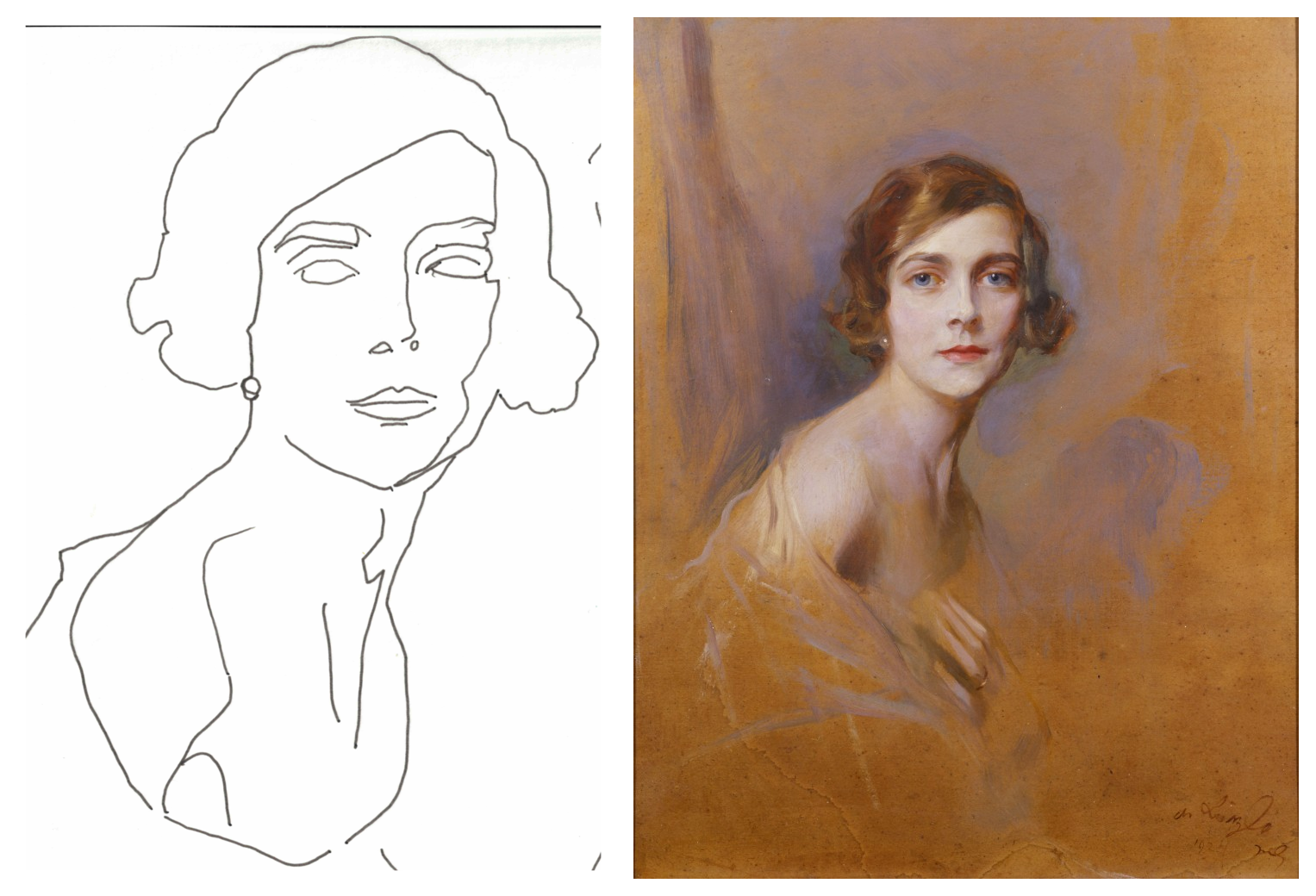 Lady Louis Mountbatten (Edwina Ashley), 1924 study — public domain (Creazilla).
In Edwina, again, that balanced and revealed face — structure and form: clean, strong. In the line I couldn’t also capture the remarkable tranquility of her expression, which he does with smoothness and with the clarity and breadth of his brush and paint mixtures.
Helen Beatrice Myfanwy Hughes
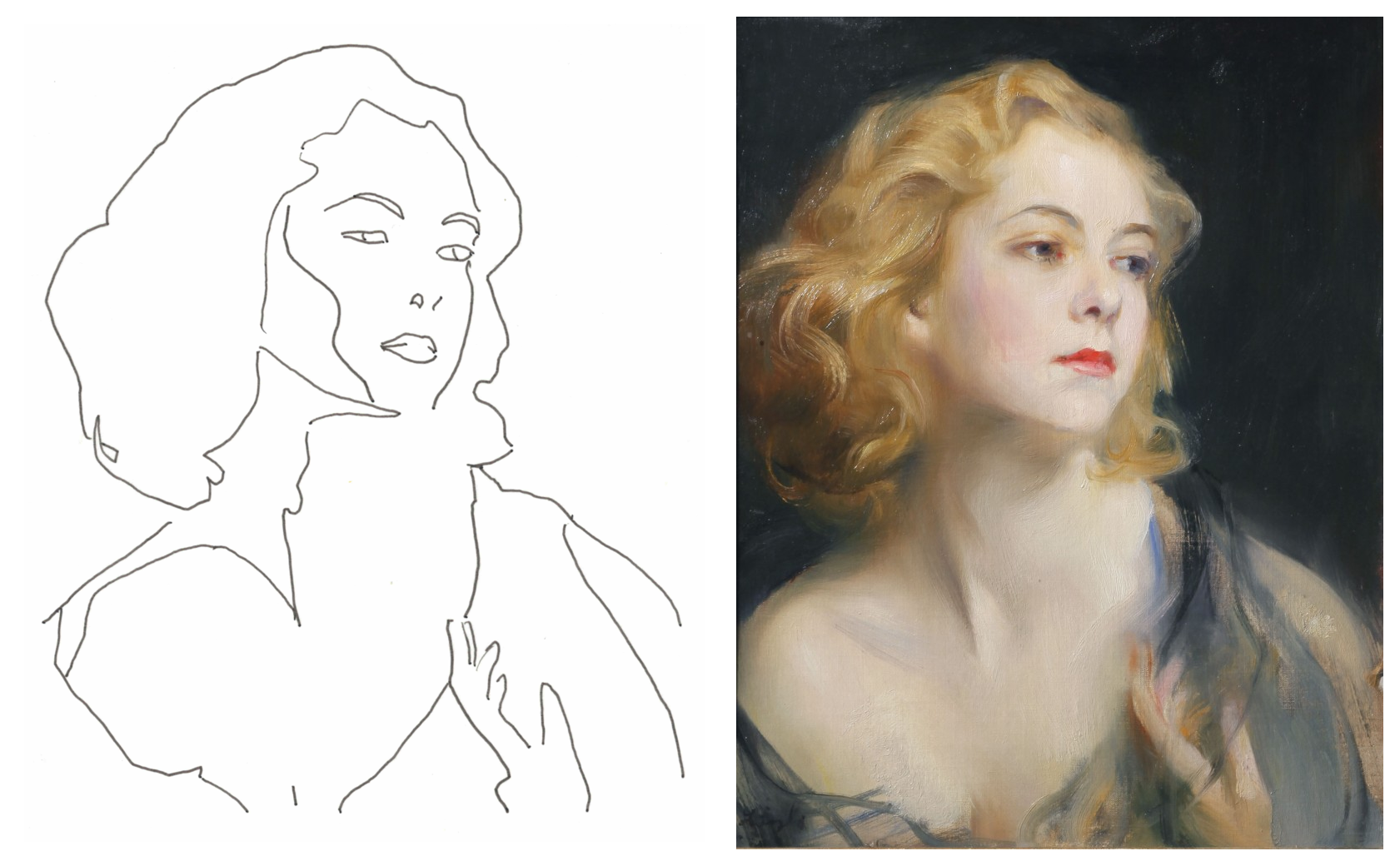 Helen Beatrice Myfanwy Hughes (“Myfanwy”), 1931 — Catalogue Raisonné, no. 5701. It sold at Christie’s in 2017 for £137,000, against an estimate of £15,000–25,000.
With Myfanwy, when I try to draw it just in lines, I have to pick certain lines, even cutting across values that he may have used. This very dramatic blonde hair, so I’m drawing it just as a silhouette. The hair is extraordinary, its silhouette makes clear the glamor and the structure are already inherent, and that he is decorating and enlivening her overall person with the beautiful brushing of the hair.
When I look at just the tracing — yes, he did a tremendous amount, but the silhouette, and just what we do have, is interesting. He’s done something with the gesture, and the person, that’s remarkable. The dress, how it falls, is one of the signals of 3-D form — kind of masked, but there.
This is not something you see — and I think it is worth even more. It’s about glamor, yes, but so much more than that: we can feel László’s sensing of Myfanwy’s personality, her emotion, and his technicality is exceptional.
Graziella — after Dalí, 1942
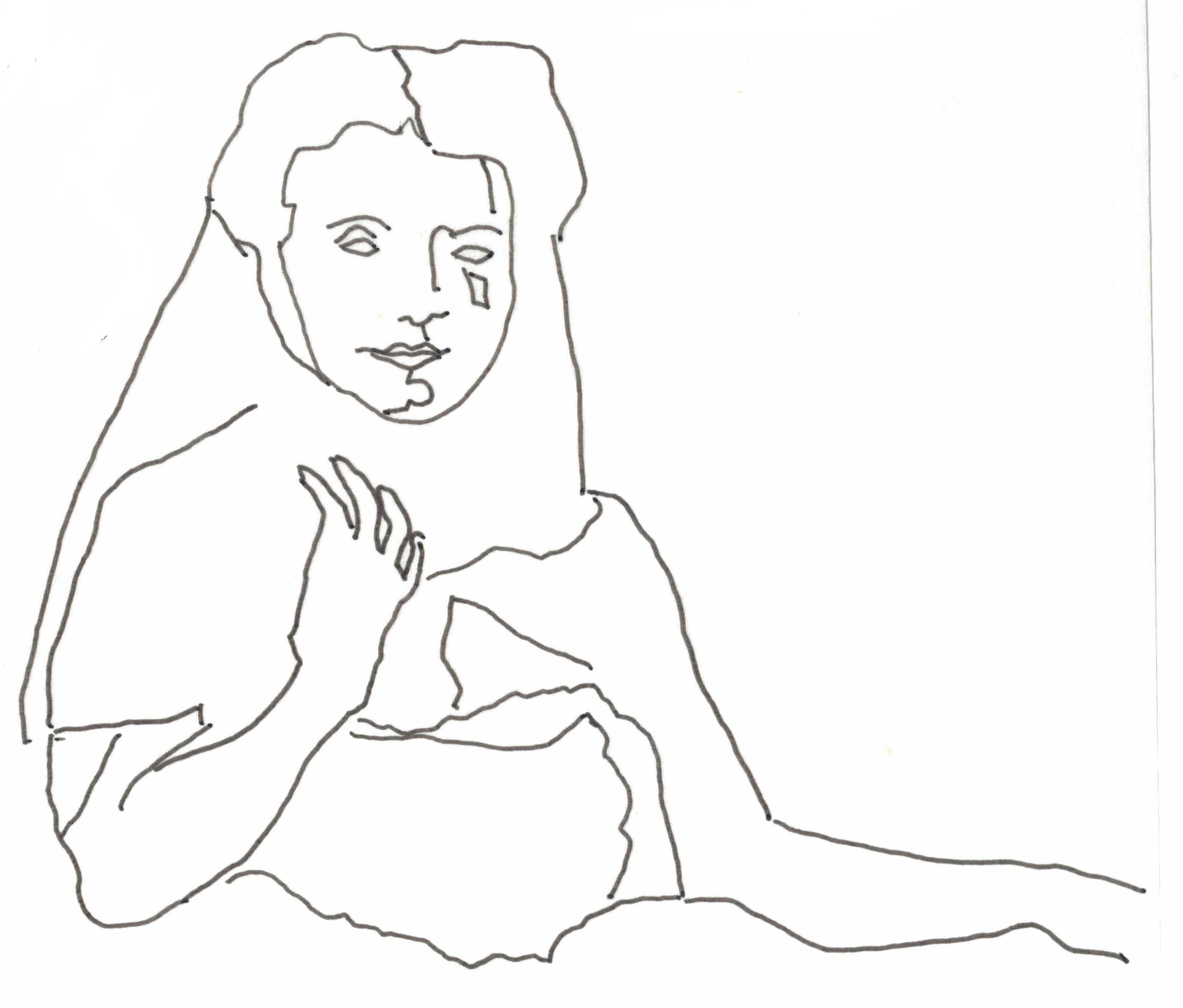 Traced from Dalí’s *Mrs. Ortiz de Linares*, 1942 — Fundació Gala-Salvador Dalí catalogue P 569.
While painting this, Dalí wrote to Graziella describing it as the third stage of a personal trilogy: “Sadism, Masochism, and now Idealism.”
A different setting — the sky is open, she’s wearing a black veil. The arm curled against her chest is anatomically precise; the other extends away, not a typical posture. The cloud at her figure gives depth.
The smile has a Mona Lisa quality — it’s in the lips. My tracing is not comparable to Dalí’s execution. Also note Dali carefully painted her eyes.
Further I traced the veil as its own shape but also needed to find the body through it. Knowing now that Dalí was carrying the Madonna alongside the sadomasochistic, taking Dali at his word (of course), I see his depiction of her veil protectively — perhaps protective of her. His choice of this contrast invokes the neurological basis of violence and sexuality in brain anatomy immediately.
She’s clearly older here, nearly two decades after de László’s 1928. Perhaps that contributes to Dalí’s trilogy — though Michelangelo’s Pieta Madonna is much younger.
Calligraphy practice
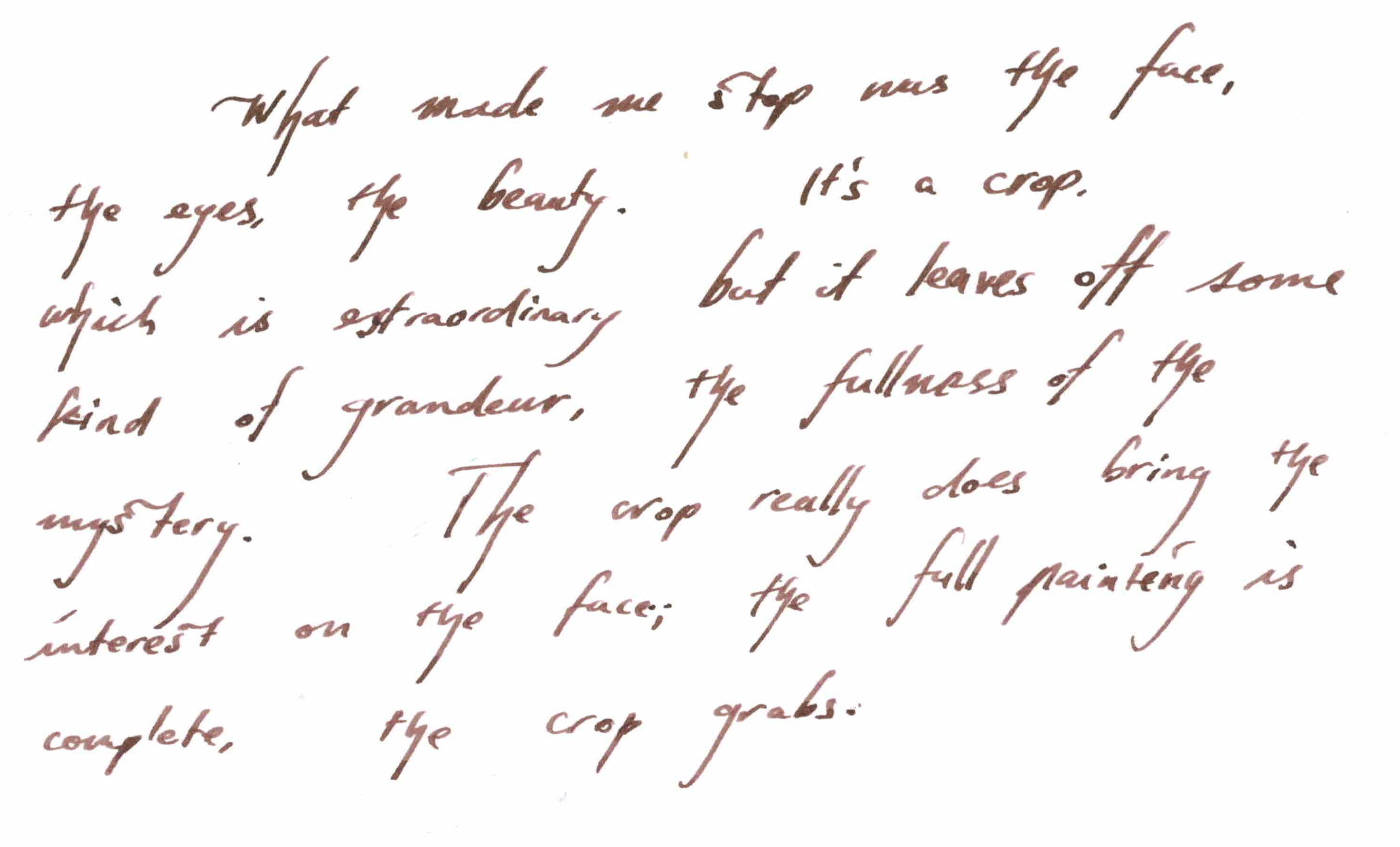
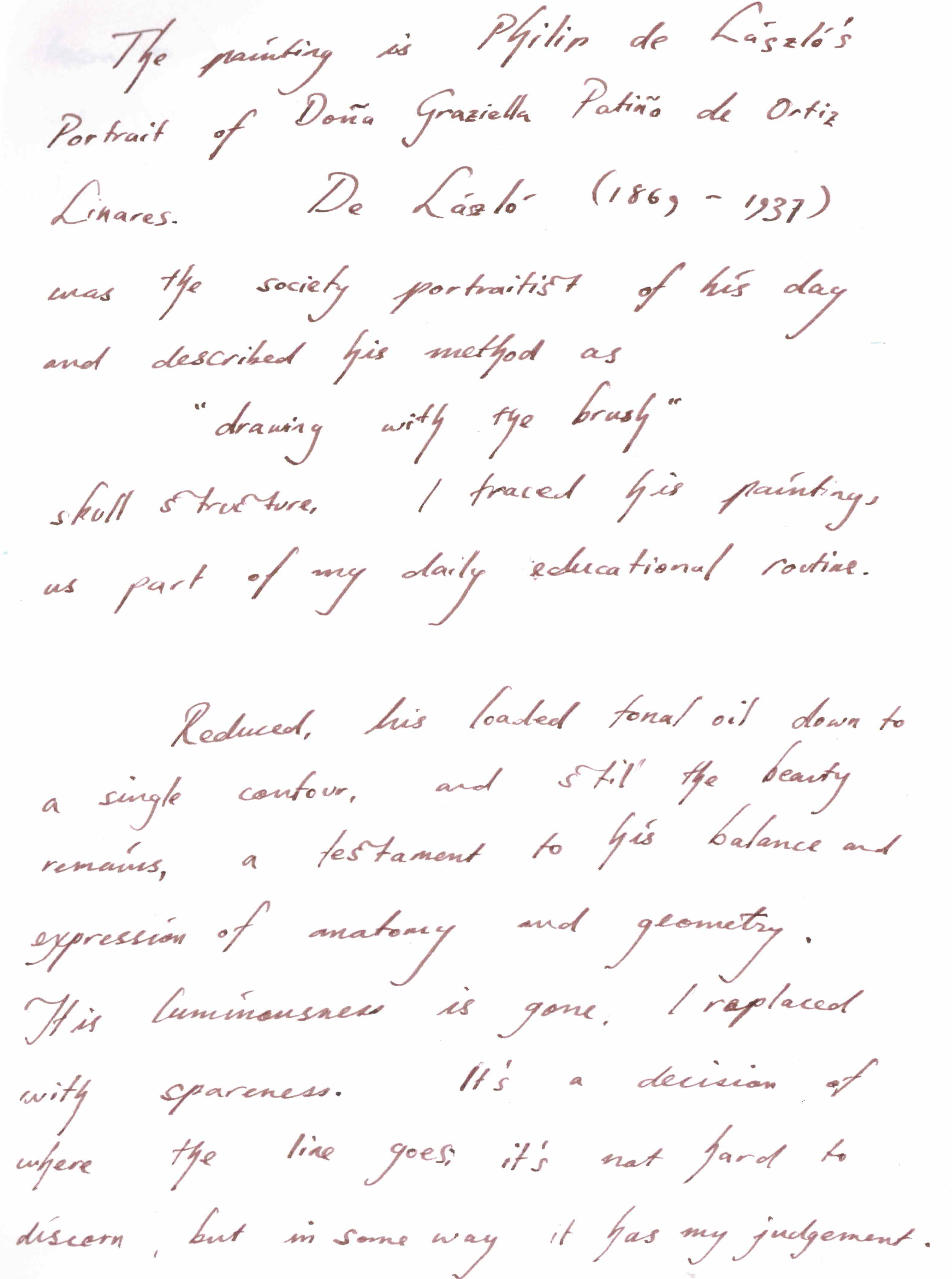
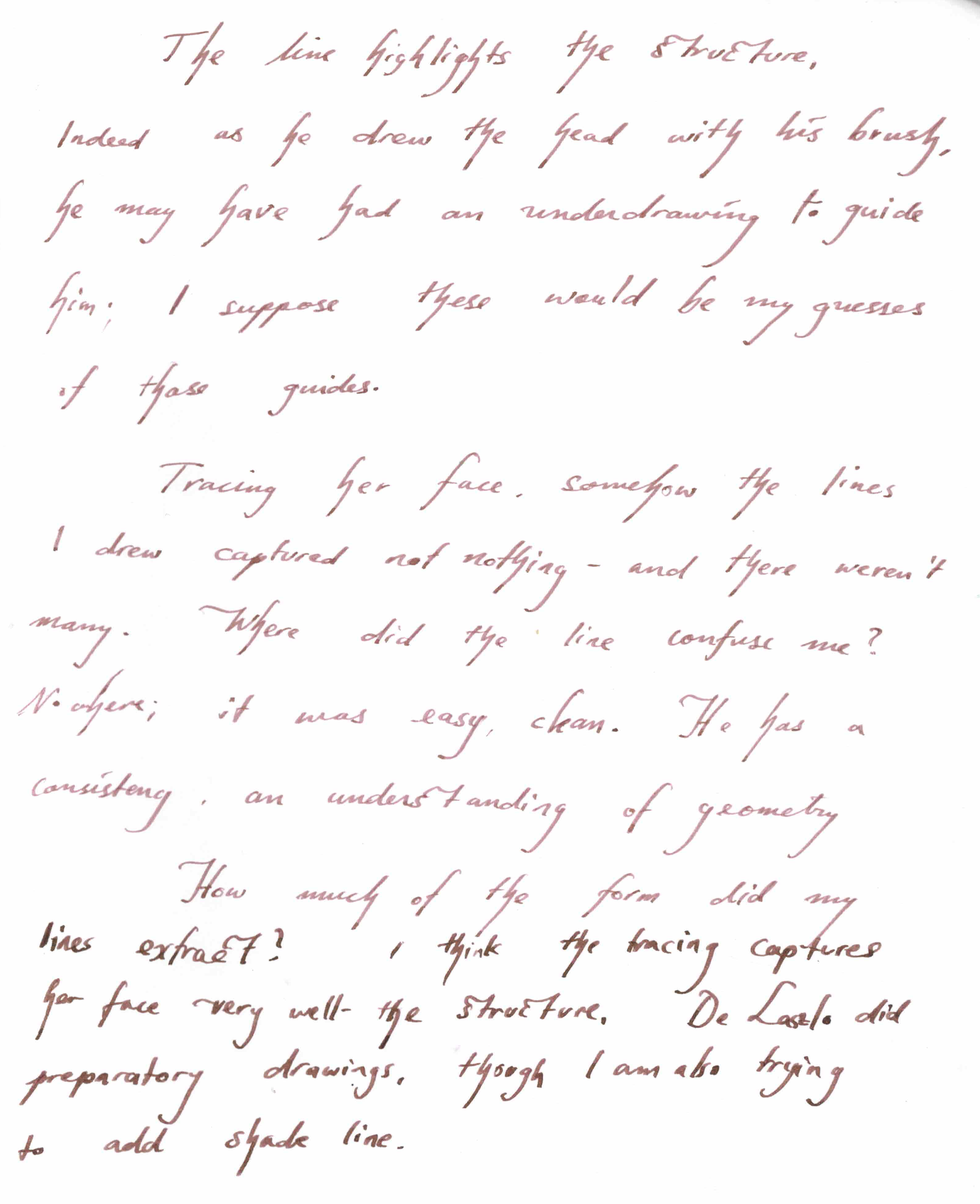
Image credits & sources. De László paintings are public domain — he died in 1937, so copyright has expired (author’s life + 70; also pre-1930 US publication); faithful flat reproductions of public-domain art carry no new copyright (US: Bridgeman v. Corel, 1999; EU: Copyright Directive 2019, Art. 14). The Dalí is copyright Fundació Gala-Salvador Dalí (Dalí died 1989; not public domain until 2060); only my tracing appears here.
- Doña Graziella Patiño de Ortiz Linares, 1928 — Catalogue Raisonné 6875 · Christie’s sale, 23 Sept 2026
- Graziella Patiño, 1931 study — Catalogue Raisonné 6879
- Lady Louis Mountbatten (Edwina Ashley), 1924 study — Catalogue Raisonné 3520 · public domain at Creazilla
- Helen Beatrice Myfanwy Hughes, 1931 — Catalogue Raisonné 5701 · sold Christie’s lot 6062540, estimate £15,000–25,000, realised £137,000
- Public-domain basis: Philip de László (1869–1937), Wikipedia
- Mrs. Ortiz de Linares (Dalí), 1942 — Fundació Gala-Salvador Dalí, catalogue P 569 · Sotheby’s London 2013, lot 68 (letter source)