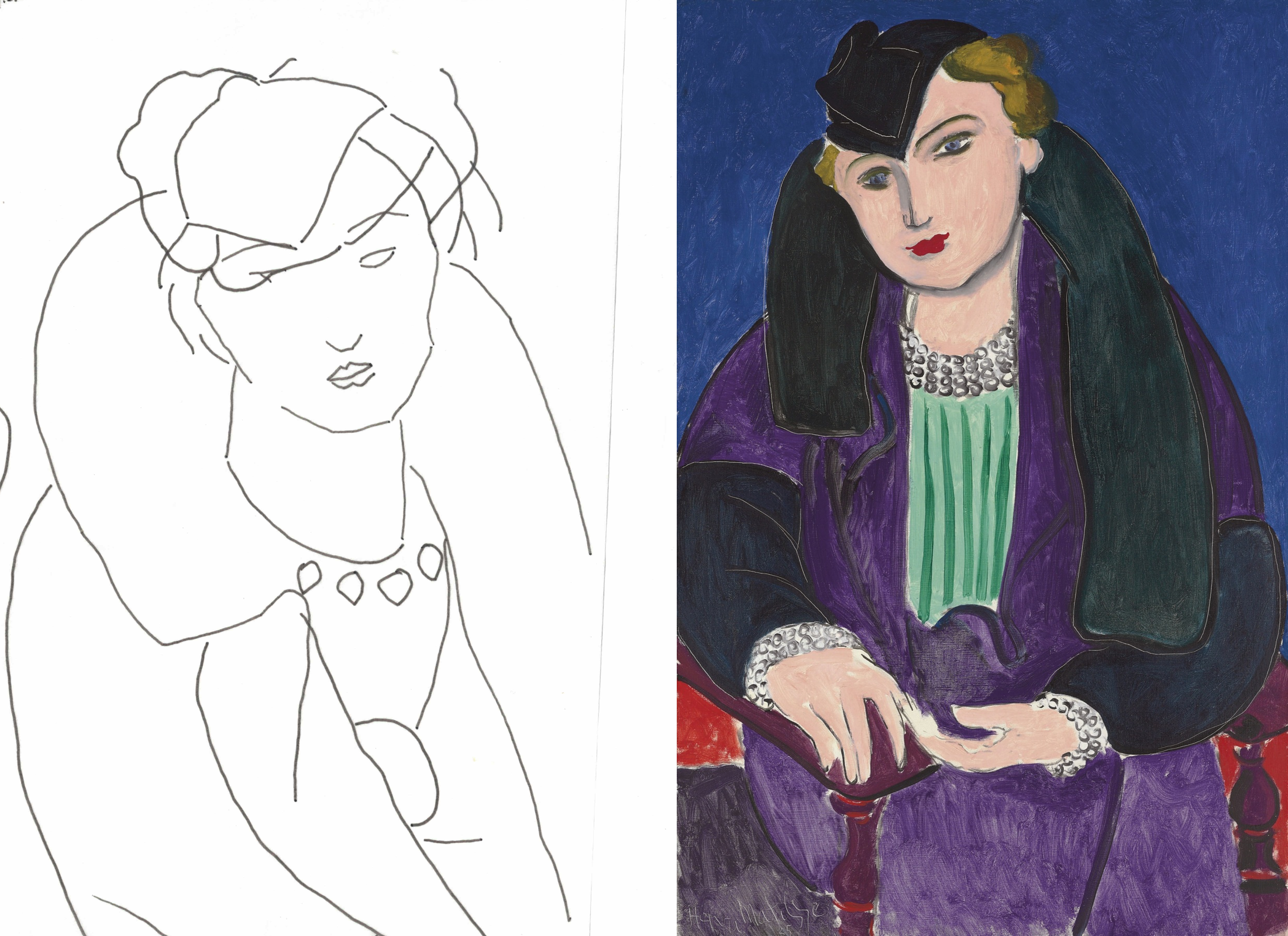
 Left: my tracing of Matisse’s charcoal study of 19 November 1935 (not shown — no open reproduction of that exact sheet exists; see below, and a related but different Matisse charcoal of Lydia from the same year for reference). Right: Portrait au manteau bleu, December 1935, oil on canvas — Wikimedia Commons, public domain.
Matisse drew his study on 19 November 1935 in Nice and it was auctioned recently. What caught me looking at the charcoal was her face. I hadn’t seen the oil painting until after working on the post — I’d only been working from the charcoal. Now, seeing the finished one, I especially think there’s something valid about looking at the lines: his colors are blocks, textured of course, but still blocks delineated by the contours. The face is angled differently, which is very interesting, and the eyes are a little different too. The hat was never the point, so I’m glad I got rid of it. It’s strange to me that he didn’t do the veil — I think he could have — but I kind of like that he didn’t.
There are actual hard lines in his study. The contour of her shoulder, the edge of the coat. Then around them — and sometimes right next to them — this soft, rubbed tone. That technique is estompe: you lay down charcoal and then rub it with a paper stump to spread and soften it. Then you erase to get the lights back. The highlights aren’t where you left the paper bare, but where you took charcoal away after the fact. So the luminosity in her face, that sense of light coming through comes from subtraction not absence.
I did one before where I was looking more at what his lines actually were. This time, a little after Nagel, I’ve tried reducing.
I started with the eyes, and even there I backed off a little. I spent a lot more time on the hat on my previous attempt — this time I’m trying to keep it to a minimum.
The face was harder to see before; this time it’s clearer, and the neck, and the upper part of the jacket. Then the hair, because I think the hair matters. One problem: how do I get the hat down to a minimum? He gives it a little hair himself.
One thing you can really see: some of his lines, especially on the jacket, are really long — literally one line from the top of the sheet down to the bottom. You know he knows exactly what he’s doing; people don’t just do that unless they do.
I don’t have any shading, I made the hat too busy on my last attempt, and I don’t know how to make it transparent-ish, but the hat is solid anyway. So I draw a single line for the outer silhouette. That diamond pattern — her necklace — is maybe the most interesting part, but if I draw all of it, it’s already too much. I considered the cross-contours, but decided against them — just the necklace, and stop there.
I might do another one with even fewer lines, without the veil, just the face.
What’s most interesting about the face: there really are eyelids here, pupils, everything. There’s an angularity to how he builds the form — he’s making a point, then just a couple of shading lines.
The other place he’s got a lot of line is the nose. I’m purposely avoiding that — like Nagel — because it’s the center of the face, and you don’t need the shading there to know it’s in place. If the nose sat on the silhouette edge you’d have to draw it. Right now, you don’t.
The subject is Lydia Delectorskaya, who was Matisse’s studio assistant. She’d been working for him for a couple of years before he one day looked up from what he was doing and said don’t move — and that was that. She ended up in at least eighty paintings.
As a line drawer, it has tension. My instinct is to trust the contour, the lines of light and shade and anatomy. Matisse is adding smoke, the line is there, but the tone that makes you feel the coat is heavy, that her face is three-dimensional, that there’s a window somewhere to the left.
I do think the line gave me the positions and orientations I wanted. The charcoal was unclear intentionally, which is nice — and that’s something I’d say I lost somewhat, though I have obscured an eye, and there’s the veil too.
Sotheby’s had the Matisse charcoal in their Masterpieces from the Lewis Collection sale — Lydia (Étude pour Portrait au manteau bleu), executed 19 November 1935 in Nice. Estimate £1.5–2m. One of five studies for a finished oil, Portrait au manteau bleu.
It sold 24 June 2026 for £3.75m (~$4.9m) — nearly double the high estimate.
The lot page is here (auction links go dead — don’t count on it). Bridgeman Images catalogues a related but different Matisse charcoal of Lydia from the same year — not this exact sheet. More on Matisse at henrimatisse.org.
Image credits & sources. Matisse died in 1954 — public domain (author’s life plus 70, expired 2025), and faithful flat reproductions of public-domain art carry no new copyright (US: Bridgeman v. Corel, 1999; EU: Copyright Directive 2019, Art. 14). The charcoal study itself has no open/freely reusable reproduction available (Sotheby’s is JS-rendered and login-gated for results; Bridgeman is paywalled stock), so the diptych above pairs the tracing with the finished oil instead. Portrait au manteau bleu image via Wikimedia Commons.
Links
- Masterpieces from the Lewis Collection — lot page — Sotheby’s (results require login; may go dead over time)
- $63.5 M. Modigliani Nude from Joe Lewis Collection Leads Sotheby’s London Double-Header Auction — ARTnews, price realized for the Matisse
- Lydia, 1935, charcoal on paper — Bridgeman Images; a related but different Matisse charcoal of Lydia from 1935, not the exact sheet sold
- Portrait au manteau bleu — Wikipédia — the finished oil
- Portrait of Lydia Delectorskaya — henrimatisse.org