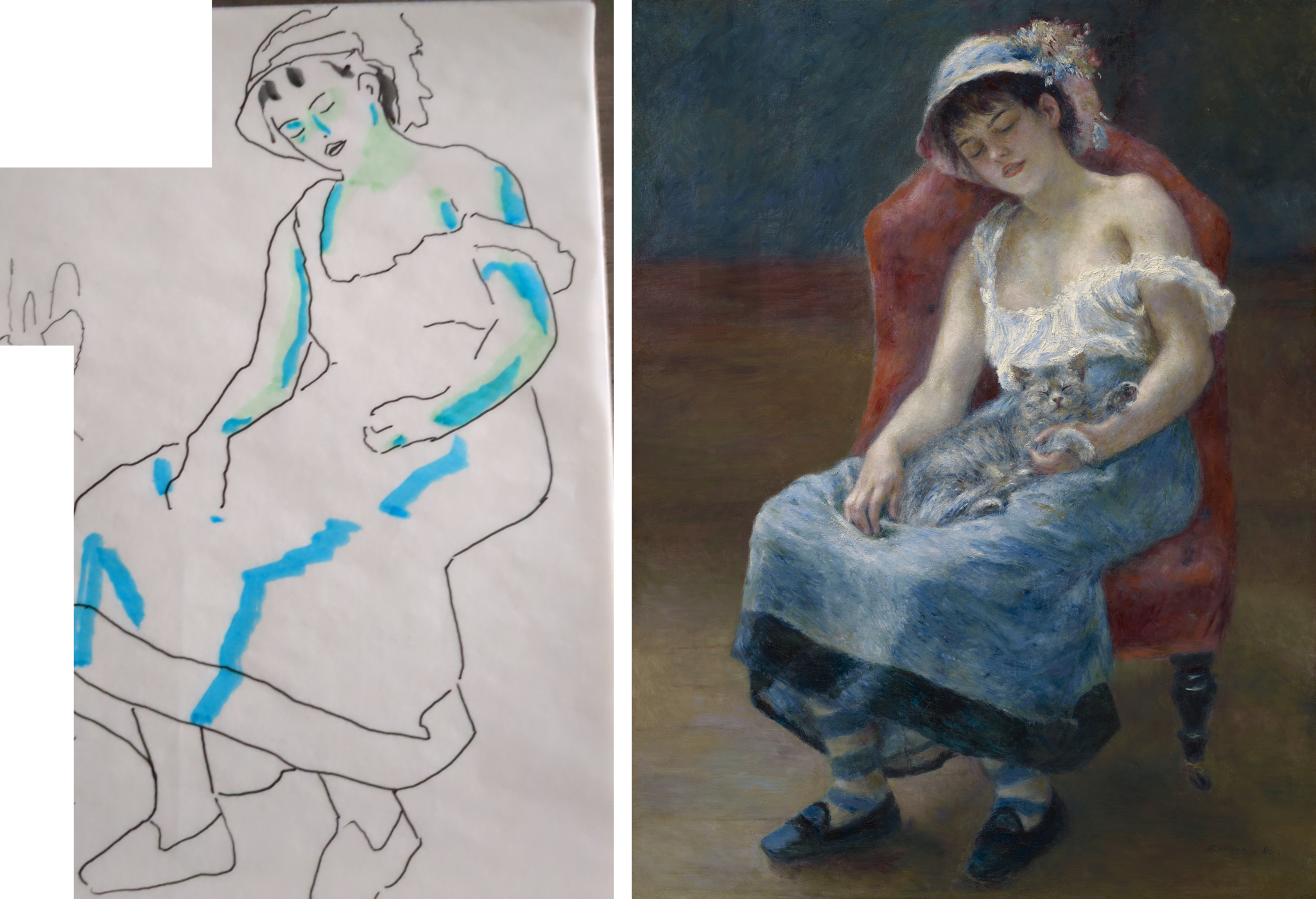
 Left: my tracing, Monday 14 September. Right: Pierre-Auguste Renoir, Jeune Fille endormie (Sleeping Girl with a Cat, also known as Jeune Fille au chat), 1880 — oil on canvas, 120 × 94 cm, Sterling and Francine Clark Art Institute, Williamstown, MA (acc. 1955.598). Public domain (Renoir d. 1919).

The tracing · Auction · Background
This is Renoir, a girl sleeping with a cat, and what’s interesting here of course is the light — the drapery and the form are really good, he’s showing off a kind of light that is gorgeous — and then the playing of hiding the form with the skirt but showing it with the light, I think, is remarkable. And then the overall position — the cat is almost hard to see, and then you see it: this cat may be sleeping too.
I was thinking a very simple line, almost like Forest, and maybe using a brush marker. I think the line itself can get some of this, but of course we’re going to lose a lot — the technical tracing of this will produce a result that’s not as meaningful as if we take a step back to a Frédéric Forest-type approach. So: just this line, and then the brush pen, the eyes — or I suppose we’ll start with the eyes. This one’s convenient because she’s sleeping, so that should give us just the orientation of the face.
The soft values are beautiful and skillful, but I don’t think they’re the primal, neurological layer — I think ultimately it’s lines. Even the dress has lines; the edges of the face, the hat, are all lines. That said, I’ll concede the light falling on her, his actual artistic power and meaning here, is beyond what the simple lines can reach.
Just down the hand, the left side of the neck, down — where we have an under and over cross the waist versus the arm lines. Drapery, and the back of the shoe.
The hat. And I think the restraint here — okay, let’s leave that there, this is where it is. I think the form has come out as well as may be expected.
But now the major thing: we have the form, the geometry, in some sense, we have the understanding that she’s sitting, her position I think is fine — I didn’t put the cat in. The question now is this beautiful soft light on her arms and shoulders. He’s just painting, showing a darker shade, but controlling it on several continuous levels, so he doesn’t just have two colors. Can we do this without many levels? I have two different bluish-greenish brush markers, one darker, but I’m going to back off and see if I can’t get it with a couple, actually following his guidance — squinting, saying, well, where is it darkest.
Gradation is fundamental to this kind of painting, to the light falling — I don’t think squinting and reducing it to my own simplified colors captures the subtle edge of his light and work. I got some crude sort of idea out of it, some limited educational value, but the way I think about it: when we draw a line around a jawline or the edge of a face, we’re sensing the form in 3D. In that same way, he knows, as he applies the paint, that the light is falling beautifully and truly on the painting — in a way I can’t replicate, or represent reliably in any related fashion.
Maybe with the lighter one first, and then get some of the darker values. The arm — the value under the arm is darker, and the question is why: it feels like he’s playing with adjacencies of light and dark. I’ll go with the darker one now — that at least gives some sense of where the darker parts might be. We can try the hair with one of them.
And of course the question of the dress comes along — and the cap for that matter. For the dress: this edge of the drapery, He’s using a couple of edges very strategically. That one is demarcating where the knee is, right there. And then this line I think is very nice because her hand is pushing into the top of the dress. And then there’s one to the upper part of her left knee.
We can put the fall of the dress, the band, it ends in an actual line, because this band tells us quite a lot about the bottom edge of the dress. And then the other, almost semantic piece is just this portion of the upper part of the dress, which is kind of not re-appliable. The cat is playing an important role there.
The cat is certainly form, and certainly carries emotional weight and implication — but I felt it wasn’t relevant to the simplest level of form and line, and the questions of light I was interested in trying to glean from this pose.
Also I did like the dimensionality of this particular shoe — the shoes are giving, obviously, the orientation, and then these striped socks are so important, giving us those checkerboard reads of things.
Small cues can be very powerful, even global — Frédéric Forest, for example, can draw a detail, a single line, that implies much about every part of the pose or face or figure. The orientation of her shoes, I think, very much supports the hidden information about her knees, her thighs, her hips, her position. I tried, with this drawing, to capture some of that local information with global implication.
But I think that’s good enough. Maybe the bow of the hat is also telling us something.
I’d like to learn more about where this sits in his arc — I don’t know yet how it reflects on the paintings before or after, but I know he often played with light, and with stripes, as recurring keys.
Okay, I think that’s it.
Auction. This is a museum piece — the Clark Art Institute’s, since before 1955 — not a market data point. For scale: Renoir’s own auction record is the smaller studio replica of Bal du moulin de la Galette (1876), sold for US$78 million at Sotheby’s New York on 17 May 1990 to Ryoei Saito — at the time one of the two most expensive paintings ever sold at auction. That’s a different kind of Renoir, though: a crowded outdoor dance-hall scene, not a single seated figure like this one. Closer in genre and scale: Jeune fille à la corbeille de fleurs (c. 1890), another single-girl half-length, carried a pre-sale estimate of $6–8 million at Sotheby’s Modern Evening Auction in New York, 17 November 2021 — the final price isn’t shown on Sotheby’s own public lot page, so it isn’t stated here.
Background. Jeune Fille endormie — Sleeping Girl with a Cat, also known as Jeune Fille au chat — is signed and dated 1880. Renoir showed it at the official Paris Salon that year, and again two years later at the 7th Impressionist Exhibition (Durand-Ruel & Cie., March 1882) — one painting straddling both the establishment and the independent show in the same period. Per French Wikipedia, the model was Angèle, a Montmartre florist. The painting passed through the dealer Paul Durand-Ruel before entering the collection of Sterling and Francine Clark, whose museum in Williamstown, Massachusetts has held it since (acc. 1955.598).
Links
- File: Pierre-August Renoir Sleeping Girl with a Cat — Wikimedia Commons — the museum’s own accession, medium/dimensions, and exhibition history
- Jeune Fille endormie — Wikipédia (French) — model identity and provenance
- List of paintings by Pierre-Auguste Renoir — Wikipedia — the source link tasked into the inbox on 14 September
- Bal du moulin de la Galette — Wikipedia — Renoir’s $78m auction record, for scale
- Sotheby’s — Jeune fille à la corbeille de fleurs, Modern Evening Auction, 17 Nov 2021 — the $6–8m estimate comparable
- Process video — Monday 14 September — YouTube
- Frédéric Forest — artist, Art of the Line in Drawing