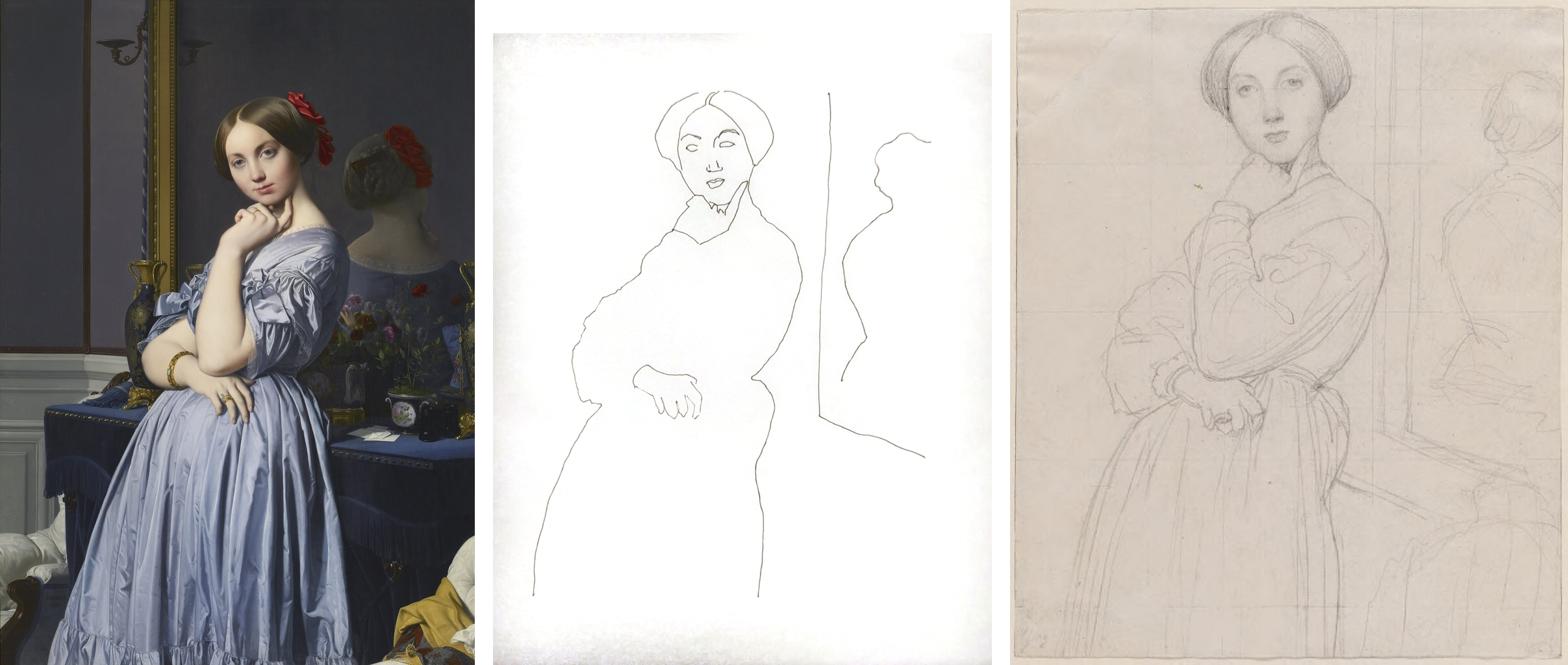
This is Ingres’s study for his famous painting.
It would be interesting to just trace in a straightforward way, I think. He did add a little bit of shading there. It’s graphite, this is a pencil drawing. I’m going to try to stay close to his drawing.
I do love the reflection. The mirror isn’t exactly for the back of the head, as much as for the other dimension. The reflection, another place that is similar, yet different. And of course these voluminal lines on the skirt. This parting of the hair is something I really like here. It’s clean, just gives a quick strong depth cue. And the dress. There are lots of lines, drapery or hair, that can also play as contours and cross-contours.
I’ll trace the hands. I’m just going to see what it looks like with just hands. Because these hands are kind of curling. Hands are important, and convey the state of mind. Here we can see a kind of tension, I think, in the hands.
I’m going to convey the fact of this mirror. How much of this in the border is required? I kind of like it with just the hands floating like that. He’s describing the sleeve and dress.
He made something like eighty studies for her. He saw something in her, I think, perhaps like a muse. Perhaps it wasn’t focused labor as much as a familiarization and calibration to her form, which he found important.
Auction
The finished painting went through the trade once. After Paul-Gabriel d’Haussonville died, it was sold to the dealer Georges Wildenstein to meet estate taxes, and the Frick Collection bought it in 1927 for $125,000.
This sheet never needed a saleroom to reach a museum. It came to the Fogg at Harvard in 1965, a bequest of Meta and Paul J. Sachs.
Background
Jean-Auguste-Dominique Ingres drew this study between 1842 and 1845, in graphite on white wove paper, 23.4 by 19.6 cm. It is squared for transfer, signed “Ing” at the lower left, and is in the Harvard Art Museums (Fogg Museum, 1965.294). By this point the composition was settled. Louise de Broglie leans against a mantelpiece, her chin on one hand, and the mirror behind her shows the back of her head.
The painting it prepares is the Comtesse d’Haussonville of 1845, oil on canvas, 131.8 by 92.1 cm, now in the Frick Collection in New York.
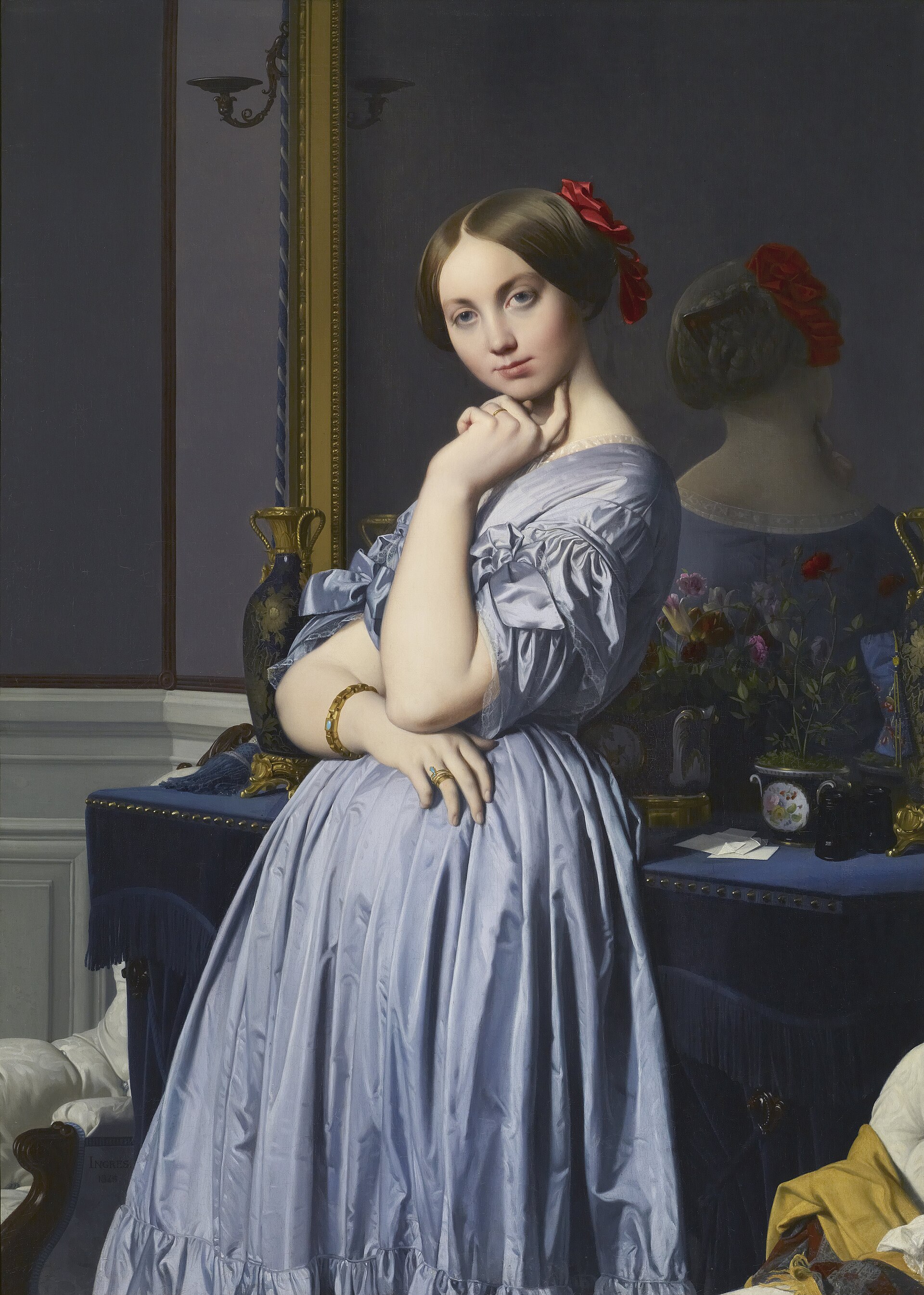
The sitter was 27, from the house of Broglie, and later wrote essays, biographies and historical novels. Ingres made an estimated eighty preparatory drawings for it. Fifteen survive. A first version in oil, begun in 1842, was abandoned when she became pregnant with her third child and could no longer pose. She complained that “for the last nine days Ingres has been painting on one of the hands.”
The mirror was an old device for him, used as early as Madame de Senonnes in 1814. Baudelaire praised the painting when it was shown in 1846. Ingres was less sure. “I do not feel that I have conveyed all the graces of that charming model.”
Links
- Study for the Portrait of Madame Othenin d’Haussonville — Harvard Art Museums, the study traced here (1965.294), and the master image
- Louise, Princesse de Broglie, Later the Comtesse d’Haussonville — the Frick Collection, another study, and the eighty drawings
- Portrait of Comtesse d’Haussonville — Wikipedia, the painting, its sitting and provenance
- Comtesse d’Haussonville, Google Art Project — Wikimedia Commons, the painting image (public domain)
- Jean-Auguste-Dominique Ingres — Wikipedia
- Process video — Sunday 4 October — the tracing session on YouTube
