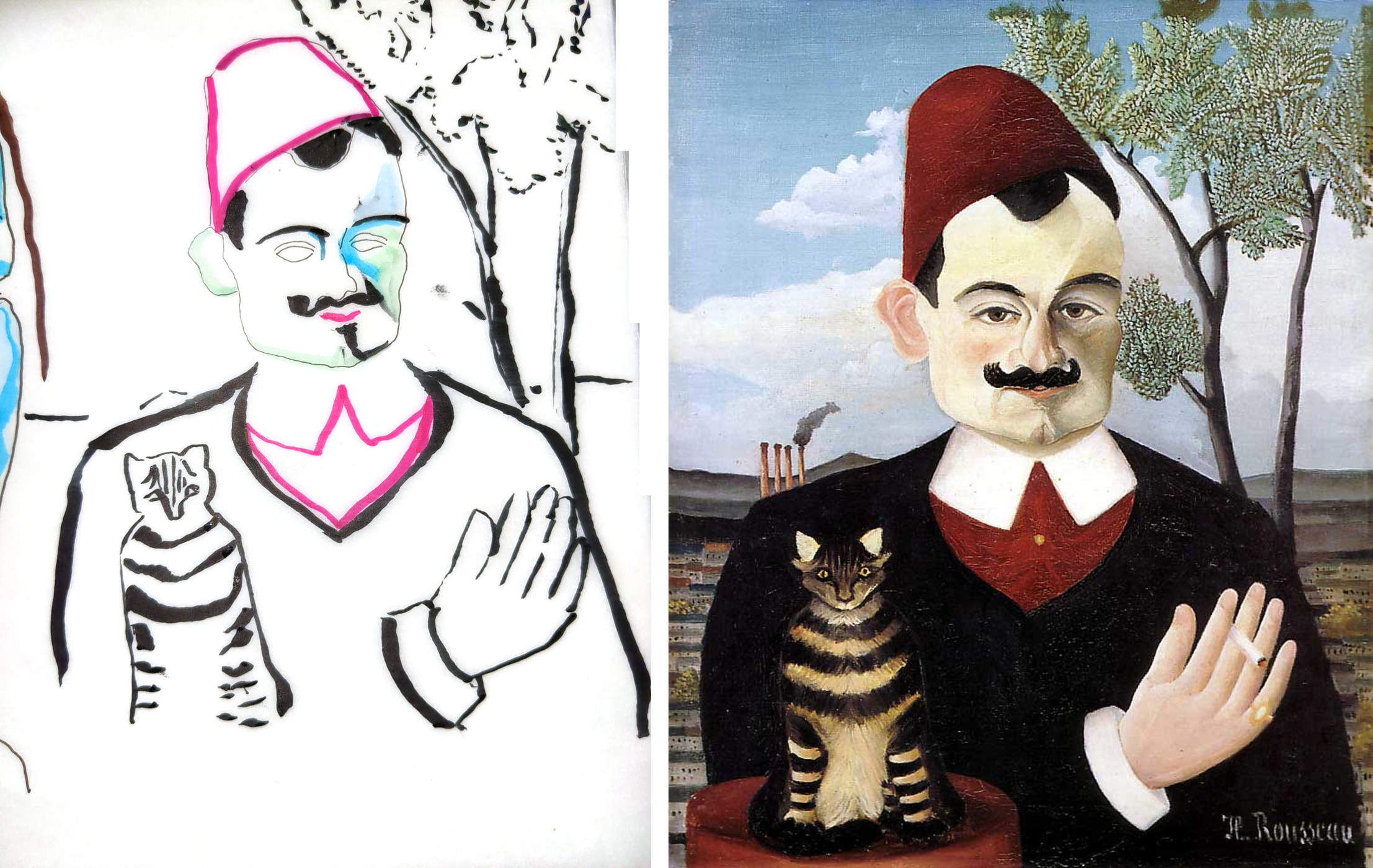
This is Henri Rousseau. It’s such a striking picture, not at all realistic. I think it will work fine in a minimal line drawing style. I love the cat. I’m going to try to get him, because of his eyes.
But again, he’s using the colours differently. His face has a certain shading and dimensionality to it, and he’s painted the trees. So some of it will work, but some will be lost. I might try colour again. I don’t know that I could do this with just black brush. Very interesting picture.
I’m tracing with a Micron 003, the finer one. I often use something a little broader than that, but I’m thinking how to get some of these more subtle things. I like how he paints the cheek. He’s very angular with a lot of this outline. There is a lot of anatomy here, but there also is an unreality to it, and it’s kind of fundamental.
The unreality is fundamental, but I was thinking perhaps he has command of anatomy.
I’m going to try a black brush for this, because I don’t see myself filling this whole thing in. I like how he left the hand against the black, a bit like Klimt. He kind of just dodged it, in a way.
It does feel not unlike Klimt’s idea. The hand is quite important, and not drawing out the arm but losing it in the drapery is a way of perhaps even highlighting the hand.
While I’ve got this brush, my idea was to do his moustache with the black brush, and the eyebrows. I guess I can do the cat. What’s good about the cat is that he’s got these natural cross contours. And then darker blues in there.
These colours are very structural. This one, the Michelangelo and the Leonardo have been quite important inside the silhouette. I do think the silhouette is most fundamental, though.
Oh, it’s a city. My goodness. I did not realise he had drawn out a whole city back here. I can’t do that.
A Renaissance portrait sets the sitter against a soft, distant landscape. The Renaissance is the right comparison. I’ve seen this painting before but never really spent time with it. The city is more dense and detailed. Perhaps that’s the contrast Rousseau is driving at.
I guess that’s it.
Rousseau had no academic training, and critics ridiculed him in his lifetime. There is nothing naive or academic about him. He is a straightforward painter. He expresses something important that he sees and understands, not naively, but directly. I think those labels, and the mockery especially, tell us more about critics than about him.
Background
Henri Rousseau painted the Portrait de Monsieur X in 1906, oil on canvas, 61 by 50 cm. It is in the Kunsthaus Zürich. It is signed “H. Rousseau” at the lower right but not dated.
The sitter has never been firmly identified. The writer Pierre Loti is the usual suggestion, which is why the painting is often called Portrait de Pierre Loti.
Behind the man, rows of houses run back into a hilly landscape, four factory chimneys rise over one shoulder, one of them smoking, and an acacia grows over the other. The art historian Michel Hoog read the tree and the chimneys as wild nature against urban industry.
Links
- Portrait of Mr. X (Pierre Loti) — Wikipedia, date, collection, the sitter question
- Henri Rousseau — Wikipedia
- Portrait de Monsieur X — Wikimedia Commons, the master image
- Process video — Saturday 3 October — the tracing session on YouTube
