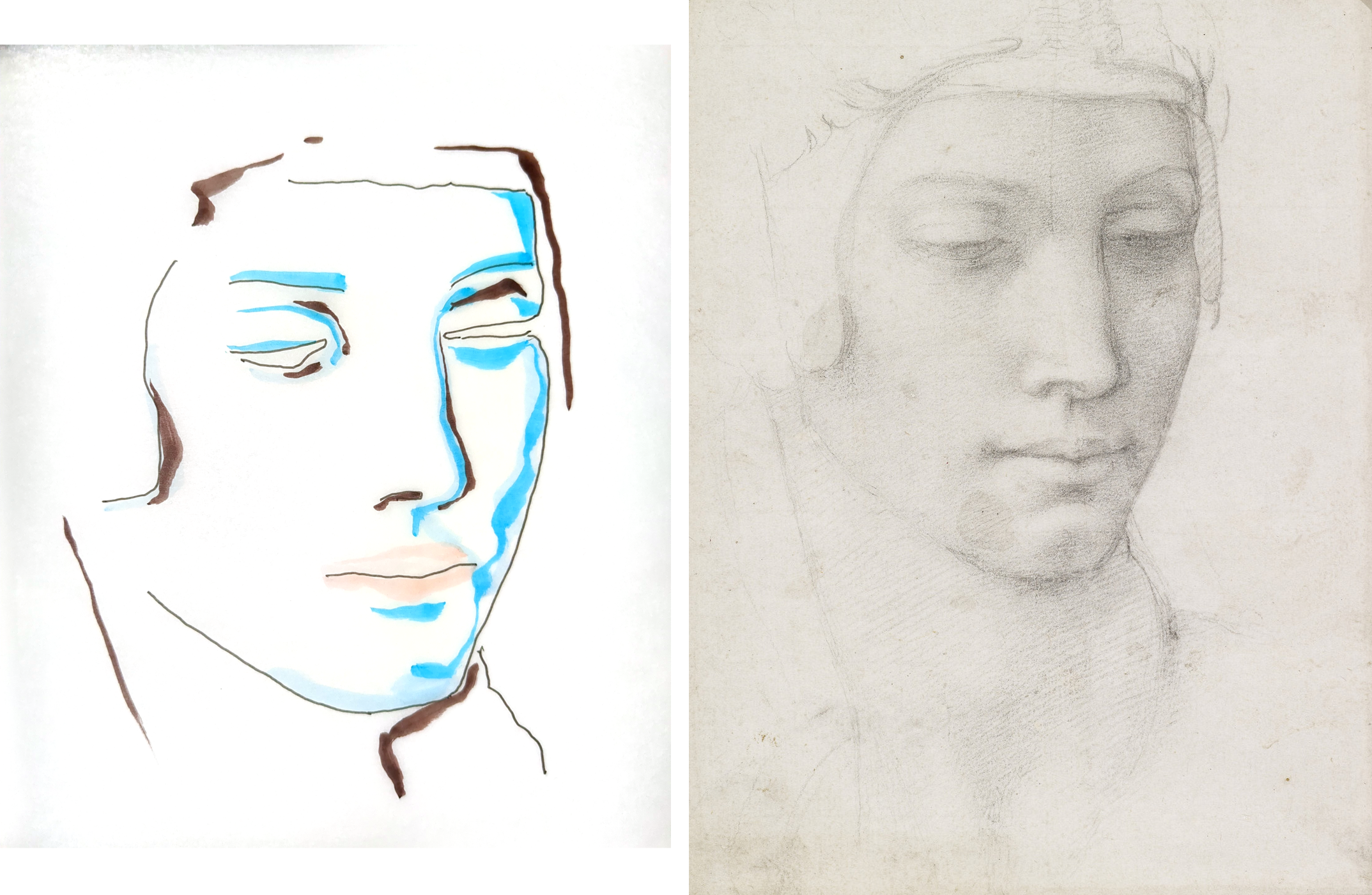
 Left: my tracing, Friday 2 October — fine liner, then blue, brown and peach brush pen. Right: Michelangelo Buonarroti, Testa della Vergine (The head of the Virgin), c. 1540 — black chalk, 21.2 × 14.2 cm, Royal Collection Trust, RCIN 912764 recto. Wikimedia Commons, public domain (Michelangelo d. 1564).

The tracing · Auction · Background
This is Michelangelo. I was unaware of the Royal Collection Trust’s collection. I’d seen a number of his drawings, but looked through their quite extensive and beautiful collection only today. They’ve had exhibitions, they have a lot of documentation and interesting write-ups on everything, and the number of pictures they have is so large that, as I was scrolling through, there were so many I liked. This one I do think is remarkable, but what’s more remarkable is how many other ones he drew that are also so remarkable.
He was an incredible draftsman, and I wonder if a lot of these were final products — they weren’t just practice, it looks like. They’ve got a huge write-up on this one, which I think is also unusual. A lot of the time these drawings don’t have such a large write-up. Apparently it was sold for a very small amount of money a long time ago, as Michelangelo’s work — these were in the market. It’d be interesting to read up on that.
It’s remarkable that we have some historical information, and that people bought this cheaply. That such a work of his was not expensive shows the market then and now works quite differently.
Visually, we have a clean line here. And, again like Leonardo, a lot of what’s happening here is — yes, we have the shape, nice, edges of the neck — but it’s really about the subtlety of the entire drawing, and how precisely that’s been done.
I actually think they approach these very similarly. They both emphasise the interior of the face, they both emphasise precision and anatomy. Here he was concerned with the face, its form and internals. The armour versus Madonna aspects were secondary and incidental, perhaps only there to help support the form in the more distant areas.
I’ll try lines first, and then go from there.
That’s kind of the starting point for me, and it’s arguably also an end point. One could finish there, and it’s not unreasonable.
It’s just a different stylistic emphasis, an idea of the orientation and simplified shape of the face, but it doesn’t capture so much of his work and thoughts.
So now the question is, should I use colour, or stay with just black and white? I’ll explore a bit of colour. A lighter colour first, around the eyes and nose. A light blue, then a darker blue. A little more emphasis in here. And the eyes.
Her eyes are lowered, where Leonardo’s angel looked straight at us. Looking at us has power, and here it is indirect. His shading work is far more graded and subtle, and mine is more direct.
Pink for the lips. Maybe a little orange. Some really dark stuff around here.
That should do it. I don’t want to overdo things.
Auction
This sheet has never come to auction — it is in the Royal Collection. Its only trace of the market is on the back, the inscription “MAngolo” by William Gibson, whose inscriptions and price codes turn up on fifty-one drawings in the Royal Collection. For scale, a red-chalk study for the foot of the Libyan Sibyl on the Sistine ceiling, found in the United States, sold at Christie’s in 2026 for about $23 million, the record for a Michelangelo drawing.
Background
Testa della Vergine is a small black-chalk head, 21.2 × 14.2 cm, drawn around 1540, when Michelangelo was in his sixties and working in Roma (Rome). The Royal Collection Trust reads it as probably a preparatory study for a painting of the Virgin and Child that was never made. Her helmet-like headdress gives the Virgin the forbidding aspect of Minerva. On the back of the sheet is a second drawing, the head of a young woman.
I traced Leonardo’s Volto di fanciulla the day before, Thursday 1 October.
Links
- The head of the Virgin — Royal Collection Trust — the drawing, its verso and the catalogue entry
- Testa della Vergine on Wikimedia Commons — the image used here, PD-Art
- Michelangelo — Wikipedia
- Process video — Friday 2 October — the tracing session on YouTube
- Leonardo’s Volto di fanciulla, the day before — line and colour value