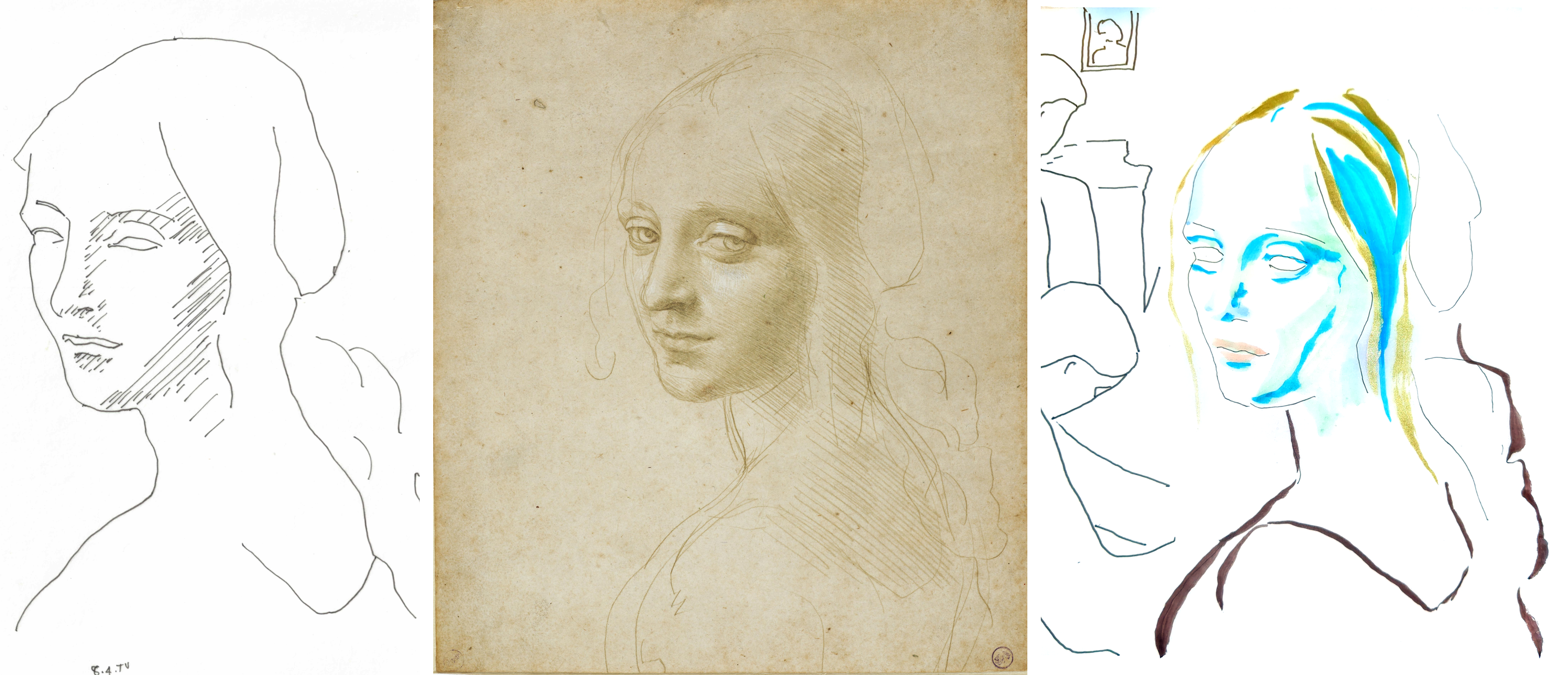
 Left: my first tracing, Tuesday 4 August. Centre: Leonardo da Vinci, Volto di fanciulla (Head of a Young Woman), study for the angel of the Vergine delle Rocce (Virgin of the Rocks), c. 1483–85 — silverpoint heightened with white on prepared paper, 18.1 × 15.9 cm, Biblioteca Reale, Torino (Turin), inv. 15572 recto. Wikimedia Commons, public domain (Leonardo d. 1519). Right: my second tracing, Thursday 1 October.

The tracing · Auction · Background
Leonardo again. I’ve been looking at these lately, and it takes me too long to pick one — and when I do, I often pick one I’ve done before. I spend time looking for new ones, and something pulls me back to a handful of them. Of course one could study this one for a lifetime, as I will. This one has so much. As one learns more things, as one draws more, one can come back to a work like this and reinterpret, re-explore and revisit it as one’s life and context change.
Yes, we can come at it with a pen and do the outline, or follow his hatching per my previous attempt. There are several lines — he’s developing her silhouette, kind of different from what Frédéric Forest is doing. But the point he’s making is fundamentally about how he conveys the shapes of her face, apart from her silhouette, through the hatching. That’s an important point he’s making.
I suspect he’s using some kind of white also in certain areas — white chalk or something. He works up from a toned ground and adds the light, where I’m on white paper over a lightbox. That’s a subtle technical point, and I don’t think the two are really comparable. They are different mediums, and different ways of interacting with the materials and the reference. For this one I feel a lot of it is in the orientation. I’m going to try a pen and see how much of this subtle form I can pick up. I’m using a very fine liner today.
The back of her head is very important — despite the fact that it’s some kind of drapery, it’s quite important to give us context.
I will try some lighter areas, and I want to work from the areas I know will be dark. What I’m really trying to do is trace his hatching values — but with a brush.
If one area is darker, I come in darker; he’s definitely spending more darkness in her eyes for example. Her eyelid, the bottom of the nose. Her lips I’ll leave aside for now. I have some quite dark brush pens, but I’m leaving those aside for now.
The eyes themselves I leave as empty almonds, though his angel turns and looks straight out at us. It’s obviously devotional, and one forgets the form, and the masquerade, in a sense of holiness.
Maybe I’ll do the hair in dark — I think that’s an interesting idea. Deviating a bit, why not. Metallic sometimes looks good on hair. His hatching runs through her hair and her shadow alike, but I think hair has a semantic and neurological immediacy, and so one can understand it either way easily. His sparseness of silverpoint is meant to keep one’s observation on her facial forms, whereas mine is more spectacular and colorful, and thus not as focused on such precision. And I want her shoulder as he indicated.
I’m relying on, translating, his shading to color. Did I learn something? I think this was not bad. We can look at his values, convert them to color values, and capture some of what he’s doing. He works with hatching, which I attempt through line variation with the brush.
Auction
This sheet has never been to auction. It has been in the royal collection in Torino since King Carlo Alberto bought it in 1840, one of thirteen Leonardo drawings he acquired that year. For scale, the record for a Leonardo drawing is Head of a Bear — estimate £8–12 million, sold for £8.8 million with fees on a single bid, Christie’s London, 8 July 2021.
Background
Volto di fanciulla, also known as Testa di fanciulla, is a small silverpoint drawing heightened with lead white on prepared paper, in the Biblioteca Reale, Torino, inv. 15572. On the back is an ornamental oval interlace in pen and ink. It was once thought to show Cecilia Gallerani, the sitter of the Dama con l’ermellino (Lady with an Ermine). Today it is read as a study for the angel’s face in the Vergine delle Rocce, the Louvre version, commissioned in Milano (Milan) on 25 April 1483. In the Louvre painting the angel turns to look out toward us while pointing at the infant John, and in the later London version the angel’s eyes are lowered. The drawing has the Louvre angel’s outward gaze.
In 1952, for Leonardo’s five-hundredth birthday, Bernard Berenson called it “the most beautiful drawing in the world.”
I first traced it on Tuesday 4 August, in line and hatching, and this second pass is about value.
Links
- Volto di fanciulla on Wikimedia Commons — the image used here, PD-Art
- Volto di fanciulla — Wikipedia (Italian) — technique, verso, Berenson
- Musei Reali Torino — Leonardo da Vinci. Disegnare il futuro — the thirteen drawings bought by Carlo Alberto in 1840
- Virgin of the Rocks — Wikipedia — the 1483 commission and the two angels
- Frédéric Forest — Art of the Line
- Head of a Bear — Wikipedia — auction-record context
- My first tracing of this drawing, 4 August — line and hatching
- Process video — Thursday 1 October — the tracing session on YouTube