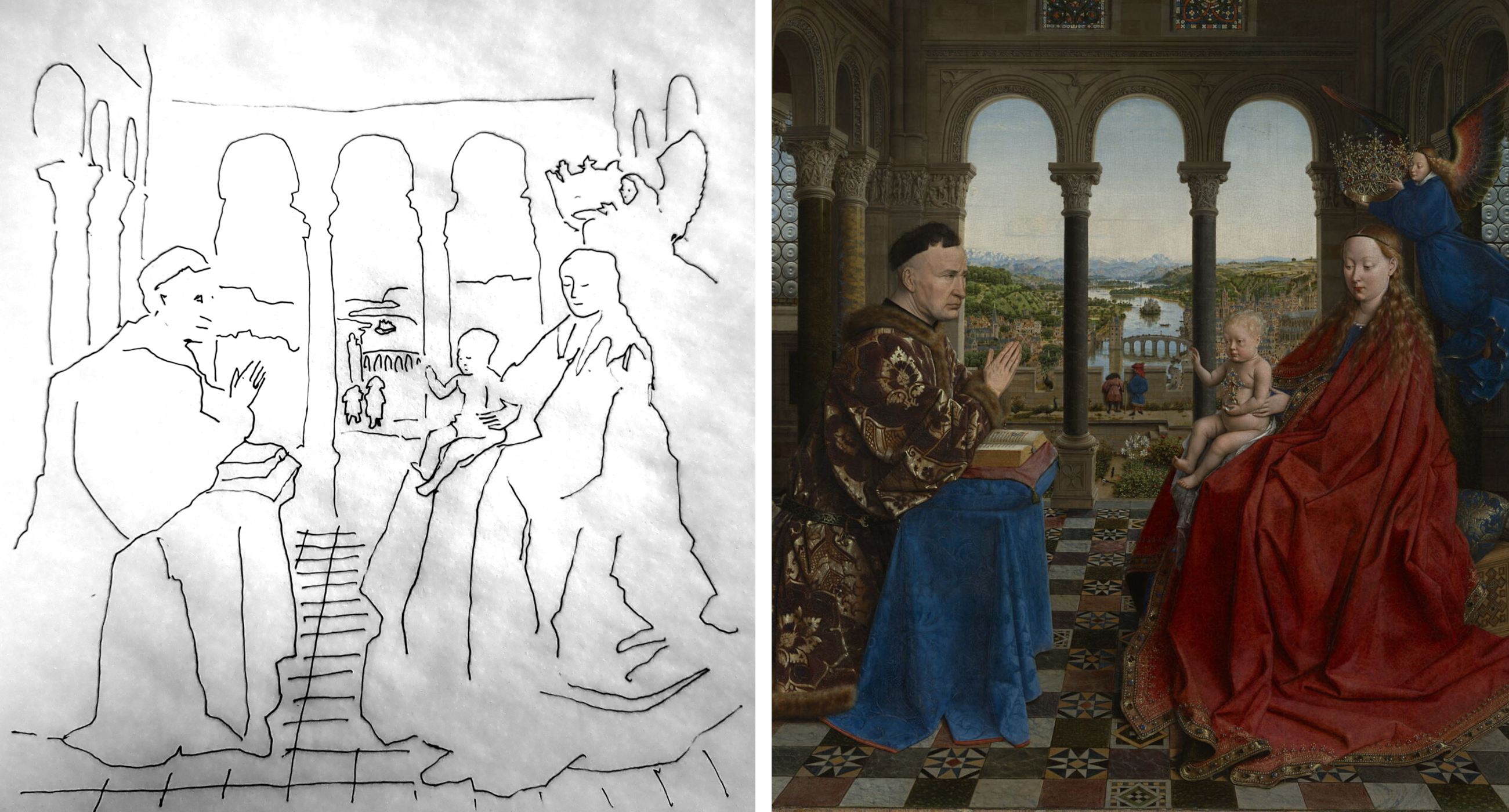
 Left: my tracing, Sunday 13 September. Right: Jan van Eyck, La Vierge du chancelier Rolin (The Virgin of Chancellor Rolin), c. 1430–1435 — oil on oak panel, 66 × 62 cm, Musée du Louvre, Paris (inv. INV 1271; MR 705). Public domain (Van Eyck d. 1441).
The tracing · Auction · Background
I traced her face, then the baby’s, then the drapery — that was important. The main figure information is the drapery. Then I traced the chancellor’s face, but these faces, though I think they turned out okay, I didn’t think my lines would be carrying terribly more information than we’d expect anyway on something of that scale in the composition. But I thought the drapery, the checkerboard, the room, the arches, the landscape far outside the room — these are somehow important to the composition and to the message of this painting, in ways that perhaps we could still capture some educational insights from the tracing.
I think Van Eyck, and other artists of that kind — mannerists, and other movements like the Egyptians, Modigliani, Picasso — used stylized, perhaps even symbolic faces, so the face carries a kind of geometric value. But in this case the composition seems richer in terms of what can be learned from the lines — the lines of drapery versus the checkerboard, for instance.
This is Van Eyck, and — so many things here. I think this is another one where the more I look, the less I think I will actually capture through lines. There are, I think, useful lines, but important as they may be they are the blueprint only. This whole drapery is a great thing — we don’t have a sense of her actual figure.
This is a large drapery, a face portrait, another one on the angel, and then we have this remarkable perspective thing — two little children, I guess, out on that bridge. So we’ll see how this goes. I’m using a finer line — Micron 003 Sakura, much finer than usual.
This is her hand, and then lots of drapery out here. It has some kind of a geometric quality — the edges of the drapery are quite sharp, almost too linear. Some cloth could be very starched, or very stiff, to achieve that. Very ornate crown which I don’t know how to simplify.
I wonder who these children are. There’s this little bridge out here — without taking away too much attention, pulling away from it. So far I’ve got just this far wall and that bridge. As put in this side wall plane, the perspective will appear.
I think the checkerboard is always there, obviously, to really give us that depth cue. I wonder why — yes, it’s great, but why does he want this much of a depth cue? The reality of the situation, perhaps. This is just the silhouettes. Maybe the horizon would be good.
And while the drapery is stunning, one can see that it is hiding, but still providing certain lines. I think we should definitely make this clear, that this guy is sort of kneeling — there’s actually two things going on here. I do like the sag of his dress. Just a few lines — we can distinguish the hair.
It has this almost perspective quality, the lines on her dress, something to contextualize against the checkerboard on the floor: we want lines pointing to something. And then at the bottom, the drapery lines point to something else — as they reach the floor, we’re meant to know that this piece of clothing has reached the floor.
I do like that little boat in the middle. It’s interesting that he decided to put a boat there. Even this winding river is part of what makes this interesting. Oh, there’s a tower, and of course, the town. I guess that’s meant to be, maybe, humanity, and a river, and then nature. I was thinking maybe it was becoming more natural towards her — but that’s not what’s happening. It’s just an extension of the city.
I think, you know, in one of those paintings, there’s just a level of expressivity that is well beyond what the lines are. The lines are interesting and instructive — this big drapery. Actually, the bottom of the crown can probably give a little bit more information. There’s just a lot of filigree and stuff on the crown.
Auction. No authentic Van Eyck has ever come to market. I checked Sotheby’s and Christie’s directly — both keep an artist reference page for him, but neither has an actual lot or sale on record. His entire surviving painted oeuvre, on the order of twenty attributed panels, has sat in museum hands for centuries; nothing genuinely by his hand has come up for sale in living memory. There’s no comparable to cite for scale here, so none is invented.
Background. Nicolas Rolin was chancellor of the Duchy of Burgundy — extraordinarily wealthy from public office — and commissioned this panel around 1435, near age 60, for his parish church, Notre-Dame-du-Chastel in Autun. It stayed there until the church burned down in 1793; after a period in Autun Cathedral, it entered the Louvre in 1800.
The Louvre’s own account of the background almost exactly matches what caught my eye while drawing: a garden, then a town, then countryside and mountains; a bridge crossing the river, an island sheltering a small castle, and two figures seen from behind, leaning from the garden toward the river. I wondered out loud who they were while tracing it — it turns out that’s an open question for the Louvre too. Its 2024 exhibition on this painting, following a restoration that stripped away centuries of darkened varnish, listed “the identity and significance of two small figures in the garden” among the things still being studied. Wikipedia’s account goes further and floats, as speculation rather than fact, that one of the two might be van Eyck himself.
The small garden just outside the columns — lilies, irises, peonies, roses, per Wikipedia — is usually read as a symbol of Mary’s virtues, an echo of Eden, set against the very worldly wealth on display in Rolin’s brocade and the room’s marble and gilding.
Links
- La Vierge du chancelier Rolin — Musée du Louvre collection — the painting’s own museum catalogue entry (inv. INV 1271; MR 705), source for medium, dimensions, and provenance
- A New Look at Jan Van Eyck — Musée du Louvre — the 2024 restoration and exhibition, source for the still-open “two small figures” question
- Madonna of Chancellor Rolin — Wikipedia — composition, symbolism, and Rolin’s biography
- Category: The Virgin with Chancellor Rolin by Jan van Eyck — Wikimedia Commons — the source link tasked into the inbox on 13 September
- Process video — YouTube