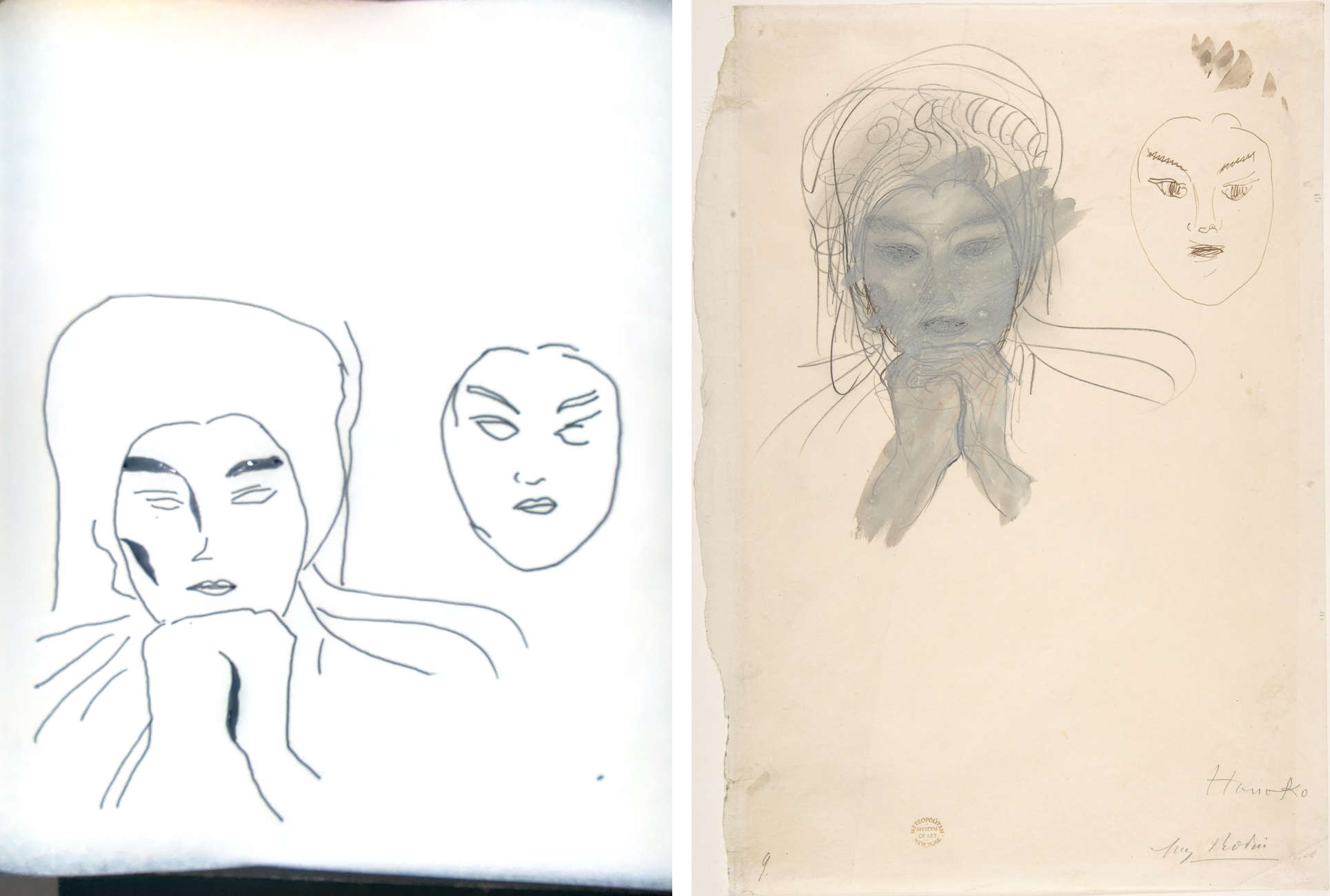
 Left: my tracing, Tuesday 6 October. Right: Auguste Rodin, Hanako , c. 1906–1907 — graphite with stumping, pen and brown ink, red crayon and gouache wash, 29.9 × 21.4 cm, The Metropolitan Museum of Art, New York, 10.66.2. Public domain.
This is Rodin’s drawing Hanako. I like Rodin quite a lot. Of course he’s famous for the sculptures. His drawings were a lot of an exercise of drawing without looking at your page, for one thing. I think drawing is a kind of a statement of freedom. And so I think by drawing the way that he does, he is allowing the freedom, right? He’s not concerned with self-criticism. And so, therefore, I like these.
This practice of his is one I often try to follow explicitly when I’m drawing. Tracing for me is a different thing, watching a master, someone whose work I admire, carefully, and carefully working with their lines to try to feel and trace them. The informality of what he’s drawing, I think, works well in tracing, partly because we’re able to infer certain things are important and certain things aren’t. It’s my interpretation perhaps, my sense of the priority of geometry and form and anatomy and aesthetic. For him, he had a personal sense of aesthetic which led to the wash. I didn’t sense it and wanted to look through it.
And this here is the mask. I guess in the Japanese theatre they have those masks that I’ve always been very towards, that surrealness. I feel that the Japanese theatre and masks seem like they’re connected to, I don’t know, just storytelling, and maybe the subconscious. When we look at the masks in Spirited Away and all that, right, it’s extraordinary to have that as part of visual culture and storytelling. Most of my drawings have no pupils and have a masklike quality. A mask can fix an expression, but a drawing usually has a fixed expression. Sometimes it can be ambiguous, and perhaps one can feel it differently at different times, though.
In this drawing I think he did draw a somewhat western sensibility to her face. I didn’t realize she was Japanese until I read the name. His style is western, but the mask is something else, exaggeration perhaps. The actual masks are also, but in a different, less childish way perhaps.
Her mouth is slightly open. Her eyebrows, I think, are more interesting. He sort of hatched them. We have hatching on the lower part of the face, and the eyebrows. These are personal sensibilities, artistic choices, style.
I think I’m going to try for a minimal thing first and see. I think that may very well be sufficient.
Auction
This sheet has been at the Metropolitan Museum since 1910, bought while Rodin was still alive. It has never been to a saleroom.
Rodin’s Hanako masks do come up, as later bronze casts. A Masque d’Hanako, étude type E, conceived 1907–08 and cast by Alexis Rudier in 1918–20, was offered at Sotheby’s on 16 July 2025 with an estimate of $12,000–18,000. Another Rudier cast, from 1930–40, was offered at Sotheby’s in July 2025 at €12,000–18,000.
Background
Rodin drew this sheet around 1906–1907, in graphite with stumping, pen and brown ink, red crayon and gouache wash. He wrote “Hanako” at the lower right and signed it. It is 29.9 × 21.4 cm, in the Metropolitan Museum of Art in New York, accession 10.66.2.
Hanako was the stage name of Ōta Hisa (1868–1945), a Japanese actress who trained as a geisha and from 1902 spent most of her career touring Europe. Her death scenes were famous for their bodily and facial expression. Rodin met her in July 1906, in Marseille. She was the only Japanese person to model for him, and between 1907 and 1911 he made more than fifty busts, masks and drawings of her. Mori Ōgai wrote a short story about her, Hanako. She spent her last years in Gifu, where two masks Rodin gave her are now shown.
That July he also drew the dancers of the Royal Ballet of Cambodia, sheets now among his most famous. His late drawings were sketched loosely, without taking his pencil from the paper or his eyes from the model. The Musée Rodin in Paris holds 7,000 of his drawings and prints.
Links
- Hanako, ca. 1906–1907 — The Metropolitan Museum of Art, New York, the master image (public domain)
- Hisa Ōta — Wikipedia, Hanako’s life
- Hanako — Wikipédia (French), Marseille 1906 and Rodin’s series
- Auguste Rodin — Wikipedia, on his late drawings
- Masque d’Hanako, étude type E — Sotheby’s, Modern Discoveries, 16 July 2025, lot 326
- Masque d’Hanako, étude type E — Sotheby’s, Modern & Contemporary Discoveries, July 2025, lot 31
- Process video — Tuesday 6 October — the tracing session on YouTube