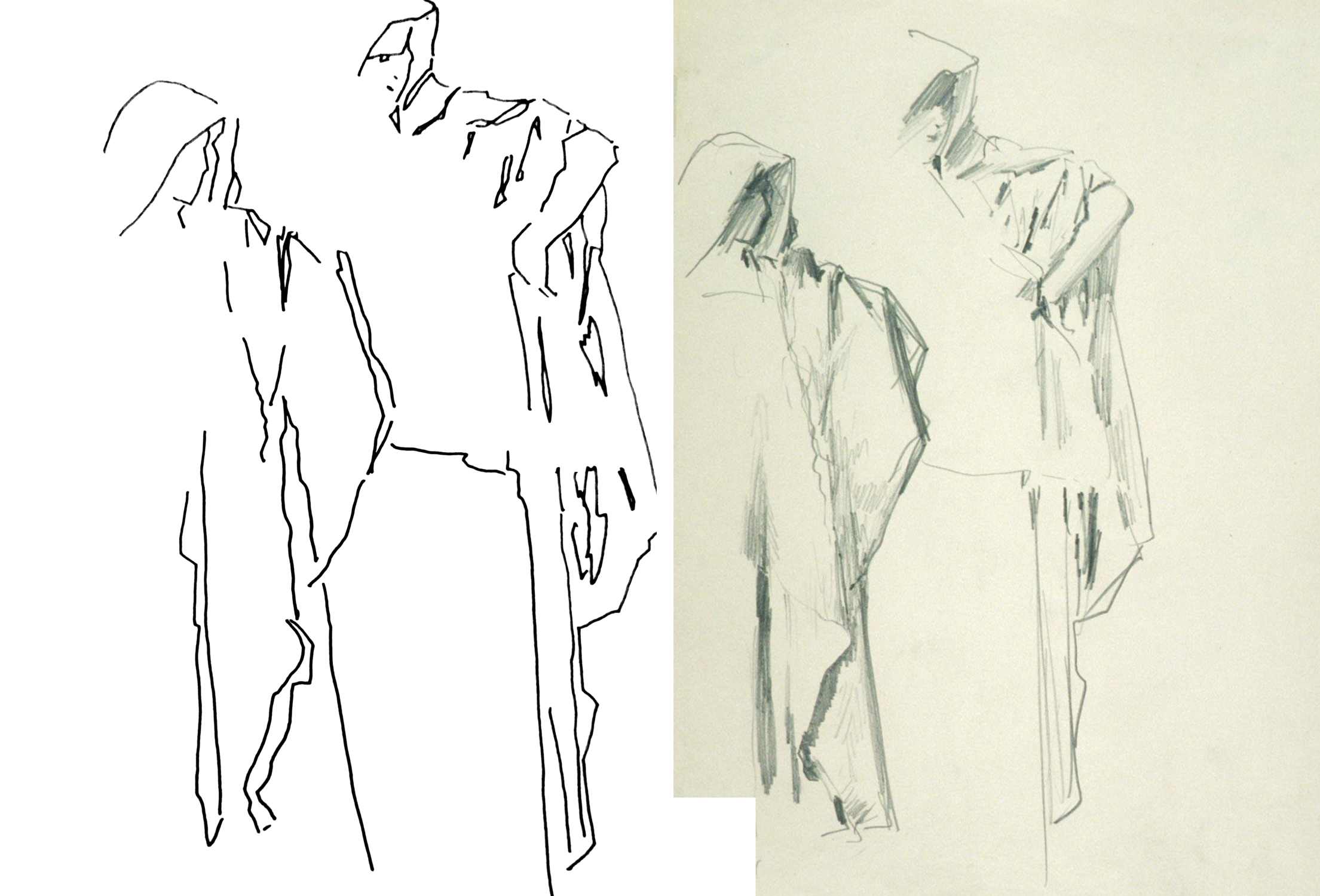
 Left: my tracing, Tuesday 8 September. Right: John Singer Sargent, drapery studies of an Arab woman, c. 1890–91 — graphite on wove paper, one side of a sheet also worked in charcoal, sheet 33.3 × 24.8 cm, Philadelphia Museum of Art (Gift of Miss Emily Sargent and Mrs. Francis Ormond, 1931). Public domain.
The tracing · Auction · Background
Sargent’s studies of drapery, for the Arab picture. The underlying proportion of the forms is remarkable: the shoulder, elbow, head, waist and legs are all anatomically precise, so the proportions come out beautiful, in the Loomis sense.
There’s a back-and-forth to some of these lines that ends up being convincing. A single faint bit of drapery here is crucial, and very precise — and then the shadows; but the main drapery line is obviously the one he drew first. The line above a shadow has to have come before the fill below it: the fills are jaggy, and they stop below the cloth boundary he had already drawn. He could have done it the other way round, but I don’t think the line would be as convincing. Towards the bottom of the left figure, this wave is very precise. There’s one on the right figure I think is just as indicative.
Then there are a lot of straight lines, and the face isn’t detailed — a bit of a placeholder, perhaps. This is a study of the drapery: he isn’t focusing on the face, but on how to make really good cloth. It’s almost as if the problem is something to do with anatomy — the upper body seems less direct than the folds lower down.
One thing he’s doing, at least with the hatching, is using the shade to pull the folds out. As I traced, it got more obvious that line alone would miss much of what he had depicted, and I had a way to capture the depth of the folds — following the ideas in Erin Meads’s The Quick Pose, but simpler. So I’m trying that more directly, to see what it does. That seems to have been his idea. This long line on the left is nice; he’s getting the length of the figure almost for free.
I got a fair amount of the value in this tracing; I liked this one. Then it’s just the hair. Basically an overall silhouette line is all that’s left to do.
That’s about it for Sargent — he’s using repeated strokes to get that cut into the cloth. These stand on their own, too, as fine studies of drapery.
Auction. Sargent’s working drawings rarely come to market. When he died in 1925 the contents of his studio passed to his sisters, Emily Sargent and Violet Ormond, and over the next thirty years they gave the drawings away — hundreds of them, to the Tate, the Fogg, the Metropolitan, the Museum of Fine Arts in Boston, and the Philadelphia Museum of Art, which is how this sheet reached Philadelphia in 1931. What circulates instead is the commissioned charcoal portrait heads he made by the hundred after 1907, and the watercolours.
When a study does surface it can be startling. In 2026 Christie’s put Sargent’s charcoal Study for “Carnation, Lily, Lily, Rose” into a London evening sale with an estimate of £3–5 million — a painting-level figure for a sheet of charcoal. For scale, the auction high for a Sargent is about $23.5 million, paid for the 1905 oil Group with Parasols (A Siesta) at Sotheby’s, New York, in 2004.
Background. In the winter of 1890–91 Sargent went to Egypt. He was beginning to plan the mural cycle for the new Boston Public Library — Triumph of Religion, whose first installed section, in 1895, would be a frieze of standing Hebrew prophets — and he travelled to study the ancient Near East and its people first-hand. In Cairo he drew and painted constantly: the watercolours and oils of Egyptian and Bedouin women at the Metropolitan and elsewhere come from this trip, and so do sheets of drapery studies like this one — how heavy cloth hangs off a standing body, folds, and takes the light.
Drapery was the governing problem of that frieze — a row of robed figures, read from a distance and from below — and Sargent worked at it the way these sheets show: the main contour laid down first and fast, then a searching second line beside it, then hatching used less as shadow than as a way to lift the folds off the paper. The faces are barely there.
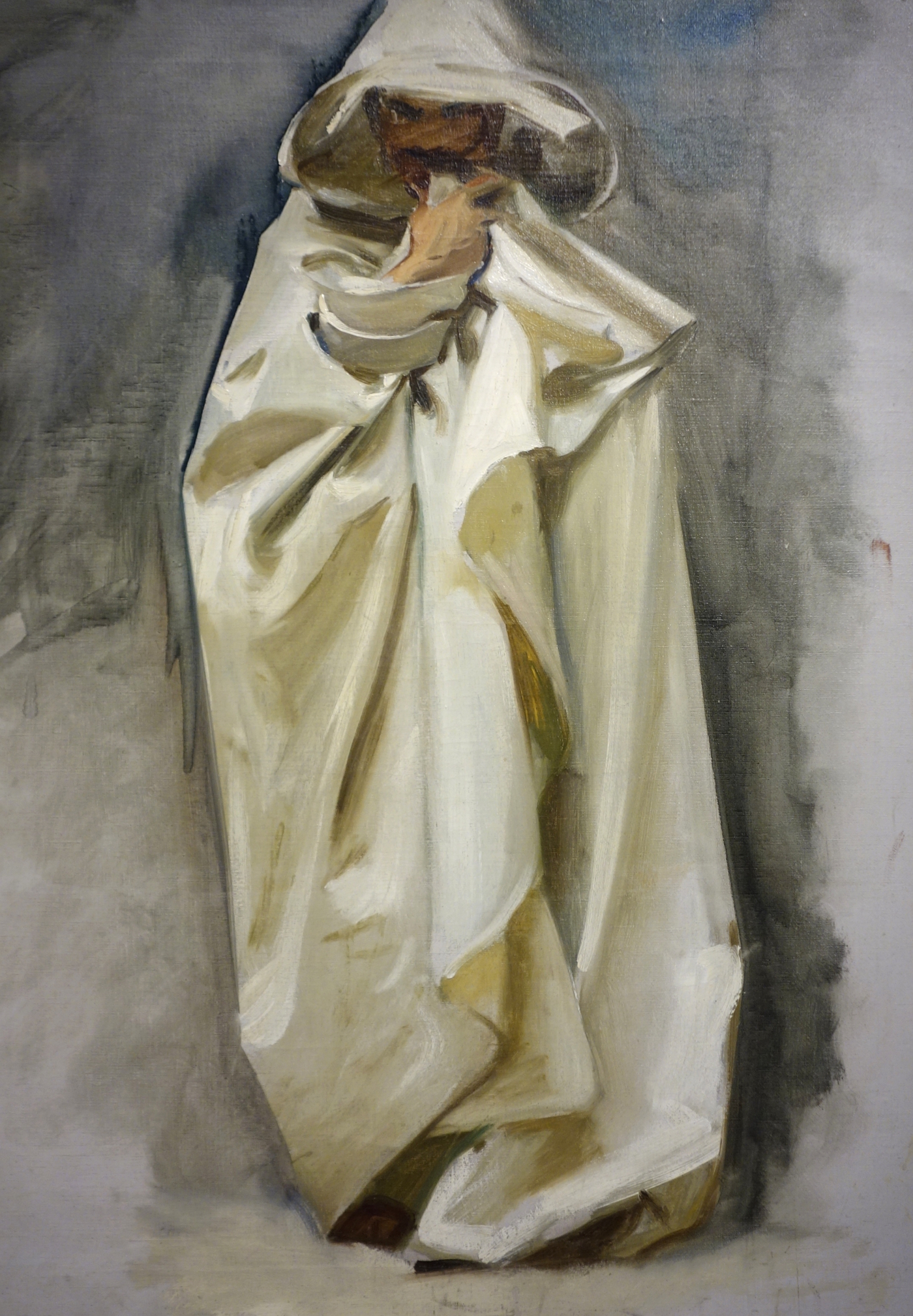
What it fed: John Singer Sargent, Robe of the Prophet Hosea, an oil study for the Frieze of Prophets at the Boston Public Library (installed 1895) — Fitchburg Art Museum. Public domain. The figure is almost entirely cloth; the head is turned away.
.JPG)
The scholarship on the murals — Sally M. Promey’s Painting Religion in Public (Princeton, 1999) is the standard account — traces the cycle from Sargent’s first thoughts around 1890, through the research trips, to a contract in January 1893 and the 1895 installation. The Harvard Art Museums hold prophet studies with drapery worked on their versos: the same working habit as this Philadelphia sheet, which is drawn on both sides.
The sheet is one of hundreds of studies that Emily Sargent and Violet Ormond distributed to museums after their brother’s death; its Philadelphia accession number, 1931-14-5, dates the gift to 1931.
Links
- Study of Drapery (Arab woman) — Philadelphia Museum of Art — the sheet traced here (PMA 1931-14-5), drawn in charcoal on one side and graphite on the other, c. 1890–91, public domain
- John Singer Sargent’s Sketches for His Triumph of Religion Murals — Boston Public Library — on the mural cycle and its preparatory drawings
- Study for the Frieze of the Prophets (recto and verso) — Harvard Art Museums — a comparable sheet, with drapery studies worked on the verso
- Robe of the Prophet Hosea — Wikimedia Commons — the oil study at the Fitchburg Art Museum
- The John Singer Sargent Archive — Museum of Fine Arts, Boston — on the studio contents and their distribution by the artist’s sisters
- Erin Meads — her book The Quick Pose: A Compilation of Gestures and Thoughts on Figure Drawing; I borrowed her way of filling in the depressions along a form’s waves, and used it on the folds here
- Process video — Tuesday 8 September — YouTube