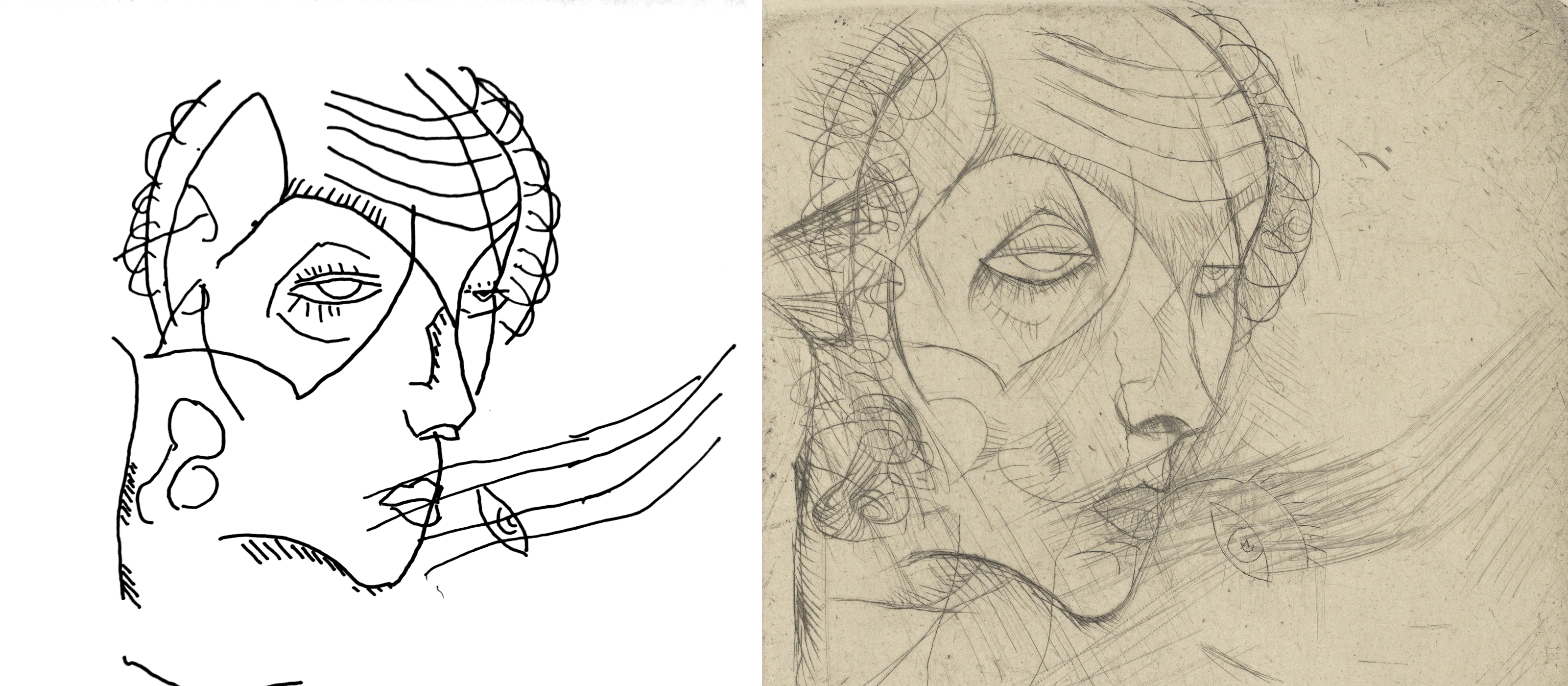
 Left: my tracing, Saturday 5 September. Right: Egon Schiele, Selbstbildnis (Self-Portrait), 1914 — drypoint, plate 12.7 × 10.7 cm, The Metropolitan Museum of Art (Bequest of Scofield Thayer, 1982), from the portfolio Das graphische Werk von Egon Schiele (The Graphic Work of Egon Schiele), 1922. Public domain.
The tracing · Auction · Background
This is a self-portrait of Egon Schiele, at the Met — quite striking and mainly lines. Maybe it was even a kind of scratch work, this eye floating away — but it produces an interesting effect, maybe not. No scratchwork, though, because of the extra eye that appears to float, perhaps out of the mouth.
The bottom eyelids are very dark, at least on the right eye, with a lot of lines coming off it. The left eye is clipped by the nose. There’s a strong nostril, and the upper lip has some undulations.
Then these sculpted lines, a lot of hatching — and these nose-type lines: one running from past the right eye, through the eyebrow, down to the top of the nose. The face planes are lined with curves.
These hatchings give the face some directionality. He’s lightening and darkening his lines more, but I’m just using a single fineliner — so he can distinguish his main lines from the secondary ones. A rather abstract drawing, the forehead lines catch some form. I think they’re stylistic, indicative of age and wear; they contribute to the old, tired expression. I was afraid they would make mine look even more like an alien. He has the iris and everything in there, which I suppose I should add and check. The other thing I missed was that triangularity around the eye, that is quite interesting as it is geometric and abstract but has a human curve also.
An interesting piece; I’m not sure what the takeaway is. It took me a moment, but then I said: it’s the expression. This is an abstract drawing, but it’s all about the expression — his, and even mine, still has that certain very human expression.
Maybe being a print made it harder to work with. I’ve tried some block printing with a Speedball set, and it’s very different from drawing — interesting, but an entirely different skillset, and not one I think can be expressive without focus, practice and time.
Auction. The rarity is the whole story. Schiele made six drypoints, all in 1914, and published none of them; what circulates is the 1922 portfolio of eighty. Single sheets from it — this self-portrait among them — turn up at Christie’s, Sotheby’s, Bonhams and the print specialists fairly often; a complete, intact portfolio of all eight prints is the lot that draws the real attention.
For scale, one of the highest prices ever paid at auction for a Schiele work on paper went to a different kind of object entirely: Selbstbildnis mit kariertem Hemd (Self-Portrait with a Checked Shirt), a 1917 gouache, which made $11.35 million at Sotheby’s New York on 7 November 2007.
Background. Schiele scratched this plate in 1914 and never printed it. It is one of only six drypoints he made — the whole of his work in the medium, all from that one year — on plates supplied by his dealer and champion Arthur Roessler. Schiele died of influenza in October 1918, aged 28; four years later Otto Nirenstein (later Otto Kallir) gathered the six drypoints and Schiele’s last two lithographs into the portfolio Das graphische Werk von Egon Schiele (Rikola-Verlag, Vienna, 1922), an edition of eighty. Almost every impression of this self-portrait (Kallir 4) is one of those eighty.
The Met’s sheet came from Scofield Thayer — editor of the American magazine The Dial, and one of the first Americans to collect Schiele — whose art collection was bequeathed to the museum.
Links
- Process video — Saturday 5 September — YouTube
- Selbstbildnis — The Metropolitan Museum of Art — the drypoint traced here (Met 363671, acc. 1984.1203.198.7), from the 1922 portfolio, public domain
- Das graphische Werk von Egon Schiele — The Museum of Modern Art — the 1922 portfolio: six drypoints and two lithographs, published by Rikola-Verlag in an edition of eighty
- Selbstbildnis, from the portfolio — The Museum of Modern Art — MoMA’s impression of the same drypoint
- Egon Schiele as Printmaker — Galerie St. Etienne — on the six 1914 drypoints, Roessler’s plates, and Otto Nirenstein’s 1922 publication
- Egon Schiele — Wikipedia — life, the 1918 death, and the print work