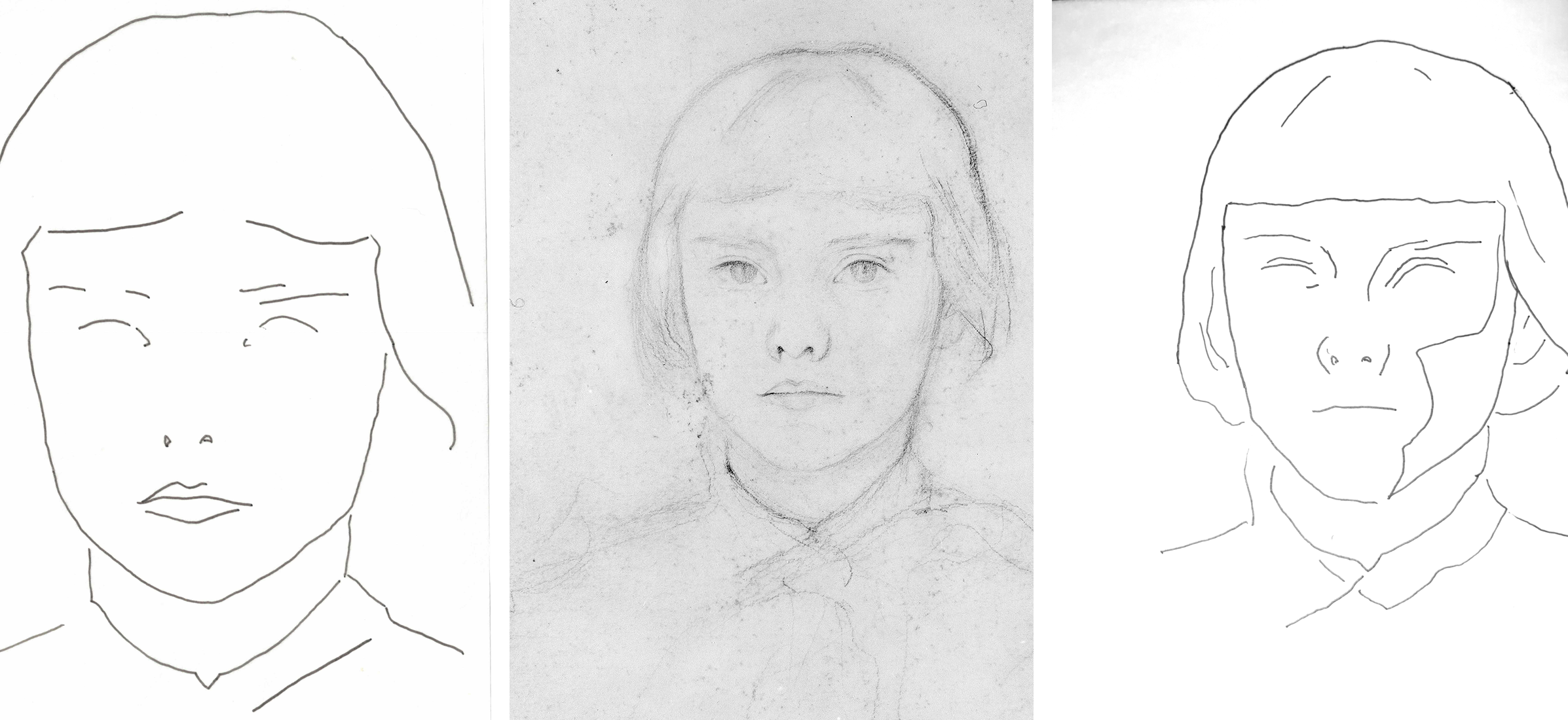
 Left: my first tracing, Saturday 11 July. Center: John Singer Sargent, Violet Sargent , ca. 1883, graphite on off-white wove paper — The Metropolitan Museum of Art (detail). Right: my second tracing of the same sheet, Wednesday 23 September. Public domain.
The tracing · Auction · Background
This is Violet Sargent, John Singer Sargent’s younger sister. It’s one of my favorite drawings, I think. I’ve posted this on the blog before — There’s more to learn here for me, it’s something to do with her expression.
It’s also hard to see, because it is kind of faint. It lends itself to tracing minimally, because I can’t really see it very well.
Coming back to the same sheet a second time, I noticed the inner corners of the eyes I’d missed before, and might suggest more of their shape next time. This time I reversed the screen and picked up more lines, but I actually prefer my previous one — simpler and more fundamental. This one has some extraneous geometry that isn’t about her expression and her eyes.
Her iris is quite important to him, and I leave it off habitually. Perhaps I’m drawing masks rather than direct gazes. It’s possible that for this one, the iris may be fundamental to going past my earlier tracing.
Now, tracing the sides of her nose, to bring some more balance, this is the line to follow on the cheek, because I do think the sides of the nose were more than I expected. So I need a corresponding level of dimensionality on the cheek.
That cheek line is the decision that’s always there whenever we’re not photographing — everything is a decision, every line. The fineliners I use aren’t the thinnest I have, I’m picking a line with a constant, discernible, non-minimal weight, and I choose where to spend it.
For him, the collar was important to set off the neck, but it’s secondary — value itself isn’t primary, even when there are many values to work with.
This one has a naturalness to it, but he’s depicting more than a photograph of her would — his decisions around the eyes, the expression, the face, control minute aspects of the depiction. And looking at both of mine, I do think the balance in my earlier tracing was closer to what I actually wanted to capture. This time I was led astray by seeing more values instead of exercising judgement.
Auction. This drawing has never been sold. It went from Violet to the Met, where the credit line still reads Gift of Mrs. Francis Ormond, 1950. For scale only — an oil, not a drawing — Sargent’s Group with Parasols (A Siesta) (1905) sold in December 2004 against a Sotheby’s estimate of US$12 million for a price realised of US$23.5 million (Wikipedia).
Background. Violet Sargent, ca. 1883, graphite on off-white wove paper, 47.8 × 35.4 cm, is in the American Wing of The Metropolitan Museum of Art (accession 50.130.87). Violet was born on 9 February 1870 (Wikidata), so she was about thirteen here, and her brother about twenty-seven.
It isn’t the first time he drew her. The Met also has Sleeping Child, possibly Violet Sargent, ca. 1872–73, a small graphite sketch from when she was two or three and he was a teenager. Both came to the museum as her gift, in 1950. She married Louis Francis Ormond, travelled with her brother on his summer trips to the Swiss Alps (Wikipedia), and died in 1955.
Links
- Violet Sargent — The Metropolitan Museum of Art — the master image (Open Access) and the 1950 Ormond gift
- Sleeping Child, possibly Violet Sargent — The Metropolitan Museum of Art — the earlier sketch of her, ca. 1872–73
- Violet Ormond — Wikidata — dates, marriage
- John Singer Sargent — Wikipedia — biography and auction figures
- Process video — Wednesday 23 September — YouTube
- Sargent’s Violet, in pencil — my first tracing of this drawing, July 2026