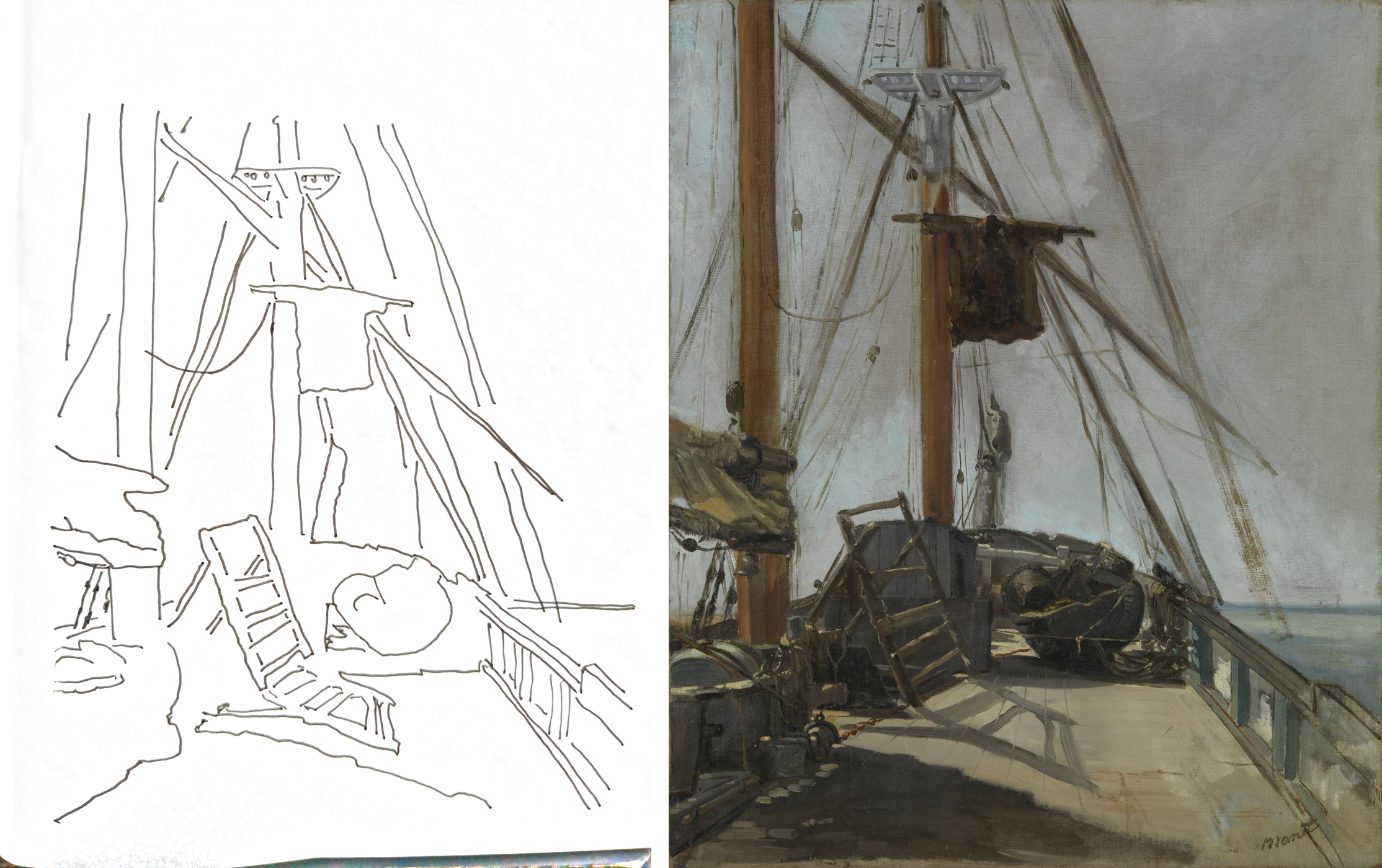
 Left: my tracing, Tuesday 22 September. Right: Édouard Manet, The Ship’s Deck , c. 1860 — National Gallery of Victoria, Melbourne. Public domain (Manet d. 1883).
The tracing · Auction · Background
Okay, Manet’s The Ship’s Deck. He’s one of my favorite painters — didn’t know he did ship’s decks. I wasn’t familiar with this picture at all; I mean, the Folies-Bergère I’ve seen at the Courtald in London, I’ve since been struck by her expression which seems jarring to me almost against the patron’s interaction.
This one I thought would be an interesting exercise, just because it involves so many lines, and has this interesting shadow stuff — shadows all over the deck, actually. And then this sort of odd sail — it almost looks like a shirt. And a crow’s nest.
So I guess the following: we’d want a vertical line, and I also kind of want to see how much I can simplify this. I don’t intend to trace it literally, but I do like the motion and the action of the ropes. And then the horizon line — interesting that we have a small slice.
Looking at all those ropes now, I don’t think I was drawing them the way I might in a more stylized, patterned piece — I wasn’t reasoning about it that deeply in the moment. I was just taken by a sense of motion in Manet’s painting itself. I almost felt like I could feel the boat moving, the bow going up and down with the waves. But my tracing is simpler, doesn’t capture that.
A rack — I’m not sure what it’s a rack for, but it’s the one that casts the shadows. Its upper edges — these little bars that go across — have light falling on them, which of course would be great to be able to delineate.
An engraver would cross-hatch that kind of lit edge, but I don’t have a way to draw that, in line — except sometimes to trigger the imagination, or draw a searching line that suggests the passage and relation of light and shadow, which might work on a figure or a portrait, but here it feels too technical, with too many geometries at once.
But the other most important thing to draw is the rest of this hull, or bow. For the shadows on the deck, I would love to do them in one pass — I think they’d read better as shadows that way. That said this rack, which I wanted to depict the shadow of, and which I have traced, has an important lesson, here it looks to me almost like some kind of a shortened lounge chair.
Its shadow in the deck isn’t reading, whereas in his original it’s marvelous, if perhaps slightly off if we trust my tracing. It’s marvelous because its lighter value on the deck, but my line constraint can’t capture that. Try as I might to have a single line of the shadow on the deck, the chair’s shadow is not a single line and so needs something else, I don’t know what, perhaps a detachment of the shadow, a gap, from the chair’s lines?
That chair is really the whole question of how much of this is drawing underneath the paint versus paint and tone alone — and I think it’s the second one. He’s using paint and tone structurally and fundamentally, the way that chair shows. What I’m doing in line is a fundamentally different and simpler thing than his light and tone.
It’s crossing a lot of the visual area, these ropes. These little knots on this lower rope are nice. A folded-up or rolled-up sail on the front of the boat. And more ropes. Ships of his day involved a large number of ropes, to get the sails up and down. He actually sailed on a ship like this one himself, years before he painted it, and I think that shows — there’s a real familiarity here with the folds and the drapes and the ropes, subtle and accurate.
And then the crow’s nest — the lookout tower. Alright, I think this is all fine — this curved rope. I think the exterior-most ropes are probably interesting or important, because they’re kind of the end boundaries of things, other than this big sail.
I was thinking about Frank Ching’s way of ranking lines while I worked out which ones here actually mattered, but I think I ended up with something a bit different, maybe even weaker — the bundle on the deck just past the rack, for instance, comes out pretty nondescript. I think it does help to know that this is a sail, because it’s hard even to know what it is that’s underlying this.
Auction. The Ship’s Deck itself last changed hands at Christie’s, London, on 2 July 1926 — lot 13 in the sale of the collection of John James Cowan, bought there for the National Gallery of Victoria via the Felton Bequest. No price for that sale survives on an allowed source, so none is given here. For scale: Manet’s Spring (Le Printemps, 1881) — a very different, much later, finished Salon portrait — sold via Christie’s in November 2014 to the J. Paul Getty Museum for more than US$65 million, the auction record for the artist, surpassing the previous record of US$33.2 million set by Self Portrait with a Palette in 2010. Not on point for this small early deck study, but useful context for where Manet’s market sits.
Background. The Ship’s Deck, painted by Édouard Manet around 1860, hangs at the National Gallery of Victoria in Melbourne (oil on canvas on wood panel, 56.4 × 47.0 cm, Felton Bequest 1926). It came to the gallery from the collection of John James Cowan of Edinburgh, sold at Christie’s, London, on 2 July 1926.
The NGV’s own catalogue ties the painting to a real voyage: Manet sailed as a junior helmsman on a training vessel bound for Rio de Janeiro in 1848, after twice failing the exam to join the navy — a trip Wikipedia’s biography confirms independently, adding that it was at his father’s suggestion, and that his father only relented to an art education after the second failed exam. So this small, early deck study comes from an artist who had actually stood on a ship like this one, handling rigging like this one, more than a decade before Olympia or Le déjeuner sur l’herbe.
Links
- National Gallery of Victoria — The Ship’s Deck, Édouard Manet, c. 1860 — the master image, catalogue data, and public-domain statement
- Édouard Manet — Wikipedia — biography, the 1848 Rio de Janeiro voyage
- Spring (Manet) — Wikipedia — the $65 million Getty acquisition, the Manet auction record
- Process video — Tuesday 22 September — YouTube