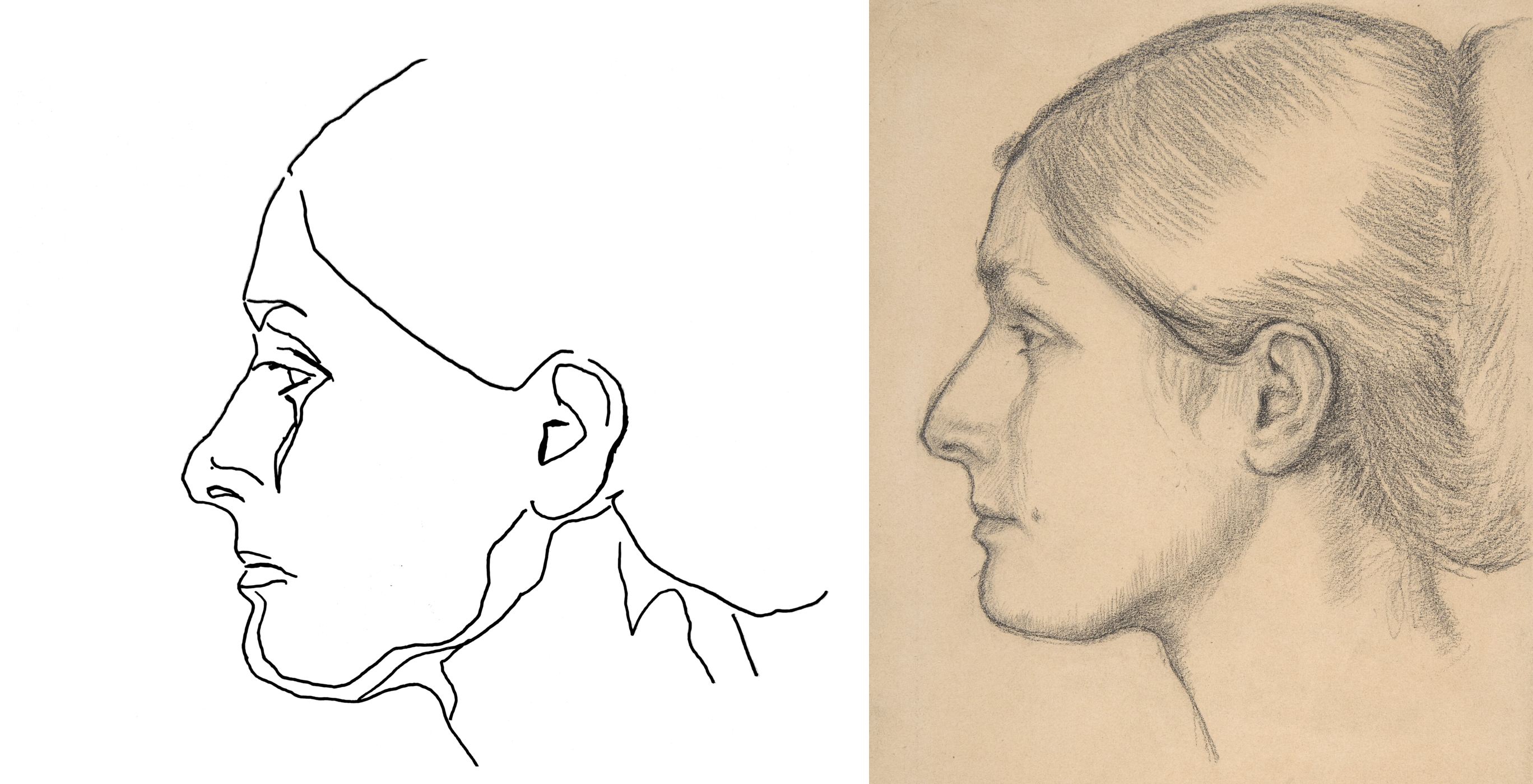
 Left: my tracing, Sunday 6 September. Right: Edgar Degas, Portrait of Hortense Valpinçon (Mme. Jacques Fourchy), 1883 — black conté crayon, 25 × 16.3 cm, The Metropolitan Museum of Art (Bequest of Walter C. Baker, 1971). Inscribed by Degas lower right: “Hortense / Ménil-Hubert / août 1883.” Public domain.
The tracing · Auction · Background
Degas, precisely anatomically convincing. There’s hatching, and a smudge or a shade — but all very precise.
It has that outside-to-in property I last saw in Klimt’s Brustbild — the outer line searches a little, then finds the inner line and commits to it, and from there into the whitespace the anatomy is precise. Her chin has a faint extra line slightly further out, would have worked either way. Degas is already so close to the exact forms that he’s searching very little. The back of her neck is very soft.
Strange — even as I draw the first few lines, there’s a lot of the anatomical information, just from the level and the quality of his primary lines.
As I’m drawing the silhouette, it also reminds me of a tracing I did once of a Sargent. I found another I may do soon — a Madame X study. So this is where it sits: it’s just lines, as Ingres advised Degas — even if what Degas is best known for is not line but the hazy paint.
And so I got pretty far with line. But Degas has much more with his fine shadings — finer, more detailed information about the form of her face, the planes, the cheek, the jaw — and done it so well. I also made her a frown a bit, unfortunately.
What is the point of any given line? Here I think each one does have a point, and then there’s the question of balance — whether to keep adding, or to resolve what’s already there, especially at the front of the face. It’s the falling away of the cheek.
I try the nose. It helps a little. Then I start hatching — he is doing all this hatching — and the heaviest line turns out to be here. Her eyelashes are special.
Finally I felt I’d over worked it, but then adding weight, surprisingly, helped. When it was all a single line it was confusing. He draws the silhouette quite heavily, and I leave that; but an extra weight at the ear, and then into the depth. Even that much contrast from the line weight helps. Adding it is a little further than the idea of just the lines, but I don’t think it really loses anything — and it gives illustrative education, since it makes a better image.
The line at the front of the cheek looks good on its own, but on its own it’s confusing. Degas draws it as a lighter tone; when I trace it as a pure line I have only one value, so it merges with everything else. Munch blended things, but not quite in this way. That line ends up reminding me of Tonnis’s warrior #17 — not on purpose; it came from tracing the tone at the front of the cheek perhaps too literally, as a line.
Auction. Degas kept most of his own work and rarely sold a drawing; the market for his works on paper effectively opens with the four sales of his studio at the Galerie Georges Petit, Paris, held between May 1918 and July 1919 — some 1,500 lots.
The two 1883 portraits of Hortense went opposite ways. This conté sheet stayed in private hands and reached the Met in 1971 with the drawings collection of the New York collector Walter C. Baker. The other — a pastel and graphite version from the same sittings — sold in the fourth studio sale in November 1918, passed through Marcel Guérin and other Paris hands, belonged to Paul Mellon by 1967, and entered the National Gallery of Art in Washington in 1995.
For scale: the auction high for a Degas work on paper is Danseuse au repos, a pastel that sold at Sotheby’s New York in 2008 for $37,042,500.
Background. The sheet is inscribed, lower right, “Hortense / Ménil-Hubert / août 1883” — drawn in August 1883 at Ménil-Hubert-en-Exmes, the Normandy estate of the Valpinçon family. Paul Valpinçon had been Degas’s friend since the Lycée Louis-le-Grand, and from 1861 Degas spent his summers there, drawing his first horses at the nearby Haras du Pin and a household full of sitters. He had already painted Hortense, Paul’s only daughter, as a child — Portrait of Mlle. Hortense Valpinçon (c. 1871, Minneapolis Institute of Art), on a remnant of mattress ticking, for want of a canvas. This conté-crayon profile is the same sitter, grown up; she later married Jacques Fourchy, hence the museum’s “Mme. Jacques Fourchy.”
The Valpinçons matter to Degas’s line in one more way. The Ingres nude in the Louvre now called the Baigneuse Valpinçon (1808) belonged to Paul’s father, Édouard — it carries the family’s name from its owners, not its model; Ingres painted it in 1808, half a century before Hortense was born. In 1855 Édouard was talked into lending it — by the young Degas, an ardent admirer, among others — to the Ingres retrospective at the Exposition Universelle, and took Degas along to the studio to return it. The advice Degas carried away, and told and retold all his life, was to draw lines — “Faites des lignes, jeune homme, beaucoup de lignes,” many lines, from memory or from nature. The family whose daughter he is drawing here, in line, is the same family that put him in front of that sentence.
Links
- Process video — Sunday 6 September — YouTube
- Portrait of Hortense Valpinçon (Mme. Jacques Fourchy) — The Metropolitan Museum of Art — the drawing traced here (Met 334310, acc. 1972.118.205), public domain
- Edgar Degas — Wikipedia — the 1861 first visit to Ménil-Hubert and the earliest horse studies; the 1855 meeting with Ingres
- The Valpinçon Bather — Wikipedia — the Ingres nude, painted in Roma in 1808 and named only later for the Valpinçon family who owned it; the model is unidentified and was not Hortense, born more than fifty years after
- Degas, Danse, Dessin: A Tribute to Degas with Paul Valéry — Musée d’Orsay — on Valéry’s 1936 book; the “faites des lignes” advice survives only in Degas’s own retellings late in life, the wording varying between them, and Valéry’s is the version most quoted
- Portrait of Mlle. Hortense Valpinçon — Minneapolis Institute of Art — the c. 1871 childhood portrait of the same sitter, oil on mattress ticking (acc. 48.1). In a 1930s interview Hortense said Degas arrived without a canvas and was handed the ticking; historians doubted it until a 1996 examination found blue-and-white striping at the taped edges of the canvas
- Hortense Valpinçon (pastel, 1883) — National Gallery of Art — the companion portrait from the same sittings; sold in the 4th Degas studio sale (1918), later in the Paul Mellon collection, to the NGA in 1995
- Catalogue de la 1ère vente de l’atelier Degas, 6–8 May 1918 — INHA — one of the four Galerie Georges Petit studio-sale catalogues that opened the market for Degas’s works on paper
- Danseuse au repos — Sotheby’s, New York, 3 November 2008 — the $37,042,500 pastel, the auction high for a Degas work on paper