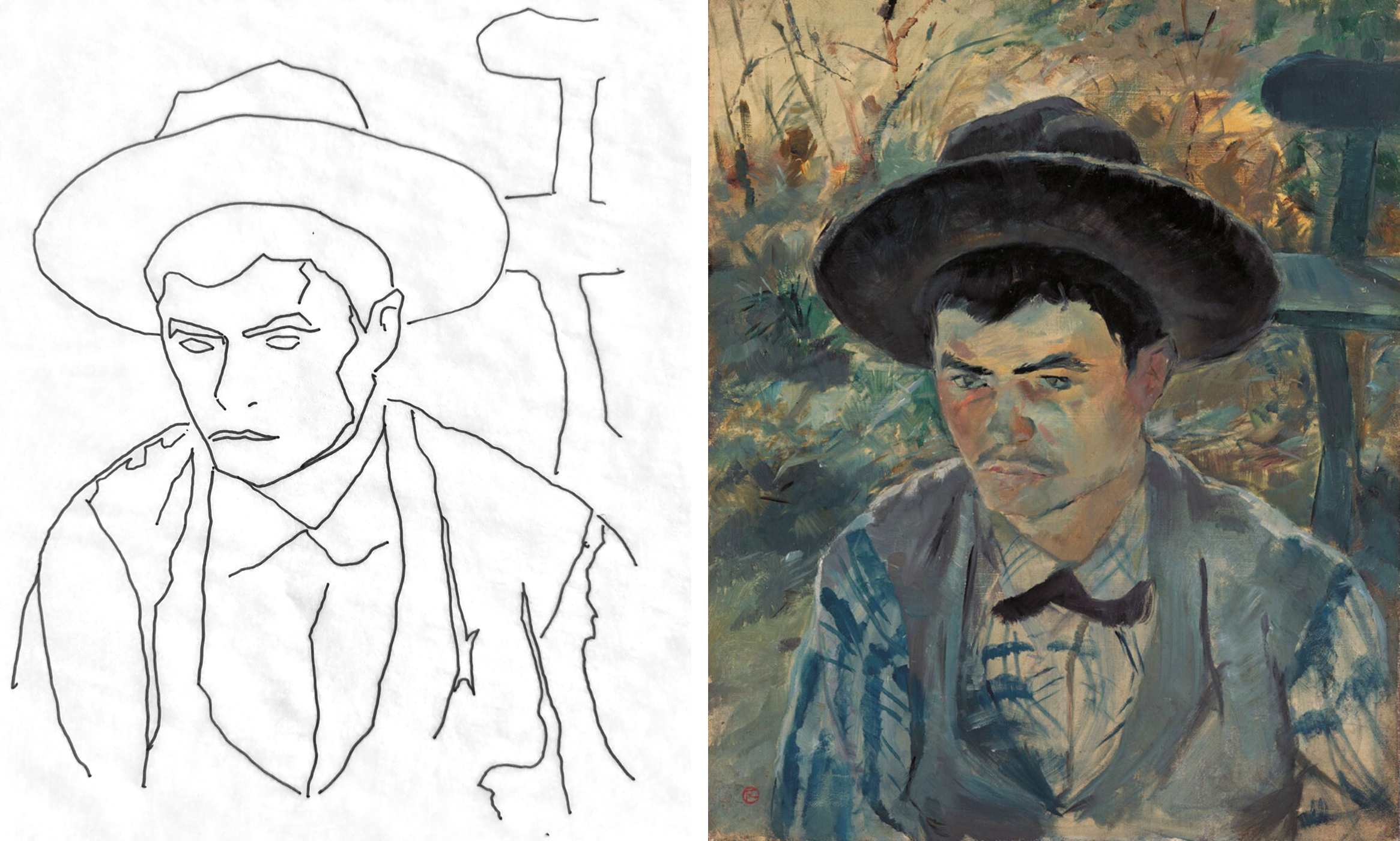
 Left: my tracing, Friday 11 September. Right: Henri de Toulouse-Lautrec, Der junge Routy auf Schloss Céleyran (Young Routy at Céleyran), 1882 — oil on canvas, 61 × 49.8 cm, Neue Pinakothek München (inv. 14928/ESK 2). CC BY-SA 4.0.
The tracing · Auction · Background
This is a portrait by Toulouse-Lautrec — an early one. Before this there was a lot more of pastoral scenes, military scenes, horses — that’s the early style, like his father driving a mail-coach, painted a year earlier, in 1881, itself modeled on equestrian scenes by Crafty, the French illustrator who specialized in horses and hunting. This early portrait has a certain force, especially in the gaze.
The hat is quite interesting, and the eyes have a very specific geometric quality — very carefully finalized here. The lower lip is blended away; he was using paint there. Interesting how straight some of these lines are around the jaw. I think the first interest is this hat, and then the shoulders and the drapery too — I’m sticking with some of the main locations here.
The eyes here are a lesson in themselves — almost the opposite lesson: yes, we’ve got our lines and we can add more, but this is a lesson in how much he accomplishes with this muted palette of his. It feels out of my scope — with lines, the lesson is it’s not going to be possible to capture this part of the face, and so the core of this work.
The top of the lip is interesting too. The bottom lip is disappearing, but the top lip has this mustache, maybe some stubble, that helps give its shape. What line could add a little more to these remarkable eyes? There’s one that could go where the left eye meets the top of the nose — that’s the darkest value — but I don’t think that’s the incremental line that will make a difference.
On the contrary — I’ve seen repeatedly adding something like that can change the meaning of the lines. Right now the lines mean something at a global level, and that dark value is a very localized shadow at the inner corner of the left eye socket, where it meets the nose. A line there could work, but I suspect it’s really the ridge of the nose — there’s very little nose here, just a bit of a nostril; that helps. Instead of the dark value, this nose portion needed more; there’s still a bit we’re not completely getting about the shape of the face. I’m pleased with that.
I wonder about the top of the lip, but I don’t want to mess that up. The only other thing that comes to mind is this side of the face, or something more aggressive around the eyes — maybe a line from above the eyebrow into the eye, because the eyes pull a lot of power back out toward the cheekbone. Sometimes it’s possible to hit this upper-nose area too.
There’s the chair, and an interesting weed or something — though I think that weed could unbalance things. The bulge in the vest is interesting too — there’s a lot of nice drapery down here
Auction. This canvas has been in the Neue Pinakothek’s collection since 1985 and isn’t itself a market data point. For scale: the auction record for a Toulouse-Lautrec painting is $22.4 million, paid for La Blanchisseuse (“The Laundress”), 1886–87, at Christie’s New York in November 2005 — still the record as of this writing. That’s a mature Montmartre-period work, a different world from this 1882 estate portrait: a laundress model painted in Paris, four years before Toulouse-Lautrec’s own arrival there, versus a farmhand painted in his family’s back garden.
Background. Toulouse-Lautrec painted this at Château de Céleyran, near Narbonne — his maternal grandmother’s estate, where the family vacationed and where he’d already been painting since around 1880. Routy, a farm worker on the estate roughly Lautrec’s own age, became a favored subject during these stays, appearing in earlier paintings of estate staff before this one.
A different, separate painting from the same Céleyran period exists too — not a study for this canvas, a distinct work in a different museum: Le jeune Routy à Céleyran, also 1882 (per Albi’s own catalogue), showing Routy full-length, seated on a rock ledge, whittling something in his hands.
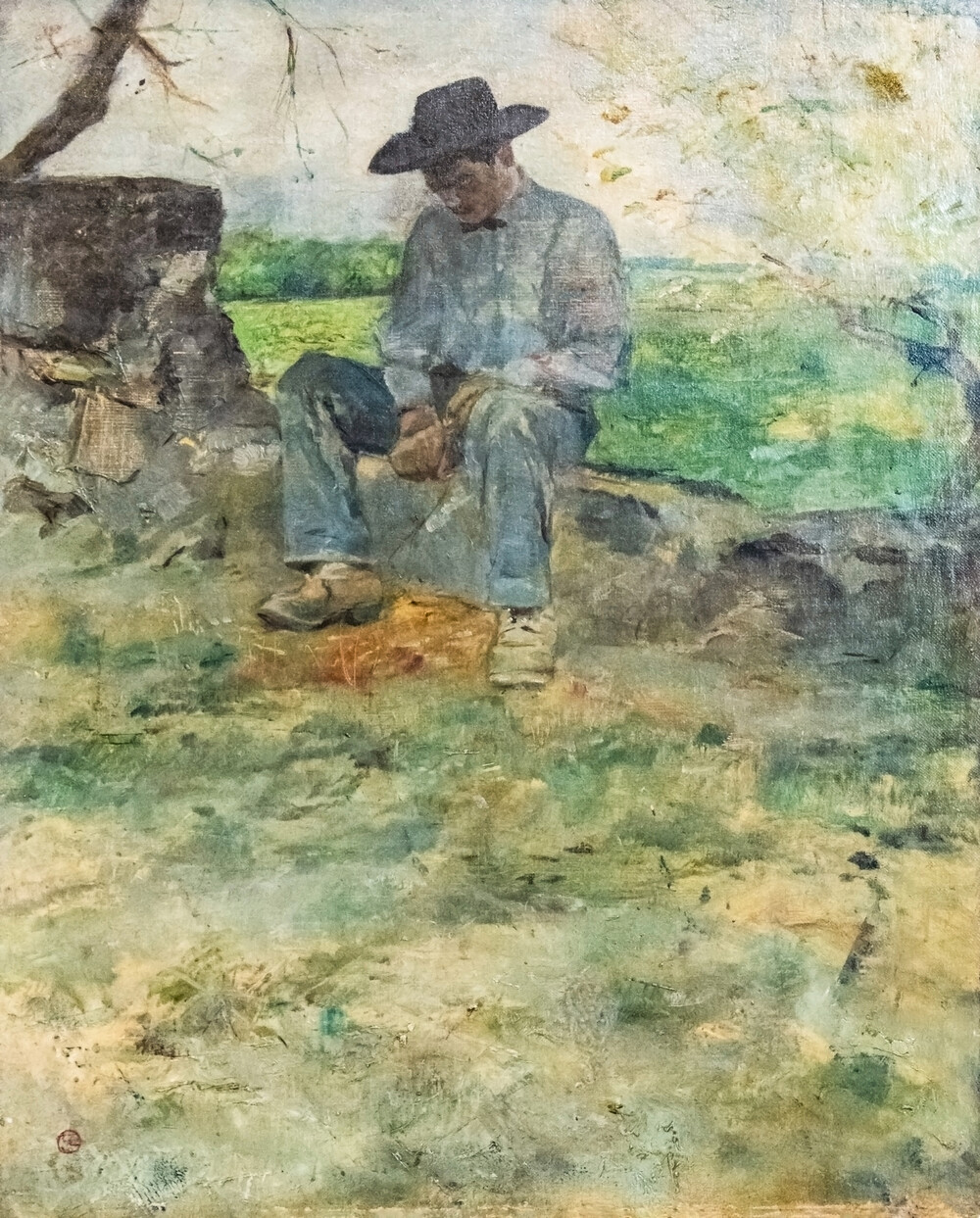
Henri de Toulouse-Lautrec, Le jeune Routy à Céleyran (Young Routy at Céleyran), 1882, oil on canvas, 30 × 49 cm — Musée Toulouse-Lautrec, Albi (inv. MTL.74). Photo: Didier Descouens, CC BY-SA 4.0, via Wikimedia Commons.
Per the Munich museum’s own account, the canvas traced here is the mature result of a series of preparatory studies — mostly charcoal sketches — with one drawing closely matching this painting’s final pose and expression. The museum describes very bright painting in direct and indirect light, sketchy brushwork giving a strong atmospheric quality: the boy seated at ground level, a bench and sunlit vegetation behind him, warm and cool tones set against each other. It also notes a restraint in the figure that may owe something to Manet’s influence — less typical of the caricatural turn Toulouse-Lautrec’s work would later take in Montmartre. Independently, the Web Gallery of Art places the painting in the same account: from the early 1880s, his work had “the brightness and the brief, easy brushwork of Impressionism” — the loose, light technique here, well before the darker, more linear style of his cabaret years.
The painting passed through several private hands across the twentieth century — an estate sale, a countess, a Berlin/New York collector, a Swiss bank — before the Bavarian State Painting Collections and the Ernst von Siemens Kunststiftung acquired it jointly in 1985.
Image credits & sources. The Bayerische Staatsgemäldesammlungen offer this digitisation of Toulouse-Lautrec’s Der junge Routy auf Schloss Céleyran (1882) under Creative Commons Attribution-ShareAlike 4.0 — not a public-domain claim (though the underlying 1882 artwork is public domain regardless, Toulouse-Lautrec having died in 1901), the museum’s own choice for this image. Because the source is CC BY-SA 4.0, the tracing/diptych in this post is offered under the same license: CC BY-SA 4.0, adapted from Henri de Toulouse-Lautrec, Der junge Routy auf Schloss Céleyran (1882), Neue Pinakothek München.
Links
- Der junge Routy auf Schloss Céleyran — Neue Pinakothek München — the painting traced here (inv. 14928/ESK 2), 1882, oil on canvas, CC BY-SA 4.0
- Le jeune Routy à Céleyran — Musée Toulouse-Lautrec, Albi (Musées Occitanie) — the separate, related painting (inv. MTL.74), 1882
- Image of the Albi painting — Wikimedia Commons — photo by Didier Descouens, CC BY-SA 4.0
- Count Alphonse de Toulouse-Lautrec Driving His Mail-Coach — Wikipedia — the 1881 painting of his father, the early “horses” style mentioned above
- Crafty (illustrator) — Wikipedia — Victor Eugène Géruzez, the equestrian/hunting illustrator whose scenes influenced the mail-coach painting above
- Toulouse-Lautrec’s early paintings — Web Gallery of Art — Routy’s identity and the Impressionist-brushwork context
- La Blanchisseuse — Wikipedia — the 2005 record-sale painting, for auction scale
- Process video — Friday 11 September — YouTube
_Le_jeune_Routy_%C3%A0_C%C3%A9leyran_-_Toulouse-Lautrec_-_1882.jpg)