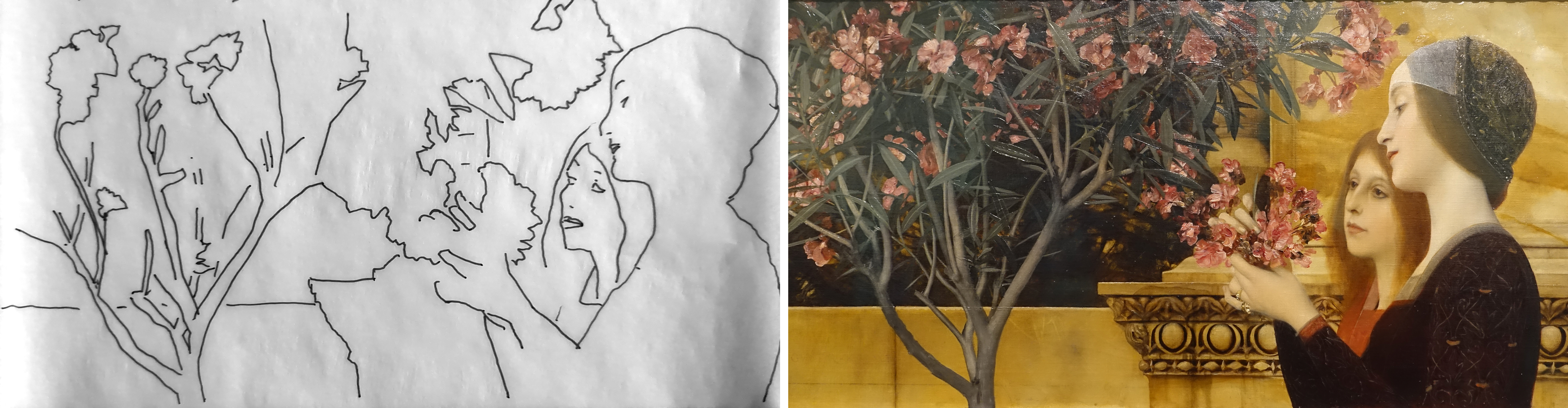
 Left: my tracing, Saturday 12 September. Right: Gustav Klimt, Zwei Mädchen mit Oleander (Two Girls with Oleander), c. 1890–92 — oil on canvas, Wadsworth Atheneum Museum of Art, Hartford, CT — The Douglas Tracy Smith and Dorothy Potter Smith Fund and The Ella Gallup Sumner and Mary Catlin Sumner Collection Fund, 1993.96. Public domain (Klimt d. 1918). Photo: Daderot, Wikimedia Commons, 9 December 2017, CC0 — taken at the Legion of Honor, San Francisco, during Klimt & Rodin: An Artistic Encounter (14 October 2017 – 28 January 2018); the painting’s home is the Wadsworth.

The tracing · Auction · Background
This is Klimt’s Zwei Mädchen mit Oleander — an early piece of his, in a style that was more realistic, obviously very different from the more famous work he’s known for.
I haven’t spent much time on this period of his, but it’s interesting to see the seeds, perhaps — the tilt of their heads, the use of the dress and the hands, beautiful yet perhaps arguably disconnected. The style struck me because of how different it was from the famous ones.
This is a study zoom-in of his composition: his has a little more space to the right, behind the girls, and more of the plant to the left, in the real painting. One thing I like about this one is that there are two profiles. And I like a lot the composition itself — it’s quite wide, the real one, a beautiful unusually wide painting, with breathing space on both sides. Zooming in gets me a little more detailed technical practice, but the composition was what was most initially surprising, and also the style.
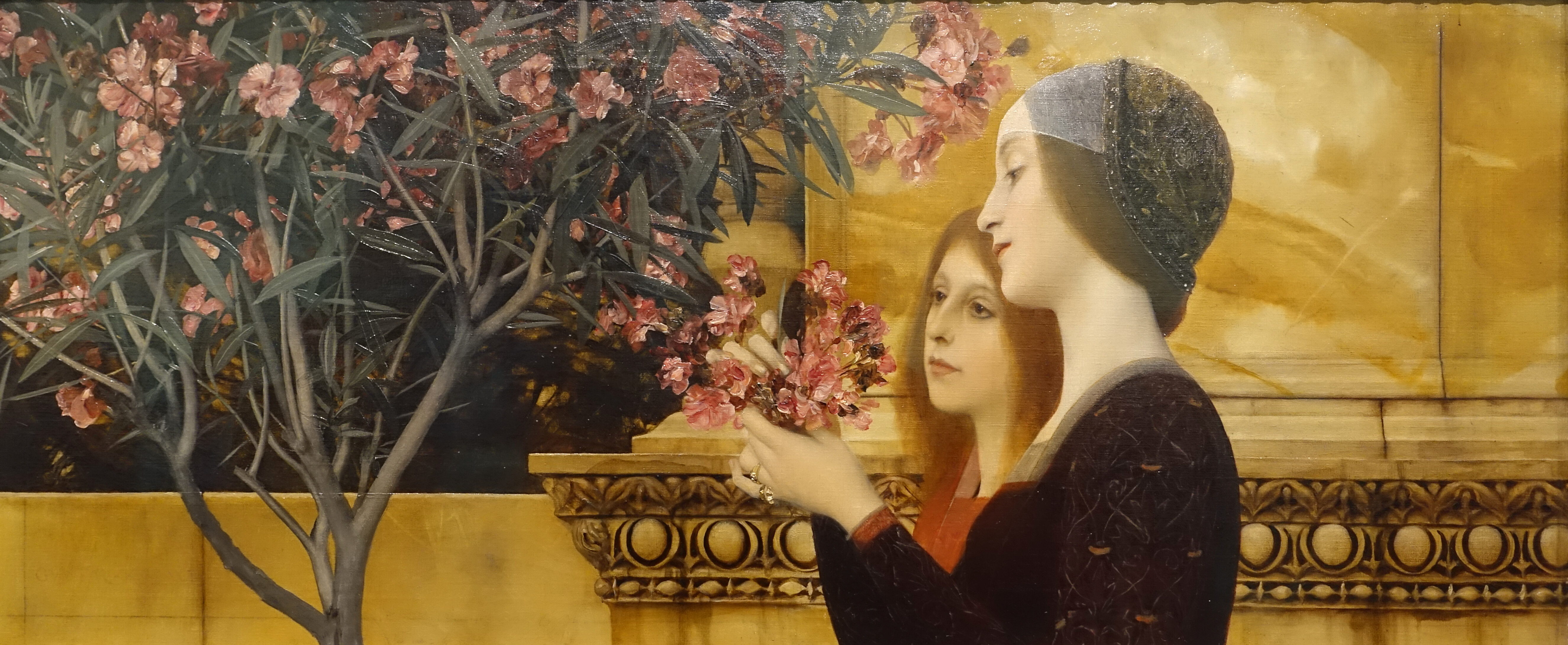 The full painting — the unusually wide format and the breathing space on both sides that I’m zoomed in past above. Same photo credit as the lead image: Daderot, Wikimedia Commons, CC0.
And then my question is how to represent this portion of the painting fairly minimally — so basic orientation to start.
One thing that’s kind of just hit me is that the closer girl’s head is ever so slightly turned away, and I think the head sort of tilts away perhaps even in Judith I (1901, Österreichische Galerie Belvedere, Vienna, one of the gold-ground works he became famous for, painted about a decade after this piece), though from the front. And the hands, and the clothes, in between, hiding the structure.

Their faces ahead-and-behind with how close they are, I do like that. I think what I was hoping for, I’ve gotten, as regards the faces.
The next thing is this big oleander, and — this one is trickier, because I’m hoping to not have a lot of lines here but still have information of what we’re looking at. She’s kind of pulling the bunch of flowers towards her.
And then this architectural stuff, of course, we always see in his famous pieces. Some of this front-vs-back might help a little bit.
And I haven’t even put in the line of her hair, because I think I just kind of like it this way.
Auction. This painting is a Wadsworth Atheneum piece and isn’t itself a market data point. For scale: Klimt’s overall auction record was set very recently, on 18 November 2025, at Sotheby’s New York — Bildnis Elisabeth Lederer (Portrait of Elisabeth Lederer, 1914–16), from the Leonard A. Lauder collection, sold for US$236.4 million, more than doubling his previous record (Dame mit Fächer / Lady with a Fan, 1917, £85.3m at Sotheby’s London, June 2023) and becoming, per Sotheby’s own account, the highest price ever paid at auction for a work of modern art.
That same Lauder sale also carried two Klimt pencil studies for the earlier, equally famous Portrait of Adele Bloch-Bauer I (1907) — a useful drawing-vs-painting comparison. One, Sitzend von vorne mit ausgestrecktem linkem Arm, das Kinn aufgestützt (Study for Portrait I of Adele Bloch-Bauer), pencil on paper, executed 1903–04, carried an estimate of $150,000–250,000 and sold for $520,700 — more than double its high estimate. Neither sale has anything to do with Zwei Mädchen mit Oleander itself; they’re here only for scale.
Background. Zwei Mädchen mit Oleander is an early Klimt, painted around 1890–92, well before the gold-ground work — Bildnis Adele Bloch-Bauer I, Der Kuss (The Kiss) — that made him famous. The Wadsworth’s own teaching material on the painting puts it plainly: it is one of his earlier works “in which the background is representational, rather than flat and decorative like his later Art Nouveau style.” Two girls pick flowers from a tree in front of a building with intricate architectural detail, both shown in profile, “with peaceful and delicate features.” The museum reads the style as academic, “with reference to the Renaissance in the right girl’s calm, fair face and embroidered bonnet and dress.”
That is the whole of what the museum says about it, and I haven’t found a museum or primary source that goes further — where it hung, what it was painted for, which Renaissance model Klimt had in mind — so I’m leaving those questions open rather than borrowing answers from elsewhere. The painting entered the Wadsworth in 1993 (The Douglas Tracy Smith and Dorothy Potter Smith Fund and The Ella Gallup Sumner and Mary Catlin Sumner Collection Fund, 1993.96), and travelled to San Francisco for the Legion of Honor’s Klimt & Rodin: An Artistic Encounter in 2017–18, which is where the photograph above was taken.
This is the second Klimt I’ve traced in nine days — the first was Brustbild nach links (Bust Portrait Facing Left), a 1915 pencil drawing, late and mannered: sharp, searching line around a sculptural white face. This one sits at the opposite end of his career, 1890–92, still academic, still representational — the two together are close to bookends on how far his line and his style travelled.
Links
- Wadsworth Atheneum — Can Girls Do That? teacher resource (PDF) — the museum’s own text on the painting (p. 4) and full credit line, accession 1993.96 (p. 16)
- Master photo — Daderot, Wikimedia Commons — photographed by Commons user Daderot at the Legion of Honor, San Francisco, 9 December 2017, and released CC0 1.0 (not my photo)
- Category: Two Girls with an Oleander by Gustav Klimt — Wikimedia Commons — collection Wadsworth Atheneum, dated 1890–92 (Wikidata Q140367679)
- Klimt & Rodin: An Artistic Encounter — Fine Arts Museums of San Francisco — Legion of Honor, 14 October 2017 – 28 January 2018, the show the photo was taken in
- Sotheby’s — The New York Sales, November 2025: Breuer Results — the $236.4m Klimt record
- Sotheby’s Lot 9 — Sitzend von vorne… (Study for Portrait I of Adele Bloch-Bauer) — the $520,700 drawing comparable
- Judith I — Gustav Klimt, 1901, Wikimedia Commons — Österreichische Galerie Belvedere, Vienna (inv. 4737), CC BY-SA 4.0; the tilting-away profile referenced in the voice above
- Brustbild nach links, in line — the other Klimt I’ve traced, a 1915 pencil drawing at the opposite end of his career from this one