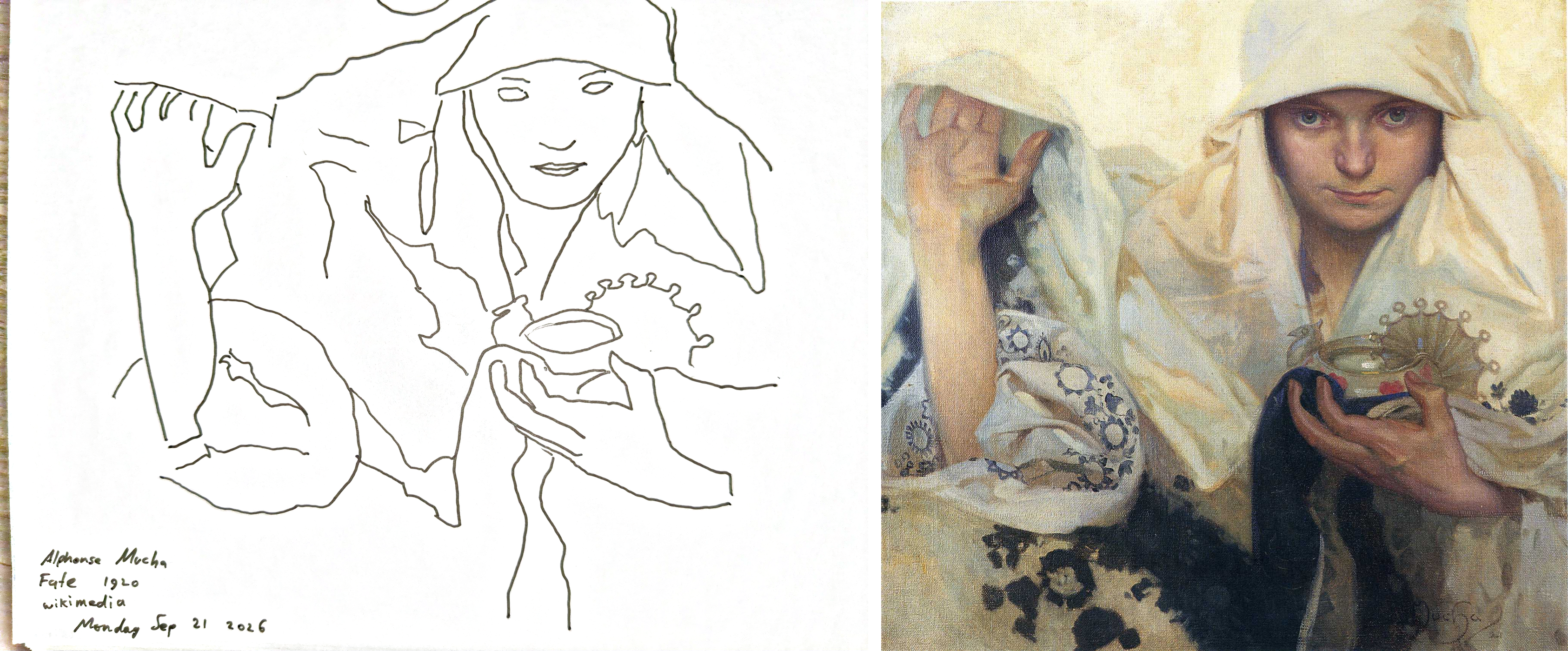
 Left: my tracing, Monday 21 September. Right: Alfons Mucha, Fate , 1920 — Wikimedia Commons. Public domain (Mucha d. 1939).

The tracing · Auction · Background
A painting by Alphonse Mucha. Of course famous for a very different style of painting, Art Nouveau, his extraordinary lines, and I’ve always been a fan of his, but I wasn’t aware of his type of more traditional painting. I wonder if my tracing could have been similar to the lines had this been of his famous style.
And striking, this one — I think the eyes especially. This is Fate, and I do like that there’s something about this one, the physical and geometric and all is nice. But the idea that this is fate, I think, is surprising to me. Fate is normally, I don’t know, something that I might have thought of as more unusual looking…
But this one actually looks like fate — isn’t it the three fates, spinning the threads? He paints fate as this singular fate, holding something, apparently simply his own depiction and not the classical. But the way this one is looking — I think it’s her simple expression, really — it does feel like fate, where it’s not menacing. It’s not clear, in a way, to me what her expression is, and I think that’s what makes it so interesting. In that way, I think the expression itself is very curious.
Very thin lips, kind of a wide face. And then all this drapery — of course, obscuring fate.
I don’t seem to have her pupils right, but that might work. And then, his lines are, as one might imagine even in painting, easy to trace. He has a style that originates with boundaries, and lines are clear; they don’t sort of dissolve and have unclear aspects.
I guess one good thing about draperies, more forgiving… There are parts of the drapery that indirectly depict her head. She holds a metal, maybe glass peacock. It’s not her neck, some darkness in her clothing.
Okay, what I’ll do — because now, again, kind of reaching the limits of how much line density can do here simply, and I’m losing something now, going forward. There are too many lines, so I think that’ll do it.
His painting has fundamental lines, which I think are very clear regardless of the fact that it’s paint — I think he probably thought in lines, and likely did underdrawings. I started line drawing because it seemed to me to express watercolor; I needed an underdrawing, and it seemed to me that was very expressive in itself.
I think there is some of his ambiguity in the eye shapes, as we can see — a different quality, perhaps less immediate and bracing than his painting is, flatter, as I have only two real values. It’s a different but related quality, and I think it carries some of my own stylistic ideas — for instance, orientation based on some of Nagel’s ideas.
I followed his tones a lot, but I did make some structural choices around the head covering — reducing some of the complexity around the drapery near her right hand. I can’t shade the lower half of her torso in that slight way, so I made the drapery simpler, but the size of it is still substantial, and so I think I respected his metaphor.
There’s no hidden face I can see, but I do see an echo of her head and head covering with her right hand and the drapery it’s lifting, compositionally balancing them laterally.
I didn’t make that choice earlier, and for now the distortion of the embroidered sleeve on the drapery is interesting, but would require too much precision, and would again delve further into the line space — which wouldn’t necessarily work in the line composition.
Auction. Fate isn’t itself a market data point — I couldn’t find an auction result for it, or for a comparable Mucha painting, on an auction house’s own page. For scale, three Sotheby’s items instead. On 6 December 2002, at Sotheby’s New York, a bronze bust of La Nature sold for US$807,000, which Sotheby’s describes as a world record for a bronze work by Mucha. Another example of the same bust (patinated bronze and malachite, c. 1900) was offered in Sotheby’s Important Design sale on 28 May 2019 (lot 62) with an estimate of €450,000–550,000; the price realised isn’t shown on Sotheby’s page. And Mistletoe: Portrait of Mme Mucha (1903, watercolour heightened with gouache on linen) carried an estimate of £40,000–60,000 at Sotheby’s 20th Century Art: A Different Perspective on 9 November 2021; its result isn’t shown on the page either. I haven’t found Mucha’s overall auction record on a house’s own page, so I’m not naming one.
Background. The Wikimedia Commons record gives Fate as a painting of 1920, in the public domain because Mucha died in 1939. I couldn’t find a museum record for it: Commons and Wikidata give no medium, size or location, Wikipedia’s list of Mucha’s works has no 1920 entry, and the Mucha Foundation’s paintings list shows nothing dated 1920 on the pages I could reach. So I’m leaving those open rather than borrowing them from a reproduction-retail page.
Alfons Maria Mucha — Czech pronunciation [ˈmuxa], “known in English as Alphonse Mucha” — was born on 24 July 1860 in Ivančice, Moravia, and died in Prague on 14 July 1939, after being arrested and interrogated by the Nazi authorities following the German occupation; he contracted pneumonia and died. The Paris theatrical posters that made his name began with Gismonda (1894), made for Sarah Bernhardt. In 1910 he moved back to Prague and took on Slovanská epopej (The Slav Epic) — twenty canvases painted between 1912 and 1926, which he gave to the city of Prague in 1928. So 1920 falls inside the Slav Epic years; I found nothing connecting Fate itself to that project.
On the fates: in Greek mythology the Moirai are three goddesses of destiny — Clotho, who spun the thread of life; Lachesis, who measured it; and Atropos, who cut it. That’s the “three fates… spinning the threads” from the voice section above. I haven’t found a source that says the painting is about them, or that explains why it shows a figure holding a bowl — nothing citable, so I’m leaving that open too.
Links
- Wikimedia Commons — Fate, Alphonse Mucha, 1920 — the master image, date, and public-domain statement
- Wikidata — Fate — creator and inception year (1920) only
- Alphonse Mucha — Wikipedia — biography (dates, Gismonda, return to Prague, death)
- The Slav Epic — Wikipedia — the cycle Mucha was painting around 1920
- Moirai — Wikipedia — the three Fates of Greek mythology
- List of works by Alphonse Mucha — Wikipedia — checked; no entry for Fate
- Mucha Foundation — paintings — checked; no 1920 work on the pages reachable
- Sotheby’s — The rediscovery of a rare bust by Alphonse Mucha — the $807,000 La Nature result and the 2019 estimate
- Sotheby’s — La Nature, lot 62 (Important Design, 28 May 2019) — the lot page, same catalogue note
- Sotheby’s — Mistletoe: Portrait of Mme Mucha (2021) — estimate £40,000–60,000
- Process video — Monday 21 September — YouTube
- Sitzend nach rechts, Halbbild, in line — the other recent tracing where a few lines had to carry the whole face