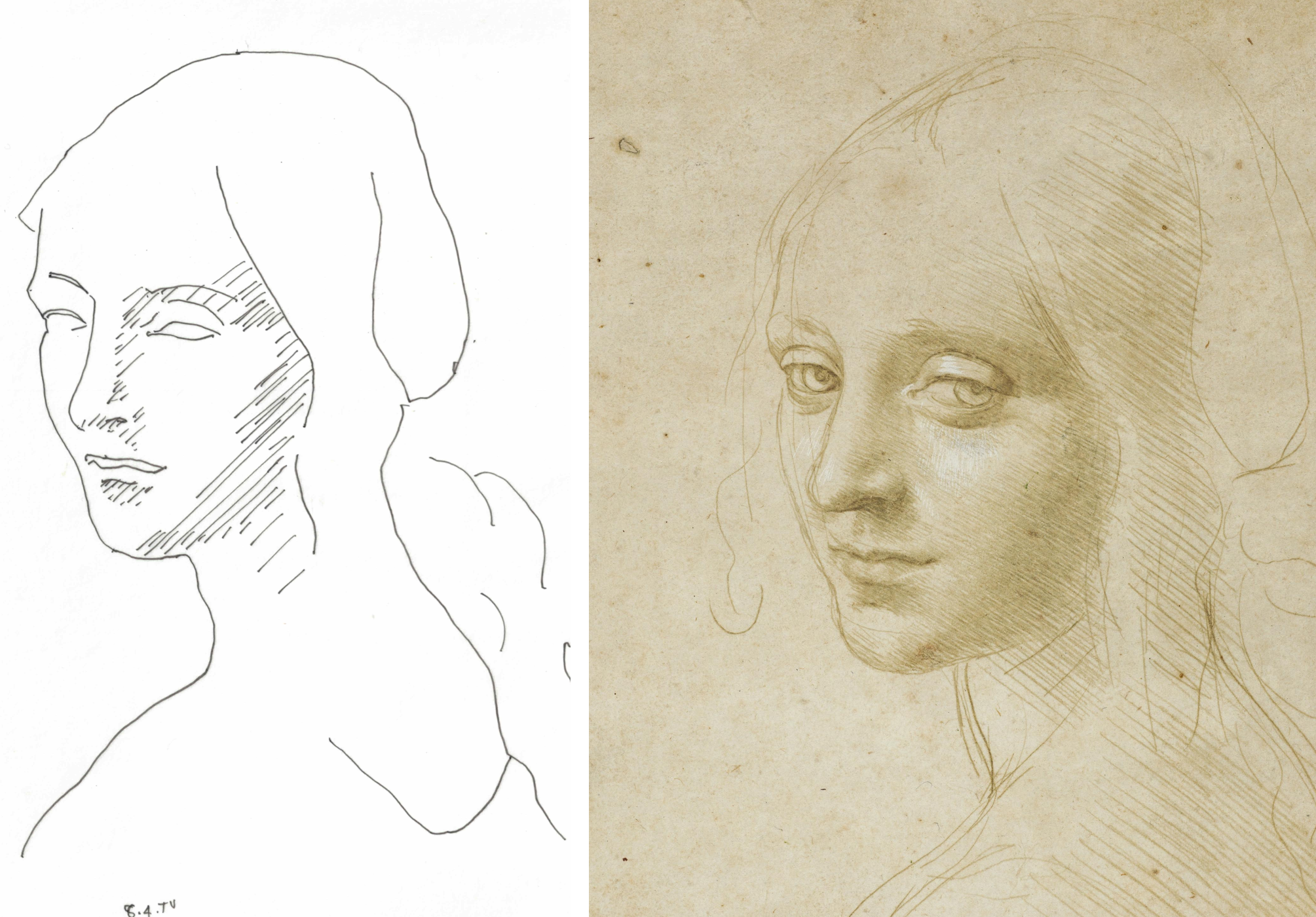
 Left: my tracing. Right: Leonardo da Vinci, Testa di fanciulla (Head of a Young Woman), c. 1483–85, silverpoint heightened with white on prepared paper, 18.1 × 15.9 cm, Biblioteca Reale, Torino (Turin), inv. 15572 recto — public domain.

This is a hatching one — a head built up with hatching, and the question is whether Leonardo actually built it that way. But it looks to me like he drew the line first, with a fine pen: there are strong lines, and then there are searching lines, and then he ends.
The eyes are worth studying in themselves — they’re very three-dimensional in his characteristic way, and even the eyelid is distinct in the tracing. There’s her brow-ridge line and then her brow. Eric Kandel talks about the minimum number of features the face patches need; this is close to that, but the cheek and the eye carry a lot of soft form, a lot of 3D, and those are not single-shot lines — he’s searching.
The darkest values sit in two places, and the hatching all runs one way, which I take to mean he was left-handed. There are a few crosses, but mostly one direction. I hatch that way too — evenly, in the opposite direction — then go back and add darkness where he does: through the center, and a little more at the bottom. The tumbling shape at the side I read as hair, or maybe a ribbon.
What I was really trying to understand: is there a way to get light the way he gets it here — that whiteness. I wanted to make part of it whiter, I tried a white Sakura pen, but it doesn’t show.
As I look at it again I feel more clear the line was first. Of course it’s possible to start from some light hatching, build up, and then lay down the final lines — but this feels too finalized, too understood, for that.
Leonardo’s control and understanding of eyes is exceptional; there are very few others who approach it with this level of precision and expressivity. My tracing is of course very simplistic in comparison — perhaps only a placeholder, one that may help with the orientation of the head.
The directionality is again instructive. He does it clearly and cleanly, though it’s not conforming to the contours of the face, so I do like the idea of controlled hatching even in a different direction — I prefer that to more typical informal hatching. And even so, in my own hatching I feel the endpoints that define the cheek structure are more arbitrary and less clear than a line, which I would typically use. But they are able to convey tonal gradations further into the cheek, which a single line cannot.
His lightness, especially at the top of her left cheek, is again evidence of a level of technique I’m trying to understand. There’s a compositional aspect, since that is some of the lightest tone — but I don’t think he used any kind of white to get it. Instead I think he’s just contrasting it with the nearby, slightly darker tones.
Part of why his paintings are so powerful, I think, is that he seriously studied the drawings and didn’t rely on the malleability of the oil. He had a direction and an understanding in his mind of what he was doing.
Background. Testa di fanciulla — the “Head of a Young Woman” — is a small silverpoint drawing, heightened with white on pale-buff prepared paper, in the Biblioteca Reale, Torino, inv. 15572 recto. It is a study for the head of the angel in the Vergine delle Rocce (Virgin of the Rocks), the Louvre version, and is usually dated to around 1483–85.
Not to be confused with La Scapigliata (Galleria Nazionale, Parma) — a different Leonardo head.
Links
- Process video — YouTube
- Testa di fanciulla on Wikimedia Commons — PD-Art
- Head of a Woman (Leonardo, Turin) — Wikipedia