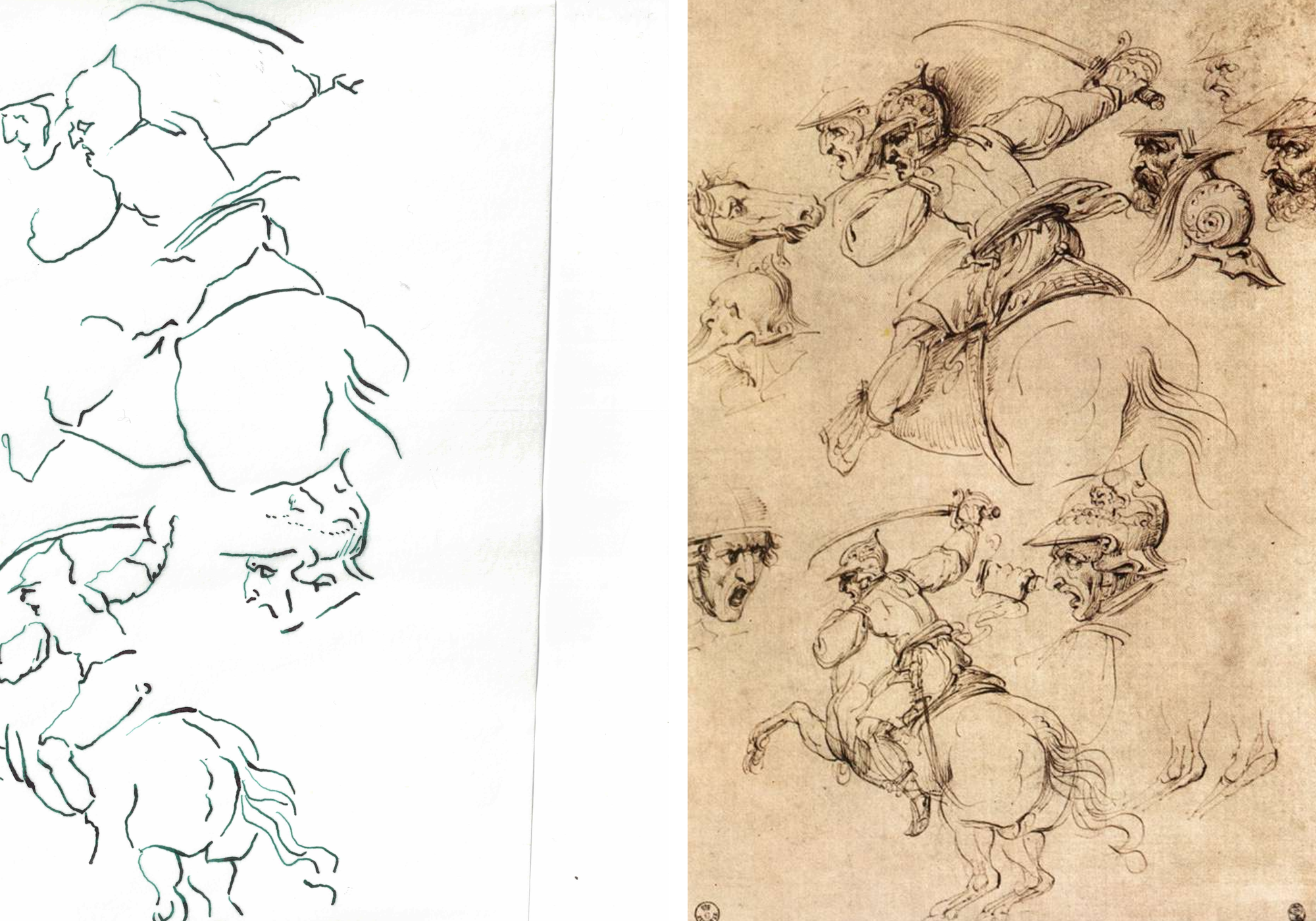
 Left: my tracing. Right: Leonardo da Vinci, Studi di battaglie a cavallo (studies of battles on horseback), preparatory studies for the Battaglia di Anghiari, c. 1503–04, pen and ink, Galleria degli Uffizi, Firenze — public domain.

In contrast to yesterday’s hatched head, this is Leonardo’s battaglia, and the lines are one-shot lines — a little hatching, but mostly the basic outline, and he does it a couple of times, one pass more tentative than the other. He gets a lot out of the clothing. He’s so familiar with the anatomy underneath — this is the top of the horse’s hip bone, the one you see on people — and the way he treats the muscles, the dynamism, is always good.
I started the way I usually do, which is not how he would have started it. This face doesn’t appear in many of his drawings. My sense is that he was freer than that — confident single lines, and he’s using the flex of the pen, coming around, knowing what he’s doing. He draws heavy and very specifically. I think it’s likely he starts something lighter and then draws heavier.
The drawing has so much life that it pulls you into it. I found myself drawing fast because it feels fast — but when I slow down and pay attention, my tracing is better. He’s masterful with the pen, or the quill: if you have flex, use it, and know where your darker points are. That’s the big lesson. I wanted the horse too — he gets a lot of value out of the sword. It’s tempting to draw fast because the tail is swirling, and maybe he did, but for a beginner (like me) it’s better not to get caught up in the emotion you’re depicting.
Most drawings are studies, I think, and the drawings I like and learn from come from people who understand form and space and use drawing better than — perhaps — some finalized works.
I love flex. I have an Eversharp, a Waterman 52 and a 52V; the 52 needs some repair. For me, especially with this kind of study — which I did with the Eversharp — this is more of an instruction to me. I have much to learn, of course, about flex drawing, from this kind of drawing.
How remarkably Leonardo conveys the motion and excitement of this battaglia — so much so that centuries later, on a tracing, my hands are moving faster than they should for a good tracing. It’s something, to see how he achieved such a feeling from just a few lines.
This study is remarkable as it is, and perhaps I would have been more interested in it than in the final painting, since this is the underlying structure and practice; it was good of his father to support his training.
Background. These are pages from Leonardo’s own working process for the Battaglia di Anghiari — horsemen, shouting soldiers, horses, a “tangle of men and animals,” the faces contorted (Leonardo was deep in physiognomy in these years).
Commissioned in 1503 for the great council hall of the Palazzo Vecchio in Firenze (Florence) — today the Salone dei Cinquecento — to commemorate Firenze’s 1440 victory over Milano (Milan). Leonardo left it unfinished, and Vasari’s frescoes later covered the wall. A 2019 study (Barsanti, Belli, Ferretti and Frosinini; Olschki, presented at the Uffizi) argues he never painted it at all: the records show a cartoon and wall preparation but no pigment, and his experimental plaster failed before he could begin. Still debated — but on that reading, the drawings, the lost cartoon and the later copies are close to the fullest record of the Battaglia di Anghiari there is.
Links
- Leonardo, Studies of battles on horseback — Wikimedia Commons — the source traced here
- La Sala Grande di Palazzo Vecchio e la Battaglia di Anghiari di Leonardo da Vinci, Olschki, 2019 — publisher page
- The Battle of Anghiari (Leonardo) — Wikipedia