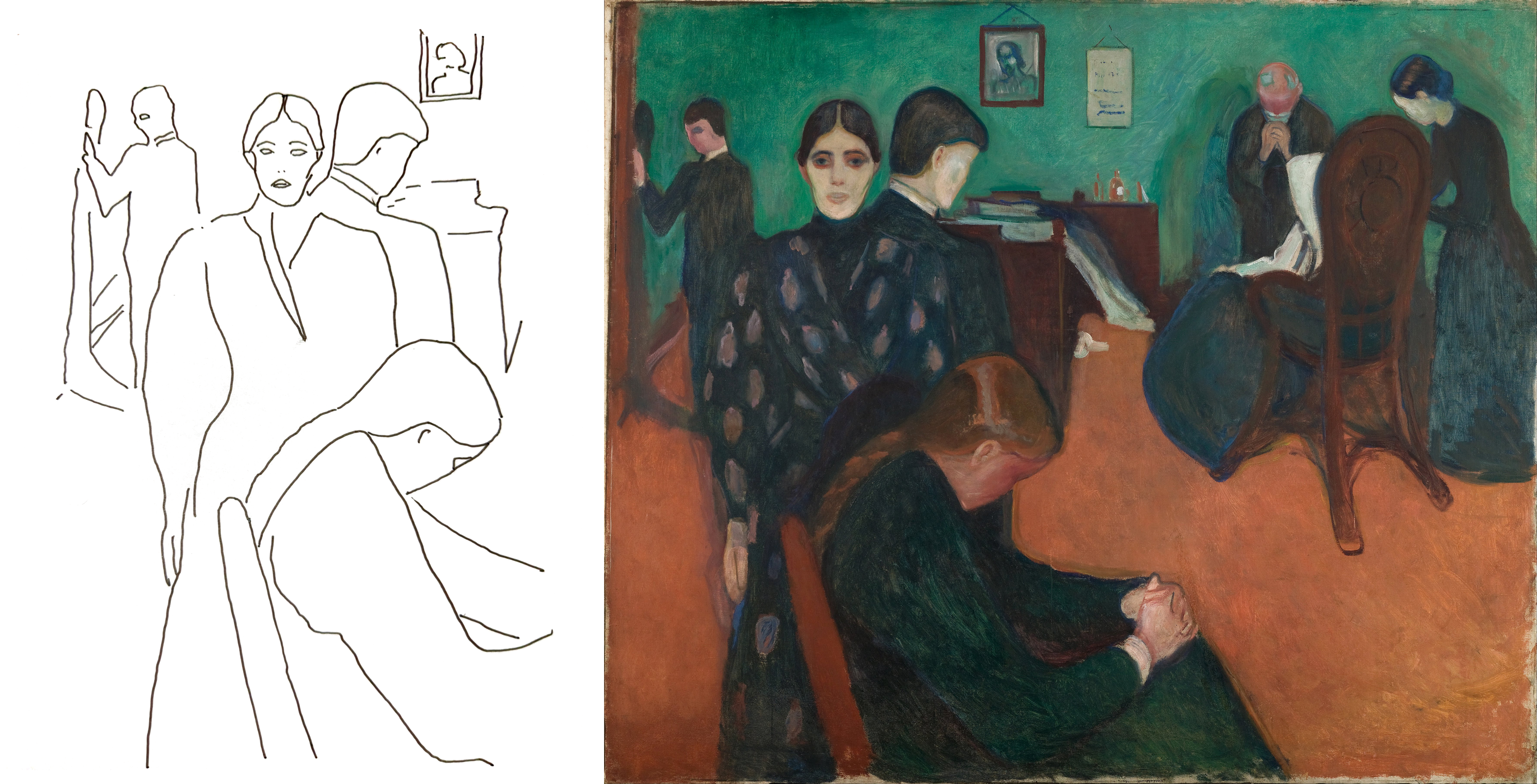
 Left: my tracing, Wednesday 30 September. Right: Edvard Munch, Døden i sykeværelset (Death in the Sickroom), 1893, oil on canvas, 134 × 160 cm — Munchmuseet, Oslo, MM.M.00418 (image: Google Art Project via Wikimedia Commons). Public domain.

The tracing · In his hand · Auction · Background
Munch’s Døden i sykeværelset (Death in the Sickroom). It’s an extraordinary work. It’s kind of fundamental to me, for me it tells me what art is about. It reminds me of why are we doing this, what he’s trying to get on paper and express, and what he achieves through and for me. I’ve never been in this kind of a room, but I understand this and him and myself when I see it. The first time I saw it I understood this painting instantly, and I was drawn to it, because it’s not often that one understands another person the way this allows that immediate connection.
What makes that possible? Its history and circumstance and emotion. These are situations and thoughts that happen in my dreams, and that I understand and relate to.
One of the main figures in the painting. I wanted to focus on her and her dress with these spots. I don’t think I’ll draw the spots, but I will draw her face, and the people around her.
Compared with his, I think mine has a different way of connecting and distinguishing the figures at the left. His are blending in dark colours and tones, but mine are separate in their silhouettes, and then the same in the sense they’re all lines of equal width and colour.
The colours are merging in many places, but there’s also a distinct set of lines. Even though it’s merging, it’s not totally merging. At her collar, these lines of the hair are quite interesting. This could be shadow or form. We’re getting this line, so I’m feeling okay to trace this one.
Munch came back to this room in prints. I think he does those prints because his forms and figures are amenable to it, which is also why it was sort of easy for me.
I need to draw their hair and some of the furniture in the background. One problem I’m having is that his work with shadows is tricky. There’s a shadow of the far figure against the wall, a painting up here, and the desk with books, which also has shadows. I think this is a shadow of the girl in the foreground onto the central woman. I’ll add her far arm. Her hair is important here. The man in the back is looking towards us. This shadow below him could work, I’ll try it. You’d need the bottom of this wall in that case. The pinkish thing at the bottom may be some kind of moulding. A little of the desk stuff here. The painting on the wall.
I don’t think this one’s meaning lives in its shadows, and I did get the far man’s shadow, which looks very much like the sunlight in Stemmen (The Voice), that kind of sun with a line coming down, so in that sense there may be dark meaning there of sorrow. But here I think the arrangement itself carries a lot of meaning.
.jpg)
The eyes. I don’t think the almond eyes are entirely incorrect. They are masklike, which seems quite appropriate. The far man’s eye also seems incongruous like Munch’s, though perhaps less clearly.
I’m glad to finish in a way that I think is the right place to stop.
Munch wrote his sister’s last hour in an 1890 note now in the Munchmuseet archive, MM N 3670. He tells it as fiction, the dying girl is called Maja, and the Nasjonalmuseet quotes it beside this picture. She points to the armchair, the one she sits in here with her back to us.
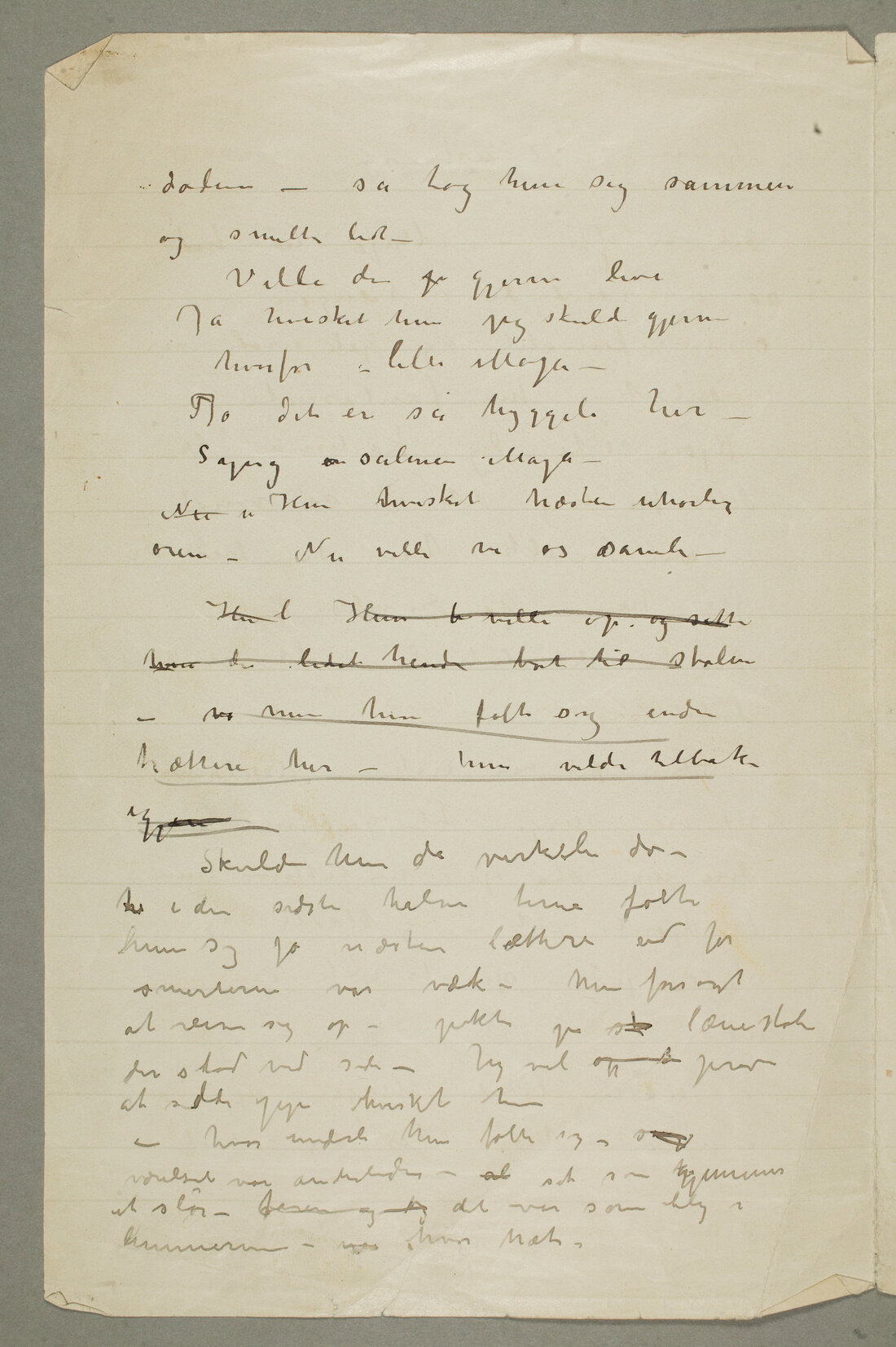 MM N 3670, page 4, Munchmuseet archive. The passage is the lower half. © Munch Museum, Oslo, via eMunch.no, where the facsimile and transcription sit side by side.
Skulde hun da virkeli dø – … i den sidste halve time følte hun sig jo næsten lættere … – hun forsøgt at reise sig op – pekte på lænestolen der stod ved siden – Jeg vil op … prøve at sidde oppi hvisket hun –
“Should she really die – in the last half hour she felt almost lighter – She tried to raise herself – pointed to the armchair that stood beside her – I would like to sit up she whispered …”
Translation from the Nasjonalmuseet’s catalogue. The Norwegian follows eMunch’s transcription, cut to match.
Auction. No sale of this canvas is on record that I could cite. It belongs to the Munchmuseet, Oslo (MM.M.00418). For scale, a different Munch, the 1895 pastel of Skrik (The Scream), came to Sotheby’s New York on 2 May 2012 with the estimate given only on request, and sold for a record US$119.9 million (The New York Times).
Background. Munch painted Døden i sykeværelset in 1893, oil on canvas, 134 × 160 cm, and it is in the Munchmuseet, Oslo (Wikimedia Commons). It depicts the death of his sister Sophie, which he re-worked in many later variations, and, in the words of Wikipedia, “portrays his entire family” with its drama “dispersed in the separate and disconnected figures of sorrow” (Wikipedia). Johanne Sophie Munch, his favourite sister, died of tuberculosis in 1877 at fifteen. Their mother had died of the same disease in 1868 (Wikipedia).
There are two main versions, both dated 1893. The other, in tempera and oil crayon, is in the Nasjonalmuseet, Oslo (NG.M.00940), and there has been disagreement about which came first. Its catalogue names the family. Sophie sits in the chair with her back to us and aunt Karen Bjølstad rests a hand on it. The father, the doctor Christian Munch, stands behind with his hands clasped. Inger is the woman staring straight at us, Laura sits in the foreground, Edvard is probably the man in quarter-face near the centre, and his brother Andreas stands at the left. “Although they are together,” the catalogue says, “each has to grapple with his or her grief alone.” Munch came back to the scene in a lithograph in 1896 (Nasjonalmuseet).
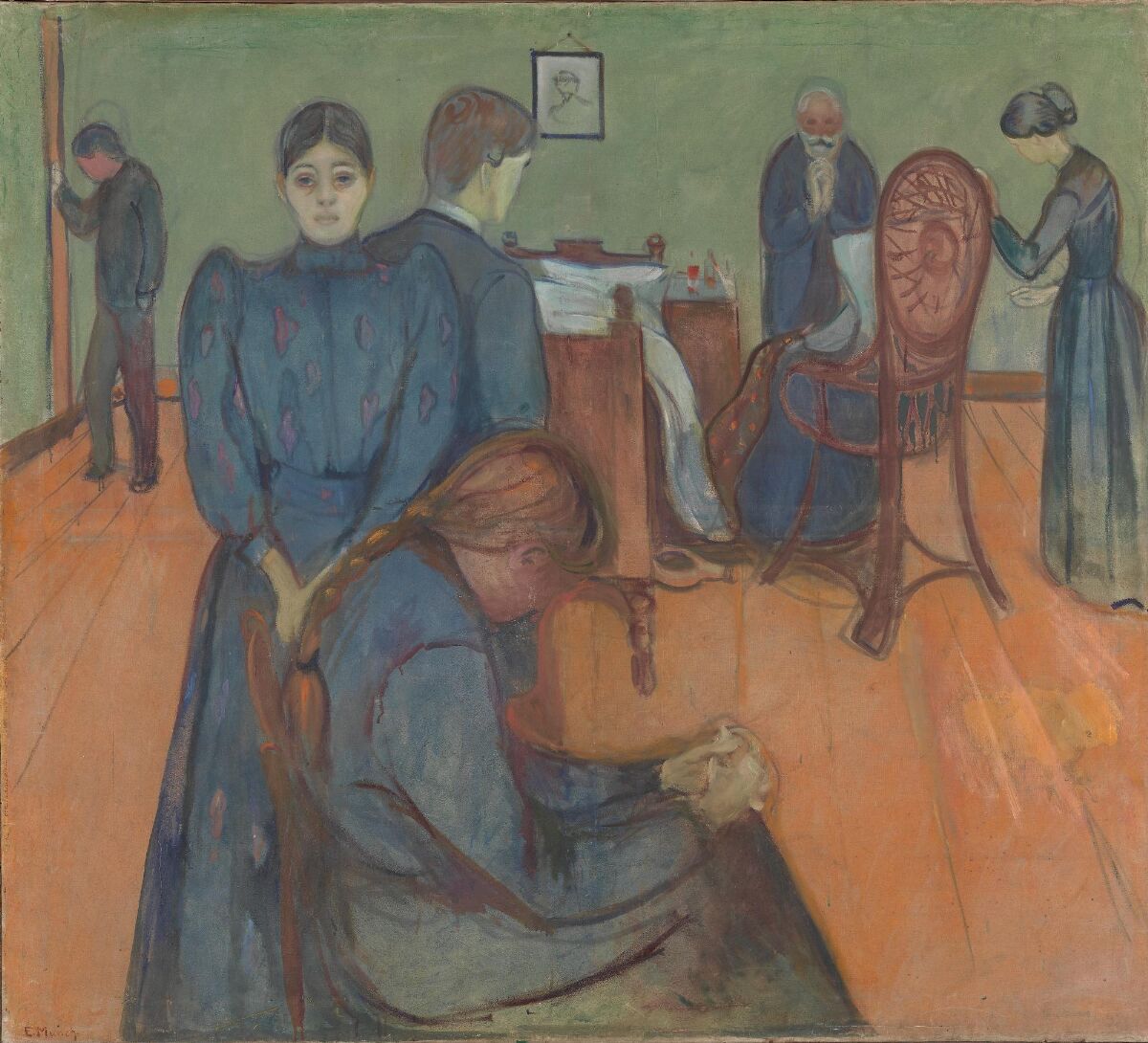 Edvard Munch, Døden i sykeværelset (Death in the Sickroom), 1893, tempera and oil crayon on canvas, 152.5 × 169.5 cm — Nasjonalmuseet, Oslo, NG.M.00940. Photo: Børre Høstland, Nasjonalmuseet. Public domain.
In a 1918 note on the Frieze of Life, MM N 36, Munch lists Sygeværelset among the pictures he was at last, disheartened, forced to sell, to Rasmus Meyer and the National Gallery in Kristiania (eMunch.no).
Links
- Munch, Døden i sykeværelset, Commons — master image, 1893, Munchmuseet MM.M.00418
- Edvard Munch, Wikipedia — Sophie’s death and the painting
- Munch, MM N 3670, eMunch.no — 1890 note on the dying girl and the armchair, facsimile and transcription
- Munch, Døden i sykeværelset, Nasjonalmuseet — the other 1893 version, with the catalogue naming the family
- Munch, Stemmen (The Voice), 1893, Commons — the sun and its line of light
- My tracing of Munch’s Livets dans — the same sun and its line on the water
- Munch, MM N 36, eMunch.no — 1918 note on the Frieze of Life
- Process video — Wednesday 30 September — the tracing session on YouTube