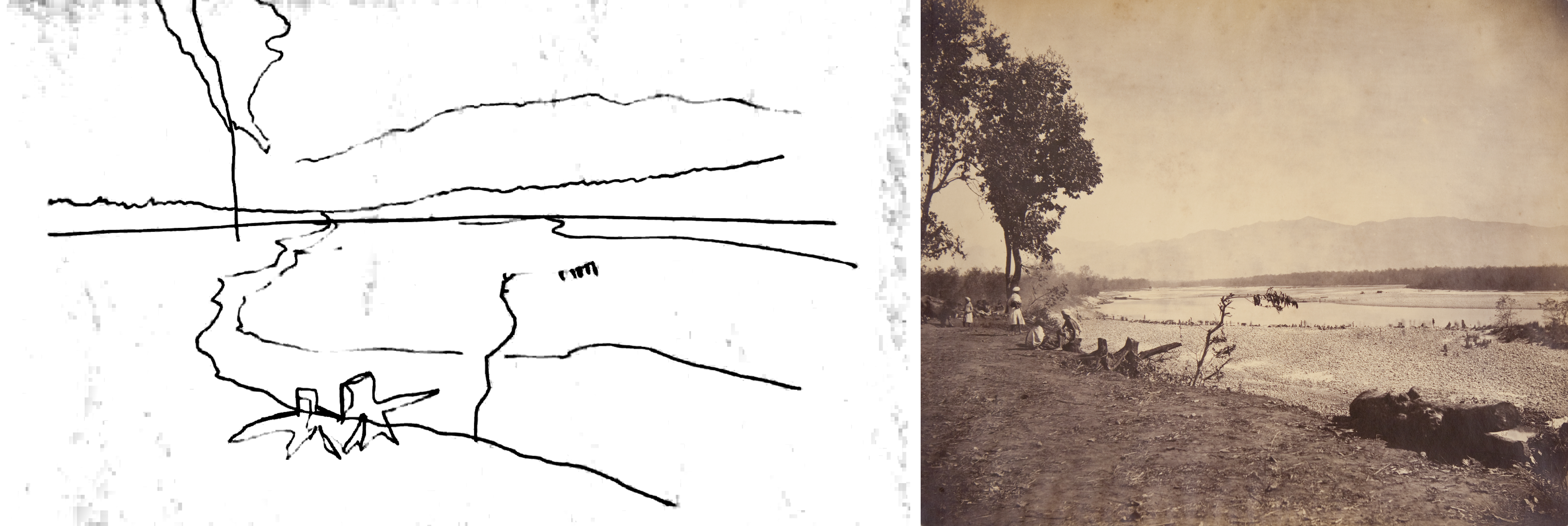
 Left: my drawing from reference, Tuesday 4 August.
Right: “View along the river,”
unknown artist, 1875–1878, albumen print — Museum of Photographic Arts,
San Diego (Catherine and Ralph Benkaim Collection,
2006.045.007) — public domain.
Left: my drawing from reference, Tuesday 4 August.
Right: “View along the river,”
unknown artist, 1875–1878, albumen print — Museum of Photographic Arts,
San Diego (Catherine and Ralph Benkaim Collection,
2006.045.007) — public domain.
This is a public-domain landscape — I wanted to try some of Frank Ching’s ideas on it. He says it’s much harder to copy off a photograph than to draw from life, and that’s the case at least here. Life immerses you in the place: you’re there, on the riverbank, you smell the air, and as your head moves and your eyes go from the page to the scene, you infer the dimensionality — people move, trees sway. None of that in the photo; it’s static. The one thing it gives back is that it stays exactly as it was for the whole drawing session, which is worth something too.
There are people in this area, he says to use the rule of thirds. I like the people, and this beautiful bent tree in the foreground — then he says: pick the level line — the horizon line. So from their point of view, I chose a level line; here it’s easier, since this is a person photographing in the 1800s, whereas now drones shoot from angles where the horizon isn’t always so easy to fold into a drawing. In the 1800s there was a person with an eye behind the camera; a drone can take far more extreme angles. Anyone could put their own eye where the drone’s is, but even so it would feel less natural, and correspond less to Ching’s technique. Then Ching says to pick one vertical element, and there’s a tree, so I use the tree as the vertical.
From the horizon, Ching says the second line you draw is very important — because it defines perspective and the vanishing point. So the second line is that tree ridge; that’s what defines the vanishing point. And this lower tree, which I really like.
Next there’s a line from this silt, or something — I think I draw from where it starts, and then the bank next. And on the other side, tree stumps — I try those; I don’t think that came out too well, and I haven’t got them properly yet. I think I get too technical, following light-and-shade lines; semantically they’re stumps, but then we veer into a symbolic, childlike drawing of a stump instead. And they’re maybe distinct from the background, or maybe meant to merge into it, like Munch. I just need to draw this more, to find where I get something that means more to me. Maybe Drawabox would help with that. Then there are these small figures here, and the tree itself. And the faint mountain back here — I think it’s absolutely gorgeous, all the more so because with a crude line I can’t distinguish a faint mountain ridge from a strong one. It’s something I don’t think I can render — out of my reach.
I don’t know how I’m going to get these people, though. I think that’s rough. I’ll leave them. So I think that’s it.
Background. The museum record gives only what it can verify: View along the river, an unknown artist, 1875–1878, albumen print. It came to the Museum of Photographic Arts in San Diego as a gift of the Catherine and Ralph Benkaim Collection (accession 2006.045.007) and is on Flickr Commons with no known copyright restrictions. No photographer, sitter, or location is recorded — I haven’t found a second source that supplies one, so none is asserted here beyond what the print itself shows: a wide gravel riverbed in a mountain valley, a bent tree at the near bank, and a small group of figures in Western dress looking out over the water.
Links
- Process video — Tuesday 4 August — YouTube
- “View along the river” — Museum of Photographic Arts, on Flickr Commons — title, date, medium, credit line, accession number, and the “no known copyright restrictions” license