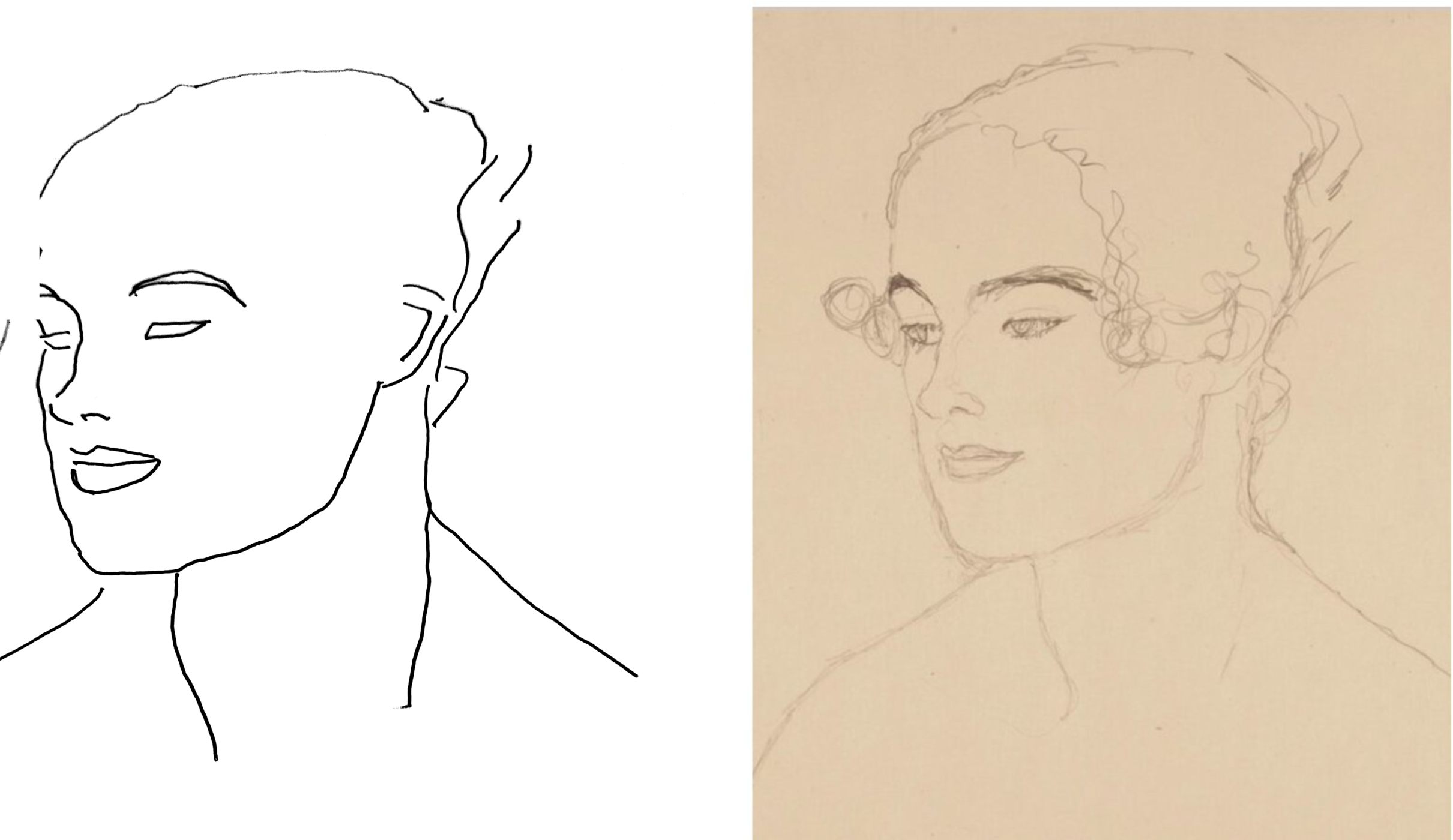
 Left: my tracing, Thursday 3 September. Right: Gustav Klimt, Brustbild nach
links (Bust Portrait Facing Left) — pencil on paper, dated 1915 in the plate.
Reproduced in Maria Peitcheva, Klimt: Drawings 126 Colour Plates (2016).
Left: my tracing, Thursday 3 September. Right: Gustav Klimt, Brustbild nach
links (Bust Portrait Facing Left) — pencil on paper, dated 1915 in the plate.
Reproduced in Maria Peitcheva, Klimt: Drawings 126 Colour Plates (2016).
This one is labelled a portrait, and what’s interesting is how lifelike it is. The other thing is the line: on the inside it is very, very sharp, and on the outside it is very searching. I think he worked from the outside in, and the final lines — the innermost ones — were so precise that he saw it, and when he had the exact spatial rendition he wanted, he stopped. The perfect spatiality is in the whiteness of the face itself, encased by the searching lines.
Her jaw does seem a little large. If you’re searching lines inward toward a sculptural white face, you naturally start with the larger silhouette searches and then reduce them — a large jaw refined to a smaller one. Here he seems restrained in that, somehow; or, more likely, this is just how her jaw looked.
The lips have the perfect rotation around the curve of the face. As the line moves away from us it wraps around a rough cylinder — the upper and lower jaws — so the far lines of the lips are foreshortened against the ones travelling across from the centre to the nearer corner of her mouth. That foreshortening gives him, and us, the curvature of her mouth and the lower part of her face, with very few lines. The shape of the face is very accurately drawn, and the foreshortening of her far eyebrow is precise.
The further eye is ever so slightly bigger than the nearer one — physically, probably wrong. In Klimt’s hands it helps orient a subtle tilt of her face away from the viewer. It has a warmth, and for that it isn’t photographically consistent. It doesn’t take anything away from the picture; I’ve seen it somewhere else before, so it isn’t unreasonable. And this curl of hair comes out from the eye socket — interesting. I use hair to hide mistakes sometimes.
So I start tracing from the eyes. With eyebrows that have texture it isn’t always clear how to begin a line. Then the nose, then the mouth. With that we more or less have the face, and it isn’t unimaginable to leave it there. The hair is on the outside. When you’re tracing you can’t usually make out the searching that went on underneath — though here you can.
The jaw, which is very perfectly done. There’s one line for the shoulder; I put it on the back of the hair. Again, the ear, so well positioned, perfectly drawn.
Now the nose. He has the ridge properly drawn and I’d left it off. I resist the nose-ridge line: it reads as very prominent in photographs and in life, but I suspect it’s actually redundant, given the position of the eyes, the eyebrows and the nostrils — perhaps I’m following Patrick Nagel there. Unless I see specific information in the ridge, I leave it off. But here, because Klimt is drawing her far eye in that unusual way, the ridge adds something of its own. So there’s a specific reason to trace it; it helps. He chose these lines for exact, precise reasons — the nose is explaining the foreshortening. This isn’t only about which way the face is turned; it’s about the face receding slightly away from you. I got a fair amount without needing the hair.
Background. The plate captions this Torso Facing Left — an over-literal turn of the German Brustbild nach links, “bust portrait facing left” (Brustbild, “breast-picture,” is simply the German for a bust-length portrait). It’s a title Klimt’s cataloguers gave many sheets: in his last years, 1914–1918, he “increasingly turned to the female portrait,” and to bust-length drawings of unnamed sitters — several catalogued under near-identical names. The drawings, “almost 4,000” of them, were catalogued by Alice Strobl of the Albertina in a four-volume catalogue raisonné published 1980–89.
This sheet is reproduced in Maria Peitcheva’s Klimt: Drawings 126 Colour Plates (2016), dated 1915. That book is a self-published reproduction anthology, not a scholarly catalogue: a reliable record of the image and its caption, not a source for provenance. I could not match this drawing to a specific Strobl number or a holding collection — so take the 1915 date as the plate’s, unverified.
Links
- Process video — Thursday 3 September — YouTube
- Klimt: The Final Years, 1914–1918 — Gustav Klimt Database — the turn to the female portrait
- Gustav Klimt’s Drawings in the Albertina Museum — the Strobl catalogue raisonné (~4,000 drawings, 4 vols, 1980–89)
- Maria Peitcheva, Klimt: Drawings 126 Colour Plates (2016) — the plate compilation traced here