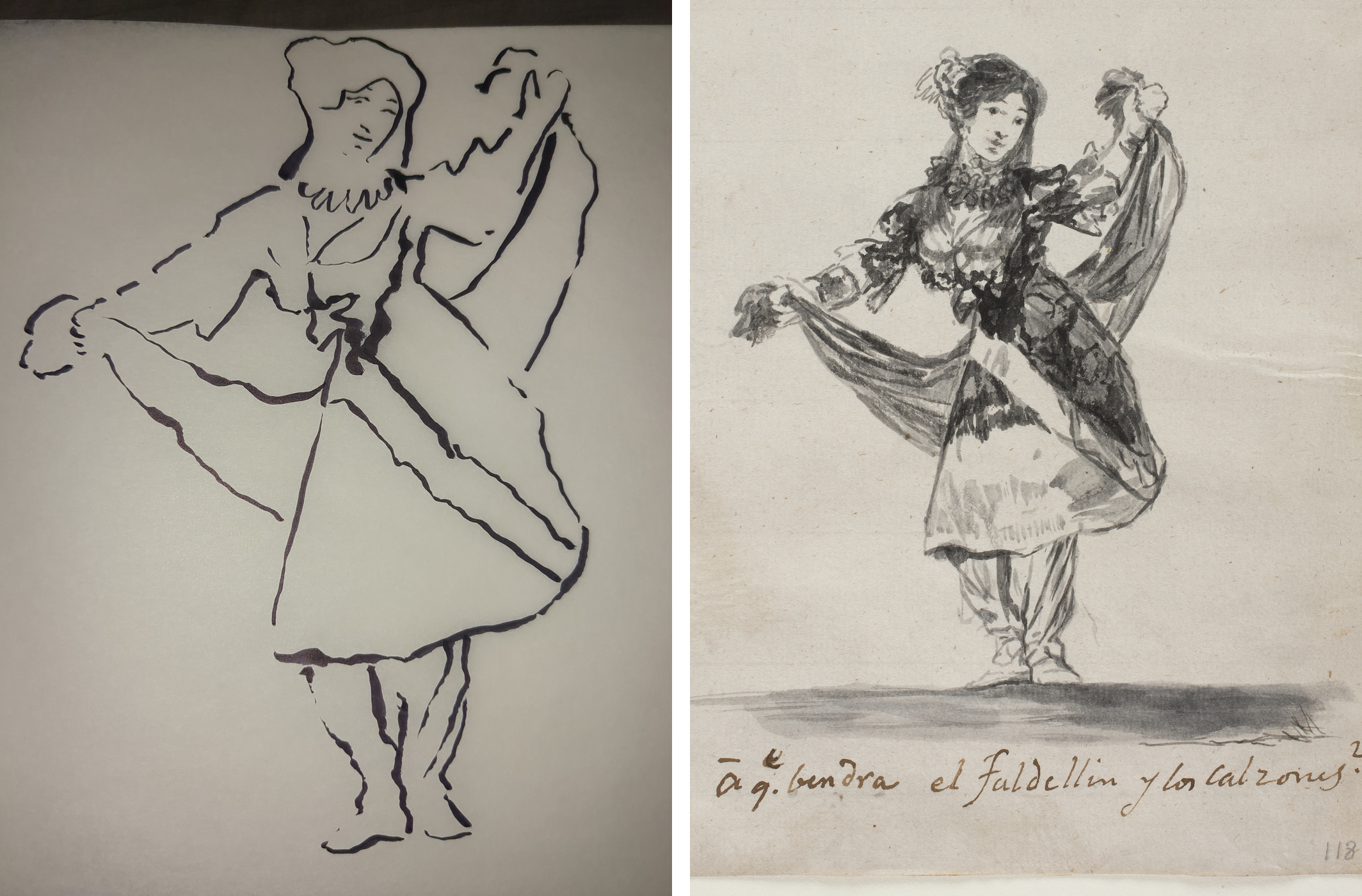
 Left: my tracing, Monday 28 September. Right: Francisco de Goya, ¿A qué vendrá el faldellín y los calzones? (What is the use of the overskirt and the bloomers?), Álbum C, sheet 3, brush and ink wash on paper — Museo Nacional del Prado, Madrid, D03944 (image: Wikimedia Commons). Public domain.

The tracing · Auction · Background
A drawing: it’s a bit of a watercolor, or maybe a pen and ink.
What I like about this one is the proportions. The gesture seems very plausible. And it does seem amenable to a line kind of a thing.
He has this bit of clothing, this overlap coming down across, that’s helping with the lower part of the skirt. The baggy pants: he’s getting that fullness, I think, from a lot of the variations in the lines here.
Goya’s caption asks what the overskirt and the bloomers are for. It’s a funny and ironic question, in my opinion, because they are doing a lot for his drawing and mine, but perhaps he’s not sure what they’re doing for her.
It might be interesting to try it with a brush pen, so I do get some line variation.
Brush pen versus fineliner: I often do my tracing with a fineliner, and I think it forces one to think about things and reveals issues in a clear way.
Her face is nice. She has contrapposto; it just feels plausible, well positioned. Almost a motion: you can feel the motion.
And this cloth that she’s holding, it feels like it was done quickly. Look at that flower in her hair: there’s not a lot of detail, not a lot of slow detail.
The first thing is: what will be those minimal lines? The silhouette is always a good place to think first. From the head down to the left arm, and then the left side of the drawing.
That can be the silhouette. And then her baggy pants. We did get some of the bagginess, so that’s nice.
I usually start with the eyes; this time the silhouette came first, and the face came last.
I think I was just taken by the form; I didn’t plan it. I don’t think we need much to indicate the face in this setting, though I do think it matters: oversimplicity in faces drawn at any size is very easily seen, and it reduces the realism and impact of the piece.
And then her sash. He’s getting inner volume, perhaps, from the sash. It’s not a sash, it’s a wrap or a fold or something; I’m just going to call it a sash.
These dark things above it have a lot of value, but they don’t have a lot of form. They’re decorative, maybe patterns on her dress. But this one at her waist has something to do with the form, so I’m going to prioritize that one first.
Value and form: the patterns have their own decorative appeal, but I’m focused on the form of the figure, so I’m prioritizing value changes that come from form, not decoration. But the decorations on the dress are their own valuable part of the work’s decorativeness, and sometimes they also powerfully reflect the underlying form.
And then her shoulder. The sash and this shoulder added more than I was expecting.
There’s a moment a few strokes before the end where it was already there. Knowing when to stop is part of it.
Motion: I chose lines. I wanted to do more like Frédéric Forest and be more architectural; I think it may have started in that direction, but then I took it too far. For me the motion comes from the economy and the suggestion of motion. Some of Rodin’s drawings have that same idea, perhaps Matisse’s famous dancers in a circle too.
Auction. This sheet has never been sold: it is one of the Prado’s Album C drawings. Goya’s album drawings rarely come up, and when they do the house estimates run to seven figures. Tambourine Player, sheet 88 of Album F, brush and brown wash, was estimated at £1,200,000–1,600,000 at Sotheby’s London in 2013 (Sotheby’s). No llenas tanto la cesta (Don’t fill the basket so full), page 8 of Album E, brush and black ink and wash, was estimated at $1,000,000–1,500,000 at Sotheby’s New York in 2018, in the Howard and Saretta Barnet collection sale (Sotheby’s).
Background. Goya drew this in Álbum C (Album C), a private notebook he kept in Madrid between 1808 and 1824, through the Peninsular War, the repression under Fernando VII and the Trienio Liberal (Wikipedia). The dominant technique is Indian ink and sepia wash, with touches of pencil and pen, on ordinary Spanish writing paper, pages about 205 × 140 mm (Wikipedia).
It is the largest of his albums, and the only one that survives almost intact: 120 of its 126 known drawings are in the Prado (Wikipedia). Goya numbered this sheet 3, top right, and wrote its title as a question beneath the figure: “á q.e bendra el faldellin y los calzones?” (Wikimedia Commons).
The Fundación Goya en Aragón catalogue counts her among the most beautiful female figures in Goya’s drawings: a young dancer, head tilted, hip swayed, lifting her shawl behind her. Pierre Gassier suggests she is dancing the shawl dance, which needed little clothing; that may explain the question in the title (Fundación Goya en Aragón).
Links
- ¿A qué vendrá el faldellín y los calzones? — Museo Nacional del Prado — the collection record
- The sheet on Wikimedia Commons — the Prado’s photograph, full resolution
- Album C (Goya) — Wikipedia — the notebook, its paper and its drawings
- ¿A qué vendrá el faldellín y los calzones? — Fundación Goya en Aragón — the catalogue entry, with Gassier’s reading
- Álbumes de dibujos de Goya — Wikipedia — Goya’s drawing albums
- Goya’s Cabeza de ángel, in line — yesterday’s tracing
- Goya’s El coloso, in line — Saturday’s tracing