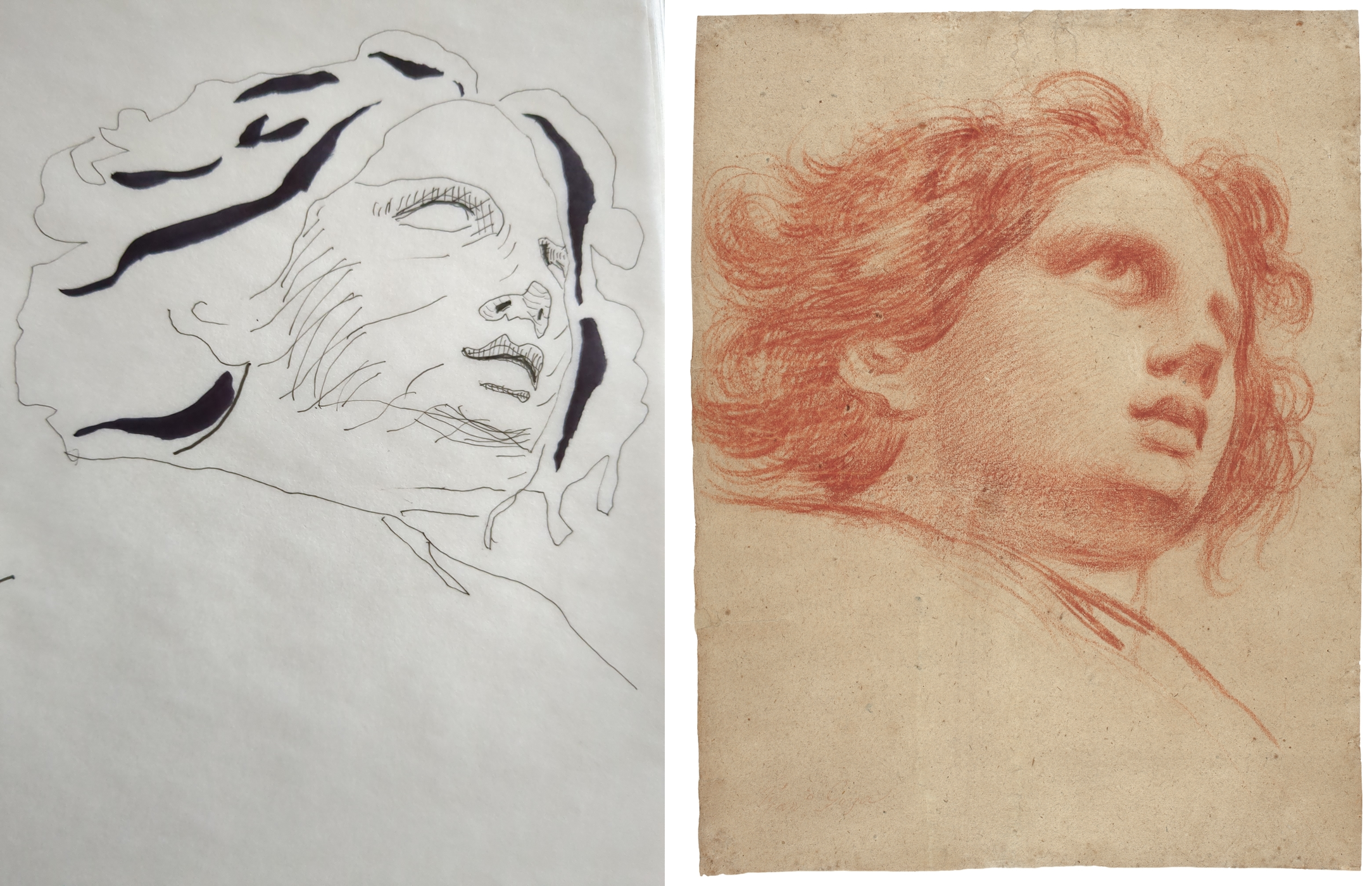
 Left: my tracing, Sunday 27 September. Right: Francisco de Goya, Cabeza de ángel (Angel’s head), 1772, red chalk on paper — Museo Nacional del Prado, Madrid (image: Museo Nacional del Prado). Public domain.
The tracing · Auction · Background
Okay, Goya’s Cabeza de ángel. Obviously he’s got a lot of shading. The orientation is straightforward enough, so I think the lesson here is contour crosshatching. I’ll try some of that, and with the ink restriction it should work.
Where the hatching goes: I kept it to a few passages rather than his full build-up; what I wanted was to see how the form comes out of his strokes. Leonardo used parallel lines, which naturally appeals to me (Leonardo’s Tête de femme). This is more complex, but how Goya does it is very compelling.
It’s a low angle. Crosshatching I think is masterful here, Goya was young.
Looking up: I rely on the markers and draw portraits from many angles, and I think my orientation ideas around the face patches were adequate here. In mine I don’t draw the pupils, yet he still seems to be looking up, I think from the inner corner of the upper eyelid.
The chin is the interesting problem here: there’s a smooth curve and not a linear edge. I’m using a finer fineliner than I usually do, because his hatching is so fine and I think that’s an important lesson here, not just the head geometry, which I think is not difficult.
How the chin came out: I used a darker value on the chin itself, and I think it pulled off. But some of my crosshatches went down the jawline and look like beard wisps, which I didn’t intend.
I will draw a thicker line too, I’m going to mix a little of the thicker line in, just for certain of these — for the hair.
Why the hair: I did like the hair; I felt it was semantically different, and it’s darker in his everywhere. Only above the eyelids is as dark in his, but I didn’t want my brush there: I already had a clean, sharp edge.
This is my second Goya in two days, after El coloso, which he painted some 36 years later. To me the power of this one — the gaze, the emotional intensity, the physicality — seems very aligned with the colossus.
Auction. Cabeza de ángel has no sale history I can find; it is a museum sheet. For scale, Goya’s auction record is a pair of 1805 portraits, Doña María Vicenta Barruso Valdés and her mother, estimated at $15–20 million and sold for $16.4 million with fees at Christie’s New York on 25 January 2023 (The Art Newspaper).
Background. Cabeza de ángel (Angel’s head) is red chalk (sanguina) on paper, 1772, one of Goya’s earliest surviving drawings, and one of the few he made as a study for a painting (Museo del Prado).
The painting is La adoración del Nombre de Dios (The Adoration of the Name of God), a fresco of angel musicians and singers on the vault of the coreto (small choir) of the Basílica del Pilar in Zaragoza (Universidad de Zaragoza). It was Goya’s first big commission after his return from Italy in 1771. He painted it in May and early June of 1772, for 15,000 reales: Antonio González Velázquez had been paid 25,000 for his (Wikipedia).
Three of these angel-head studies survive: this one in the Prado, one in the Museo de Zaragoza, and one in the Louvre (Gobierno de Aragón). Of the Zaragoza sheet, the Aragón government notes “trazos cruzados en el rostro y cuello” (crossed strokes on the face and neck) to build the shadows.
Links
- Cabeza de ángel — Museo Nacional del Prado — the collection record
- La adoración del Nombre de Dios — Universidad de Zaragoza — the Pilar fresco
- Adoration of the Name of God — Wikipedia — commission, fee, restorations
- The Zaragoza angel head — Gobierno de Aragón — the sister study and its crosshatching
- Goya’s El coloso, in line — yesterday’s tracing
- Process video — Sunday 27 September — YouTube