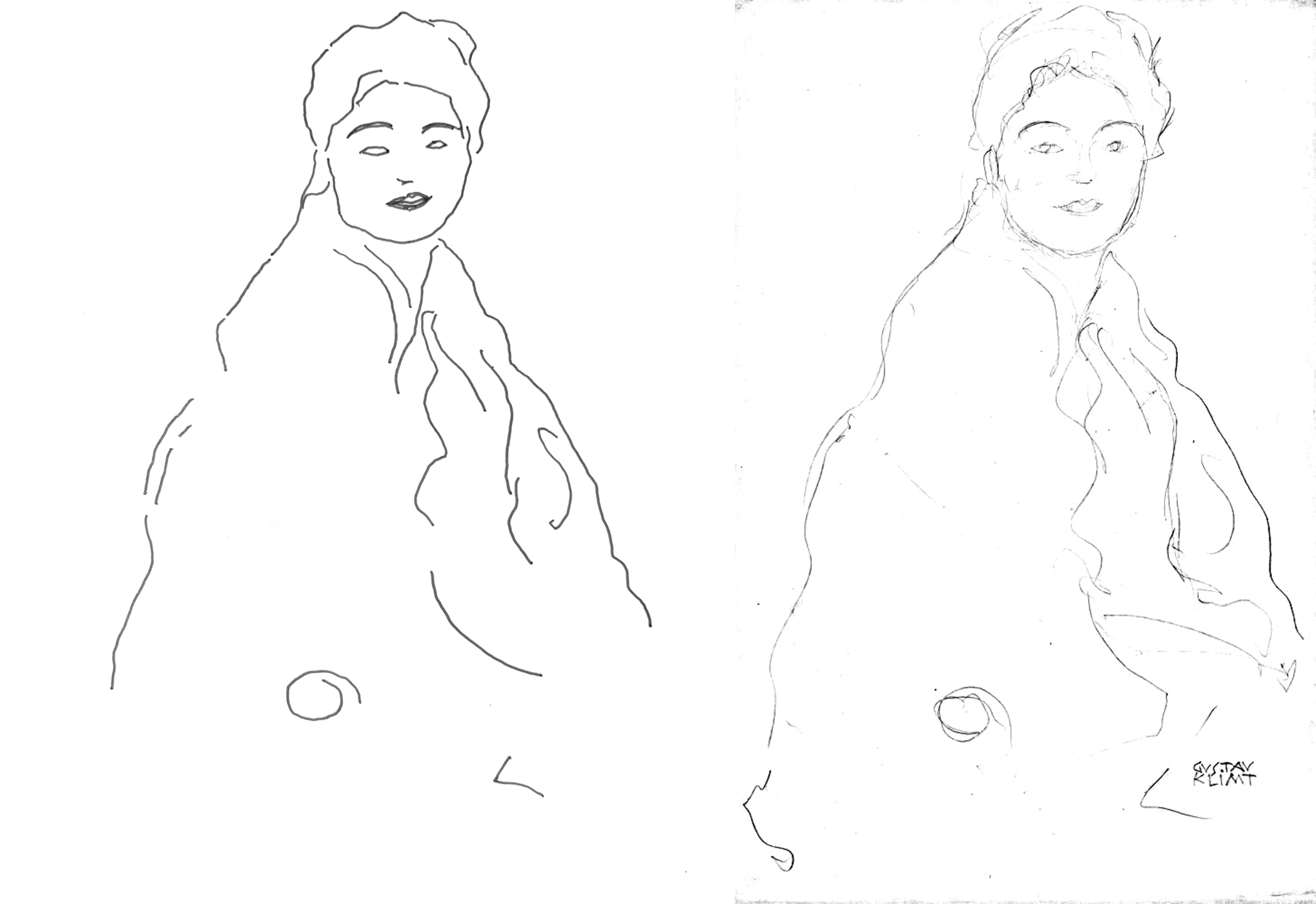
 Left: my tracing, Sunday 20 September. Right: Gustav Klimt, Sitzend nach rechts, Halbbild (Seated Woman) , c. 1915 — pencil and colored pencil on paper, 19 3/4 × 12 7/8” (50.1 × 32.7 cm), Museum of Modern Art, New York — Gift of J.B. Neumann, 1964 (accession 3.1964). Public domain (Klimt d. 1918). Photo: MoMA’s own collection image, converted to grayscale with the paper tone flattened and contrast raised so the very faint pencil reads.
The tracing · Auction · Background
I did some kind of filtering to try to get it a little more visible through the paper — those lines are very, very fine, very difficult to see through.
She has a kind of an impressionistic sort of expression. I think her expression, the motion, and then her form — it’s just not a lot of lines, but it tells you something about the subject.
Her mouth… I drew a different expression, so sensitive. Not entirely unrelated, but something different about it.
I do think I got a reasonable amount of form, of the drapery form. So that’s good.
Some of her hair… He seems to have drawn a tiny bit of cheek structure — I leave that off, I want to see how much I can get from just silhouette which is required. The top of her head I can’t make out very well.
Maybe the mouth isn’t too far off.
I don’t see exactly where to get more of her expression from. I could do more on her eyebrows.
Mine have a height component that is not his, I can fix with another pair of lines to fill out her brows.
I’ll stop there because now again my lines are changing what they mean, going beyond just the simplest.
It’s a strain — I had to keep flipping back and forth a lot, and infer, and use my memory, and look closely for the hints of line showing through. I made some mistakes also around her mouth and brows, and so her expression is different, since those are so sensitive.
I did think mine is flattened and his is more dimensional and beautiful. Mine is more basic, though, and that’s why I did it. Also, looking, I did her right side of her jaw more severely; his is more gently curved, and that matters.
The face is very, very sensitive — face patches, a specialized part of the brain — whereas I think clothing is always freer, since it moves constantly anyway. Mine has a kind of basic solidity where his was perhaps slightly freer.
I think this is fundamental to drawing and balance and composition. If you just draw the silhouette, then the lines have very primal meaning; if you then add, e.g., cheekbone internal lines, then they carry more meaning; and if you then add lines separating shadow from light or other structural suggestions, then even more — and sometimes these can conflict, or create artificial complexities or unintended harmonies. But I think by starting with silhouette and learning what it means, we can often use our implicit understanding of face orientation and structure to infer things, and have a better understanding and a cleaner, less conflicted rendition. Then we can decide if we want to go further, depending on what we see, what we think is important, and what we want to express or convey.
He was obviously using the pencil to search; he wasn’t diving off with ink lines like Schiele, for example. He had tremendous ability of subtle facial expression, and of form of drapery and its implications and suggestions. We can see from her drapery her form, her position, perhaps a sense of why she might be wearing heavy clothes — perhaps it’s winter, or perhaps she likes warm clothing.
Auction. This drawing is a MoMA piece and isn’t itself a market data point. For scale: Klimt’s overall auction record was set very recently, on 18 November 2025, at Sotheby’s New York — Bildnis Elisabeth Lederer (Portrait of Elisabeth Lederer, 1914–16), from the Leonard A. Lauder collection, sold for US$236.4 million, per Sotheby’s own account the highest price ever paid at auction for a work of modern art.
That same Lauder sale also carried a Klimt pencil study — closer in medium to this MoMA sheet than the record painting is — for the earlier, equally famous Bildnis Adele Bloch-Bauer I (Portrait of Adele Bloch-Bauer I, 1907): Sitzend von vorne mit ausgestrecktem linkem Arm, das Kinn aufgestützt (Study for Portrait I of Adele Bloch-Bauer), pencil on paper, executed 1903–04, estimate $150,000–250,000, sold for $520,700 — more than double its high estimate. Neither sale has anything to do with this MoMA sheet itself; they’re here only for scale.
Background. Sitzend nach rechts, Halbbild (Seated Woman) — German Halbbild, “half-length picture” — is a pencil and colored pencil drawing from c. 1915, now in the Museum of Modern Art, New York, a gift of the dealer J.B. Neumann in 1964. MoMA’s own collection record gives the medium, dimensions, and credit line. I haven’t found a curatorial essay on this specific sheet, so what follows is general context on Klimt in this period, not a claim about this drawing in particular.
Klimt died on 6 February 1918, less than three years after this sheet was drawn. Per Wikipedia, he suffered a stroke on 11 January 1918 that paralysed his right side; while hospitalised, he died of pneumonia brought on by an early case of the Spanish flu. Wikipedia also describes his working method with sitters more generally: he “required lengthy sittings by his subjects” and “cultivated close relationships with some of his clients, who were primarily from the assimilated Jewish Viennese Haute bourgeoisie.” Numerous paintings were left unfinished at his death — this drawing isn’t one of them (it’s a finished, signed sheet), but it belongs to the same last few years.
I haven’t found a museum or primary source that identifies the sitter, dates the specific sitting, or traces the sheet’s history before it reached MoMA in 1964 — so I’m leaving those open rather than borrowing an answer from elsewhere.
Links
- MoMA — Sitzend nach rechts, Halbbild (Seated Woman), Gustav Klimt, c. 1915 — the museum’s own object page
- MoMA collection open data —
MuseumofModernArt/collection— the museum’s own CC0 dataset; source for the catalogue facts and the master image above - Gustav Klimt — Wikipedia — biographical facts (dates, death, working method)
- Sotheby’s — The New York Sales, November 2025: Breuer Results — the $236.4m Klimt record
- Sotheby’s Lot 9 — Sitzend von vorne… (Study for Portrait I of Adele Bloch-Bauer) — the $520,700 drawing comparable
- Process video — Sunday 20 September — YouTube
- Zwei Mädchen mit Oleander, in line — the other recent Klimt I’ve traced, an early (c. 1890–92) academic painting at the opposite end of his career from this late, searching pencil sheet