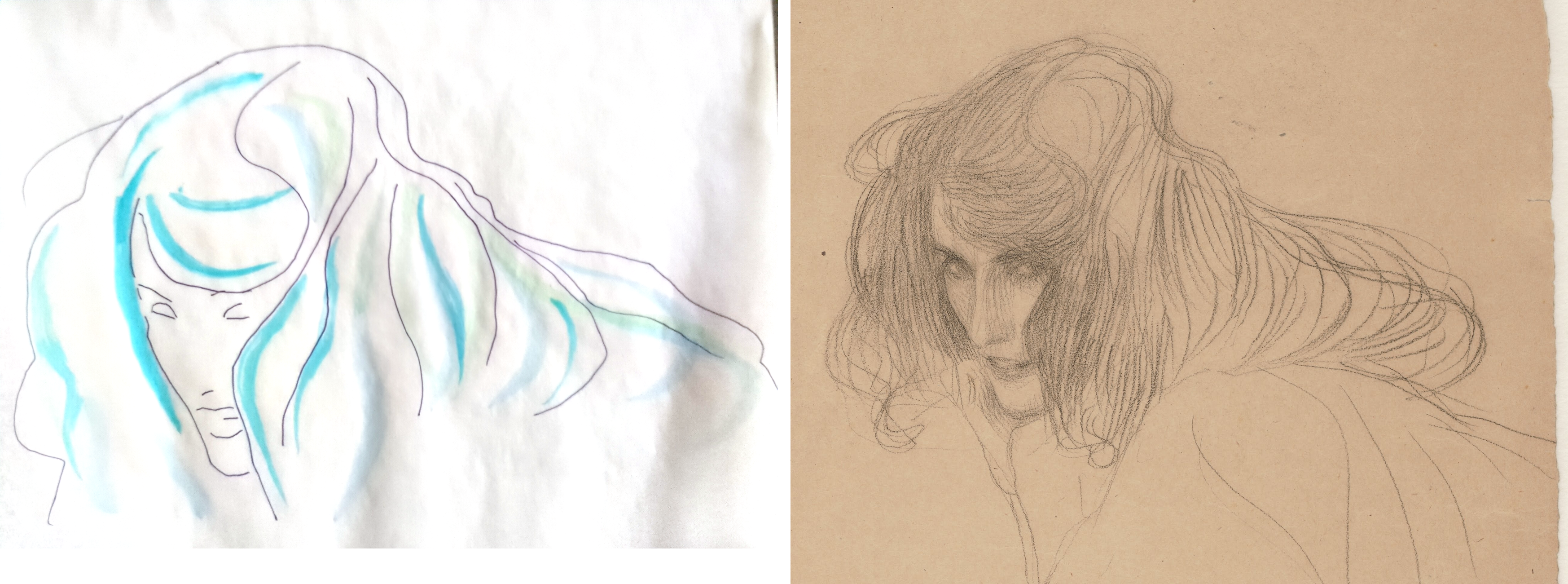
 Left: my tracing, Monday 19 October — fine line and coloured brushes. Right: Gustav Klimt, Studie für „Wollust“ im Beethovenfries (Study for “Lust” in the Beethoven Frieze), 1901 — black chalk on paper, Albertina, Wien (Vienna), 39323. Public domain.
Tracing · Toorop · Auction · Background
This is Klimt. It’s unique looking, and has a lot of interest. I think the lines are extraordinary, the expression, the orientation. That’s quite a striking looking drawing. This one is different, and specifically about the lushness and volume and form of the large hair, as a contrast with her face.
I think three quarters really helps. Just this curve on the side of her face is quite gorgeous in that way. It gives the dimensionality of the side of the face, the cheekbone, while letting us see both eyes and eyebrows. In terms of her actual core facial structures, that’s it. So we have the orientation of her face now.
He is working on the inside with those lines. With the rest of her hair, the main thing he’s showing is the masses. The extent of her hair is unusual and striking. The density of line does get thinner farther from her face. So the question is, what do we want to do with that? How do we want to capture these masses? There’s a mass above her forehead. There’s the side, the back, past her head. There’s this large cloud on one in front of her cheek.
It undulates, and he’s using these contours to show the undulations. And he’s using multiple hatches to get some of these undulations. And hair, I think, is well suited to this, because he can start with an important line, but then just drop it somewhere. Hair naturally is voluminous, yet each strand is not necessarily distinct. So hair is natural for the kind of hatching he’s doing here.
Starting off with fine colored lines, and I do think I should be using finer lines on this one. Let’s get a silhouette of her hair overall, and then let’s try to get some of this undulation that I think he’s really drawing. So to get some of these undulations, using a few different colors of brushes could be interesting. We start lighter, and then go darker. Lighter, I would say, is stuff out further from her face. And her shoulder, I think, is really good. And then a little bit darker, then maybe just some very strong lines to certain things. His sheet is black chalk only, and with the colours I was following the density of his lines.
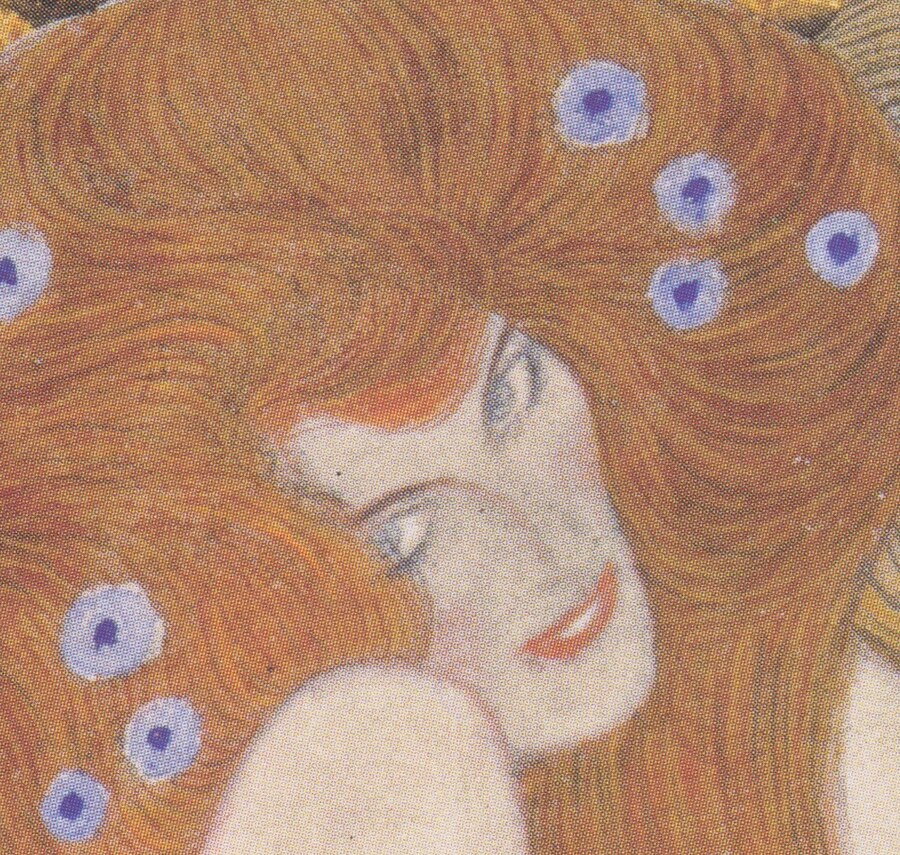
In the frieze she became one of the three women beside the Gorgons. I think in miniatura my drawing doesn’t capture the full intention and power of her eyes. It’s vaguer, but some of the hair masses did work nicely.
Toorop
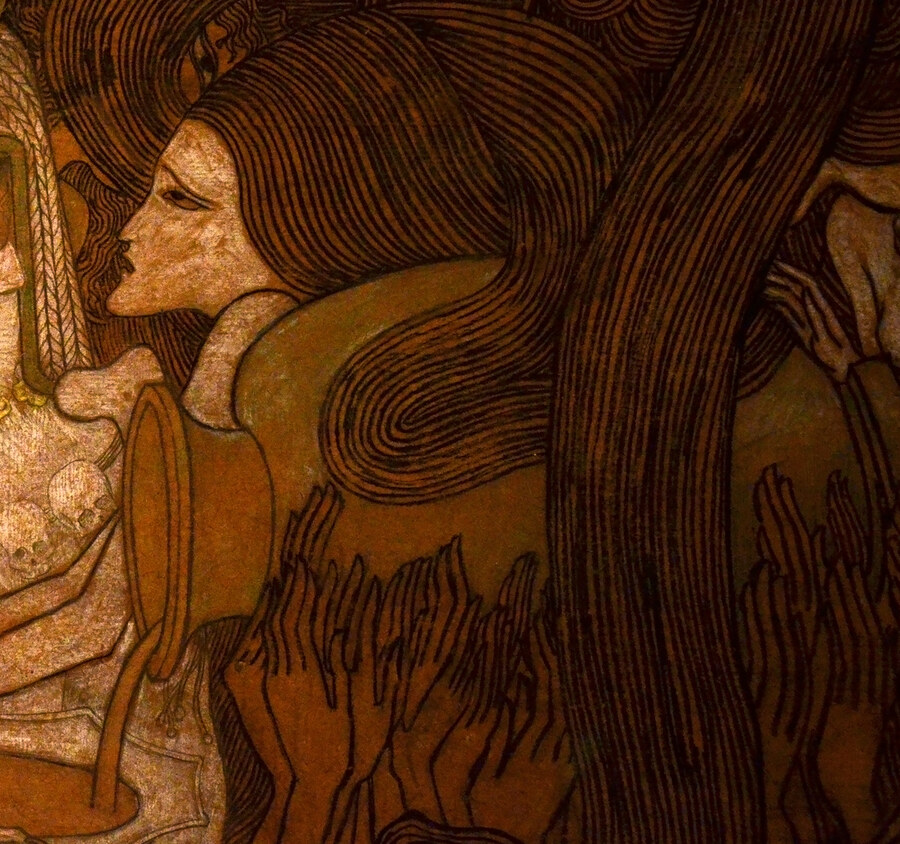

Google Arts & Culture’s note on this sheet calls her lasciviousness and says she “points to the symbolist linear art of Jan Toorop whose influence on Klimt in his Beethoven Frieze was paramount.” In Toorop’s De drie bruiden the hair streams out in long parallel lines that carry the whole picture, the same way the lines run with the hair here.
Auction
Klimt’s studies for the frieze still come up at auction in Wien. At im Kinsky’s Gustav Klimt sale on 24 April 2024, a black-chalk study for the centre of the Gorgons, the figures on the hostile-powers wall beside this one, had an estimate of €60,000–120,000 and realized €89,600 with fees. Like much of the frieze material, it had belonged to August and Serena Lederer, then their son Erich.
Background
Klimt painted the Beethovenfries (Beethoven Frieze) in 1902 for the 14th exhibition of the Wiener Secession (Vienna Secession), a show built around Max Klinger’s sculpture of Beethoven. It was meant for the exhibition only, painted straight onto the walls in light materials, charcoal, graphite, chalk, pastel, casein colours, gold, silver and gilt stucco, with mother-of-pearl buttons and semi-precious stones, 2.15 metres high and 34.14 metres long. Its programme follows Wagner’s reading of Beethoven’s Ninth Symphony.
On the middle wall are the hostile powers, the giant Typhoeus, the Gorgons, and to their right three women, Wollust, Unkeuschheit und Völlerei (lust, unchastity and gluttony), with gnawing grief beside them. This head, with its sidelong look and spreading hair, is a study for one of those women.
The Albertina keeps 172 of Klimt’s drawings for the frieze. Carl Reininghaus bought the frieze in 1903 to save it, and Klimt gave him over a hundred preparatory sketches. August Lederer bought it in 1915. After the Anschluss in 1938, Serena Lederer fled to Hungary and left her collection behind. The frieze came back from the Altaussee salt mine in 1945, and Erich Lederer sold it to the Austrian state in 1973. It has been on show in the basement of the Secession since 1986.
Links
- Studie für „Wollust“ im Beethovenfries, Albertina — the museum’s catalogue
- Klimt’s Beethovenfries drawings, Albertina — 172 studies for the frieze
- The master on Wikimedia Commons — public domain
- Beethoven Frieze on Wikipedia — the 1902 exhibition, the walls, the Lederer history
- Beethovenfries on the German Wikipedia — the hostile powers, figure by figure
- Head of a Woman in Three-Quarter Profile, Google Arts & Culture — the Albertina’s note, with the Toorop point
- Toorop, De drie bruiden, Kröller-Müller Museum — the whole drawing
-
im Kinsky, The Gustav Klimt Sale, lot 4 — a Gorgons study, 2024
- Process video — Monday 19 October — the tracing session on YouTube
