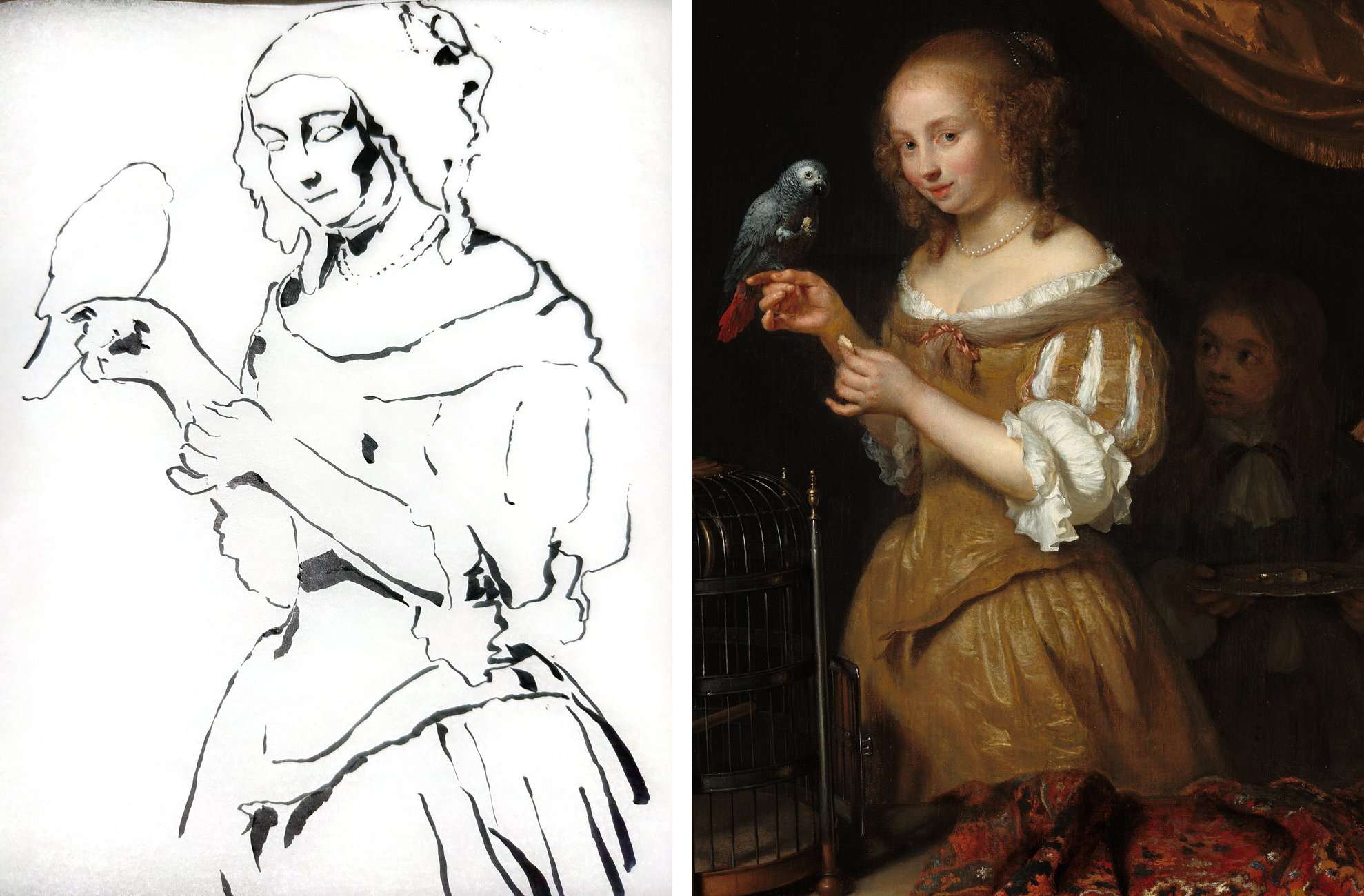
 Left: my tracing, Sunday 18 October — brush. Right: Caspar Netscher, A Woman Feeding a Parrot, with a Page , 1666 — oil on panel, 45.7 × 36.2 cm, National Gallery of Art, Washington, 2016.118.1. Public domain.
Tracing · Auction · Background
I was looking at Vermeer, and came across Netscher, who influenced Vermeer, from the Dutch Golden Age. Vermeer has a lacemaker, so I was thinking of doing that, but then I saw that his could have been modeled on this Netscher. So then I started looking at Netscher, and I see a clear connection. Vermeer takes the light and shadow even further, the expressivity, intensity of work.
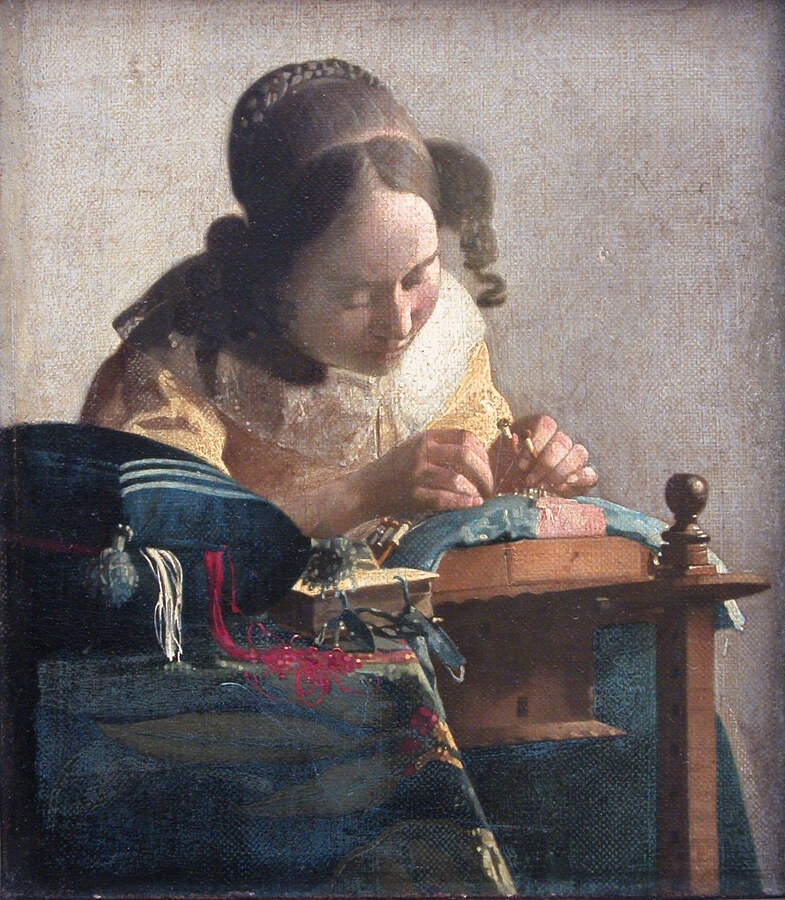
I liked Netscher partly because of the gaze. Vermeer’s lacemaker looks down at her work, but Netscher’s woman looks straight at us. That’s a key difference with Vermeer’s Lacemaker. The gaze is communication and recognition.
This drapery, I think, works really well. There’s her big sleeves and her parrot. I think her forms responded fairly well to the brush. The variation of the brush mimics the flow of the material and the light and shadow over it. It feels natural and like the material, and in cases like this draws the ink nicely.
I’ll start with a silhouette. The thing that’s quite interesting is the lighting, and how well Netscher captured the lighting, like Vermeer. With my brush it’s become a lot more stark. He’s giving us the guidance really, if we choose to push it to just a black and white with broad brushes. He gives where he sees the light and darkness much more minutely. We do have to decide where our brush will go, but he gives us a consistent, more complex scene to start with and simplify. I love this shadow of the hair here off the edge of the shoulder. He’s portrayed a lot of shadows too.
Her hat, her eyes are very fine. There’s a lot of description there. I think she’s feeding the parrot a cracker. I was interested in learning about how he depicted her and the light, and kept the parrot minimally.
Auction
The painting left the Alte Pinakothek in München (Munich) in the late 1930s, probably sold off by the Nazi regime for foreign currency, and the dealer Julius Böhler sold it on in 1938. Its next owners, Hugo and Elisabeth Andriesse, Jewish collectors in Belgium, fled to the United States in 1940. The Einsatzstab Reichsleiter Rosenberg seized their collection, and a Göring list records the picture in Paris in March 1942. After the war it passed through a Köln (Cologne) dealer to the collector Rudolf Ziersch, who gave it in 1950 to the museum in Wuppertal.
Wuppertal returned it to Elisabeth Andriesse’s heirs in 2014, and they sent it to Christie’s New York for charity. The dealer Richard Green bought it there, and the National Gallery of Art has owned it since 2016.
Background
Caspar Netscher was born in 1639, in Heidelberg or Praha (Prague), and grew up in Arnhem, adopted by a physician. From 1654 he trained with Gerard ter Borch in Deventer. He set out for Italy in 1658, but married in Bordeaux in 1659, which ended the journey, and settled in Den Haag (The Hague) in 1662. There he turned to portraits, with William III as a patron, and Cosimo III de’ Medici bought four of his paintings. He was known for silk, brocade and oriental rugs. He died in Den Haag on 15 January 1684, aged about 45.
His The Lace Maker, 1662, is in the Wallace Collection in London. Vermeer’s La Dentellière (The Lacemaker) in the Louvre, from about 1669 to 1670, is often compared to it.
This picture, dated 1666, is one of seven versions Netscher painted of the subject.
Links
- A Woman Feeding a Parrot, with a Page, National Gallery of Art — the museum’s page
- The master on Wikimedia Commons — public domain
- Woman with a Parrot at a Window on Wikipedia — provenance, wartime seizure, restitution
- Caspar Netscher on Wikipedia — life, ter Borch, The Lace Maker
- Vermeer’s The Lacemaker on Wikipedia — and its comparison with Netscher’s
-
Vermeer’s La Dentellière on Wikimedia Commons — public domain
- Process video — Sunday 18 October — the tracing session on YouTube

