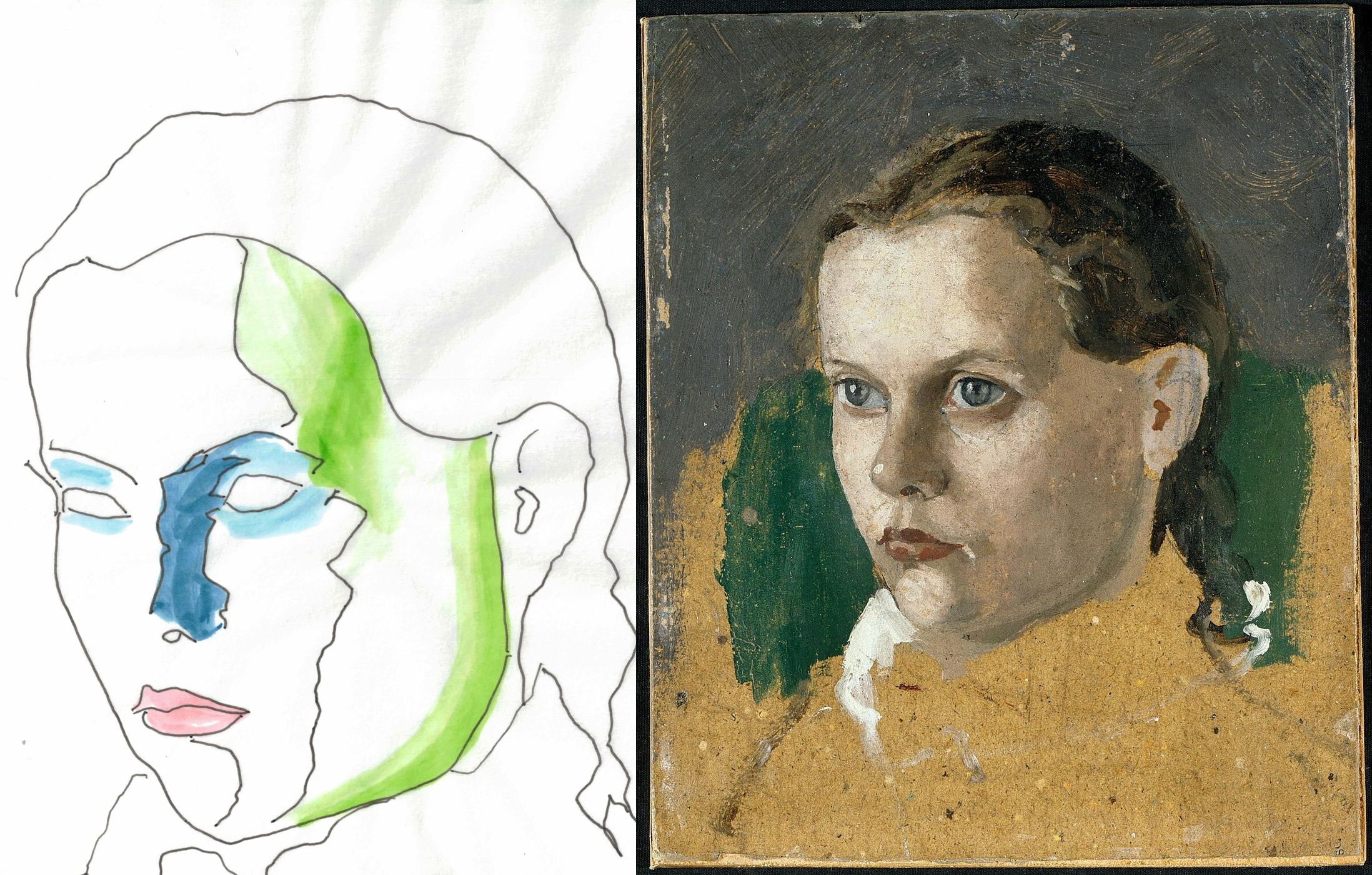
 Left: my tracing. Right: Edvard Munch, Laura Munch, 1882, oil on board, 18 × 15 cm, Munch Museum, Oslo (MM.M.01045) — public domain.

Okay, so this is another view of Laura Munch — interesting that there are two of these already. I’ve done the Madonna and the straight view elsewhere, so now this is the three-quarter view. I think that’s especially interesting because it has a particular signature to it — it doesn’t take much information to convey the orientation. It’s about orientation. The straight-on view is mining the baselines, in a way — the Madonna has that tilted-back head, and now this three-quarter Laura gives us something like the axes of the coordinate space. There’s the eyes, here are the basic features and their locations — especially the lips. Already a huge amount of information, and a very canonical face structure too, which is part of what makes this useful for this kind of study.
Digging into the color, especially this early on — I love this golden tone. Trying to get a very clean line here. Value-wise there’s a side of the nose that’s adding some information, but it’s not obviously needed. The bottom of the eyelids, which I’ll leave out for now, but which I’m studying, I do think the eyes, the skin of the eyelids, curvature, are all important.
Now we can color it — not just lines, brushing something on, closer to paint once the shape is there. A little green, a little blue — an aquatic effect. I do have a straight color match for the lips, but I’m going for a slightly orangeish one instead, hopefully more interesting. I like the water brush here — pulling some of the color up and away, softening a band here, softening it there again, blending in with the guidance the original gives.
The only other question is whether to pull any more of that color around — there’s color there that isn’t the eyes, and that would want a different color. I like this blue, it’s aquatic, reminds me a bit of the warrior pieces — they had that same treatment around the eyes. So I’ll stop it there.
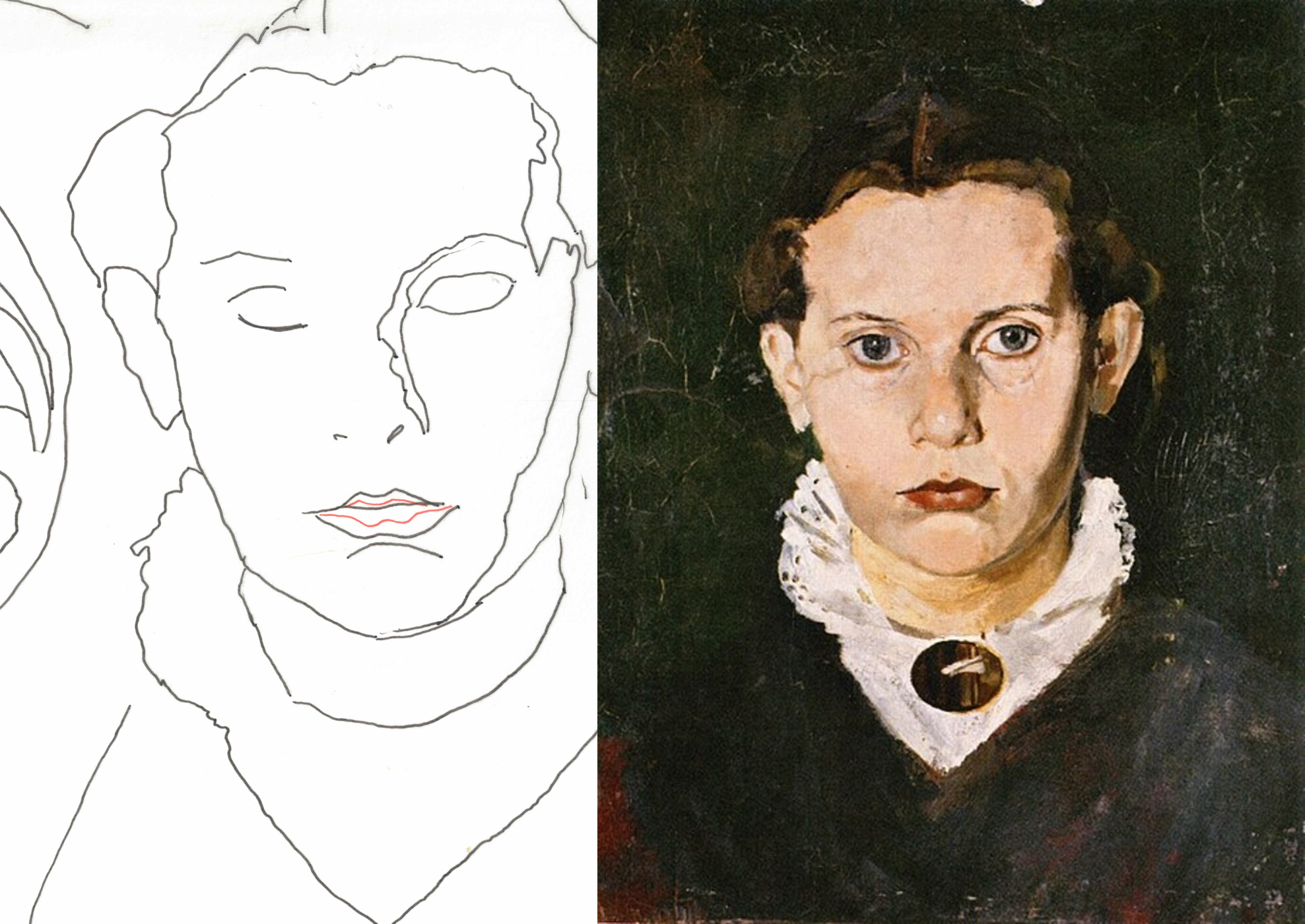 Left: my tracing. Right: Edvard Munch, Laura Munch, 1882, oil on paper — public domain.

What I find interesting about seeing Laura straight-on and three-quarter, both through Edvard’s eyes, is the precision — there’s no real mistake in either one. Sometimes even a master shows a glitch, and that can be interesting too, but here it’s Laura from both sides, and what comes through is the connection: intense yet comfortable with him, which I think is the crucial point.
Her eyes are actually open here, not closed — there are just no pupils. That mask-like quality is something of Modigliani’s I still find important, even now; I rarely draw pupils.
Background. Laura Munch, 1882, oil on board, is Edvard Munch’s portrait of his younger sister Laura Catherine Munch, painted when he was about eighteen and Laura around fifteen — one of two small board portraits from that year (Munch Museum accessions MM.M.01045 and MM.M.01046), the other a straight-on, wide-eyed view of the same sitter that this three-quarter study is the companion to. Same green-and-ochre palette, same close, unfussy crop to just the head and shoulders — Munch working out orientation on a single face across two sittings rather than two different subjects, which is more or less the same exercise as tracing both of them now. Laura recurs across Munch’s career more than almost any other family member; she was hospitalized for much of her adult life, which shadows how the later, more symbolic paintings of her tend to get read, but these early 1882 studies predate all of that — they’re just a young painter learning a face.
Auction context. No direct comp here — small early studies like this stay in institutional hands (this one’s at the Munch Museum, Oslo) and essentially never come to market; the Munch works that do sell are almost always the Frieze of Life exhibition pieces and beach/street scenes rather than early family studies. For scale: Munch’s auction ceiling is The Scream (1895 pastel) at $107M, Sotheby’s New York 2012, with Girls on the Bridge (1902) at $48.2M (Sotheby’s New York, 2016) and Vampire (1894) at $34M (Sotheby’s New York, 2008) below that. Munch portraiture specifically tends to cluster much lower when it does surface — Self-Portrait with Palette (1926) made £3.6M at Christie’s London in 2021 — which gives some sense of where a piece like this would sit if it were ever deaccessioned, which it won’t be.
Image credits. Edvard Munch died in 1944 — public domain (life + 70 and beyond). The photograph is a faithful flat reproduction of a public-domain 2-D artwork and carries no separate copyright of its own (US: Bridgeman Art Library v. Corel, 1999; EU: Copyright Directive 2019, Art. 14).
Links
- Watch the three-quarter process video on YouTube
- Laura Munch (MM.M.01045, three-quarter) — Wikimedia Commons — full painting, license
- Laura Munch (straight view) — Wikimedia Commons — full painting, license
- Edvard Munch — Wikipedia