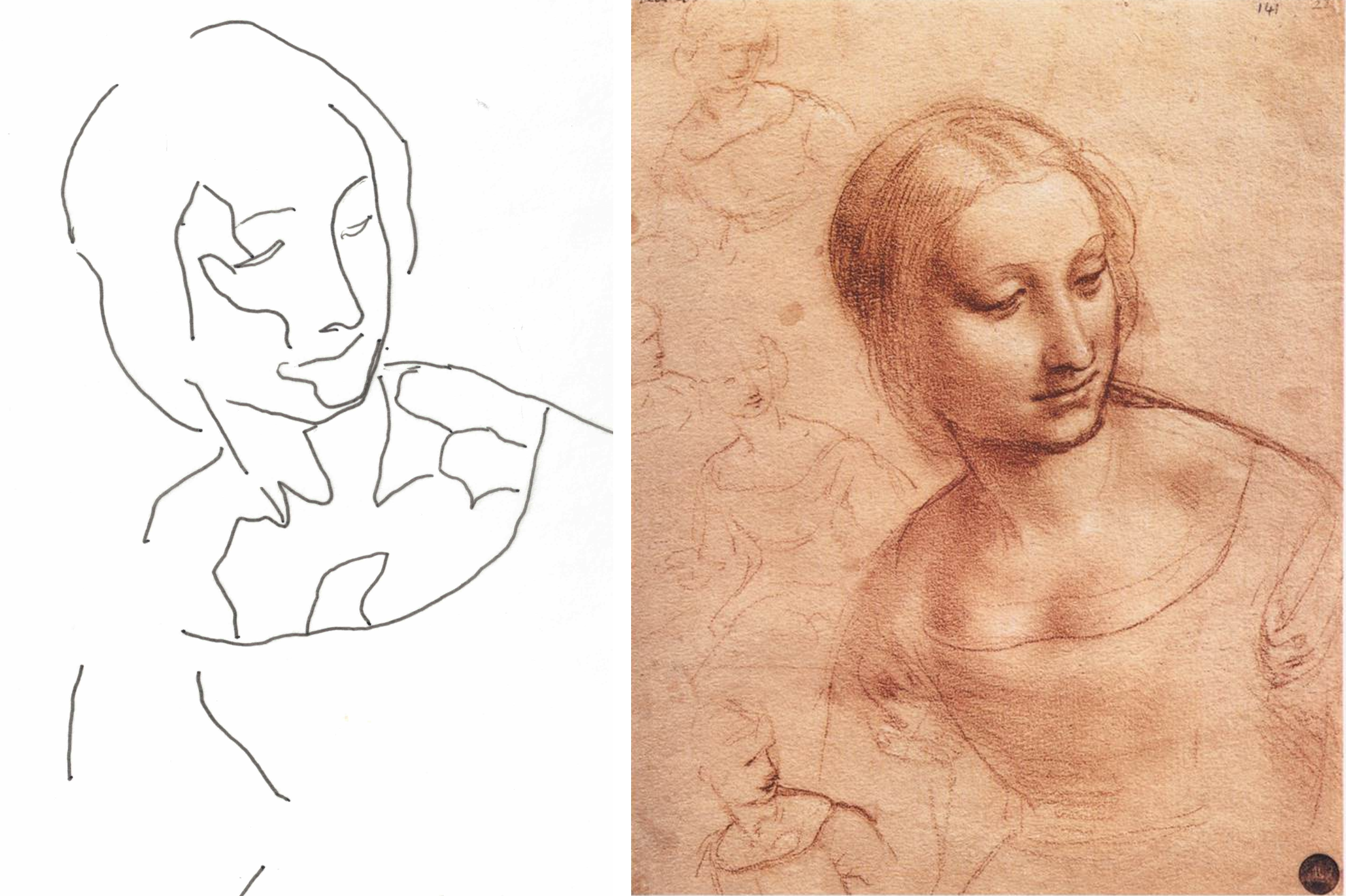
 Left: my tracing. Right: Leonardo da Vinci, Studio per la Madonna dei Fusi (Study for the Madonna with the Yarnwinder), c. 1501, red chalk and silverpoint on rose-prepared paper, 25.7 × 20.3 cm, Gallerie dell’Accademia, Venezia (Venice) — public domain.

This is called in English Madonna of the Yarnwinder, a spindle toy that Jesus is pictured with. Leonardo has a separate study of just the shoulder area — I had that one, RCIN 912514, on screen here too. Her face looked perfect, then I thought her shoulders might be a little too big. There are faint line drawings off to the side — I think those are where he starts from. I didn’t trace them, but I think he was getting the position and the form ready in his mind. They’re too faint to trace anyway, at least from here.
Her eyebrows aren’t that clear, which is fine. What’s interesting is a shoulder line that could be two lines, and I think the one he’s proposing is the one carried from the other study. It gives the head a tranquil aspect.
The real strength of this one is the shoulder. You have to look at it without the face, because the face is so good it takes over — and that can make you miss something important. Here I think he was uncertain about the shoulder, and then found something very good. The shoulder is shading and form, and it’s not obvious how to trace it — there’s no line there. I’m forced to invent one. Is that still tracing? Perhaps not — but perhaps more important, I followed, and tried to decide when I needed to. Mine is overdone now, but I think it sort of worked.
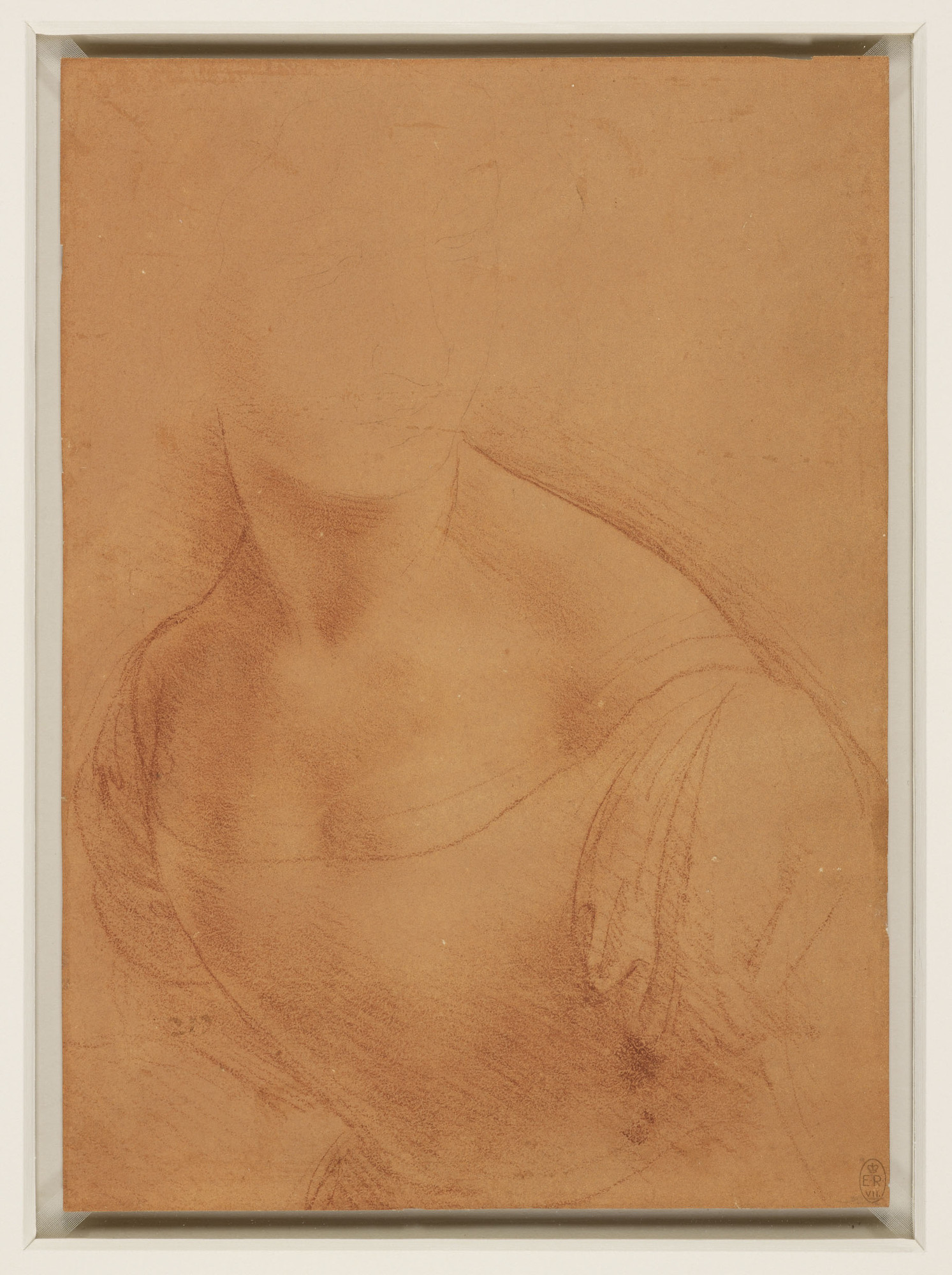 Leonardo da Vinci, Il busto della Madonna (The bust of the Madonna), c. 1500, red chalk over metalpoint, Royal Collection Trust, Windsor (RCIN 912514) — the “separate study of just the shoulder area.” Public domain.

Leonardo made a separate sheet just for that bust and shoulder — RCIN 912514, at Windsor — the features barely outlined in metalpoint, everything worked up in red chalk.
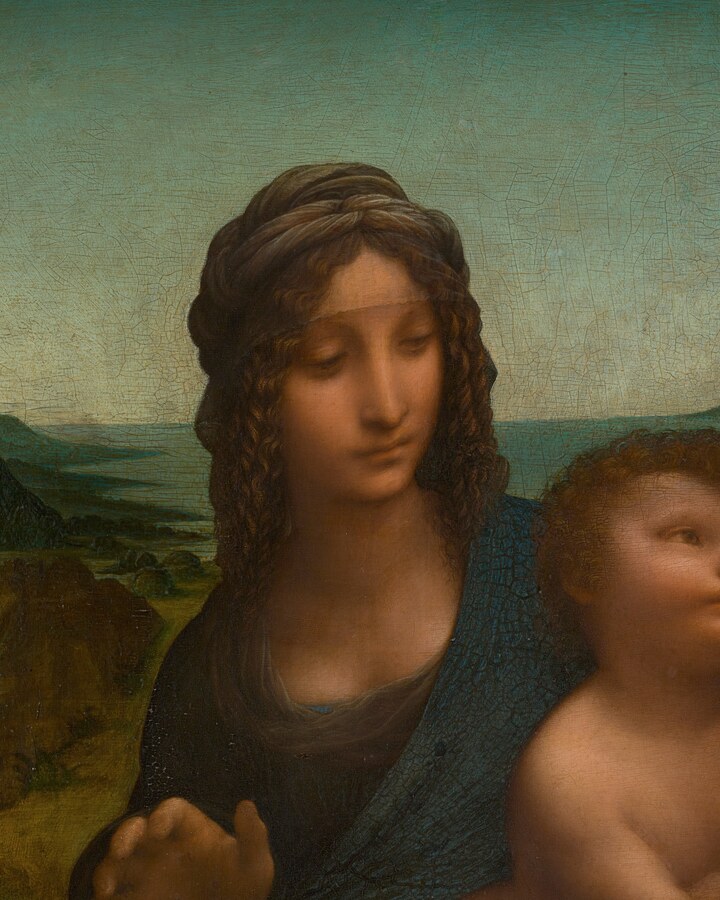 Leonardo da Vinci (and workshop), Madonna dei Fusi, “Buccleuch version” (detail), c. 1499–1501, oil on walnut, Scottish National Gallery, Edinburgh — public domain.
This is a study for a small devotional painting, domestic in scale, next to the mythological Leda and the battle — but I don’t think that changes how I read it. His work has a consistency and understanding to it.
Background. The drawing is a red-chalk and silverpoint study for the head and bust of the Virgin in Leonardo’s Madonna dei Fusi (c. 1499–1501, Scottish National Gallery, Edinburgh), with faint compositional sketches of the Madonna and Child in the margin — the searching lines above. Wikimedia Commons gives it to Leonardo (the title with a query), at the Gallerie dell’Accademia, Venezia (Venice). The bust study reproduced above, RCIN 912514 at Windsor, is a separate autograph sheet for the same shoulder.
Links