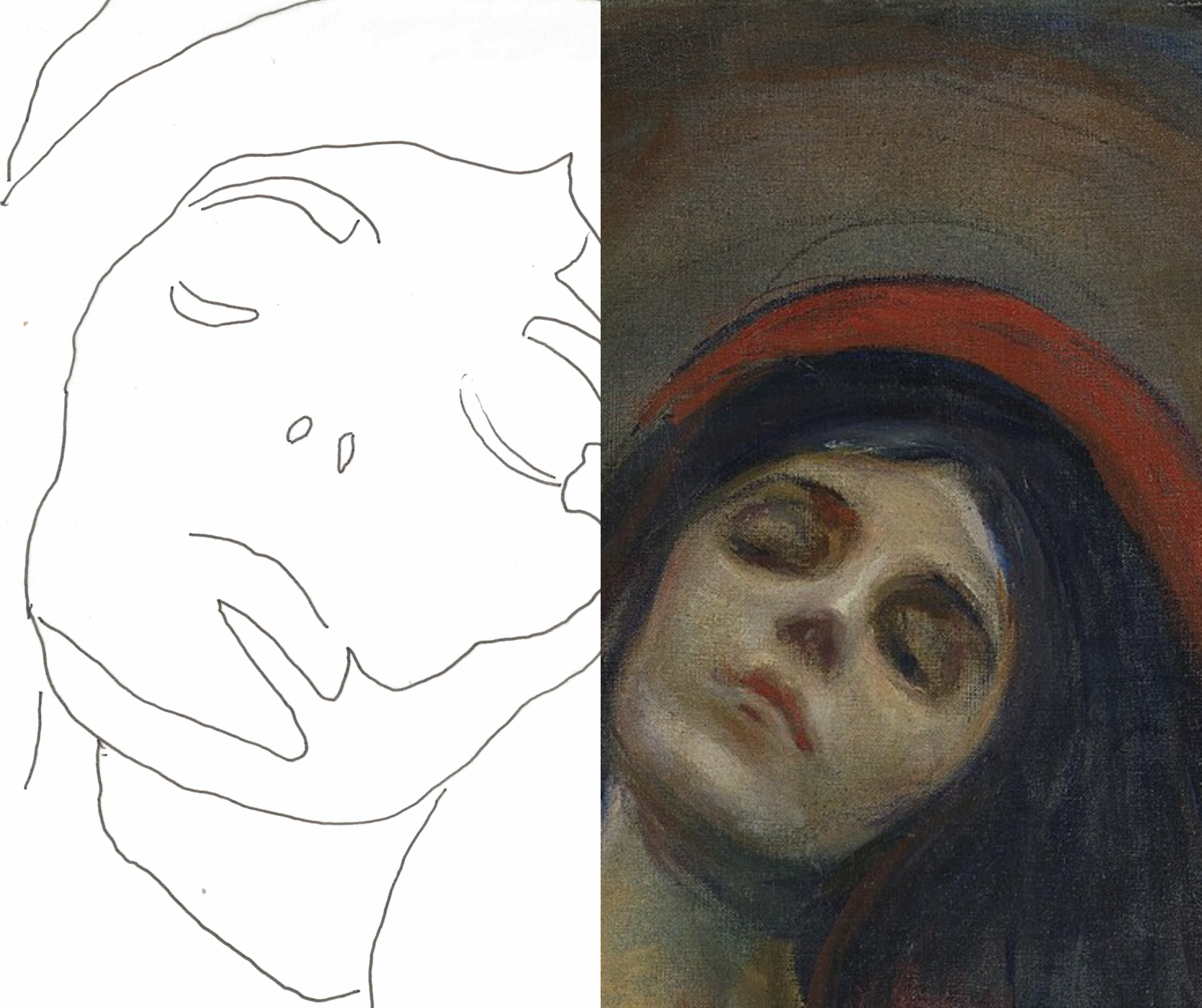
 Left: my tracing. Right: Edvard Munch, Madonna, 1894, oil on canvas, National Museum of Norway (Nasjonalmuseet), Oslo (NG.M.00841) — public domain. Cropped to the face, matching the scope of the tracing.

Here I’m looking at Munch’s Madonna, her face, to see what tracing shows me. What’s interesting is how stylized she already is in the original — there’s a lot of her form that’s already doing the work before I’ve touched anything. She’s in a very specific position in space, and she’s blurry — a lot of blur also in her halo and atmosphere behind her, brushwork Munch also carried into the print version.
Starting as usual with her eyes: they’re closed here, so I’m starting with her eyelids, the minimum — maybe a little color later, then her eye sockets, then her eyebrows, since that’s next for the orientation of her whole face.
She has a resonance, a power — something perhaps linked to The Scream. Graceful. Strange that she’s called Madonna, but upon reading the museum texts, that makes more sense. I was also interested in the merging of the foreground and background that he does — here it’s muddier, and interesting.
These were based a lot on minimal rules, all about the orientation — the features that face patches look for. But here there’s also a lighter glow above her left eye, for example, and her lips are more complex than my line, so I’m missing a lot. Her expression comes fundamentally from her eyes and lips, I think, whereas in mine I have a clean orientation but I’m missing some of the tranquility he shows.
If whatever survives maintains some of that dichotomy, then that’s great — it’s a function of his chosen structural form and orientation. I didn’t do the halo; I didn’t know it was a halo, and I was focused on the biological face. I also think the idea of sacred and erotic is kind of extremal but also ordinary, and perhaps even a link to the amygdala or hypothalamus, where eroticism and violence are both processed. We don’t have violence here, but Munch himself mentions love and pain and death in his writings, per Wenche.
Background. Summarizing the texts of the museums, Munch painted Madonna five times. None of the five canvases is dated, but recent research points to this one — the Nasjonalmuseet’s, from 1894 — as the first. He also made two prints of the image: an etching in 1894, then a lithograph a few years later. What’s actually in the picture: a nude woman shown half-length, head thrown back, eyes closed, one arm raised behind her head, ringed by a red halo where a religious Madonna would wear a gold one.
The title itself carries meaning. Nasjonalmuseet curator Wenche Volle notes in the text describing this piece that when Munch showed the painting at a Berlin gallery in March 1895, he hung two versions side by side under different titles — one as Madonna, the other as Das liebende Weib, German for “The Loving Woman.” He used a Norwegian equivalent, Elskende kvinde (“Amorous Woman”), for the same image elsewhere too — pairing the religious title with a more human one.
The lithograph version carries a border of sperm cells and a fetus in one corner, part of the same conception-and-birth theme that runs through the Frieze of Life. The Munch Museum’s account traces that design back to a painted wooden frame Munch made for one of the oil versions; he later replaced it with an ordinary frame, but the border survived into the print. (Klimt took up related imagery a decade later: Danaë, 1907–08, renders Zeus’s fertilizing stream as cells drifting toward an egg, an idea he picked up from his friend Emil Zuckerkandl, an anatomist who tutored him in embryology.)
This canvas has been in the National Museum of Norway’s collection since 1909. The Munch Museum’s own copy of Madonna was stolen in 2004, alongside The Scream, and both paintings were recovered in 2006. Madonna and The Scream anchor Munch’s Frieze of Life — his cycle of paintings about love, anxiety, and death, which also gave us Dance of Life and Melancholy.
Auction context. The oil versions are all in museum hands and won’t move. The lithograph is where Munch’s Madonna actually trades: individual prints surface periodically, though nothing at the scale of his major Frieze of Life paintings — for comparison, a Munch aquatint (Young Woman on the Beach, 1896) set the record for any print sold at auction, £2.1M at Christie’s in 2013, and a black-and-white Scream lithograph made £1.5M at Sotheby’s in 2016. Munch’s overall auction ceiling remains The Scream (1895 pastel), which sold for $119.9M at Sotheby’s New York in 2012.
Image credits. Edvard Munch died in 1944 — public domain (life + 70 and beyond). The photograph is a faithful flat reproduction of a public-domain 2-D artwork and carries no separate copyright of its own (US: Bridgeman Art Library v. Corel, 1999; EU: Copyright Directive 2019, Art. 14).
Links
- Madonna (NG.M.00841) — Wikimedia Commons — full painting (nude), license
- Madonna — Nasjonalmuseet collection — museum object page; catalogue text by Wenche Volle, first published in Edvard Munch in the National Museum: A Comprehensive Overview (Oslo: National Museum, 2022) — much of the Background section above draws on her essay
- Madonna (Munch) — Wikipedia
- Edvard Munch — Wikipedia
- Munch and Women — Visit Norway — the women (mother, aunt, sister, lovers, models) who shaped Munch’s life and work