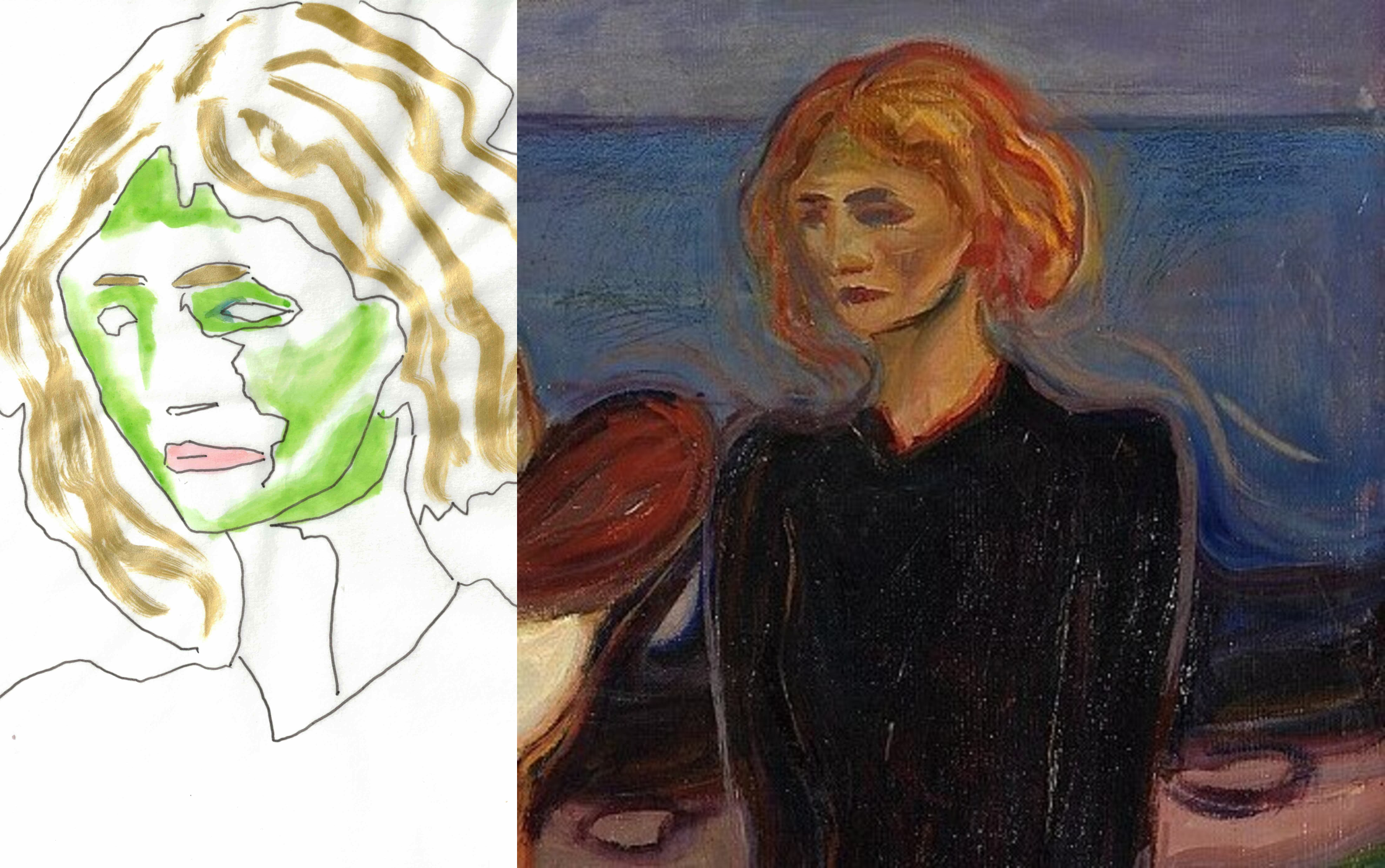
 Left: my tracing. Right: detail, the lone woman in black, from Edvard Munch, The Dance of Life, 1899–1900, oil on canvas, 125 × 191 cm, National Museum of Norway (Nasjonalmuseet), Oslo — public domain.
.jpg)
The woman in black · The central couple
Munch himself wrote about this painting — in a notebook now held by the Munch Museum (MM T 2800), written in 1908, eight years after the fact. Translation by Francesca M. Nichols. A few pages before he describes starting this exact picture (quoted further down, with the central couple), he’s recalling a woman who came to him one spring: “a Young lady from a good Family… I love You… I did not respond… She returned on the third Day — would You like to have this Ring… Yes Thank-you very much I said… We did not meet again —” Full notebook, facsimile pages alongside the translation: eMunch.no.
I’m looking a bit at Munch’s Dance of Life here. It’s an interesting picture — the more I look at it, the more I see different things going on in it. There’s the couple with the red dress; I think the colors are doing some kind of symbolic work. That shape behind them, reflecting on the water — it’s a similar structure to the light we’ve noted in other Munch pieces, and it has a curious, almost jarring form to it, not really realistic — more like a symbol. Looks a little like a person, maybe a god.
There’s a flower down in the grass, this sun-or-moon reflecting on the water, couples dancing at different distances — he’s pulling us into a three-dimensional arrangement just by height on the page: this is a lawn with depth to it, and far away is the sun.
Two women here don’t have partners — one in white, one in black. The one in the middle does, and she’s in red. I think that’s one of the key points of the picture: most of these women are wearing white, and she’s the only one in black — the other figures in black are the men. Her face has a very particular shape, more distinct than the others, so I want to zoom in and trace it.
This turn of the head is angular — really special for this picture. There’s a little swoosh down near her collar I’m not sure about, maybe fur trim, and then the line of the jacket. After the first pass, and always, the question is always what’s the next line worth adding. There’s something about her eye — a subtle emotion in it, I think it’s the squint, if I pull a little more of that shape. There’s a thinness to the cheek too. A shadow under it — I’ll stop there rather than push it further.
Then color: green, perhaps because of Lautrec. Softened with the water brush, blending in along the lines the painting itself is already giving me. I love this thing happening at her chin. Her eye has an edge to it — a downward sweep — and lips that aren’t bright in the original, so orange again rather than the true match. Tried a metallic for the hair, since Munch gives such beautiful indications of the masses of her hair rather than individual strands, and left the rest alone — anything more would just be a distraction from what’s already there.
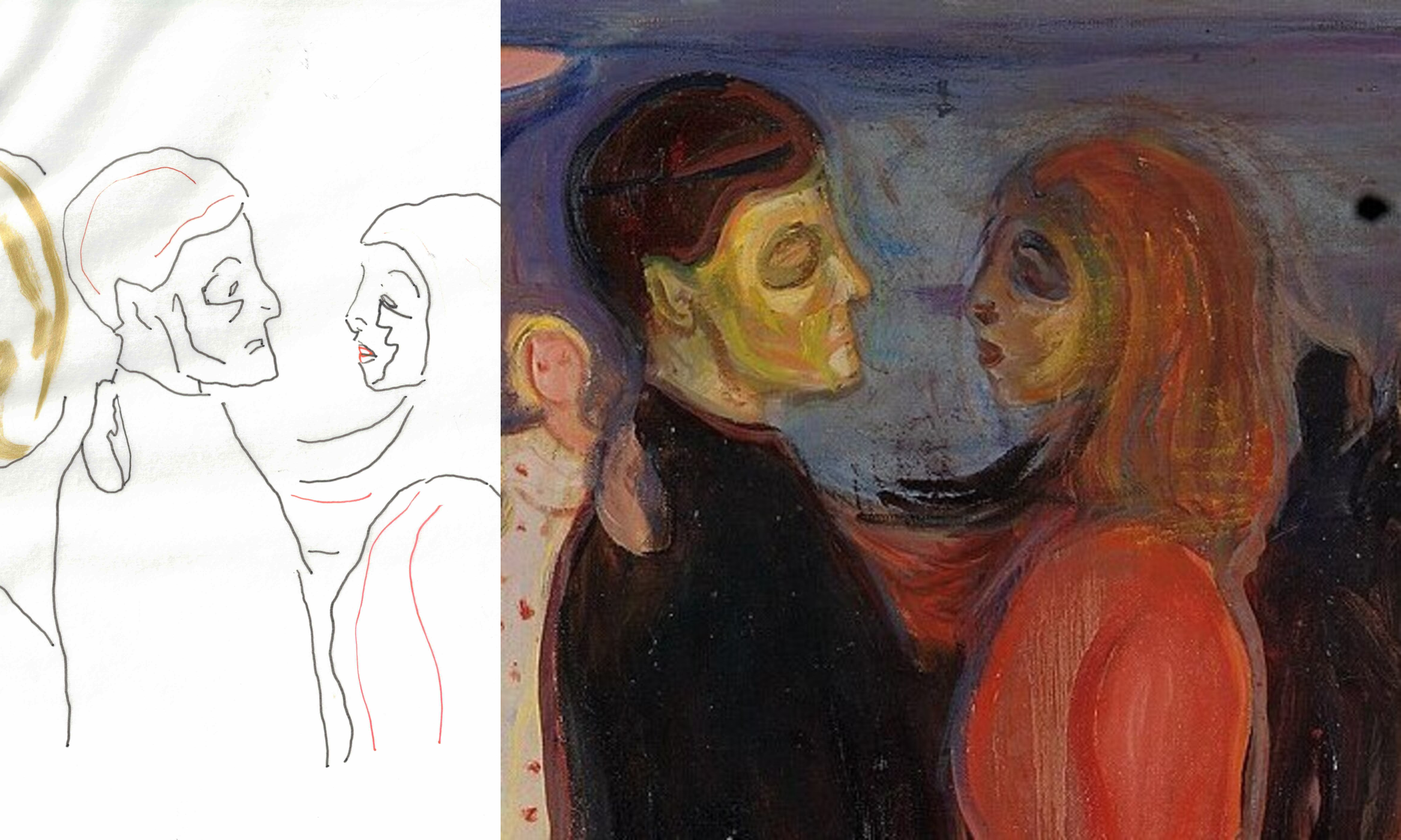 Left: my tracing. Right: detail, the central couple, from the same painting.
A few pages after the passage above, in that same 1908 notebook (MM T 2800, p. 15), Munch describes starting this exact picture — in his own hand:
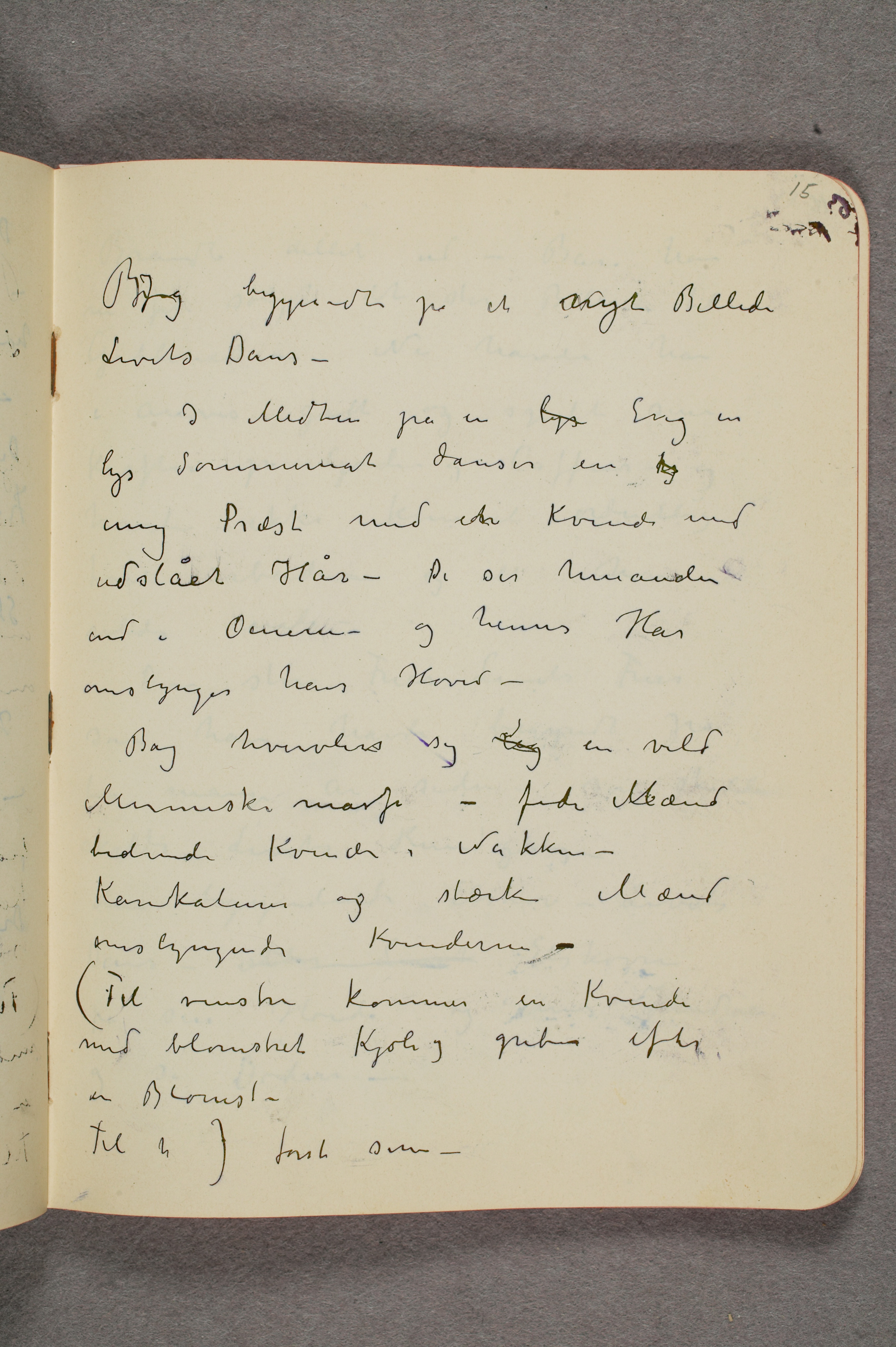 MM T 2800, p. 15, Munch Museum archive — the passage transcribed and translated below. Photo: Halvor Bjørngård, © Munch Museum, Oslo, via eMunch.no, whose facsimile-and-translation pairing for this notebook is genuinely worth spending time with in full.
Jeg begyndte på et nyt Billede Livets Dans – I Midten på en lys Eng en lys Sommernat danser en … ung Præst med en Kvinde med udslået Hår – De ser hinanden ind i Øinene – og hennes Hår omslynger hans Hoved –
“I began work on a new Picture The Dance of Life – In the Middle of a Meadow on a light Summer night a young Priest dances with a Woman with flowing Hair – They look into one another’s Eyes – and her Hair encircles his Head –”
— translation by Francesca M. Nichols
This is the central couple. You can see the woman in black over on the right that I did last time. There’s others nearby I don’t think I’ll be able to catch on this pass — hard to tell where the orientations of their eyes even is. The nose is very particular, the mouth too — a very specific, stylized shape to both of them.
I’m curious to put the eyes in and see what that does, because it might have something to do with why this pairing reads as so harmonious despite everything else going on in the painting. Here, I think, is really where the movement is coming from — there’s a calmness to this couple that the rest of the picture doesn’t have.
He does this blending a lot — her hand and his arm dissolve into each other, and there’s someone else behind them who’s blended into the background entirely, the space back there never really resolves. It’s confusion but deliberate, not careless. The eye sockets are deep and dark in the original; I left them off for now, wasn’t sure what to do with them yet.
Then color, a little. Her hand continues into her partner’s almost like a mitten shape. That’s the color going onto this one for now.
Perhaps the flashback, yet with the foreknowledge that this would not work, is the wistful wish and the sadness here. The priest is a religious figure, infused with transcendent meaning — or at least whose life is suffused with transcendence — and so this painting is one of the stations of life and fate. As for what gets said online — if this is Munch and Milly, it may well be, but such a resolution is simplistic. He is depicting his life and his fates.
Background. The Dance of Life (Livets dans), 1899–1900, is one of the centerpiece paintings of Munch’s Frieze of Life — the cycle he built around love, anxiety, and death. The three women along the dance floor are usually read as a triptych within the painting itself: white for innocence on the left, red for passion at center, black for mourning or the far side of desire on the right — echoing a “three ages of woman” figure Munch returned to across the Frieze. The setting is the beach at Åsgårdstrand, where Munch summered for years and which recurs across most of the Frieze of Life paintings. The central couple’s faces are close to masks — flattened, simplified, the man’s coat bleeding into her red dress where their hands meet — a device Munch used throughout the cycle to push a private anguish toward something universal rather than a portrait of specific people. The painting has been in the National Museum of Norway’s collection since 1910, a gift from the collector Olaf Schou.
The notebook page quoted above (MM T 2800, p. 15) is worth pausing on for what comes just before it, in the same pages: several paragraphs of first-person narrative about a young woman who tells him she loves him, comes back three times over three days, gives him a ring, and then — “We did not meet again.” The very next line is the one quoted above: I began work on a new Picture. Munch doesn’t name her, and he doesn’t call the dancing man himself — he writes “a young Priest.” So the manuscript doesn’t confirm what gets repeated online, that the couple is a literal self-portrait with a named former love. What it does show, in his own hand, is a real, remembered, unresolved love sitting directly behind the picture’s beginning.
Auction context. The Dance of Life itself is not going anywhere — permanently held in Norway’s national collection. But the closest thing to it on the market is Dans på stranden (Dance on the Beach, 1906–07), part of the later Reinhardt Frieze commission and the same dancing-couples-on-the-Åsgårdstrand-beach subject: sold for £14.5M at Sotheby’s London, March 2023. Munch’s broader auction ceiling sits well above that — Girls on the Bridge (1902) made $48.2M at Sotheby’s New York in 2016, and The Scream (1895 pastel) remains his record at $119.9M, Sotheby’s New York, 2012. Portraits and beach scenes from the Frieze of Life years are the works that reliably draw those numbers; large multi-figure “event” paintings like Dance of Life almost never leave museum walls.
Image credits. Edvard Munch died in 1944 — public domain (life + 70 and beyond). The painting photograph and the manuscript facsimile are both faithful flat reproductions of public-domain 2-D material and carry no separate copyright of their own (US: Bridgeman Art Library v. Corel, 1999; EU: Copyright Directive 2019, Art. 14). The facsimile photo is credited to Halvor Bjørngård, © Munch Museum, Oslo, via eMunch.no.
Links
- The Dance of Life — Wikimedia Commons — full painting, license
- The Dance of Life — Nasjonalmuseet collection — museum object page
- The Dance of Life (Munch) — Wikipedia
- Edvard Munch — Wikipedia
- MM T 2800 — eMunch.no, facsimile + translation side by side — Munch’s own 1908 notebook in full, handwritten pages alongside the English translation by Francesca M. Nichols. Photos: Halvor Bjørngård, © Munch Museum, Oslo
- Process video — tracing the woman in black — YouTube
- Process video — tracing the central couple — YouTube