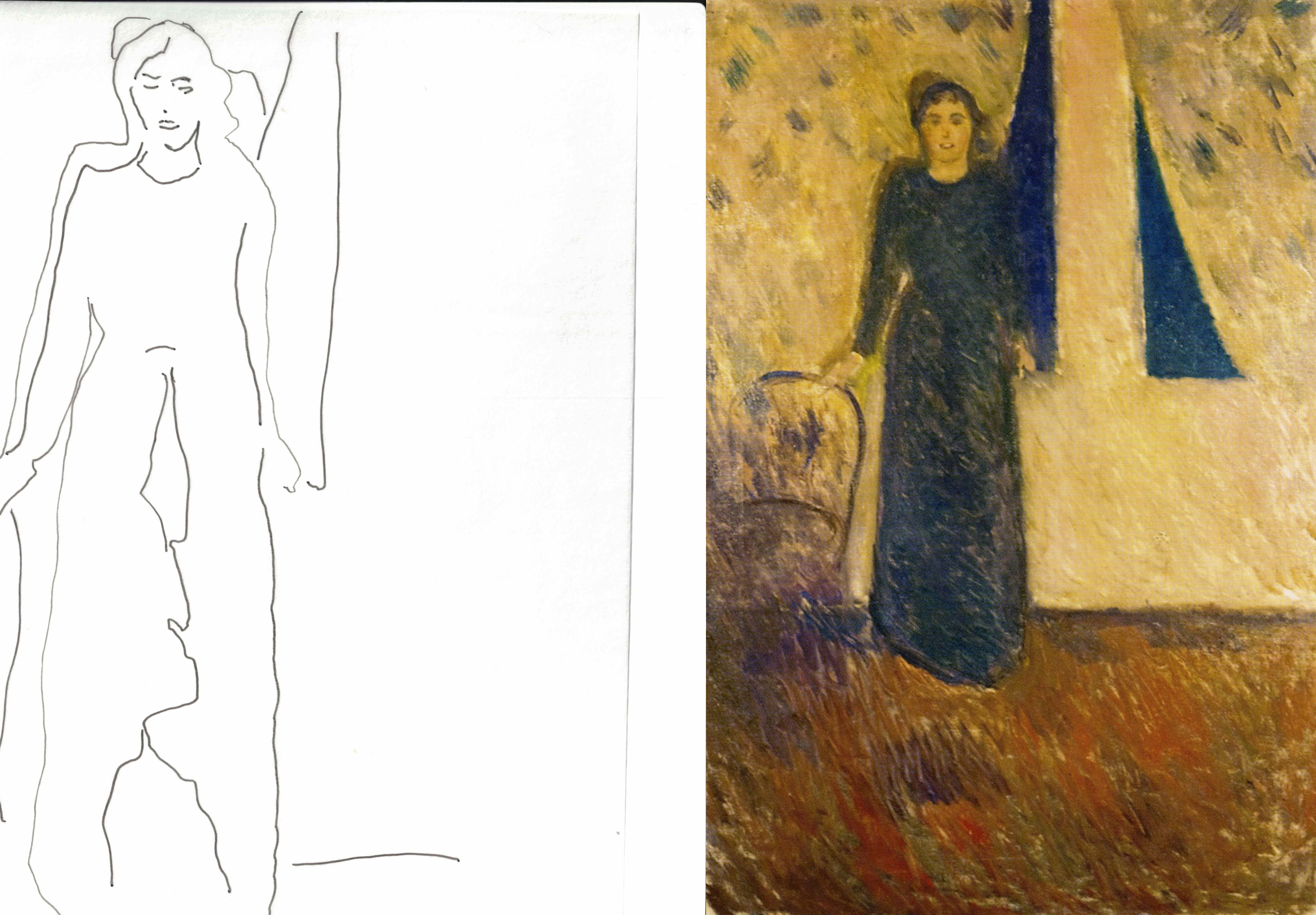
 Left: my tracing. Right: Edvard Munch, Alexandra Thaulow, 1891, oil on canvas — public domain.

Alexandra Thaulow · Sommernatt. Inger på stranden
This one’s from 1891 — two years after the Inger tracing below, even though it’s first here. What I like most is the dress — I kind of carved it out. I don’t think I did the face the same way; it has some of my imposition on it, not quite true to the real face.
I do like the shadow behind her, connected to the triangle in the original — what little I captured of it is actually the most interesting part. I suppose those could be curtains: a window with two curtains rising to a central point, and that large straight line is the stud between the two windows, which are dark blue. I especially love how her dress merges with that window — I have a line there, but the more I look at it, the more I think that’s the most interesting thing in the piece. What it reminds me of, and what I see in my own drawing too, is the wing of an angel.
The geometry here — she’s very flat, and unfortunately I think mine has more dimensionality than his. The face in the original is almost an ovoid, almost a void, where mine has more of an actual person in it. I traced lines around the contours of her dress that give it more realism than his — and looking at it now, I think that’s the flaw. What’s more valuable is his flatness, his abstraction. I don’t think the lines I drew are less valuable exactly, but they’re mine, not his — and it’s his approach I actually want to understand and lift, so mine end up less instructive to me than his are.
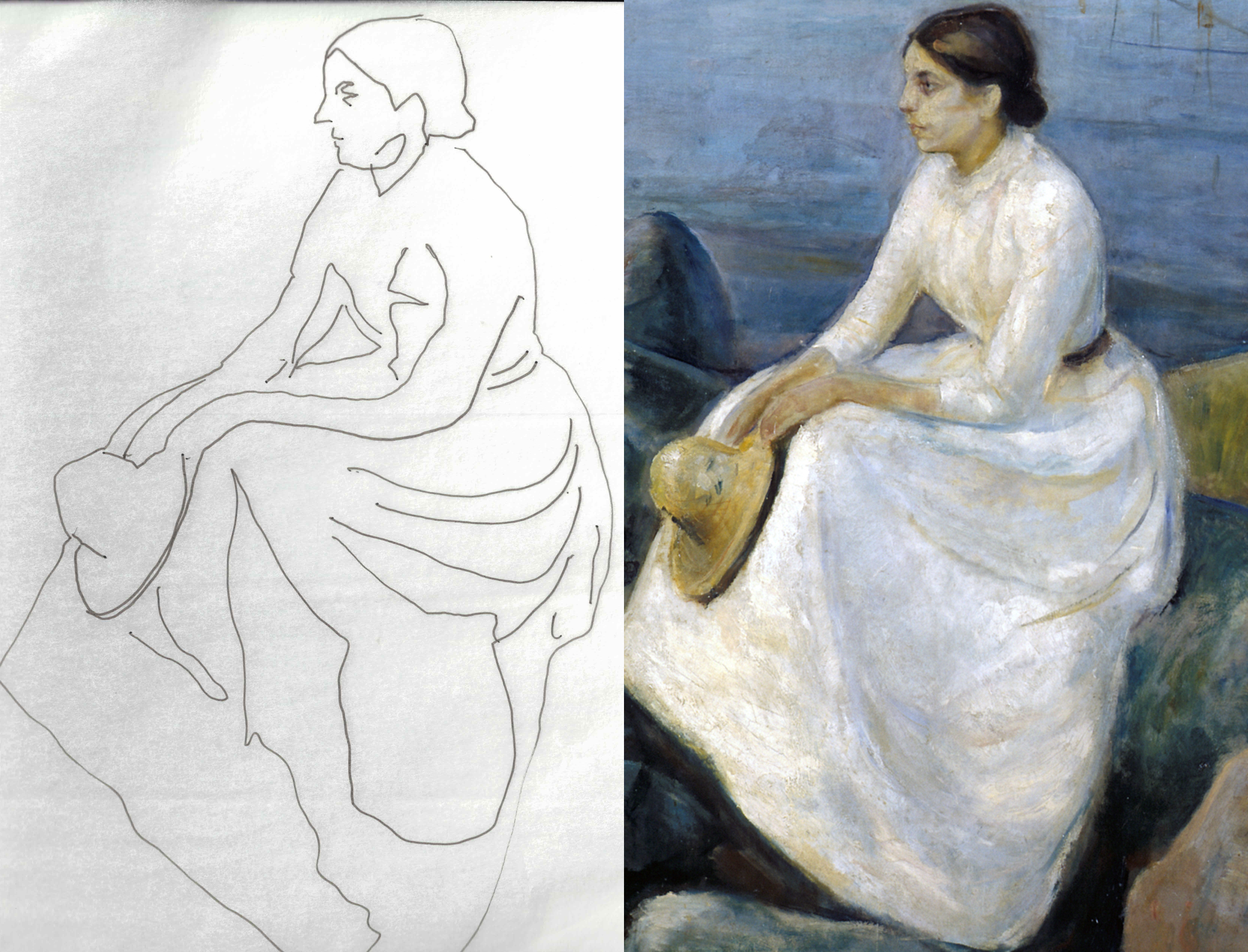 Left: my tracing. Right: Edvard Munch, Sommernatt. Inger på stranden (Summer Night: Inger on the Beach), 1889, oil on canvas, KODE Bergen (Rasmus Meyer Collection) — public domain.
.jpg)
This one has a kind of tranquility to it. I like the motion of the arms — in my tracing, the arms and even the skirt have that motion, which I thought was quite interesting. I kept the face flat and simple. I also liked the hat. I left out a lot of the rest — the rocks, all the way out.
This predates Døden i sykeværelset (Death in the Sickroom / The Sick Room), 1893, by four years, and it’s his sister Inger, which makes it much more interesting. I do feel some kind of harkening to the later work in the face — you can see something there that connects to Døden i sykeværelset, I think. Partly it’s just the stillness, the emotional stillness of it.
Background.
Alexandra Thaulow (back to the tracing)
A standing portrait from 1891, two years after Inger (below) — a woman in a dark, almost floor-length dress, one hand resting on the back of a chair, a triangular blue curtain catching a window behind her. The dress in the original is loosely brushed, more mass than detail; reduced to a single contour it reads almost as bare shoulders and a plain silhouette, which is the interesting tension in this one — the line doesn’t add the fabric back in, it just holds the shape the fabric made.
Alexandra Thaulow (née Lasson) was part of the Thaulow family circle Munch knew well in Norway — painter Frits Thaulow among them — though this appears to be a less-documented, less-exhibited work than Inger or the Madonna series. The same family circle produced a much heavier chapter in Munch’s life: Frits’s brother Carl Thaulow was married to Milly Thaulow (née Andrea Fredrikke Emilie Ihlen), Munch’s first serious love — an affair in 1885 that ended badly and left a mark on his work for years after (the Vampyr (Vampire) paintings of 1893–95 are sometimes read as a veiled reference to it). Alexandra and Milly are two different women who both married into the Thaulow name, not the same person under two names — easy to conflate, worth keeping straight.
Sommernatt. Inger på stranden (Inger on the Beach) (back to the tracing)
Munch painted this at Åsgårdstrand in the summer of 1889 — his sister Inger, seated on the rocks in a white dress, looking out past the frame. It’s often pointed to as the moment Munch found his own voice as a painter: the figure and the landscape start reading as one emotional register instead of separate subject-and-background, years before Skrik (The Scream). Oil on canvas, 126.4 × 161.7 cm, in the Rasmus Meyer Collection at KODE, Bergen — home to the world’s third-largest Munch collection.
Image credits. Edvard Munch died in 1944 — public domain (life + 70). Both photographs are faithful flat reproductions of public-domain 2-D artworks and carry no separate copyright of their own (US: Bridgeman Art Library v. Corel, 1999; EU: Copyright Directive 2019, Art. 14).
Links
- Alexandra Thaulow — Wikimedia Commons — full painting, license
- Sommernatt. Inger på stranden (Summer Night: Inger on the Beach) — Wikimedia Commons — full painting, license, KODE Bergen source
- Edvard Munch — Wikipedia