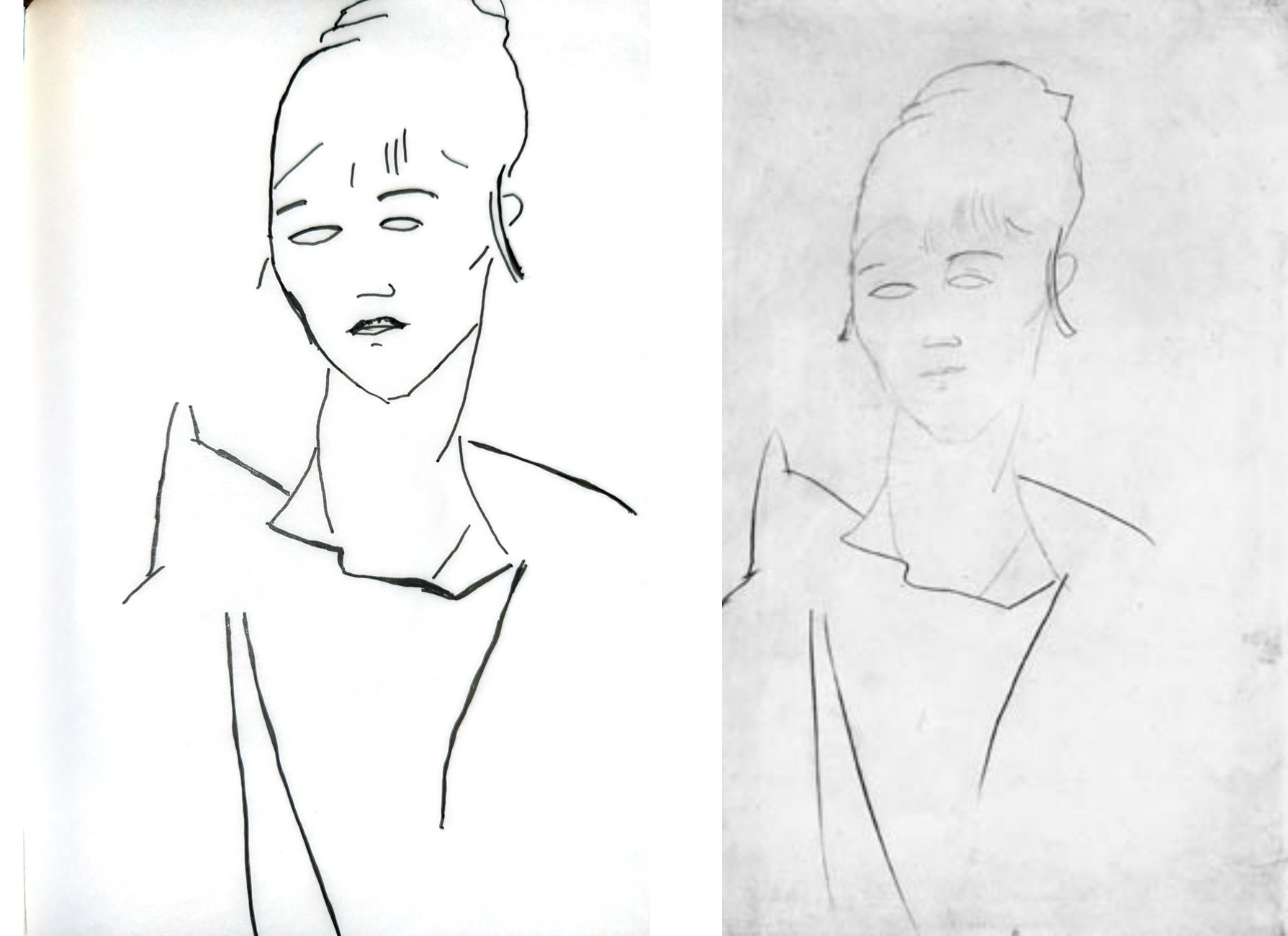
 Left: my tracing, Saturday 17 October. Right: Amedeo Modigliani, Portrait de Gabrielle Souenne , c. 1916–1919 — pencil on machine-made paper, 42.4 × 25.7 cm, Statens Museum for Kunst, København, KKS1965-1. Public domain.
Tracing · Auction · Background
Modigliani is a line-drawing master. This one is simple. He has his characteristics, the neck and the eyes. Her head has form, and he’s gotten a lot of just the solidity of her head. She has a kind of a realism. Her eyes are characteristically not level. But still, things are in the right place and form. This one has like a double property of, yes, she looks like his style, but at the same time she looks realistic too. The overall size of her head, vertical, is his characteristic, but this could very well be a person. I’ve traced his L’Amazone and his Ritratto di giovane donna before. This one is the most realistic, even beautiful, I think. The aesthetics of her neck are more persuasive.
And this drapery is free. And I think her neck and this drapery is simple, but just covers a lot. I love the implicit fashionability of her clothes, even now, and his willingness to use that, acknowledge that, along with his sense of her archetypicality, more clear in his than mine. Her clothing seems almost like lightning, quickly drawn.
He’s using a fair amount of line variation here. On this drapery, he’s very fast. I think that is why this looks… he’s very fast, but he’s descriptive. Speed is intuition and the intuition the sense. Slowness can be overtaken by symbolism, but it is an important tension. There was of course Drawing on the Right Side of the Brain, which has so many interesting exercises, and Rodin’s pure contour, which may be related.
I like this very gentle little S-curve near her neck. And her tiny cheekbone indentation. The bottom of her jaw is faint, but it is. This is faint, but… The fineliner forces a minimum. If I make a mark, we will see it. It is not faint. I went over his heavier lines again, so my fineliner adds weight, but I have a minimum that is higher than his, and so more intention and consequence.
See, her lips are subtle. He’s using the line variation a lot more. Just that little bit of lips is giving her a slightly different expression. His doesn’t have this down part. His is a little flatter. These various facial elements are incredibly sensitive to the smallest mark. Tracing with permanence gives us the immediate feedback, and we must recognize and learn and accept these. I think they become ultimately, if less aesthetic, more educational at least.
Auction
Portrait de Gabrielle Souenne has been in the Statens Museum for Kunst since 1965 and has no sale we could cite.
For scale, his Nu couché sold in 2015 for US$170.4 million.
Background
Modigliani drew this portrait in pencil around 1916 to 1919, on thin, slightly yellowed machine-made paper, torn along the left edge, 42.4 × 25.7 cm. It is in the Statens Museum for Kunst (National Gallery of Denmark) in København (Copenhagen), which acquired it in 1965, and it is catalogued only under its Danish title, Portræt af Gabrielle Souenne.
Born in Livorno in 1884, Modigliani moved to Paris in 1906. He worked mainly as a sculptor from about 1909 and was mostly back to painting by 1914. From 1916 the dealer Léopold Zborowski supported him, which places this drawing in his last years. His only solo exhibition in his lifetime, in 1917, was closed by the police on its opening day. He died in Paris of tubercular meningitis on 24 January 1920, aged 35.
Links
- Portrait de Gabrielle Souenne, SMK Open — the museum’s page (as Portræt af Gabrielle Souenne) and public-domain download
- The master on Wikimedia Commons — public domain
- Amedeo Modigliani on Wikipedia — life, Zborowski, the 1917 show, auction records
- Modigliani’s L’Amazone, reduced to line — an earlier tracing here
- Modigliani’s Ritratto di giovane donna, in line — another
- Process video — Saturday 17 October — the tracing session on YouTube
