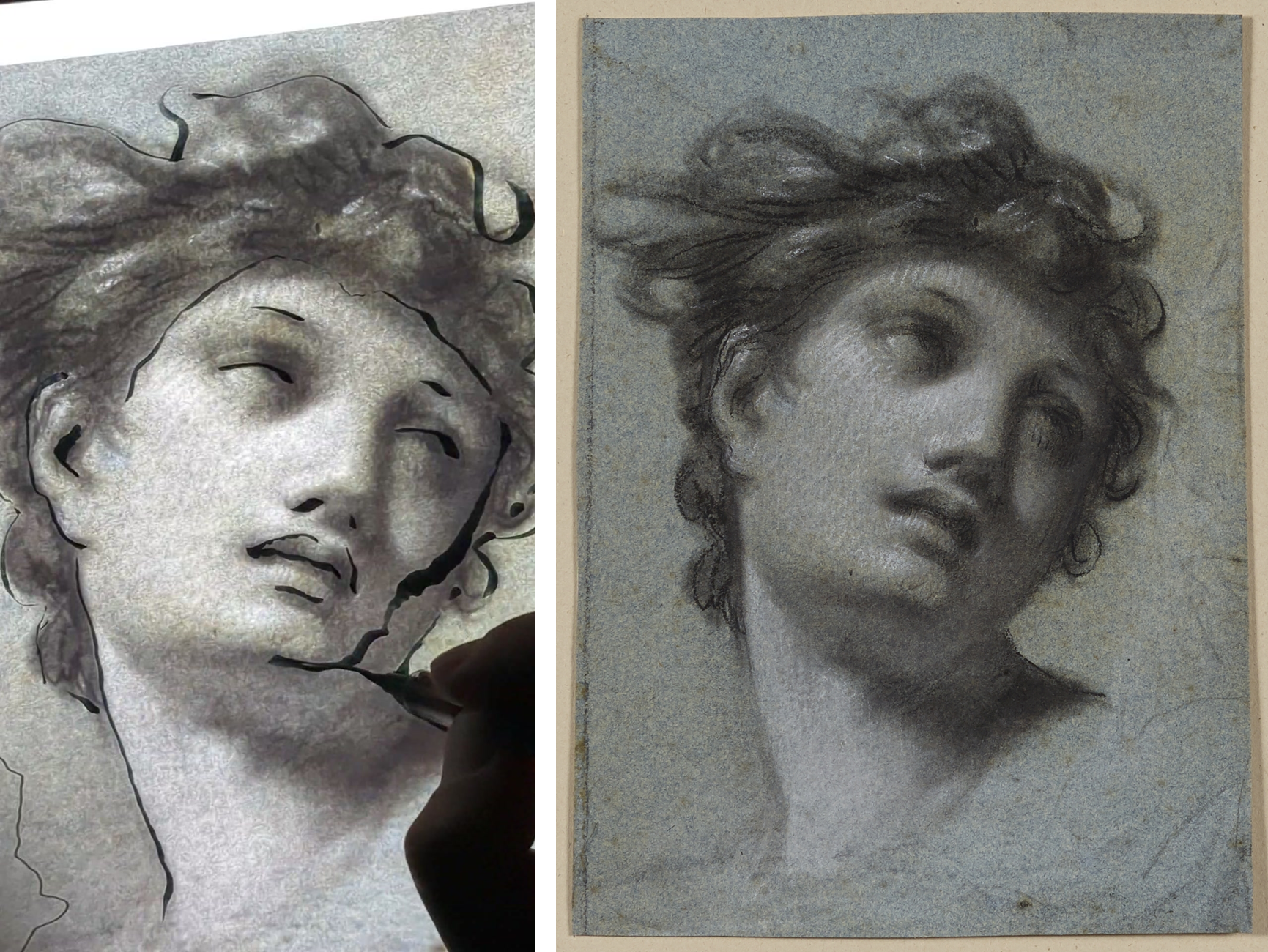
 Left: my tracing at 3:34 in the session, over the reference, Wednesday 21 October — brush pen. Right: after Pierre-Paul Prud’hon, Tête de femme (Head of a Woman), c. 1800 — charcoal, stump and white heightening on blue paper, 16.2 × 12 cm, Petit Palais, musée des Beaux-Arts de la Ville de Paris, PPD1327. CC0.
Tracing · Auction · Background
This is after Prud’hon. It’s quite strange, it’s a strong rendition. I wonder what the Prud’hon original looks like. This had very good light and shade. I couldn’t tell when I was tracing that it wasn’t Prud’hon, and I even selected it scrolling through drawings of his. It seemed more stylistically bold, sharper, perhaps, and perhaps that’s the difference, perhaps it stood out slightly.
Just a nice light and shade, I thought, and I’ll try it with the brush pen. Expression is kind of cool too, but we’ll see. The sheet works in light and shade on blue paper, mine in line. I think the edges are primary, and the colors are more secondary, complementary, emotional. They can harmonize and bring additional meanings.
Just the eyes and nose and mouth are enough to orient the face. Her head is tipped back, so the face is foreshortened, and the underside of the jaw and nose show. Here these are very important to really sense the form of the face and head. We do have a way to understand these deeply inside, and we can know intellectually that these perspective effects are part of how light reaches viewers, but it is most important to internalize and sense, even in the sense of Nicolaïdes, the tactile sense of the skull. Also important to note, the skull is bone and so is a fixed form. Only the jaw moves.
So go for just the silhouette next. Quite an active rendition of the hair. This boundary of hair and face is always a question, complex. And then the hair is always a question of how much of it — what about this line where the hair and the face, the hairline around the edge of the face. How much of that? So that’s one line that is about this hairline. There are as many solutions as there are positions of strands of hair and renderings of them. I was interested here in the emotion and the action of the brush, not in the precise rendition of the hair. And the bottom of the chin — there are some more delicate lines that are kind of going on here.
And then Prud’hon, of course, did more on the inside of the silhouette, so there’s more to learn there. In fact, I think that’s where I’m trying to learn more in general. But earlier, with just the orientation and the hair, is a valid stopping point. A valid stopping point is one where there is something important that we can see, that perhaps we hope others will see, in the drawing.
Auction
Prud’hon’s own head and figure studies in this manner — black and white chalk, stumped, on blue paper — reach the major Old Master drawings sales. His first study for Le Criminel, the fleeing figure in the Louvre’s La Justice et la Vengeance divine poursuivant le Crime (1808), was offered at Sotheby’s London, 8 July 2015, lot 135 with an estimate of £20,000–30,000.
Background
The sheet is not quite Prud’hon’s own. The Petit Palais lists him as auteur du modèle, the author of the model, and it comes from an Album de dessins d’après Prud’hon, an album of drawings after him, left to the city of Paris by Pierre Amédée Pichot in 1921. So this is a careful copy, around 1800, by a hand nobody named, of the way Prud’hon built a head. Copying him was ordinary. The young Géricault painted copies after Prud’hon too (Wikipedia), whom the nineteenth century knew for allegories and portraits and we now know mostly for his drawings.
The method is a three-value system, and the paper does a third of the work. The blue sheet is the middle tone. Charcoal, rubbed in with an estompe (a stump of rolled paper or leather that smears the dust into continuous tone), gives the shadows, and touches of white chalk give the lights. Nothing is drawn for the half-tones at all. Wherever the artist left the paper bare, that is the half-tone. Prud’hon’s own sheets work this way, for instance the Study for Astyanax’s Nurse at the Met.
The pose is a geometry problem too. With the head tipped back, the face is foreshortened. Brow to chin gets shorter, and the underside of the nose and jaw, usually hidden, takes up real area of the sheet, which is where the copyist put the darkest stumping.
Links
- Tête de femme, PPD1327 — Petit Palais, Paris Musées collections (CC0)
- Wikimedia Commons file — the reproduction I traced from
- Pierre-Paul Prud’hon — Wikipedia
- Sotheby’s 2015, lot 135 — Prud’hon, The Criminal, black and white chalk on blue paper
- Process video — Wednesday 21 October — the tracing session on YouTube
