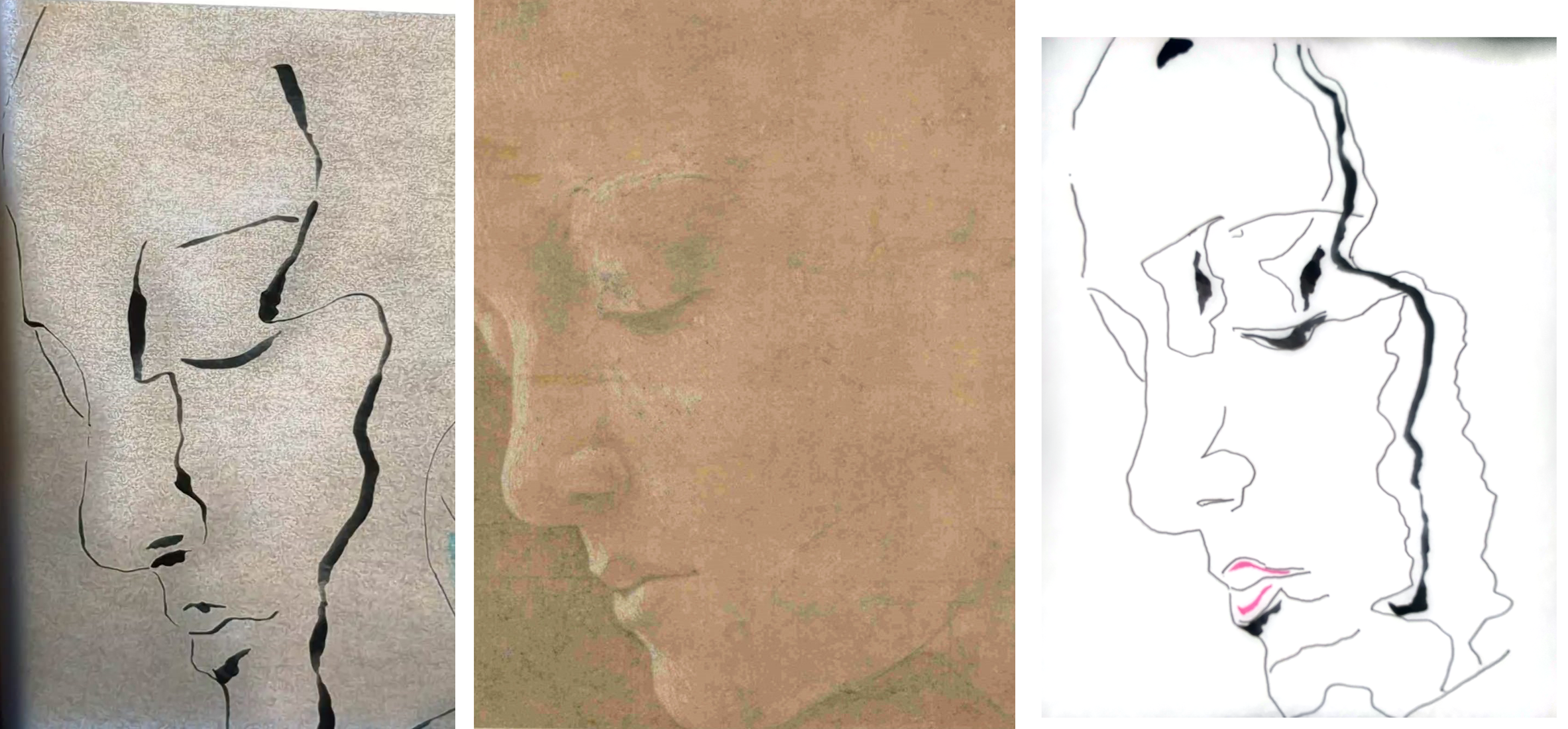
 Left: my first try, Tuesday 20 October, brush only (the last video frame: it smudged afterwards). Centre: Sandro Botticelli, Head of a Woman in Near Profile Looking Down to the Left, c. 1468–70 — silverpoint heightened with white on prepared paper, Christ Church Picture Gallery, Oxford. Public domain. Right: my second try, fine line first, then brush and colour on the lips.
Tracing · Auction · Background
Okay, so this is a Botticelli metalpoint drawing, this preparation for a painting. I didn’t know you could find these, but this was at the Legion of Honor in San Francisco.
First of all, I find many of his finished paintings, the faces look quite similar, but this one has kind of more detail. This drawing is more anatomically real, I think, than many of the drawings, which seem to me flatter, more symbolic and similar to each other. These are not negative characteristics. In a way these are his style, perhaps not unlike how Modigliani’s or Klimt’s or Rousseau’s or Schiele’s faces often look kind of similar.
And it looks a little different, I feel like, from his famous works. I don’t think the face is entirely that of the famous Venus or Annunciation or his other masterpieces. I think this drawing actually shows more of the head’s actual form than those do.
This one also talks about those reference anchors really clearly, to orient this face somewhat. And we can see this interior detail. So we just go for these sort of top-level points, I think. I think the eyes, eyebrows, nostrils, lips, chin and jawline are all important anchors. What’s interesting to me is how characteristic this is. This is just really good anatomy and choice of landmarks.
I guess to do this, we could do this in pencil, but I’ll try it with a brush. A brush can’t be erased, any more than his silverpoint could. I prefer not erasing. It forces one to plan and understand more. However, I do also think in some ways using an eraser can be a kind of sculpting of the work.
I did it twice. I don’t think either is terribly close to his, and I think they both have a certain value to them. I did the second because right after I finished the first one to take the photo, I smudged it, so I did the second one.
Another way to do it, I guess, is just maybe with lines, heavy lines, maybe there’s…
For the lips, I wonder about…
Auction
Botticelli’s market is almost all paintings. At Sotheby’s New York on 28 January 2021, Young Man Holding a Roundel had an estimate of about $80 million and sold for $92.2 million with fees, some nine times the previous Botticelli record. The seller, the estate of Sheldon Solow, had bought it at Christie’s in 1982 for £810,000.
Drawings almost never come up. Fewer than 40 are known, nearly all in museums. The last one in private hands, a study of a seated St Joseph, came to Sotheby’s London on 9 July 2014 with an estimate of £1–1.5 million. It sold for £1.3 million ($2.2 million), the record for a Botticelli drawing. Barbara Piasecka Johnson had bought it at Sotheby’s New York in 1988 for $80,000.
Background
This head is silverpoint, one kind of metalpoint, and metalpoint doesn’t leave ink on the page. It files metal off. The paper is first brushed with a ground, bone ash bound in animal glue, often tinted, and its slight grit wears a trace of metal off a silver or lead-tin stylus, like a file. The line is pale, even in width, and almost impossible to erase, so a metalpoint study is built up from many small, sure strokes. Silver also tarnishes to silver sulphide, so the line darkens and browns over the centuries. The lights here were added last, with a brush and lead white. Graphite, which erases, pushed metalpoint aside in the 1500s.
Christ Church, Oxford, long listed the sheet as the work of an anonymous fifteenth-century artist. For Botticelli Drawings at the Legion of Honor, San Francisco (November 2023 – 11 February 2024), the curator Furio Rinaldi gave it to Botticelli by matching features, the way you’d match two data sets, the round eyes, the high arched brows, the small, slightly pushed-out lips, against the Virgin in the Louvre’s La Vierge et l’Enfant avec le jeune saint Jean-Baptiste (Virgin and Child with the Young St John). He thinks this head and Christ Church’s Head of a Man may once have been cut from the same sheet.
The face then went on working. Botticelli’s shop in Firenze (Florence) used it as a pattern, and versions of it turn up in other Madonnas, the Madonna della Loggia in the Uffizi among them. That’s why so many of his painted faces look alike, and it’s what tracing is for, a good drawing carried over, as is, onto a new surface.


Links
- Christ Church drawings could be studies for Botticelli paintings — Christ Church on the attribution
- Botticelli in San Francisco — the loan to the Legion of Honor
- Botticelli drawings, FAMSF — the exhibition story
- Researchers name Botticelli as the artist behind anonymous drawings, artnet — Rinaldi’s argument
- Botticelli, Study for a Seated St Joseph, Sotheby’s 2014 — the drawing record, lot 27
- Sotheby’s on Young Man Holding a Roundel — the 2021 record
- La Vierge et l’Enfant avec le jeune saint Jean-Baptiste, Musée du Louvre — the Louvre’s record (INV 286); image on Wikimedia Commons
- Madonna della Loggia, Galleria degli Uffizi — the Uffizi’s page; image on Wikimedia Commons
- Silverpoint on Wikipedia — grounds, styluses, tarnish
- Process video, first try — Tuesday 20 October — brush only, on YouTube
- Process video, second try — fine line, then brush and colour, on YouTube