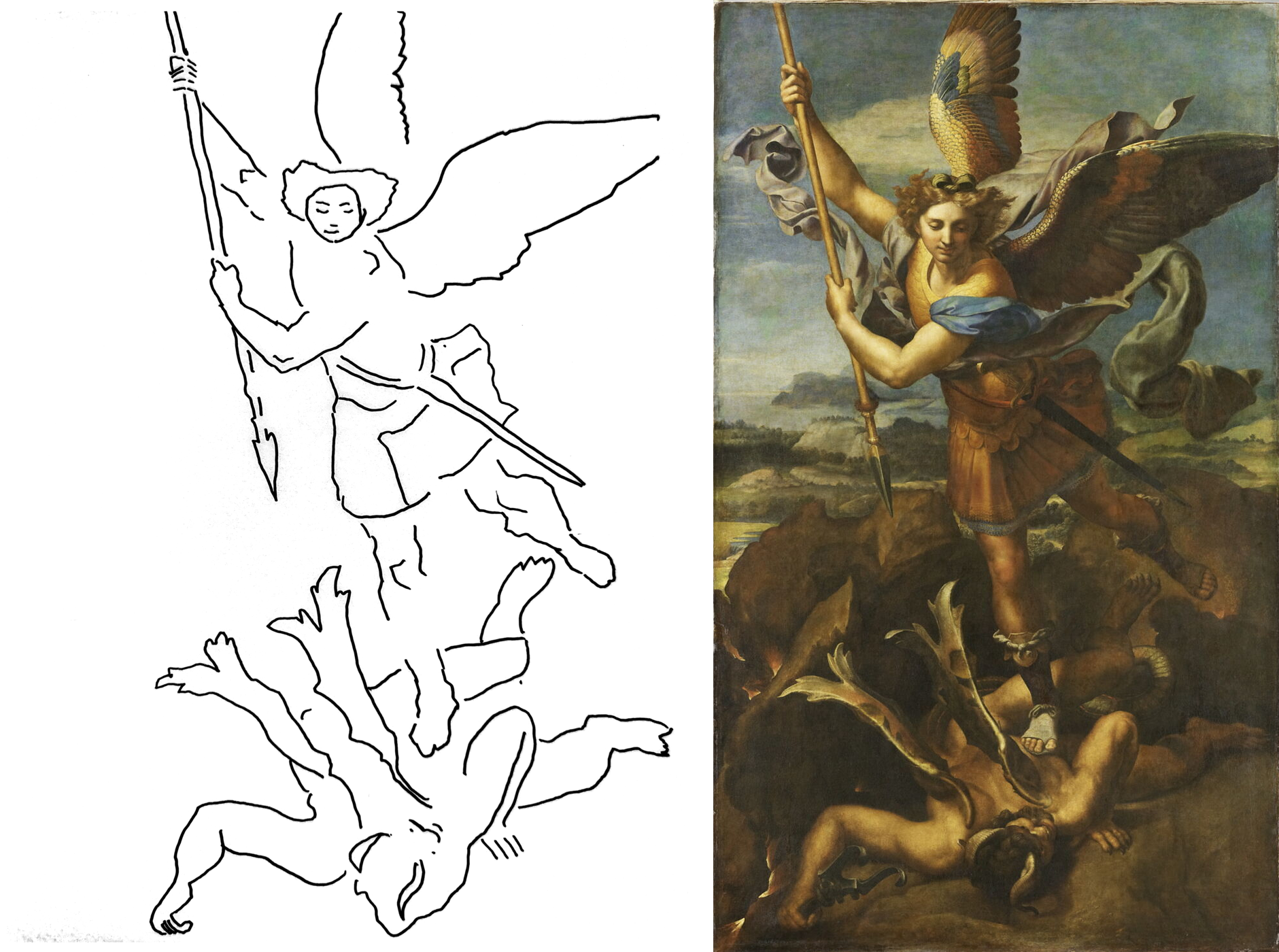
 Left: my tracing, Thursday 24 September. Right: Raffaello Santi, called Raphael, Saint Michel terrassant le démon, dit Le Grand Saint Michel (Saint Michael Vanquishing Satan), 1518, oil on canvas (transferred from panel) — Musée du Louvre, INV 610. Public domain.
The tracing · Auction · Background
I love this one: the wings, the twist of the body, the foreshortening. The fundamental geometric questions here, and the expression. And then there’s the devil, looking up — he’s got his own wings and everything, his own legs. The background, I don’t know how much of that I’ll do.
Mostly I’m thinking of Saint Michael first, and the spear. Actually, I think the compositional flow is what’s interesting first. The face, and just that basic arrangement.
Another thing I’ve been quite interested in is Johansson’s studies of people walking around with lights on their joints, for example this demonstration. If you know where the joints are, you know a lot about that person, so I have his joints, and the wings, and the spear.
But a painting is a single still frame, and Johansson’s dots only read as a person once they move. The joints remain fundamental, but I’m no longer drawing only the dots. What he showed is that when the dots move, we can infer so much about the position and the person from the dots alone. The dots themselves are too sparse, though. Add minimal silhouette lines, and again I think perhaps we have a useful, meaningful description that is not unrelated to his experiment of tracking the joints, as we have an anatomical understanding, I think, at our neurological level.
The Indian goddess Kali or Durga also stands on the devil. That’s part of the iconography. What that vertical stack does to a viewer, I think, has to do with gravity: we are pressing down, with our own weight, onto this demon, who is being pulled toward the center of the earth. And the victor’s calm face is perhaps fate, even like Mucha, perhaps we found some neurological link across anger to primality.
Actually, the sword is telling us something about the motion. It’s flung back, and its point is like an arrow, flying in the direction that would put the arrow that way. A lot of this cloth and wind has that same function. It’s the shape of the drapery wrapping around that tells us it has velocity, that it’s being pushed by the body and by the wind.
On the armour, I’ll try to be more selective — not just pick out things with lots of value or change, but things that help with position or composition. I think that’s the question: like this bit of shoulder.
Leaving out the value changes what the drawing shows. I do think Michael’s core anatomy is slightly oversimplified: the hips and upper body, for example, seem perhaps disconnected, or overly twisted. In the painting the value is both enhancing and distracting, pulling us toward the tranquil face and its profundity, whereas the line turns us away from those to a simpler, and perhaps more basically plausible, shape.
Now let’s see if we can catch any of the devil. It’s tricky, because now he’s small and foreshortened. His right hand is curled. I think that helps with the defeatedness.
Hands carry what a face can’t, and that’s true here: the devil’s face is hardly visible, but his hands give us his orientation and expression. Schiele and Klimt, of course, come to mind.
Is this minimal? No, nor did I approach the tranquility of Michael’s facial expression. But I captured the twist.
Auction. Le Grand Saint Michel has never been sold: it went into the French royal collection in 1518, and the Louvre still lists it as ancienne collection de la Couronne. Raphael on paper does come up, rarely. Head of a Young Apostle, a black-chalk study for the Transfiguration from the Devonshire collection at Chatsworth, was offered at Sotheby’s London in December 2012 with an estimate of £10–15 million (Sotheby’s, lot 52) and realised £29.7 million (Wikipedia).
Background. Saint Michel terrassant le démon, 1518, is 2.68 × 1.60 m, oil, and hangs in the Grande Galerie of the Musée du Louvre (INV 610), whose record gives its history in three words: « François Ier, 1518 ». The Louvre lists it as oil on canvas. Wikipedia says it was painted on wood and transferred to canvas in 1753, though it gives no source for the date.
It was Raphael’s second pass at the subject. The Little Saint Michael of about 1504–05, a small panel, is also in the Louvre.
The colour was argued over from the start. In July 1518 Sebastiano del Piombo wrote to Michelangelo that the figure looked smoky, or made of iron, and Francesco Primaticcio restored it in 1537–40 (Wikipedia, citing Eugène Müntz). In 1667 Charles Le Brun made it the subject of his first lecture at the Académie royale de peinture et de sculpture. He pointed to a body that reads as moving though frozen, under a face that stays calm (Wikipedia).
Links
- Saint Michel terrassant le démon, dit Le Grand Saint Michel — Musée du Louvre — the catalogue record and master image
- Saint Michael Vanquishing Satan — Wikipedia — history, restoration, Le Brun’s lecture
- Saint Michael (the Little Saint Michael) — Wikipedia — Raphael’s earlier treatment, c. 1504–05
- Head of a Young Apostle — Sotheby’s, 2012, lot 52 — estimate and provenance
- Biological motion — Wikipedia — Gunnar Johansson’s point-light displays, 1973
- Process video — Thursday 24 September — YouTube