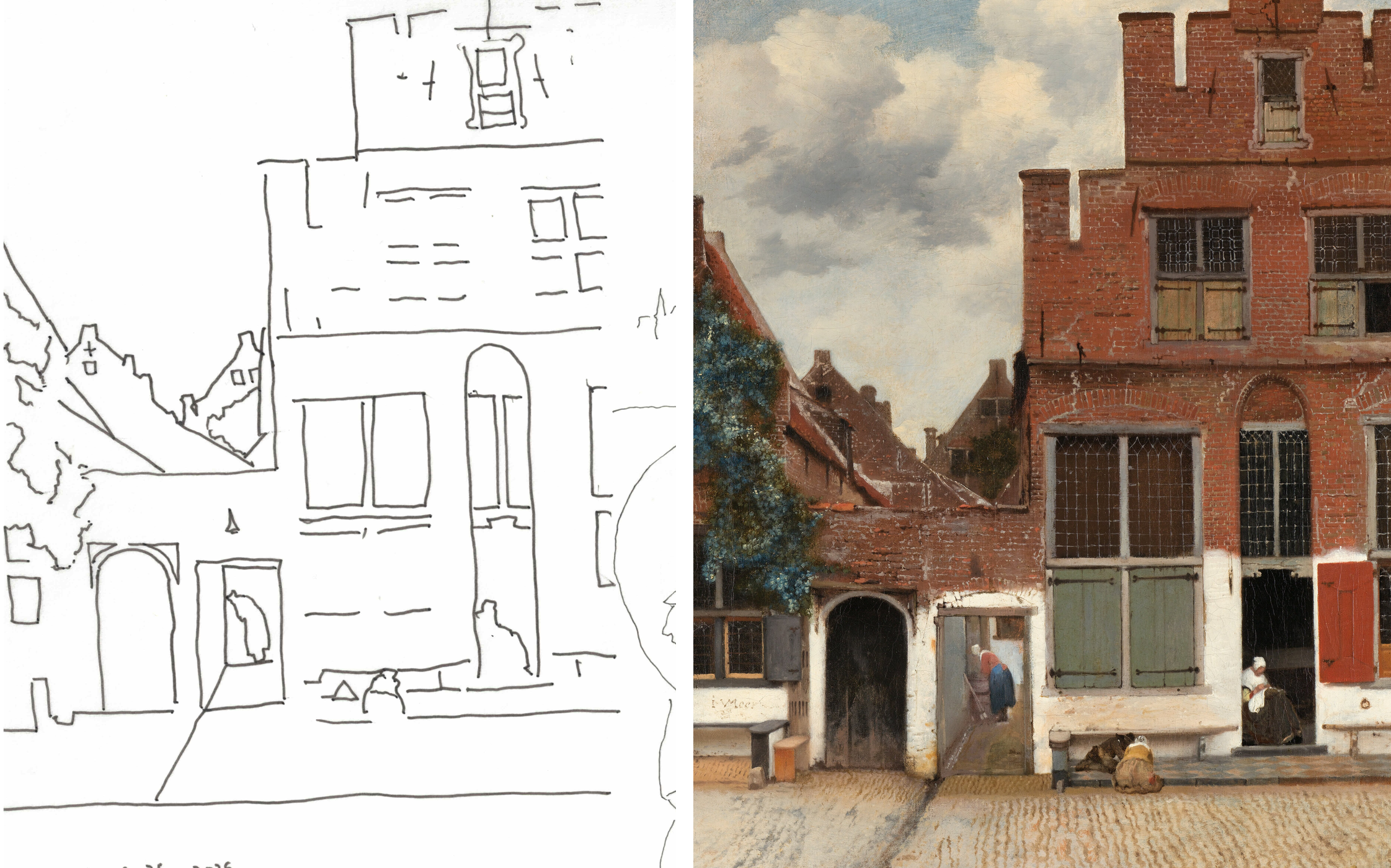
 Left: my tracing. Right: Johannes Vermeer, Het Straatje (The Little Street / Gezicht op huizen in Delft), c. 1658, oil on canvas, 54.3 × 44 cm, Rijksmuseum, Amsterdam (SK-A-2860) — public domain.

Here’s a little street — very charming, and probably one a lot of you know. Two figures in it? The perspective lines make me think about Ching right away. You can’t actually see the vanishing point. The other main horizontal is the line at the foot of the sidewalk — I start there. A main vertical, which conveniently turns over as it goes. Ching says the third line is the important one, and it is: it’s the one that gives us depth.
Of course a picture can emphasise depth — the first perspective example in every drawing guidebook is the rails going to the horizon. Here we have perspective, but something else too: light, composition. And as you look you discover more small figures — children. So the decision to draw the façade and not the perspective seems very advanced: this is about composition, not a technical 3D geometry but a façade. Vermeer has depth, but he isn’t obsessed with it — it’s an important part, not the only part. The façade looks like a façade; a façade on the street is what he’s actually drawing. The doorway he did perfectly.
Perhaps he used something like a camera lucida or obscura — as in the Vallein post, the Neolucida is an interesting thing to draw with. I think the lucida and the obscura have fallen out of favour for no reason I can understand. Maybe they seem cleaner, more precise than oil?
The rooflines are façades too, at angles, and they add fairly complex information — complex because the angles arise from parallel lines, but also because the roofs have their own geometries and angles. The archways are important. The nice little decorations here and there. There are clouds; some vegetation. What I was after was some impression of it — the façade, the people; perhaps that was enough for me. At the end I noticed the brick arches over the windows, which I didn’t trace, but which I think are important.
Background. Het Straatje (The Little Street; full title Gezicht op huizen in Delft) is one of only two surviving Vermeer townscapes — the other is Gezicht op Delft (View of Delft). In 2015 the historian Frans Grijzenhout pinned the exact spot from Delft’s 1667 quay-dues ledger: Vlamingstraat 40–42, in what was then a poor eastern quarter of the city. The house on the right belonged to Vermeer’s aunt, Ariaentgen Claes van der Minne — a widow who sold tripe there. The woman sewing in the doorway and the children on the pavement are small and quiet — you find more of them the longer you look — but the drawing’s subject is the brick, the whitewash, the shuttered windows.
At the 1696 Dissius sale in Amsterdam — the auction that scattered twenty-one Vermeers in a single afternoon — it fetched about fifty guilders (the View of Delft made two hundred). It then sat in the Six family collection for generations, until 1921, when the oil magnate Henri Deterding of Royal Dutch Shell bought it and gave it to the Rijksmuseum, where it can no longer be sold.
Links
- Process video — YouTube
- View of Houses in Delft, Known as ‘The Little Street’ — Rijksmuseum — the painting’s page (SK-A-2860)
- Exact location of Vermeer’s ‘The Little Street’ discovered — CODART — Grijzenhout’s 2015 Vlamingstraat identification