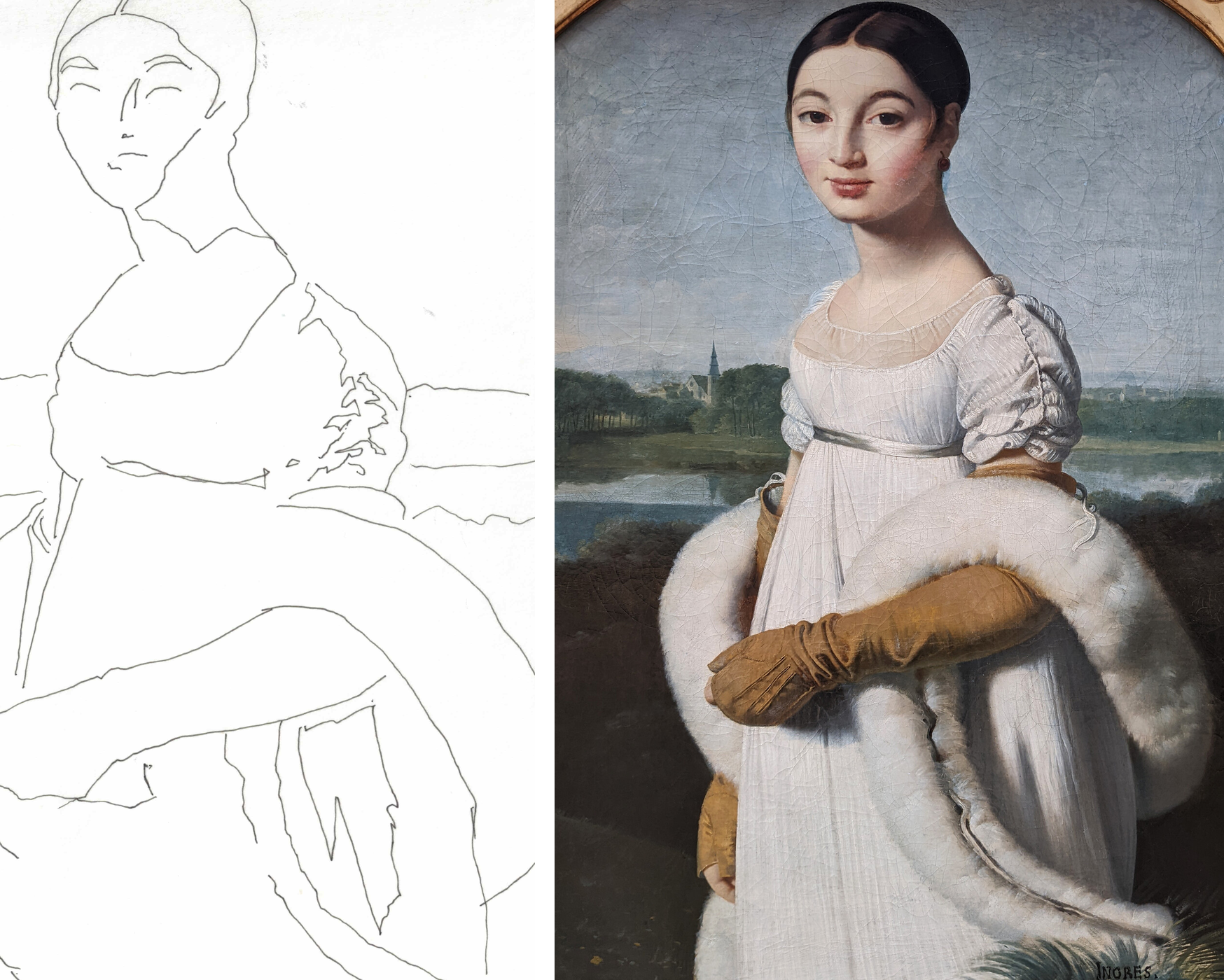
 Left: my tracing. Right: Jean-Auguste-Dominique Ingres, Mademoiselle Caroline Rivière, 1806, oil on canvas, 100 × 70 cm, Musée du Louvre, Paris (MI 1447) — public domain.

This is Ingres — a portrait of one of the Rivière daughters. He painted two other family members alongside it. What interests me is that it feels like he made some slight mistake. Not a mistake exactly, but unusual shapes: the hands feel too big for the picture, the head a little small. Maybe that’s just how she looked — and something about the face feels oversimplified. The text I found this in said the picture was thought somewhat gothic, and you can see that. The more I look, the more it feels like there might be mistakes — or not — but it starts to feel more real. That’s why I picked it.
I start with the eyes, the eyebrows, the orientation of the face. The lips have shading on both sides that I can use just to suggest which way the face is turned. Shadow and line are always sort of interchangeable and fluid. Sometimes a line is a physical edge of a form, sometimes a crisp shadow; sometimes I draw a line through a soft shadow because I have to pick something to convey the shape. Soft shadows are difficult — imagine the classic shading example, a ball with a highlight and a soft shadow. If you draw the silhouette and then want to minimise lines, you have to pick a value, just one, to convey what that soft shadow conveys. But you can’t, and so you’ve been forced to convey something else. Then the silhouette of the head, at least. The hair is very closely trimmed — part of what makes the picture interesting is the hairstyle itself. The parting gives volume; she has a very specific head shape.
The gloves are enormous. Often gloves like this symbolise something — the boa too, maybe. Those are historically interesting, sometimes with illuminating stories, but not really relevant except geometrically, for me here. But they have finger holes. What’s interesting about the boa is that it moves through space and around her, casting shadows that help place her and describe the forms of the dress: a complicated shape moving through space. I like the drapery, and I trace it carefully. Drapery usually doesn’t track the directions you’d want, but here he’s simplified it. Actual fabric has complex folds and pinches and lines and shadows, which can help show what’s underneath — the Winged Victory, for example. Here the simplification seems, again, slightly unexpected; perhaps to accentuate her youthfulness.
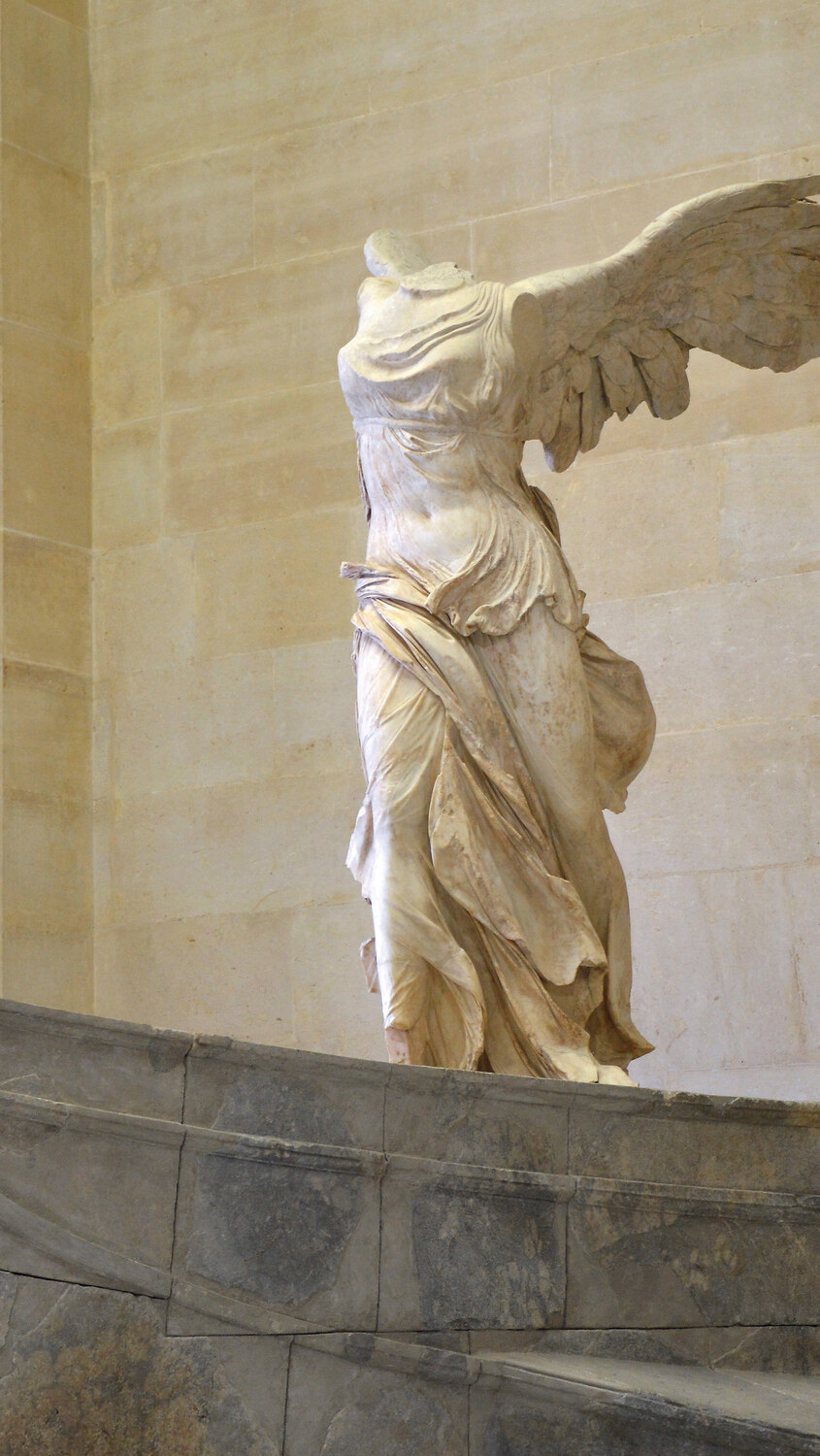 The Winged Victory of Samothrace, c. 190 BC, Musée du Louvre — drapery that shows the body under it, the opposite of Ingres’s smoothing-out. I keep a 3D print of Cosmo Wenman’s scan on the desk and draw from it often. Photo: Musée du Louvre (CC0).

Then the neck shadow, and I think that’s it. Some of the interest is here, in my tracing. There’s a question the picture keeps asking — is there an anatomical problem, a mistake that ends up looking interesting? But really, for me, the problem is my tracing: it seems to have lost something. I don’t see her elegance in it, that Las Meninas quality. I think I got caught technically. For example, I think here her pupils are so emphatic that it’s not possible to just trace only the top eyelid line that we see — so perhaps pupils would have helped.
That’s something to revisit one day.
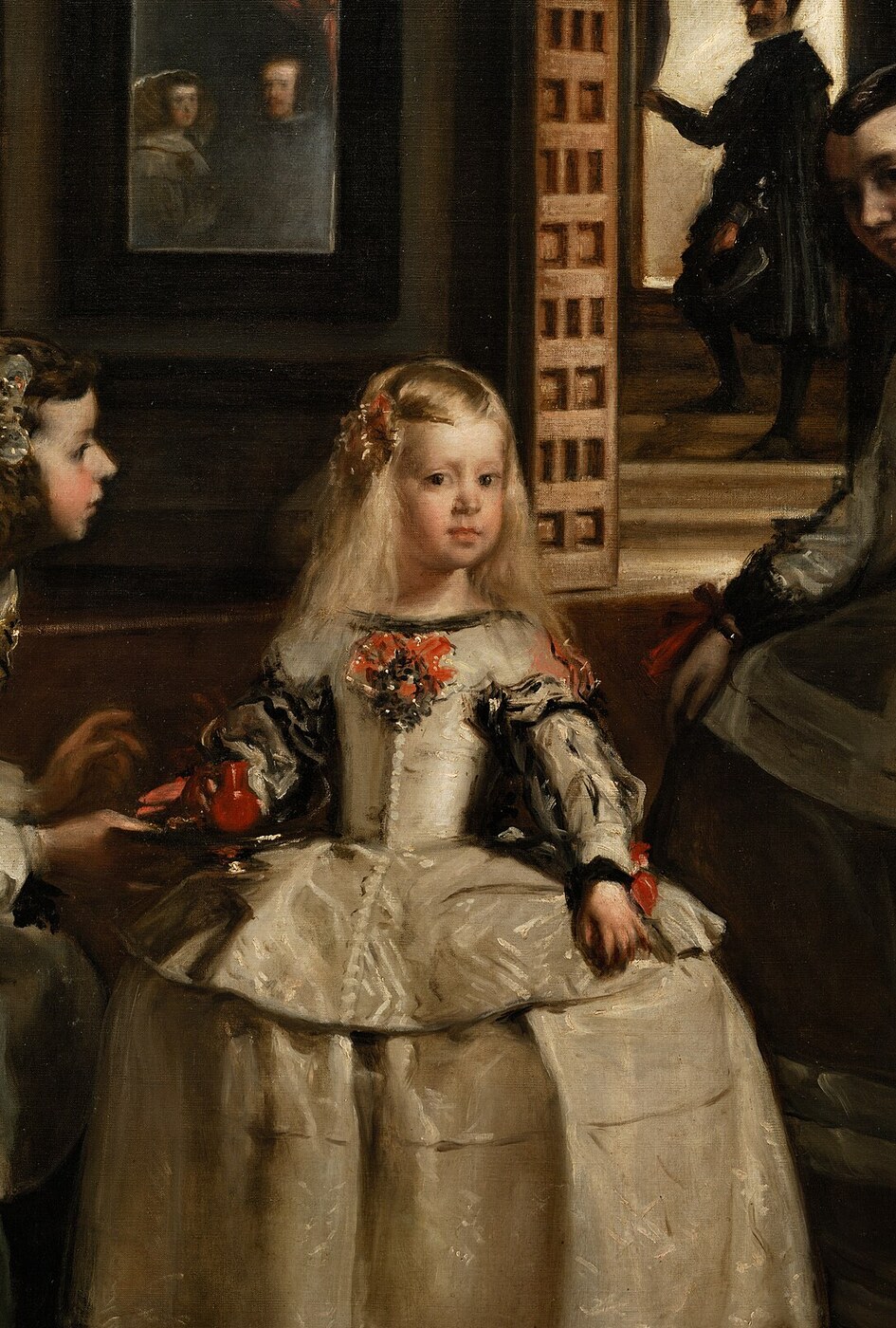 The Infanta Margarita Teresa at the centre of Diego Velázquez, Las Meninas, 1656, Museo Nacional del Prado, Madrid — the elegance I mean, and the thing my tracing let slip.
Background. Mademoiselle Caroline Rivière was the last of three Rivière-family portraits Ingres painted for Philibert Rivière, a court official under Napoleon — the father and Madame Rivière in 1805, Caroline, then about thirteen, in 1806. All three hung together at the 1806 Salon and were badly received: critics found them “gothic” — too precise, too enamel-smooth, too much like the newly rediscovered Van Eyck and the early Netherlandish painters, whose hard clarity still read as primitive. Caroline died within a year of sitting. Robert Rosenblum later admired exactly what the Salon disliked: the “flattened horizontal tiers” of the landscape against which she stands “crisply silhouetted as if in low relief.”
It never came to market. The Rivière family kept it for sixty-four years — through the decades when Ingres’s early portraits were dismissed — and in 1870 Caroline’s sister-in-law left it to the Louvre (the MI in MI 1447 marks a Second-Empire acquisition). The best price an Ingres portrait has ever fetched at auction is about $2.7 million — Portrait de la comtesse de La Rue, in the Yves Saint Laurent and Pierre Bergé sale at Christie’s Paris, February 2009 — and the great ones are all in museums.
Links
- Process video — YouTube
- Mademoiselle Caroline Rivière — Musée du Louvre — the painting’s page (MI 1447)
- Mademoiselle Caroline Rivière — Wikimedia Commons — PD reproduction
- Las Meninas — Museo Nacional del Prado
- Winged Victory of Samothrace — Cosmo Wenman’s 3D scan
- Portrait de la comtesse de La Rue — Christie’s — Ingres’s auction record, ~€2.08m / $2.7m, Yves Saint Laurent & Pierre Bergé sale, February 2009