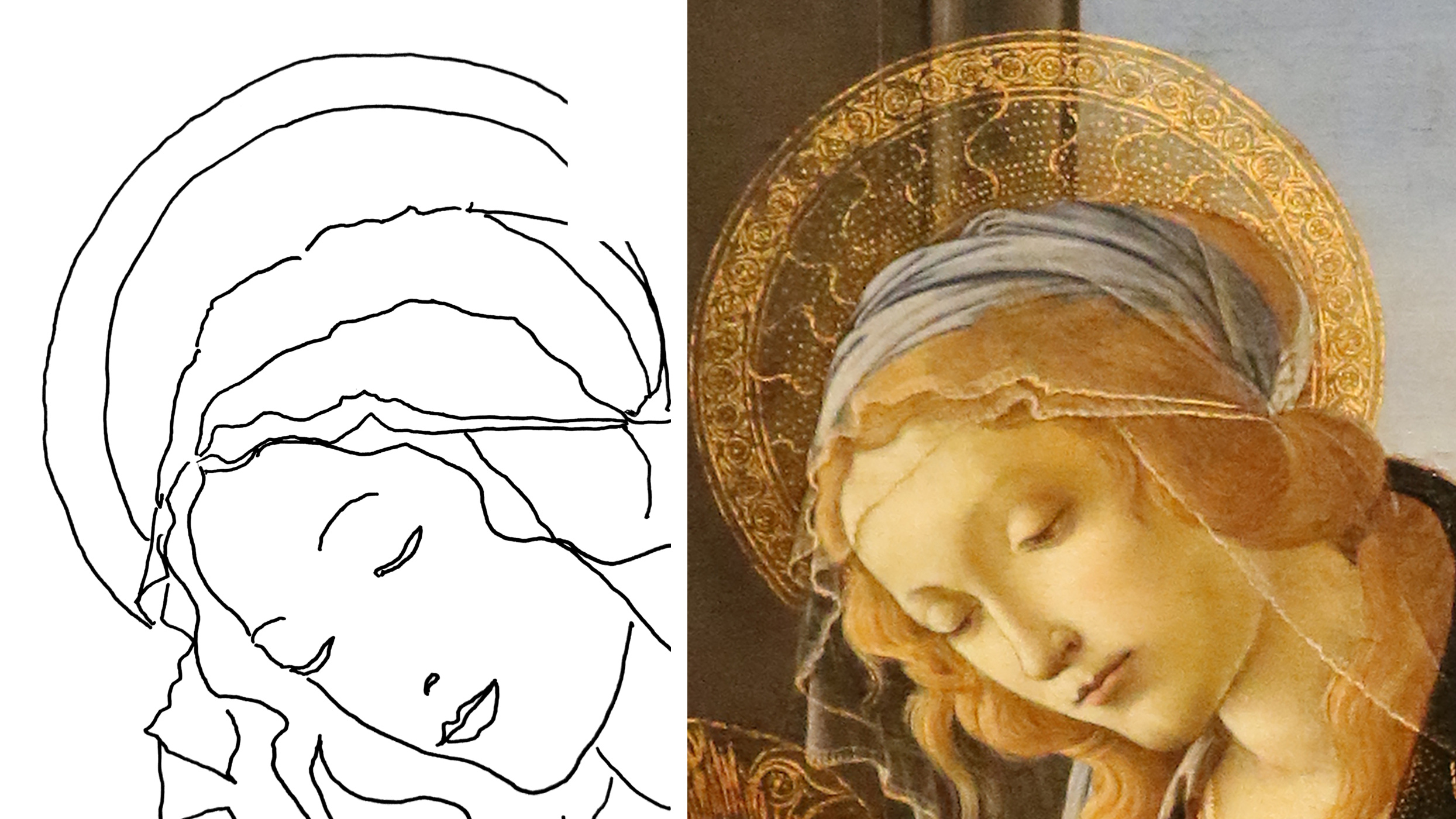
 Left: my tracing, Thursday 4 September — the Madonna’s head only. Right: Sandro
Botticelli, Madonna del Libro
(Madonna of the Book), c. 1480–81, tempera on panel, Museo Poldi Pezzoli,
Milano — public domain, cropped to the head.
Left: my tracing, Thursday 4 September — the Madonna’s head only. Right: Sandro
Botticelli, Madonna del Libro
(Madonna of the Book), c. 1480–81, tempera on panel, Museo Poldi Pezzoli,
Milano — public domain, cropped to the head.
_-_Madonna_col_Bambino_(Madonna_del_libro)_(1480-81)_tempera_su_tavola_dimensioni_altezza_59_cm;_larghezza_39.6_cm_-_Museo_Poldi_Pezzoli_-_Milano.jpg)
Botticelli — among the most beautiful and graceful artworks in history. Obviously a lot is going on with the tone. But what can we take just from the basic orientation of the face? And the halo interested me: it’s flat to us, not tilted behind her head. I was curious to see what that looks like with and without.
He has almost a signature at the corner of the eye — in some of them it hooks a little down. It’s a curve; a little flat in places, but the eyebrows are curved. One nostril, then the mouth. That’s almost the interesting thing: that’s kind of enough. His choice of those basic features is precise, unique, and enough to make a noteworthy amount of her beauty and grace. His colour and shading are so much more — but underneath, the proportional decisions are fundamental. Loomis: beauty is beauty of proportion.
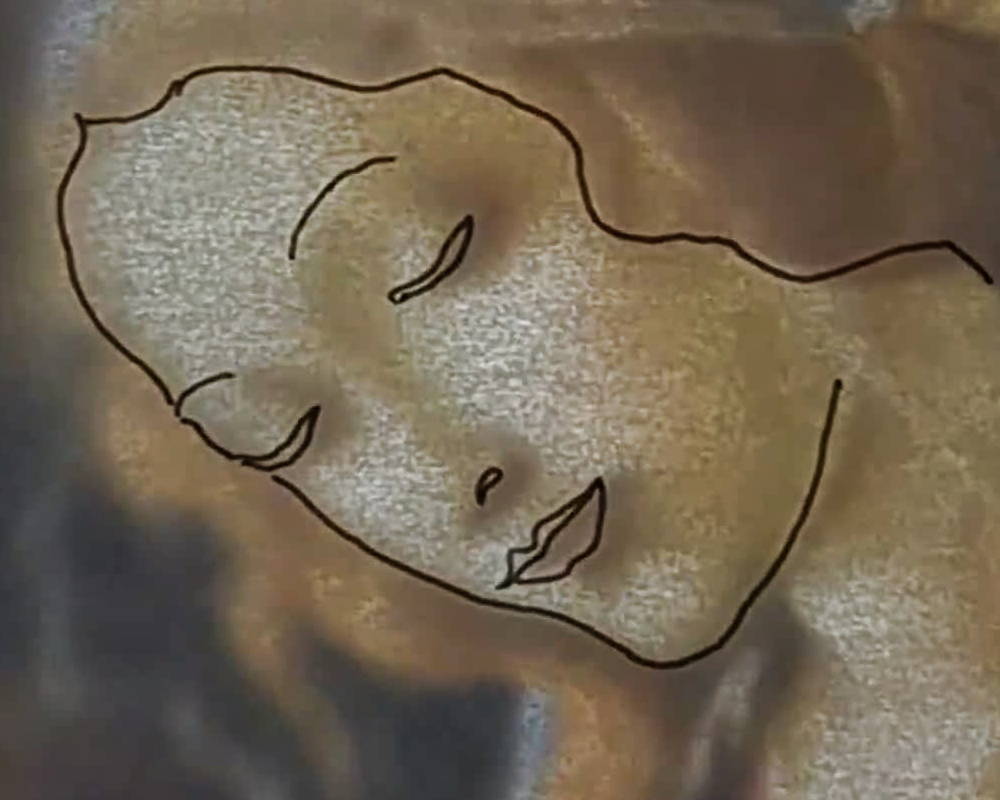 Partway through: the face alone, before the veil and the halo.
The veil, because I don’t get many veils to work on — though at this level of detail I think it distracts, even if it’s conceptually appealing. Then her hair, always so beautiful. Her hair has impact right away, even though it isn’t muscle or bone or structure. Mass is in some ways subordinate to visuality — and the face patches, if I recall, do look for hair: we know hair and look for it, for identity, and even though it changes more easily than the bones of the face, it still means something — to know who we’re looking at, and what they might mean.
So that’s without the veil. Now let’s put in this flat halo and see what it does. In the real painting the halo is so finely executed; it has all this profoundness. In line I’m not sure we get much — I’m glad that with two lines you can at least see it’s flat, but not much more. The flat halo contradicts the orientation of her face; it carries symbolism, not geometry. That’s why it doesn’t carry or improve the drawing when I’m trying to stay very primitive.
Which leads to the veil. It’s a nice drapery exercise, this one especially, because you get to see through it. The point where the veil and the head-lines meet wasn’t something I noticed until I was tracing — then it became obviously a technical point of Botticelli’s, and a good one, if only for the unity of the composition; but it may also be geometry, even perspective, since the back of the head is further from us.
I think that’s where this ends. The maximum was really just the face. The further parts — the halo, even the veil — I’m not sure they’re as valuable in line. We’re not necessarily trying to show the best tracing, but the lessons we learn as we trace: here, as with a lot of minimal tracing and drawing, we add too much. That point of where to stop is important.
Background. The Madonna del Libro is a small panel for private devotion — 58 × 39.6 cm, tempera on panel, c. 1480–81, the years Botticelli was also at work on the Birth of Venus and the Primavera. Mother and Child read from what is probably a Book of Hours; the three nails in the Child’s hand and the crown of thorns on his wrist look ahead to the Passion, and the fruit carries the same doubled meaning — cherries for the blood of Christ, plums for the sweetness between them. The mantle is crushed lapis lazuli and the haloes are pure gold: costly materials for a prestigious patron who has never been identified.
It came to Milano in Gian Giacomo Poldi Pezzoli’s 1879 bequest of his apartment and collection — his favourite, the museum says, of all the pictures in the house. It can’t be sold. For a sense of what that forgoes: in January 2021 a comparable small Botticelli panel of the same years, the Portrait of a Young Man Holding a Roundel, made $92.2 million at Sotheby’s — the most any Old Master has fetched at that house, and an 8× jump on the artist’s previous auction record of $10.4 million, set in 2013.
Links
- Process video — Thursday 4 September — YouTube
- Madonna and Child (Madonna del Libro) — Museo Poldi Pezzoli — the owning museum
- Madonna of the Book — Wikipedia
- Botticelli’s Young Man Holding a Roundel sells for $92.2m — Sotheby’s — the 2021 record