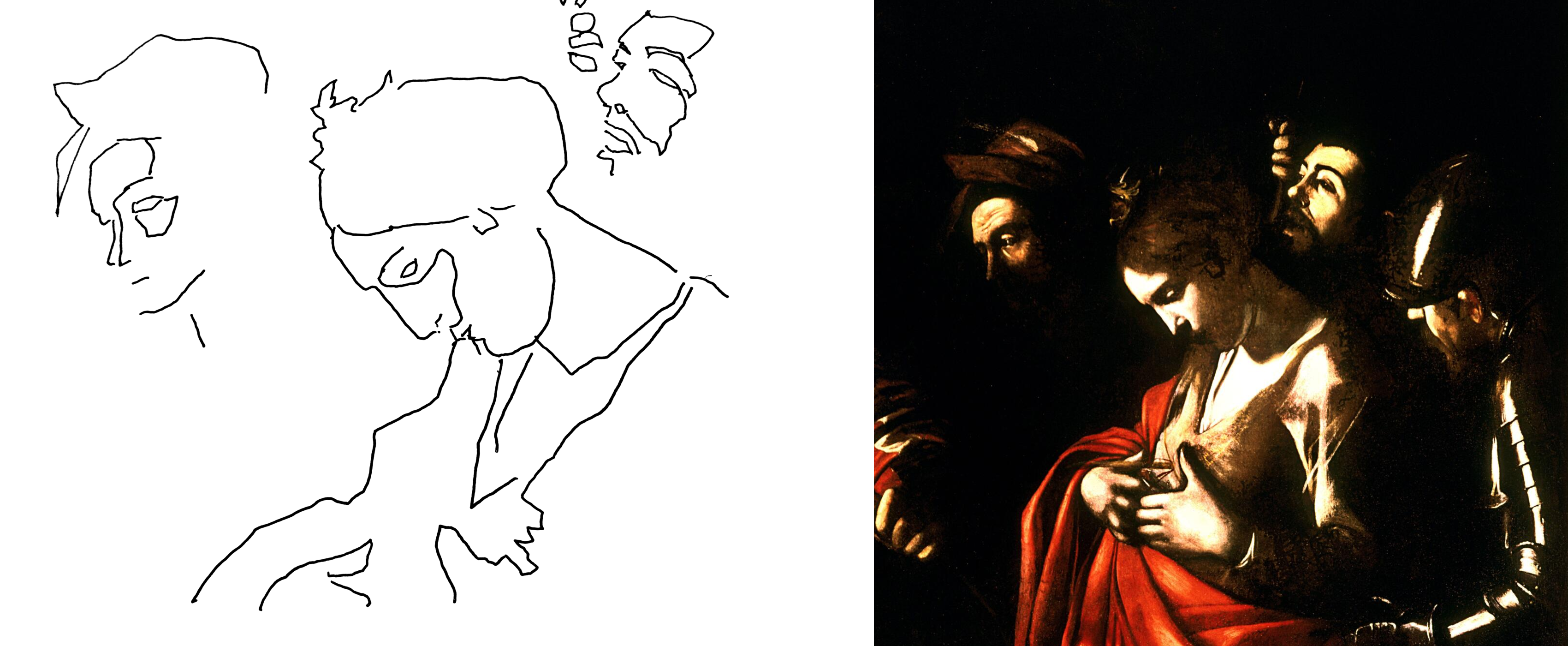
 Left: my tracing, Monday 31 August. Right: a detail of Michelangelo Merisi da Caravaggio, Il martirio di sant’Orsola (The Martyrdom of Saint Ursula), 1610, oil on canvas, Gallerie d’Italia, Napoli — public domain.
.jpg)
31 August · 30 August · Background
Monday 31 August
The first time, below, I fell into a technical approach — simplistically following the lines. This time, a harder question: is there a minimal set of lines that can get these shapes? There’s a lot of chiaroscuro, but that doesn’t mean we have to slavishly trace only that. I stick with silhouettes; I think they’re good. I wasn’t satisfied with the first one, and I wanted to see if I could add something.
The other problem is that a lot of the forms are missing — and faint through the tracing paper. The man on the left: you can see a bit of his mouth, his chin, a line there; then the eye, the eyebrow, hard to see; and the big turban. The next man — I can’t make out much beyond the edge of his face. And then her.
This tracing is a bit more successful, which is a little strange — and a little obvious, too: slavishly following light and shadow doesn’t give you as good a result. Here I’ve followed none of it, and the result is simpler and better. Simpler and better — but I’ve thrown something away.
So I put back, on each one, just a few important lines. Caravaggio is Caravaggio for a reason: he is the master of exactly this. The shade line down by the neck; the drapery; the fineness of the shadow lines. I might go with this one. I use these tracings as warm-ups for drawings, and this was the better warm-up — it warmed up a sense of spatial expression.
The last question is the drapery — do I want it or not? I add a few lines. And can I choose the ones that aren’t the largest contrasts, but that describe the form? That’s the interesting question. It isn’t a general rule, but it’s a useful thing to have practiced — it helps you understand form and light better.
Sunday 30 August
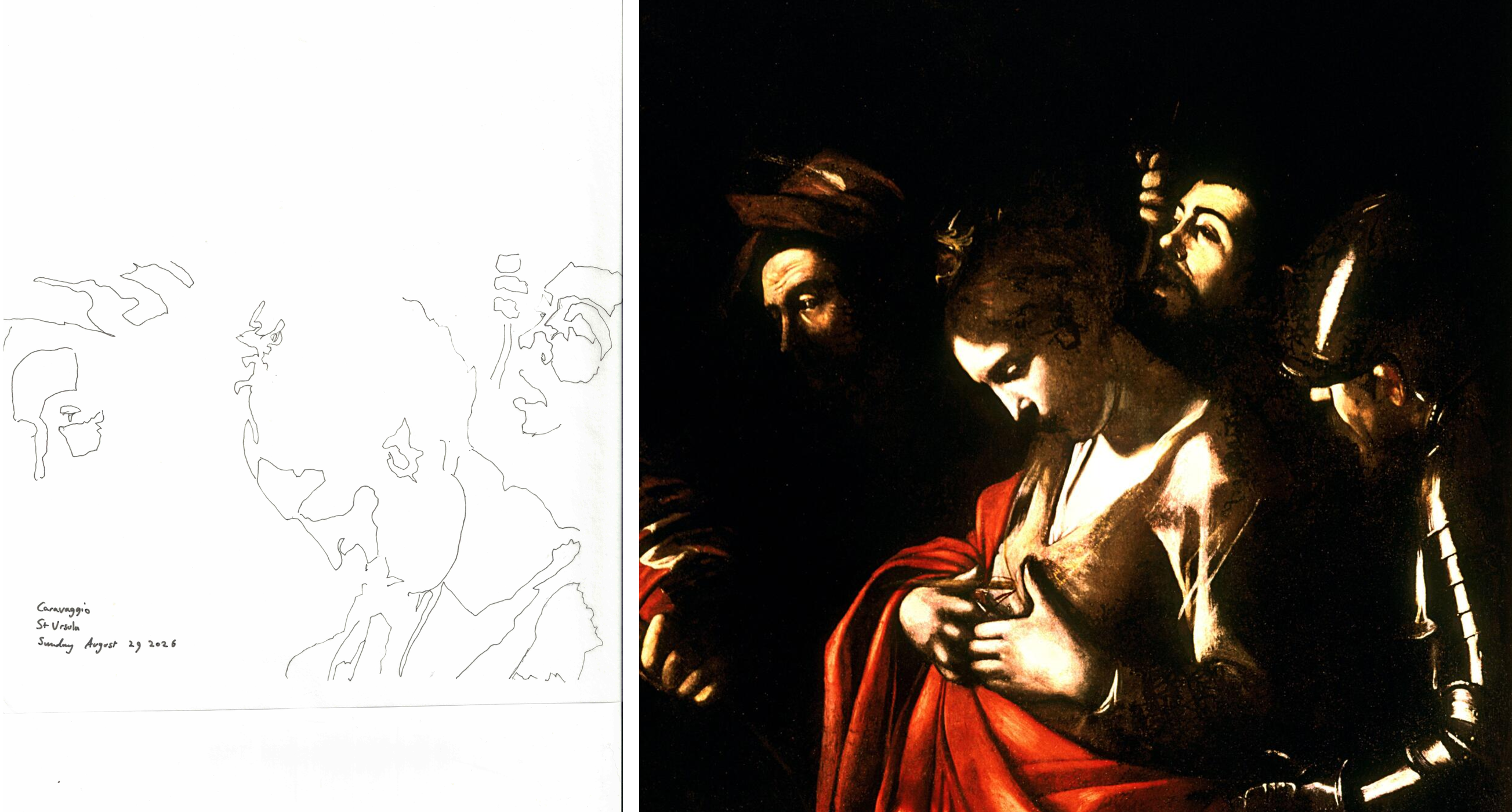 Left: my tracing, Sunday 30 August — the first pass, more of the page left blank.
Right: the same detail — Orsola between the man in the beret
and the self-portrait.
Left: my tracing, Sunday 30 August — the first pass, more of the page left blank.
Right: the same detail — Orsola between the man in the beret
and the self-portrait.
This is a detail of the painting — I zoomed in. It has three faces, and I thought it a good candidate: can we get three of them? Caravaggio is probably well suited to this line technique because of the intense tenebrism, the light and shade — he uses it very strikingly.
I start here. I try not to infer anything beyond his lines. The eye of the leftmost figure I could infer more about, and draw from inference — I stay with what I see instead. Though to reduce it to line at all, I have to infer something: he is working in very dark values, but they are there. His headgear plays an important role, a hint to the head. The man to her left, you can’t make out much of his face; it’s very faint — I might have to pull some of it — I leave it.
Through the tracing paper it almost has a photographic quality, like someone used a bright flash.
He isn’t using the tenebrism in an anatomical way. He’s using it very precisely, for something else, for the shock and moment. Tracing her jaw here, I trace the jaw because it benefits from a line — but he’s hinting at it more broadly, with tone. He uses tone more than I’d seen at first. The heavy contrasts make me think he isn’t using tone; he is. There are hidden shapes — the darker ones, like the lower part of the mouth — and as I’m tracing lines I’m forced to decide whether to include them. He doesn’t need that decision: he just draws them, very dark. That lets him deceive you into thinking it’s all this intense light, when a lot of the form is coming from the dark tones. I’ve left them off, mostly, and it still sort of works.
At first I traced the lines without thinking. Later I was thinking about the shapes and the forms, keeping some minimalism — lessons from Frédéric Forest. Both tracings lose something, though — more, I think, than most paintings I’ve traced. Caravaggio is working in a nearby space of light and dark, using it subtly, in ways adjacent to what I’m doing with lines; I can’t simply drop in Forest-style lines and be done, and even when I do, I give up a lot of his work.
I didn’t know, while I traced, that the craning open-mouthed man behind her is Caravaggio himself, watching the arrow land. He dramatizes himself.
Background. Il martirio di sant’Orsola is Caravaggio’s last known painting, from 1610 — the year he died at Porto Ercole. It was bought as a Mattia Preti by the Banca Commerciale Italiana in 1972, and only recognised as a Caravaggio in the 1980s, after a letter surfaced in the Doria d’Angri archive in Napoli: the patron’s agent, Lanfranco Massa, writing to Genova that the picture was finished but that he had botched an attempt to dry the fresh varnish in the sun. It is now Intesa Sanpaolo’s, at the Gallerie d’Italia in Napoli.
The scene: Orsola at the instant the tyrant she refused shoots an arrow into her breast; she looks down at the wound, and the men around her are still taking in what he has done. The open-mouthed figure just behind her is a self-portrait — Caravaggio in his own picture.
Chiaroscuro or tenebrism? Chiaroscuro is the broad term — form modelled in gradations of light and shade, which any number of painters do. Tenebrism is the extreme: a near-black field, figures picked out by one hard raking light, everything else lost to the dark. Caravaggio is its origin; his followers were called the tenebrosi for it, and the Orsola is a plain case — five heads lit, the rest swallowed.
Links
- Process video — Monday 31 August — YouTube
- Process video — Sunday 30 August — YouTube
- Il martirio di sant’Orsola — Gallerie d’Italia, Napoli — the owning museum (Intesa Sanpaolo)
- The painting on Wikimedia Commons — the public-domain reproduction traced here
- Secrets of Caravaggio’s last masterpiece — The Art Newspaper (2024) — the letter, the 1972 Preti purchase, the 1980s reattribution
- The Last Caravaggio — National Gallery, London — the 2024 exhibition built around this picture
- Frédéric Forest — artist, Art of the Line in Drawing