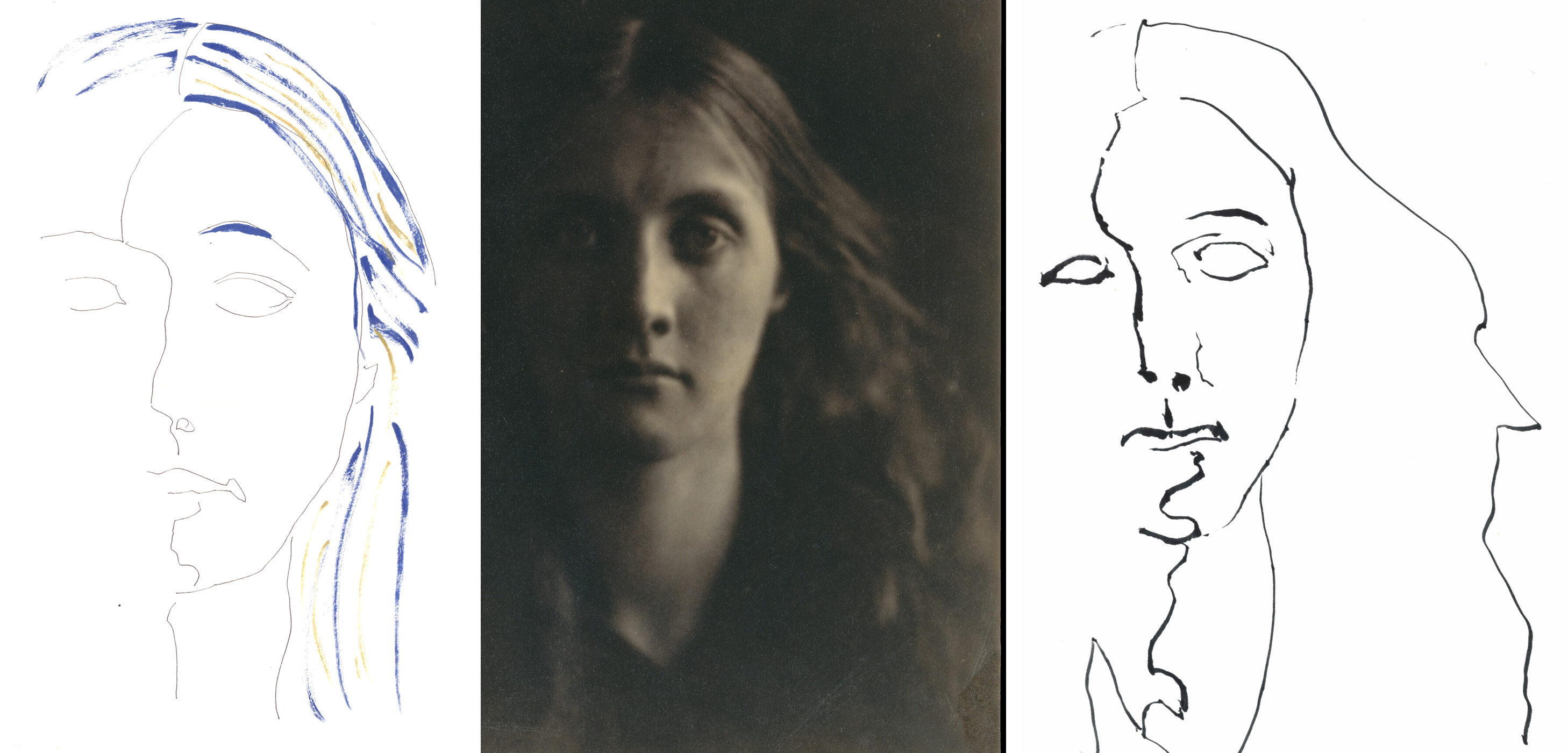
 Left: 14 July, blue and gold. Centre: Julia Margaret Cameron, Julia Jackson, 1867, albumen silver print, 27.4 × 20.6 cm, The Metropolitan Museum of Art (1996.99.2) — public domain. Right: 30 August, brush pen.
The frontal, drawn twice · The profile · Background
The frontal, drawn twice
14 July. First I get a sense of the size, and where I am on the page. The eyes are very open on this one. There’s a slight angle, and I love how dark this side is — almost a verticality. I do the top of the eyebrows, the nostril, the mouth; the fine indentation above the lip, and I stay with the lower lip even though the light there is tricky. Then the top of the head, drawing around it.
It’s about the orientation of the head — that’s the thing never to lose sight of. The orientation is the basis of everything: here, a straight-on face with a slight tilt. The other eyebrow is just disappearing. Some hair, which adds form; a neck, which I’m not sure I’ve got right — I made a small mistake and came back up.
Now I have the basic shape. There’s an ear, more hair, things around the eye — but those are shading, not what I’m after. What I’d really want is the plane of the cheek. Line and shading are two important uses of the same mark. If we understand what we’re trying to convey — what the meaningful part of the image is — that should help say which line matters to draw and which doesn’t.
Then a bit of metallic — a crazy colour, blue, and some gold in the hair. I’ve always liked metallic, especially for hair, thinking of Ravenna, Klimt, and others. The hair came out better than I thought. The eyes I like blank, though maybe a little cut here; the blank, mask-like quality isn’t bad, especially on the metallic one. On the far side you can hardly see anything, so I leave it — I respect that the reference doesn’t have much there either. Sometimes I get that wrong: in an earlier Munch drawing, the arm and the window behind it, I drew a line separating them — but Munch was blending, and that was better. The septum, the lips — leave those too.
Six weeks later I found more of Julia Margaret Cameron’s photographs. I think they’re among the best portraits, and they’re public domain — ideal references for me; I’ll do many more. So I came back to this one with a broad brush pen, in black. The brush has a different quality, and even my tilt is off. I’m not sure it’s any better.
The profile
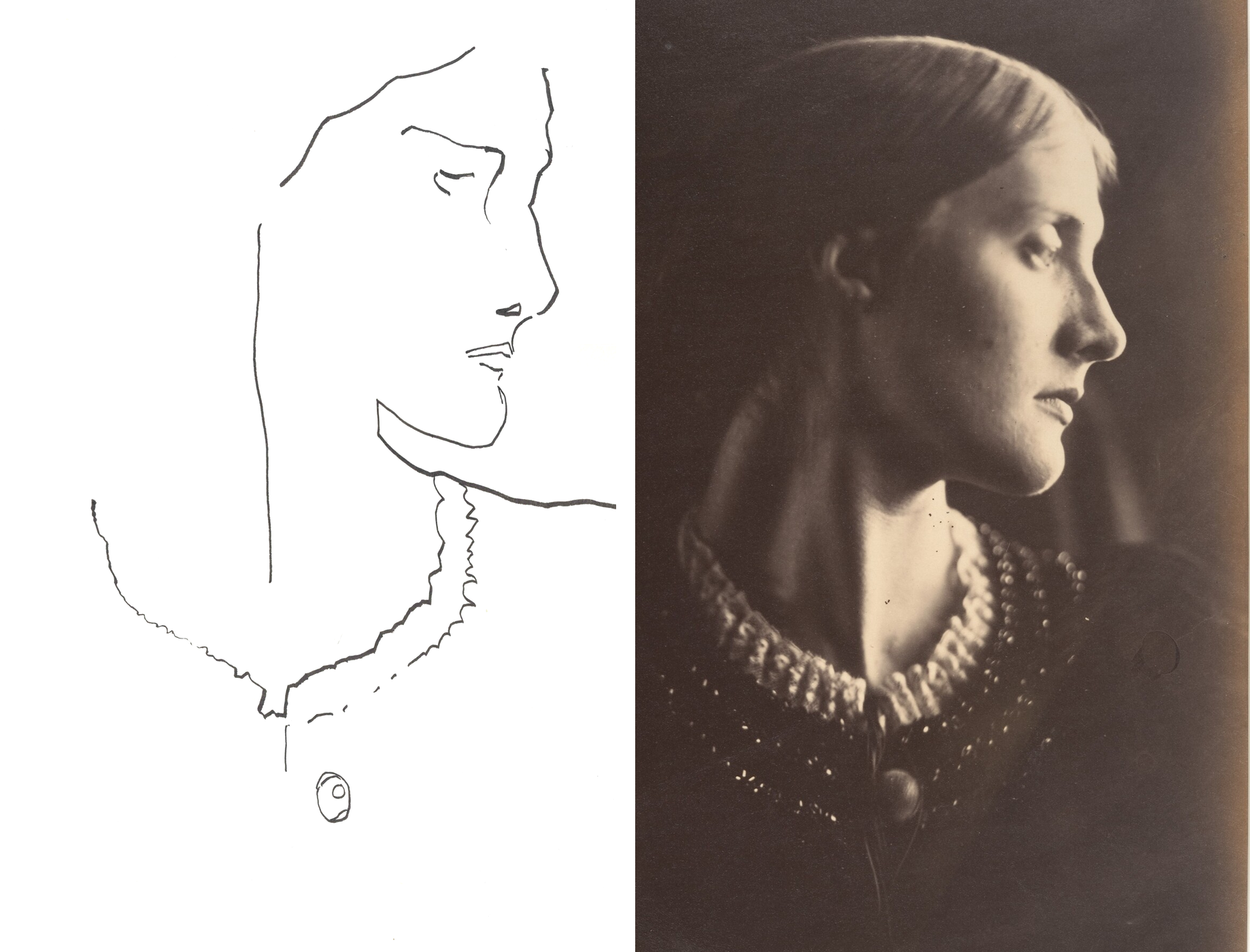 Left: my drawing, 16 July. Right: Julia Margaret Cameron, Mrs. Herbert Duckworth (Julia Jackson), 1867, albumen silver print, 32.8 × 23.7 cm, The Metropolitan Museum of Art (2005.100.26) — public domain.
16 July. I’m using the Faber-Castell Pitt pen — I love it, though it’s waterproof, so no waterbrush afterward; always a trade-off. Another Cameron photograph, public domain, on the Met site — I love this kind of source: an exceptionally good line to work from, and free to use.
I scope out the page first. Her eye sits about four-fifths of the way across and a third of the way down, and that’s where I start these days. The eye is probably the most important thing, at least in the face — though I wonder if I’m becoming over-reliant on it. The eyebrow is gorgeous. She has a tilt — she’s tilting away — and the face is going down a lot, so I need more of the nose, and nailing the lip helps, and the chin. Then the silhouette, but I don’t think I got that particular tilt.
There’s a lot of black, and one line in the hair that’s just begging to be drawn — which I’m not drawing. I don’t know that I’m skipping it, exactly. Leaving a big line out lets you imply it — it’s about composition, decision, implication. Sometimes the prominent line is the one you want; sometimes you’d rather suggest it. I love the jaw and a line of her sternocleidomastoid at her neck. Something like a ponytail; it’s hard to say. It comes up steeply, and then there’s a button, which has a real dimensionality to it.
I didn’t register at the time that this was the same face as the frontal, drawn days apart — I think I should pay more attention to that. I didn’t know she was Virginia Woolf’s mother either. I’ve never read anything of Woolf’s; I probably should.
Background. Julia Jackson (1846–1895) was Julia Margaret Cameron’s niece and one of the sitters she returned to most often. Cameron made both of these portraits in 1867, the year Julia married Herbert Duckworth; the near-frontal one is often trimmed to an oval, like a cameo. Widowed at twenty-four, Julia later married Leslie Stephen and became the mother of Virginia Woolf and Vanessa Bell — and the face Woolf drew on for Mrs Ramsay in To the Lighthouse.
Cameron rarely comes to market as single prints — most of the value is in her albums. The frontal Julia Jackson is the exception:
- A$122,727 — an albumen print signed “From Life April 1867”; Deutscher and Hackett, Melbourne, 3 May 2023 (estimate A$30,000–50,000).
- £57,650 — another print from the same 1867 sitting; Bonhams, London, 17 November 2011 (provenance to Sotheby’s Belgravia, 1975).
The profile has no comparable auction record.
Links
- Process video — the frontal — YouTube
- Process video — the profile — YouTube
- Julia Jackson (frontal), 1996.99.2 — The Met — Open Access
- Mrs. Herbert Duckworth (profile), 2005.100.26 — The Met — Open Access
- Julia Jackson — Deutscher and Hackett — albumen print, A$122,727, Melbourne, May 2023
- Julia Jackson — Bonhams — albumen print, £57,650, London, November 2011