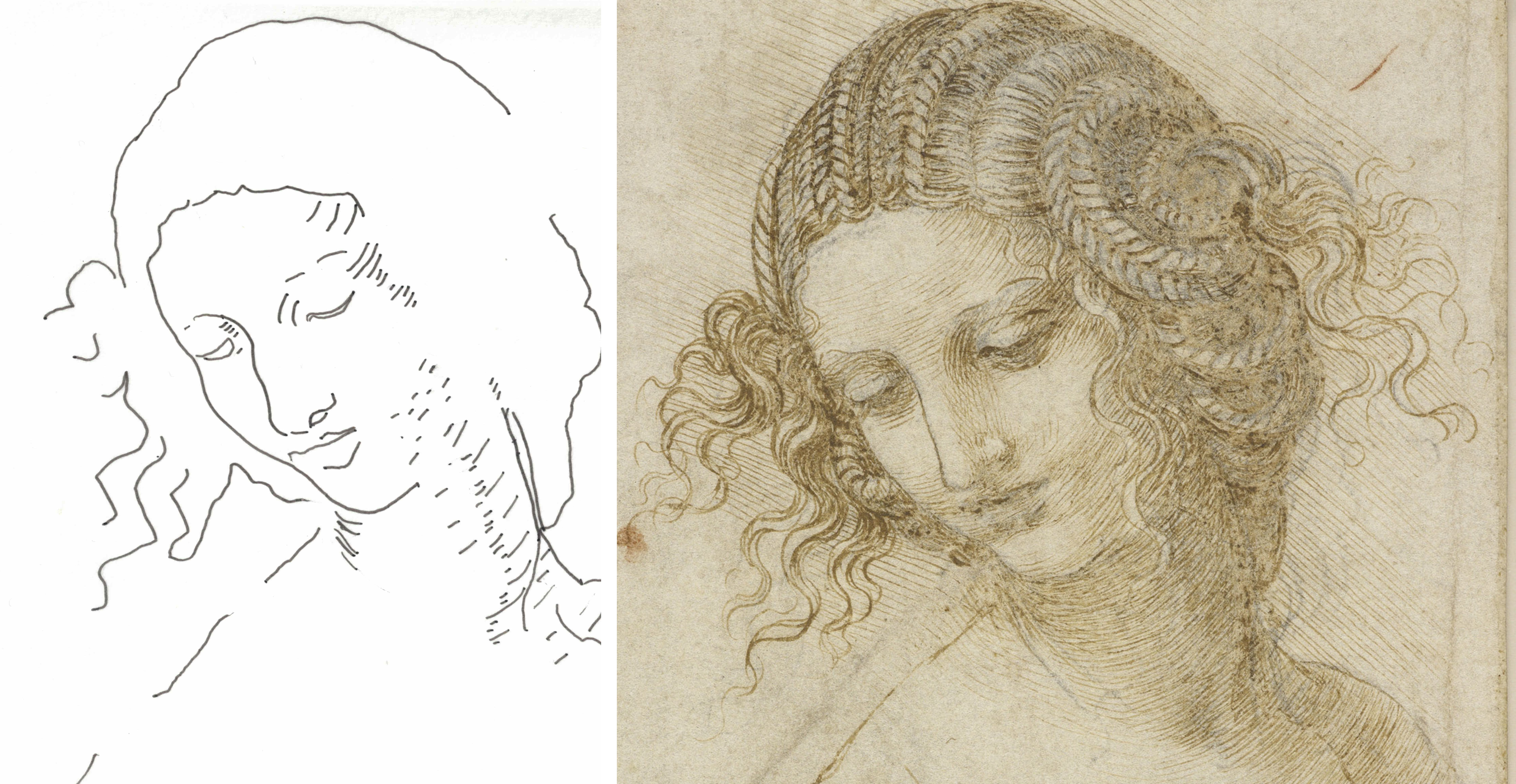
 Left: my first tracing. Right: Leonardo da Vinci, Testa di Leda (The Head of Leda), a detail of the sheet, pen and ink, Royal Collection Trust, Windsor (RCIN 912516) — public domain.

First sitting · Second sitting · Third sitting
First sitting. This is from Leonardo’s notebook, a study for Leda e il cigno (Leda and the Swan), and there’s far more hatching here than in Fanciulla. The edge is fairly clean, so it should trace. I’ve traced this one before; coming back to it I’m more exploratory, more curious, though I still fall back on my typical approach — the one that seems most effective for me. I break the eyebrow, because he did; get a nostril; start from the center of the head, the indentation, out. There’s a huge amount of hair, braided very carefully — it must have taken a very long time to do.
The more I looked at it, the more I saw how anatomically perfect it is; Leonardo knows his anatomy, and the broken lines are just a tool for rendering it. He’s emphasizing the depression into the eye socket. And where Fanciulla was hatched straight — one direction, left-handed — here he’s hatching along the contours of the form, a different technique, perhaps more common. I tried to follow it, but I feel there’s more to do.
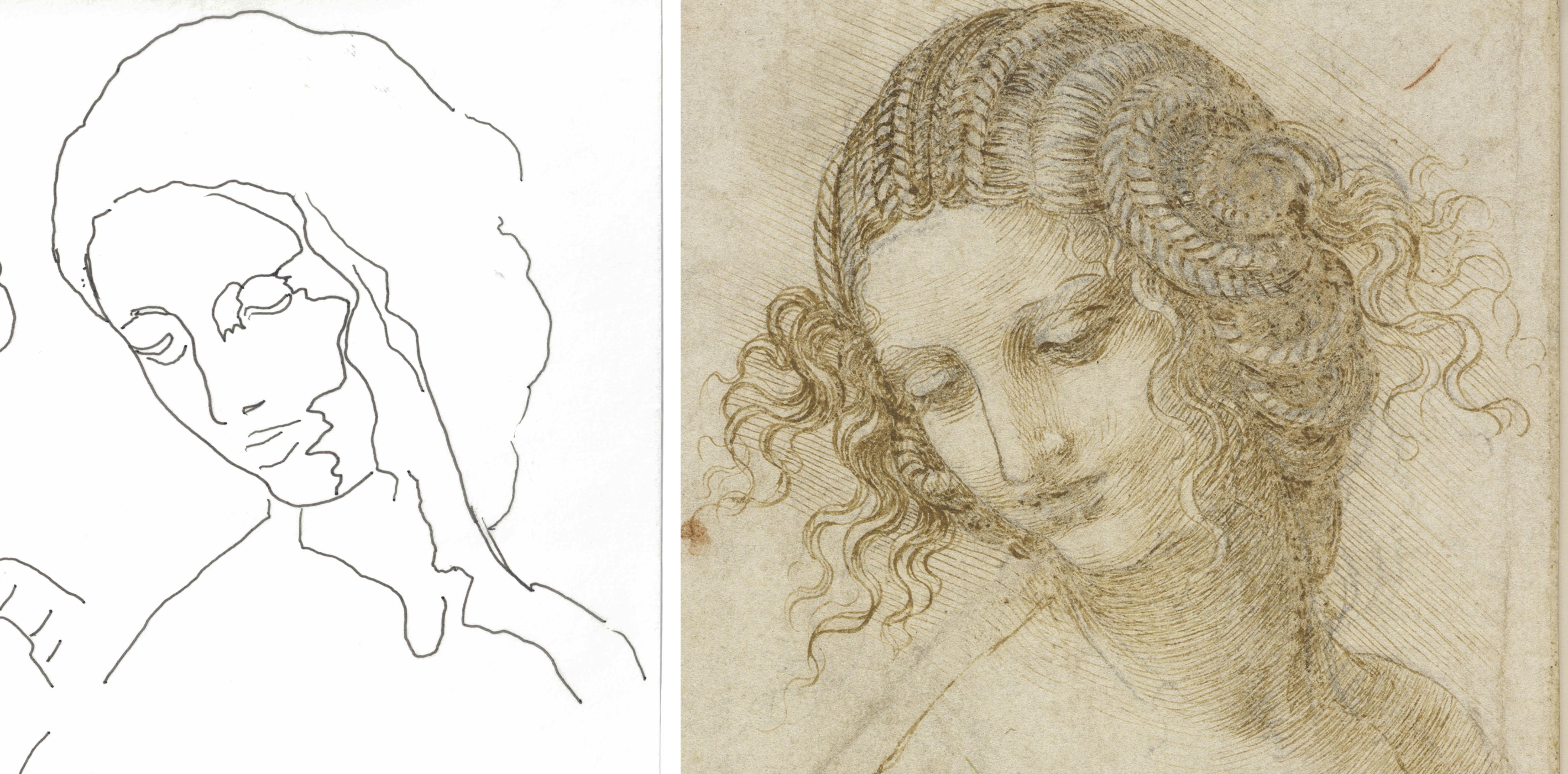
Second sitting. Try again. The last one didn’t come out as I wanted — I didn’t follow the contours as correctly as he does — but the basic contour was okay, so I start from there. His eyes are three-dimensional. I track the bones, the collarbone. I think this one was somewhat better, though too busy.
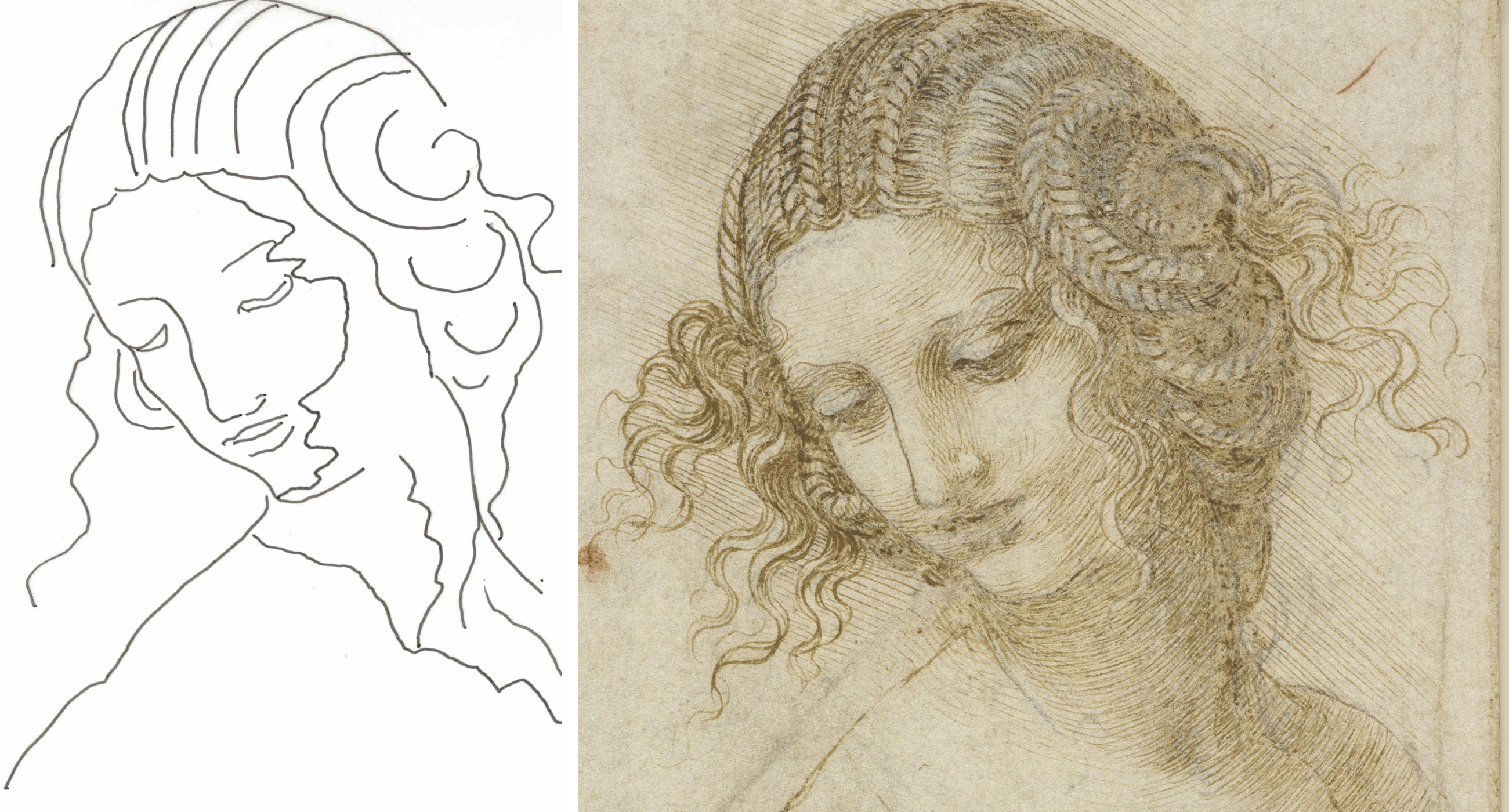
Third sitting. Another attempt, and this time to use more judgment about the 3D form itself rather than just tracing the edges. The shoulders are great. There’s a very smooth change of surface — how do you convey that without just following the outline? The eye sockets go in more than I had them. That’s probably the best one yet, though it still feels a little unfinished.
Tracing is tracing lines to elucidate and depict form, which is the shape in 3D. Tracing lines without knowing the form in 3D leads to a simple and less believable rendition. By the third try what I had was just that the form is real, and that it is what he is capturing; I have a way of doing it, but I have more to learn from his, especially the finer, contour-following hatching.
This one I think Leonardo did the face; it seems too subtle. But on the same page is another one where the face is just a simplistic placeholder. Three sittings and none of them finished — this is something that will probably always hold lessons and value to trace and draw and observe, the hair and the face.
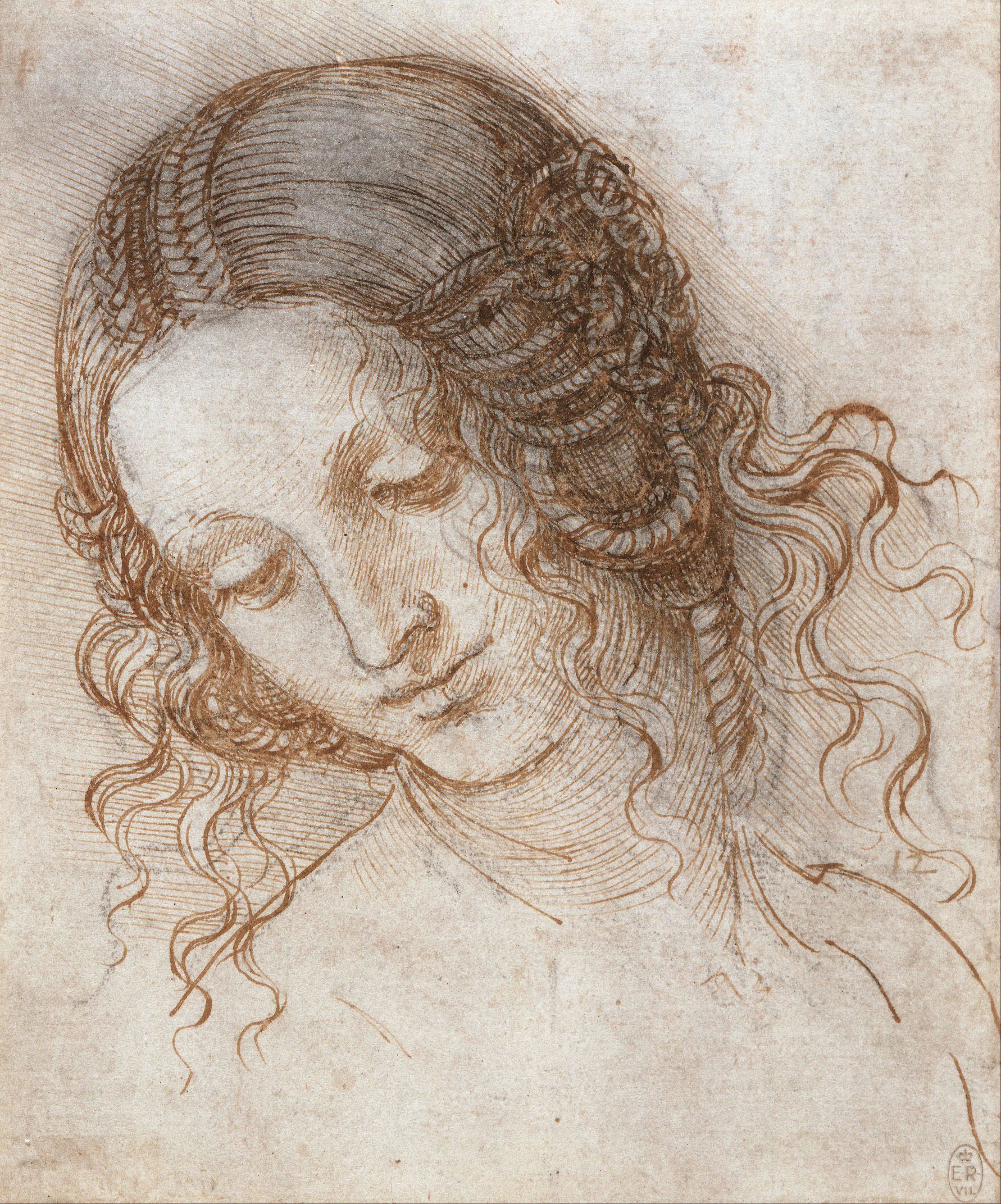 Leonardo da Vinci, Testa di Leda (RCIN 912518), c. 1505–8, pen and ink over black chalk, Royal Collection Trust, Windsor — the same head with the coiffure and falling hair carried further. Public domain.

Background. These are Leonardo’s studies for the head of Leda in his lost painting Leda e il cigno, c. 1505–08 — pen and ink, some over black chalk, all in the Royal Collection Trust at Windsor Castle.
The painting itself is known only through workshop copies; the most cited is the “Spiridon Leda” in the Galleria degli Uffizi, Firenze (Florence).
Links