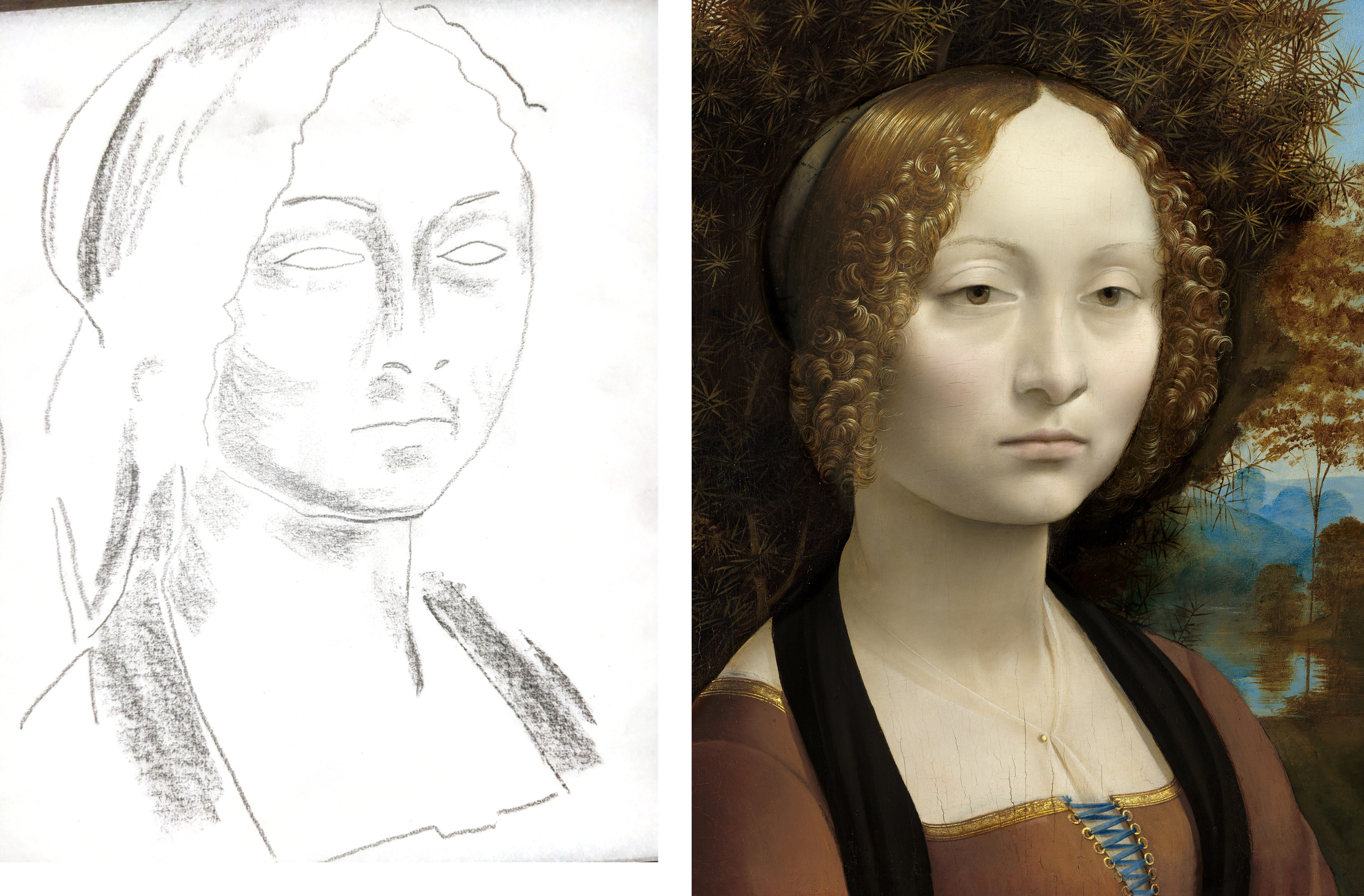
 Left: my tracing, Thursday 15 October. Right: Leonardo da Vinci, Ginevra de’ Benci , c. 1474–1478 — oil on panel, 38.1 × 37 cm, National Gallery of Art, Washington, 1967.6.1.a. Public domain.
This is Leonardo’s Ginevra de’ Benci. I saw it at the NGA, and it is striking. I do love how the NGA mounted it in the center of a room, so we can see both sides. In reality it has infinite resolution, and even a dimensionality from the slight shape of the paint on the canvas. On my tablet perhaps not, but even so, the beauty of his work is apparent.
I’m doing this in graphite. We could just do the lines. Interesting, but this one, again, has the internal structure. It’s an important part of this one, and so I think it’s a good idea to look at it that way. He used silverpoint to develop the shapes. For him it wasn’t about contour and silhouette, but about form. Silhouette for me is a simple, basic exercise, and so I concede that there are important forms inside which I simply cannot render with line, which are important and meaningful, and which I am seeking to learn from his shadings and renderings.
Part of what I like about lines and fountain pens is that it’s intentional. So that’s an interesting thing. Early on, with just a few lines, we do have, essentially, that face orientation, and that’s where a minimal line would be going. But this is a different type of study that I’m trying to do. Here, there is so much form inside that is meaningful. And what I’ve been doing at the beginning is very amenable to a flex pen, for instance. I’m just using line weights right now to get that far, which I think is nice.
Graphite has different hardnesses. I have these graphite sticks. They’re kind of fun. I don’t know if they’re quite right here. With a softer graphite, we get it darker faster. So if we want to bring out a lot of darkness, we can try it here.
I start with the eyes. These are very narrow, when one draws them, they do feel quite narrow. This is one part that I have never really — the eyes, right. Eyes often have socket shading around them, and that helps us learn more of the form around the eyes. But the problem for me is that, especially when you’re just using a line, if you draw lines under the eyes, you will just draw a circle. It’s too much, let’s say, semantics. Anatomically, of course, the skull has a clear edge around the eye socket, but her face is smooth and curves gently. By removing that line of the skull, we emphasise how smoothly her face curves, and the narrowness of her eyes is part of what gives a harmoniousness to her eyes.
I left out the juniper behind her. The symbolism and semantic layer was secondary, an intellectual layer, to the basic human form which he rendered. My tracing stops at the bodice, with no hands. We do have neurological understanding and rendering of the face, and he is choosing and depicting a certain facial expressivity here. Hands are simply another feature to render. On the same canvas, to draw hands, he would need to depict her face smaller, and we’d have less of her subtle rendition in geometric space on the canvas. He chose otherwise.
Auction
Ginevra de’ Benci has never been to auction. In February 1967 the National Gallery of Art bought it privately from Franz Joseph II, Prince of Liechtenstein.
For scale, Leonardo also holds the auction record for any work of art. His Salvator Mundi sold at Christie’s New York on 15 November 2017 for US$450.3 million with fees.
Background
Leonardo painted Ginevra de’ Benci in Firenze (Florence) between about 1474 and 1478, in oil on a panel 38.1 × 37 cm. It is in the National Gallery of Art in Washington (1967.6.1.a), the only painting by Leonardo on public view in the Americas.
Ginevra, born around 1458, came from a wealthy Florentine family. Her brother Giovanni was a friend of Leonardo. At sixteen she married Luigi di Bernardo Niccolini, and the portrait more likely marks the engagement.
The juniper bush behind her head is a pun. In Italian juniper is ginepro, and in the Renaissance it stood for female virtue.
The back of the panel is painted too. A sprig of juniper sits in a wreath of laurel and palm, with the motto VIRTVTEM FORMA DECORAT (Beauty adorns virtue). Laurel and palm were the emblem of Bernardo Bembo, the Venetian ambassador to Firenze, whose platonic attachment to Ginevra survives in poems. Infrared shows his own motto under hers, so he may have had a hand in the commission.
At some point the bottom of the panel was cut off, probably because of damage, and her arms and hands went with it.
Links
- Ginevra de’ Benci, National Gallery of Art — the museum’s page
- Ginevra de’ Benci on Wikipedia — sitter, reverse, provenance
- The master on Wikimedia Commons — public domain
- Salvator Mundi on Wikipedia — the 2017 sale
- Process video — Thursday 15 October — the tracing session on YouTube
