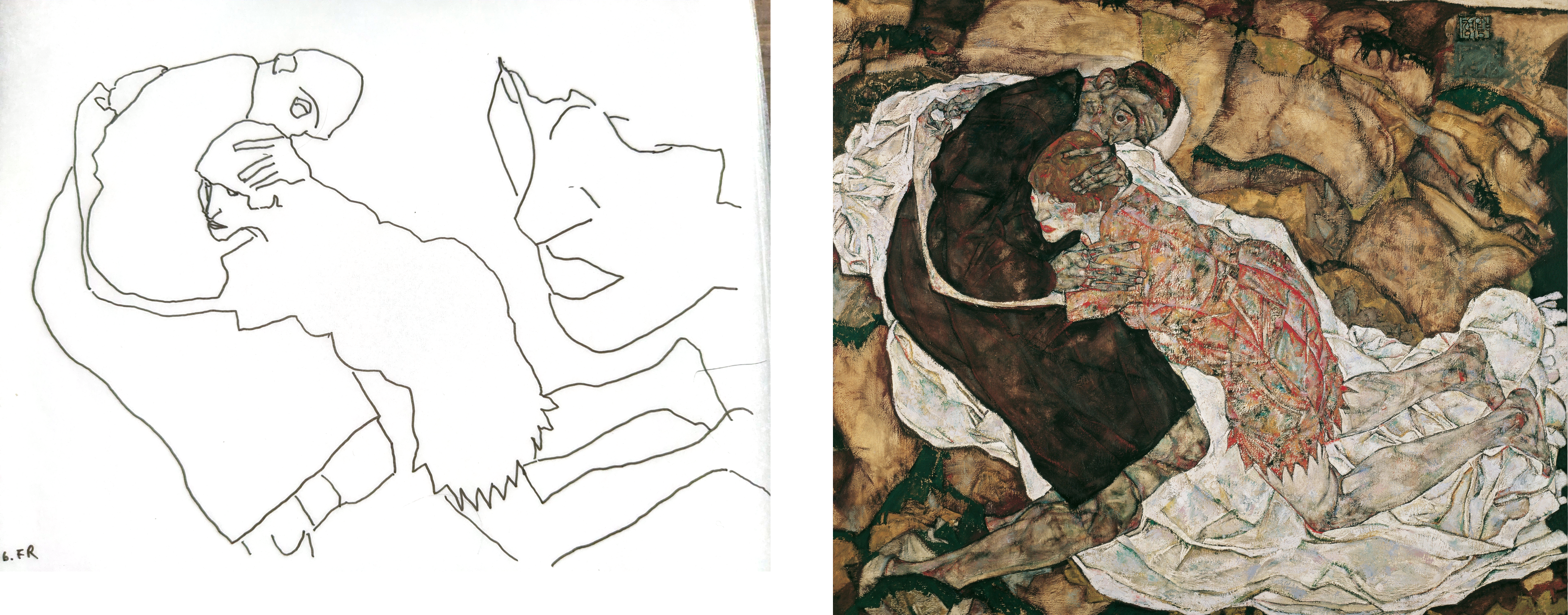
 Left: my tracing, Friday 16 October. Right: Egon Schiele, Tod und Mädchen (Death and the Maiden), 1915 — oil on canvas, 150 × 180 cm, Österreichische Galerie Belvedere, Wien, inv. 3171. Public domain.
Tracing · Auction · Background
Schiele’s Tod und Mädchen (Death and the Maiden), just a striking piece. The woman is Wally, his long-time lover, but he had gone and married a different woman that year, and so Wally left him, and he painted this in that year. Wally died in 1917, and both Egon and his wife died in the following year. Death looks like Schiele’s 1910 self-portrait.
The thing is that normally we don’t depict death in this kind of tender way. Normally death is depicted in a fearsome way… Apparently this might not even originally have been called Tod und Mädchen, but Mann und Mädchen (Man and Maiden). I think the sympathy here is in many ways for Wally, especially when he titled himself Death. It’s fairly surprising for him to be so self-absorbed as to not conceive Wally would leave him as he married Edith. Yet more surprising, to me, with that kind of short-sightedness, is the extraordinary power of this work.
Their hands are characteristic. I was thinking of just tracing their faces, but Wally’s arms are so striking, so then I wanted to do her arms. And then, of course, her legs are also contrasting, and then the coloration of her dress and everything. But I want to just draw the lines, because he is one of my influences, and I think he thinks often in a kind of a line. I do still think he’s using lines a lot. The paint is powerful but secondary, at least how I view it.
It’s interesting how he thinks about her joints, on this long thin arm. I think the elbow is still kind of offset, those two sides of the elbow. I think he has very good anatomic instincts around the joints. He’s depicting something that makes the joints feel correct even when they’re distorted. And then just the coloration and cut of this dress is, I think, remarkable. And then his hand is there, of course, with those large fingers and everything. Just the detail on knees. So the tracing is kind of mixing up a little bit of the forms here. And then her legs, contrasting, not like her arms.
Kokoschka’s Die Windsbraut (The Bride of the Wind) and Klimt’s Der Kuss (The Kiss) also wrap two bodies together. Something about especially Wally’s eyes, arms, legs, his own, the wild patterns, seems perhaps related but reaches me more deeply than Kokoschka, which seems related yet not as cutting, perhaps. Klimt, I think, is somewhat different, and elegant in a different way.
I can’t even really see her eyes very well, especially through the tracing paper, but yes, they are ever so slightly there. There’s something about his expression here that I’ve kind of lost, and her expression. He’s working with very, very fine details to get that, and I don’t even know if I can see it well enough through the tracing paper. This eye, kind of peering slightly back, I think. He does so much with such a small detail. I feel like it has even to do with that tiniest bit of her pupil there.
There’s a little more structure and kind of vulnerability there, indeed vulnerability.
I think the original was approximately life-size, whereas my tracing is through paper on a small device, there’s no way to see her eyes, hence I thought to trace her face separately. That’s where I’ll leave it.
Auction
Tod und Mädchen belongs to the Belvedere in Wien (Vienna) and has no sale history we could cite. The nearest thing to it at auction is a drawing of the same couple, Liebespaar (Selbstdarstellung mit Wally) (Lovers, self-portrait with Wally), 1914/15, sold at Sotheby’s London in 2013 for £7.88 million, then the auction record for a Schiele work on paper.
For scale, his oil Häuser mit bunter Wäsche (Vorstadt II) (Houses with Colourful Laundry) sold at Sotheby’s in 2011 for US$40.1 million. And Wally’s own portrait, Bildnis Wally (1912), never went to auction. After a Nazi-looting dispute, the Leopold Museum settled with the heirs of its former owner in 2010 for US$19 million.
Background
Schiele painted Tod und Mädchen in Wien in 1915, in oil on canvas, 150 × 180 cm. It is in the Österreichische Galerie Belvedere (inv. 3171). He first called it Mann und Mädchen (Man and Maiden), and also Verschlungene Menschen (Entwined People).
He had painted Wally Neuzil since 1911. He told her of Edith Harms at the Café Eichberger, and they never saw each other again. He married Edith on 17 June 1915, and three days later he was ordered to report for army service. Wally’s face here is taken from an earlier portrait. The Belvedere reads the man as Schiele himself, staring into space, their poses unstable, a balance that could shatter at any moment.
The subject is an old one, death and the maiden, going back to the Renaissance. Here death wears a monk’s habit and holds her like a lover, and she clings to him. The picture is often set beside Oskar Kokoschka’s Die Windsbraut (The Bride of the Wind, 1914), another couple lying in a tangle of drapery. When it was first shown, people found it morbid and too erotic, but it is now counted among his most important paintings.
Wally trained as a nurse after they parted and died of scarlet fever in Sinj, in Dalmatia, aged 23. Edith was pregnant when the Spanish flu took her, and Schiele died three days after her.
Links
- Death and the Maiden (Schiele) on Wikipedia — the painting, titles, reception
- Tod und Mädchen, Belvedere — the museum’s page
- The master on Wikimedia Commons — public domain
- Wally Neuzil on Wikipedia — the model
- Egon Schiele on Wikipedia — marriage, call-up, auction results
- Process video — Friday 16 October — the tracing session on YouTube
